
Why You Have Rhomboid Muscle Pain After a Car Accident and How to Fix It
June 22, 2026
Is That a Knot at the Base of Your Spine or Something Else?
June 24, 2026
Rhomboid Knot Ergonomic Solutions: Work Pain-Free Today
Why Rhomboid Knot Ergonomic Solutions Matter for Your Upper Back Pain
Rhomboid knot ergonomic solutions are workplace and lifestyle adjustments that reduce the strain on the muscles between your shoulder blades — helping prevent and relieve that nagging, burning pain many desk workers and manual laborers know all too well.
Here are the most effective solutions at a glance:
| Solution Type | Example |
|---|---|
| Workstation setup | Ergonomic chair, monitor at eye level, armrests |
| Tool redesign | Air-powered fixtures to replace manual twisting |
| Stretching | Scapular squeezes, thoracic extension, chest openers |
| Strengthening | Resistance rows, banded pull-aparts |
| Self-care tools | Foam roller, massage ball, trigger point wedge |
| Work habits | Breaks every 30-60 minutes, posture checks |
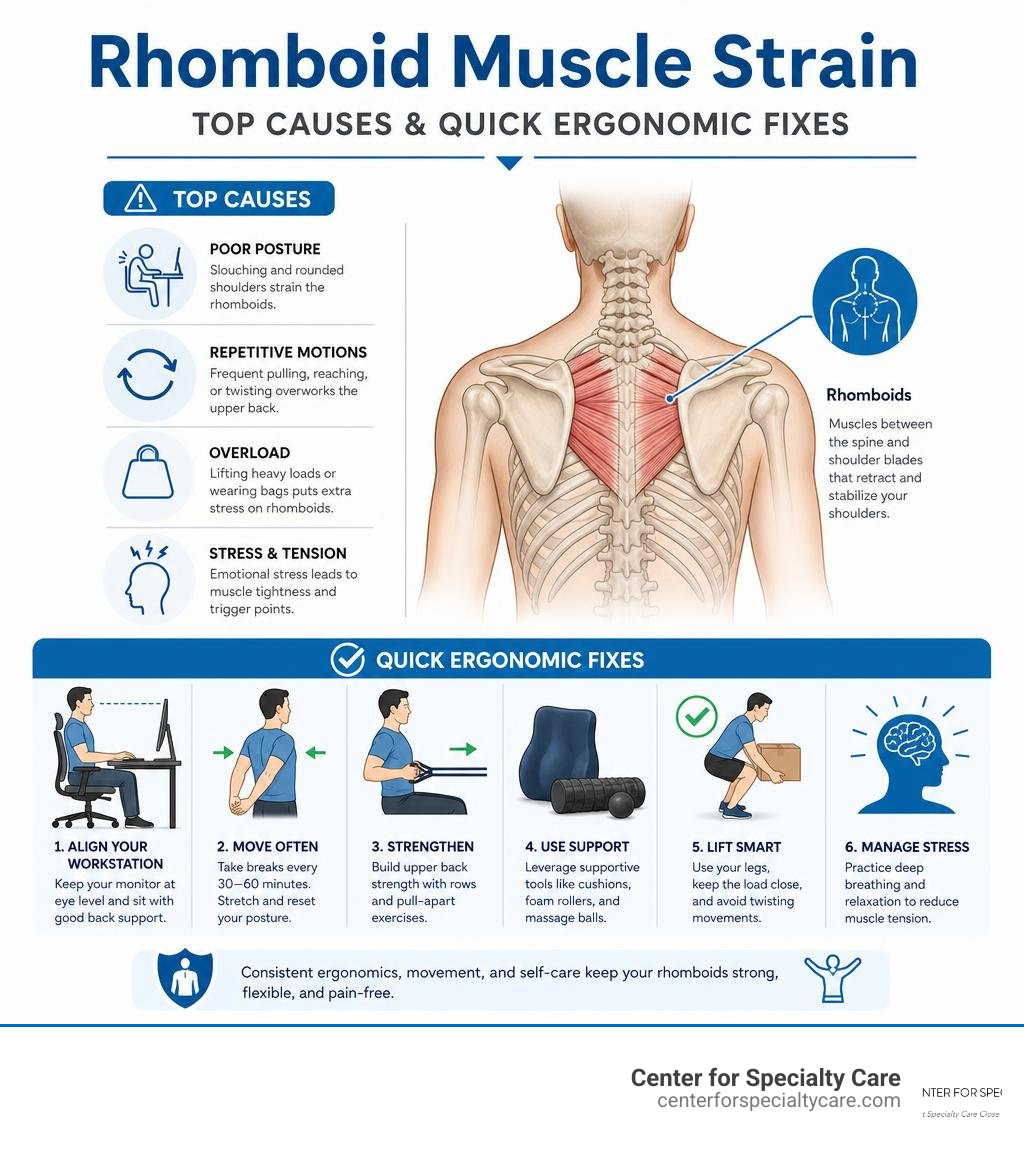
That dull ache or sharp burn between your shoulder blades is one of the most common complaints among people who sit at desks, perform repetitive tasks, or carry tension from daily stress. The muscles responsible — your rhomboids — sit between your spine and shoulder blades, and they take a beating from modern work and lifestyle habits.
The pain can range from a mild stiffness to a visible muscle knot that tightens with every breath or movement. Left unaddressed, it often gets worse — limiting shoulder movement and pulling down your productivity and quality of life.
The good news? Most rhomboid knot pain responds well to targeted ergonomic changes, simple exercises, and smart self-care strategies.
I’m Dr. Corey Welchlin, a board-certified orthopedic surgeon and sports medicine physician with over 30 years of experience treating musculoskeletal pain — including the kind of chronic upper back strain that rhomboid knot ergonomic solutions are designed to prevent. As the founder of the Center for Specialty Care in Fairmont, Minnesota, I’ve helped countless patients move from pain to full function, and this guide brings together the best of what works.
Understanding Upper Back Pain: The Anatomy of a Rhomboid Knot
To understand why your upper back feels like a ball of tight wires, we have to look under the hood. Your upper back relies on a complex network of muscles to keep you upright and moving. At the center of this network sit the rhomboids.
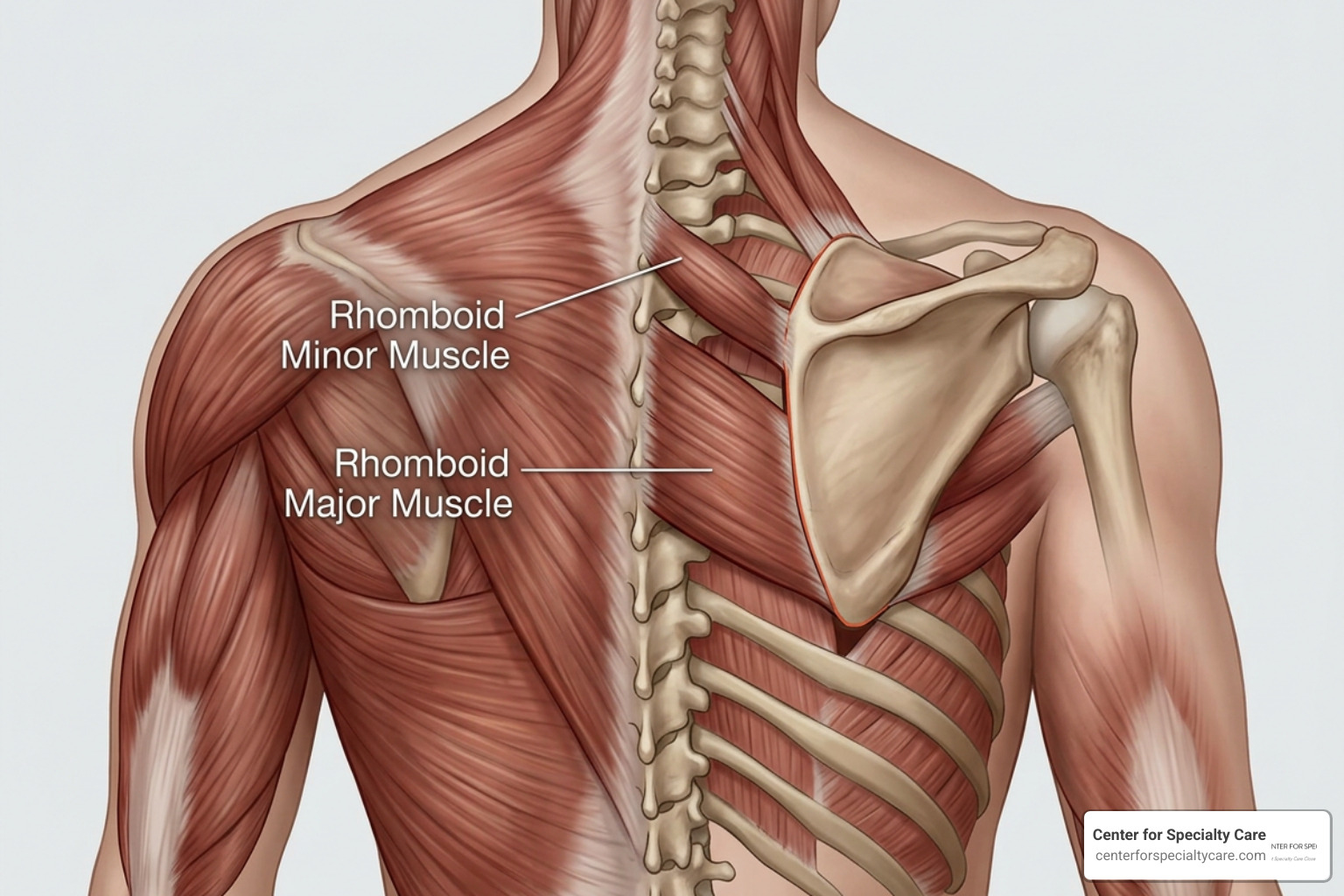
The rhomboids are divided into two distinct parts:
- Rhomboid Major: The larger, lower portion of the muscle.
- Rhomboid Minor: The smaller, upper portion located just above the major.
Both of these muscles originate along your spine (specifically the lower neck and upper thoracic vertebrae) and attach to the inner border of your scapula (shoulder blade). Their primary job is scapula stabilization and retraction. Whenever you pull your shoulder blades back together, squeeze your shoulders, or stabilize your arms to carry a heavy load, your rhomboids are doing the heavy lifting.
When these muscles are overworked, dehydrated, or forced into awkward positions for hours at a time, they can suffer from microscopic tears. In response, the muscle fibers contract defensively, leading to painful muscle spasms and localized lumps of tight tissue. These are what we commonly refer to as muscle knots.
What Causes Rhomboid Trigger Points?
Myofascial trigger points are highly irritable spots within a taut band of skeletal muscle. In the rhomboids, these trigger points present as localized, highly sensitive “hotspots” that can feel like tiny, hard marbles under the skin.
These trigger points do not just cause pain where they sit; they are famous for causing referred pain. When a rhomboid trigger point is active, it can send aching or burning sensations upward toward the base of your neck, down along the edge of the shoulder blade, or even radiating slightly outward toward the shoulder joint itself. This referred pain makes it feel as though your entire upper back and neck are locked up, when the root culprit is actually a localized pocket of muscle tightness in the rhomboids.
To learn more about how these points develop and map across your back, you can read this detailed breakdown of Rhomboid Trigger Points: A Pain Between the Shoulder … .
The Rhomboid Paradox: Overstretched Yet Tight
If you ask someone with chronic upper back pain what their muscles feel like, they will almost always say, “My back is so tight, I need to stretch it.” However, this leads us to what physical therapists and sports medicine specialists call the “Rhomboid Paradox.”
Most modern desk workers spend their days with rounded shoulders, a collapsed chest, and a forward head posture. In this position, the shoulder blades are pulled far apart, away from the spine. Because the rhomboids attach the shoulder blades to the spine, this forward position forces the rhomboids into a state of chronic elongation. They are literally being stretched out all day long.
When a muscle is held in a stretched position for hours, it undergoes muscle inhibition. It becomes weak and exhausted. In a desperate bid to keep your shoulder blades from sliding even further forward, the weak, overstretched rhomboids perform “protective guarding.” They contract with all their remaining strength to anchor the shoulder blade.
This creates a paradox: the muscle is overstretched and weak, yet it feels incredibly tight and is full of burning trigger points. If you try to fix this by only stretching your upper back, you actually pull the muscle further apart, which can make the protective guarding worse. To truly resolve this issue, you must address the postural imbalance that is pulling the shoulders forward in the first place.
For a deeper dive into this fascinating muscular tug-of-war, check out The Rhomboid Paradox: Why a Weak, Overstretched Muscle Can Still Feel Like a Burning Knot.
Workplace Ergonomic Risk Factors for Rhomboid Strain
To implement effective rhomboid knot ergonomic solutions, we must first identify the physical hazards in your work environment. Musculoskeletal disorders develop when physical demands exceed your body’s natural capacity. The primary ergonomic risk factors associated with rhomboid strain are force, repetition, and posture.
While we often associate back pain with heavy lifting, static desk jobs can be just as damaging. Let’s compare how these risk factors manifest across different work environments:
| Ergonomic Risk Factor | Static Desk Work | Repetitive Manual Labor |
|---|---|---|
| Force | Low active force, but high static force required to hold the head and arms forward against gravity. | Moderate to high force required to lift, carry, pull, or operate heavy machinery. |
| Repetition | Low movement repetition, but extremely high “static repetition” (holding the exact same position for hours). | High repetition of arms reaching, twisting, or assembling components (up to thousands of times per shift). |
| Posture | Awkward static postures: forward head posture, rounded shoulders, slouched spine. | Dynamic awkward postures: overhead reaching, bending, and repetitive torso twisting. |
Repetitive Twisting and Forceful Motions
In manual assembly and manufacturing environments, repetitive twisting motions of the hands, wrists, and forearms are major contributors to upper body strain. When a worker performs forceful forearm rotations, the muscles of the arm and shoulder girdle must contract to stabilize the limb.
For example, historical data from manufacturing plants shows that workers performing up to 10,000 forearm rotations per 8-hour shift experienced cumulative trauma disorders (CTDs) at rates 2 to 3 times the plant average. In one healthcare assembly task involving repetitive knob twisting, a staggering 67% of documented injuries were related to elbow tendinitis.
While the pain may manifest in the elbow or forearm, the stabilizing muscles of the shoulder—including the rhomboids—are forced to work continuously to keep the shoulder blade steady during those thousands of daily rotations. This constant, low-level tension eventually leads to muscle fatigue, spasms, and painful knots in the upper back.
Poor Posture and Static Desk Positions
For office workers, the primary culprit is not motion, but the lack of it. Sitting in a fixed position for extended periods is linked to weakened muscles and joint stiffness.
When you slouch in front of a computer, your head drifts forward. This “forward head posture” (often called tech neck) forces the muscles of your neck and upper back to work overtime. For every inch your head moves forward from its neutral alignment, it adds an extra 10 pounds of pressure on your spine.
This forward pull, combined with rounded shoulders and thoracic kyphosis (an exaggerated outward curve of the middle back), places the rhomboids under constant, unrelenting tension. Over time, this static posture starves the muscle of fresh, oxygen-rich blood flow, leading to the metabolic waste buildup that forms painful trigger points.
Implementing Rhomboid Knot Ergonomic Solutions at Your Workstation
Preventing and relieving upper back pain requires a combination of engineering controls, workstation modifications, and personal habits. By optimizing your workspace, you can reduce physical stress, prevent injuries, and significantly boost your daily productivity.

Engineering Controls and Workstation Redesign
The most effective way to eliminate ergonomic hazards is to design them out of the workspace entirely. In industrial or assembly environments, this is achieved through engineering controls.
A classic example of this is the implementation of specialized fixtures to replace highly repetitive manual tasks. When plants replaced manual twisting tasks with an air-powered Knob Twist Fixture – Ergoweb LLC, the physical strain on workers plummeted.
By eliminating the need for manual twisting and reducing the torque required by the worker’s body, the implementation of these ergonomic fixtures resulted in a 95% reduction in new elbow trauma cases within just six months. Furthermore, reducing the physical strain on workers led to a 10-15% productivity increase on most jobs, and a massive four-fold productivity gain on the specific knob-twisting tasks. When workers aren’t fighting pain, they work faster and with fewer errors.
Adjustable Tools and Fixtures as Rhomboid Knot Ergonomic Solutions
If your job requires repetitive tool use, utilizing adjustable tools and fixtures is a crucial step in protecting your upper back. Modern ergonomic fixtures incorporate features such as:
- An adjustable clutch to prevent over-torquing and sudden physical jars to the arm and shoulder.
- Speed control and a selectable auto-reverse feature to accommodate different worker paces and reduce sudden, jerky movements.
- Compact, narrow designs that minimize the reach distance, keeping your elbows close to your body and reducing the load on your stabilizing rhomboid muscles.
These adjustable features ensure that the tool conforms to the worker’s body, rather than forcing the worker to contort their body to fit the tool.
Ergonomic Office Chair Setup and Supports
For desk-bound workers, your chair is your primary line of defense. To set up your office chair for optimal rhomboid support, follow these steps:
- Adjust Chair Height: Your feet should rest flat on the floor, with your thighs parallel to the ground and your knees bent at approximately a 90-degree angle.
- Utilize Lumbar Support: Your chair should have a built-in lumbar curve that supports the lower back. If it doesn’t, place a rolled-up towel or small pillow behind the curve of your lower back to maintain your spine’s natural “S” shape.
- Position the Armrests: Adjust the armrests so your shoulders are relaxed and your elbows rest at a 90-degree angle. If your armrests are too high, they will shrug your shoulders and strain your upper back; if they are too low, you will lean to one side, twisting your spine.
- Keep Your Screen at Eye Level: Position your monitor directly in front of you, with the top of the screen at or slightly below eye level. This prevents you from tilting your head forward or backward.
Physical Therapy and Self-Care for Rhomboid Knots
While ergonomic adjustments prevent future strain, you still need to address the active knots and tightness currently lingering in your back. A balanced approach combining targeted exercises and self-massage is highly effective for long-term relief.
Targeted Stretching and Strengthening Exercises
To break the cycle of the “Rhomboid Paradox,” you must combine chest-opening stretches with upper-back strengthening exercises. This releases the tight, dominant muscles on the front of your body while building the endurance of the weak, overstretched muscles in the back.
- Doorway Chest Stretch: Stand in a doorway, place your forearms on the doorframe at a 90-degree angle, and gently step forward until you feel a comfortable stretch across your chest. Hold for 30 seconds to release the tight pectorals pulling your shoulders forward.
- Scapular Squeezes: Sit or stand tall with your arms relaxed. Gently squeeze your shoulder blades together as if you are trying to hold a pencil between them. Hold the contraction for 5 to 10 seconds, then release. Repeat 10 times to build endurance in your rhomboids.
- Thoracic Extension on a Foam Roller: Lie on your back with a foam roller placed horizontally beneath your mid-back (just below your shoulder blades). Support your head with your hands, keep your hips on the floor, and gently lean backward over the roller to open up your thoracic spine. Repeat 6 to 8 times.
For a complete, structured video guide on relieving these stubborn spots, take a look at these Knot Rhomboid Muscle Stretches Fast Rhomboid Muscle Pain Relief: Exercises Stretches Coach .
Myofascial Release and Trigger Point Tools as Rhomboid Knot Ergonomic Solutions
Sometimes, stretching alone isn’t enough to release a deeply embedded muscle knot. In these cases, direct, targeted pressure is needed to encourage myofascial release.
Using a firm massage ball or tennis ball against a wall is an excellent way to target rhomboid knots at home or in the office. Place the ball between your shoulder blade and your spine, lean your body weight into the wall, and gently roll until you find the tender spot. Hold firm, steady pressure on that point for 30 to 60 seconds until you feel the muscle begin to soften and release.
For a more specialized, hands-free option, tools like the Shoulder Blade Wedge Trapezius Trigger Point Massage Rhomboid Release – THERANUB Wellness use targeted, firm bumps designed to mimic a therapist’s fingers. Lying back on a specialized wedge can help open up the chest cavity, stretch the scapular region, and melt away stubborn trigger points after a long day at work.
Frequently Asked Questions about Rhomboid Pain
Why do I get a burning knot between my shoulder blades?
A burning sensation is a classic sign of muscle fatigue and localized oxygen deprivation. When you sit with rounded shoulders, your rhomboids must contract continuously to keep your shoulder blades from sliding forward. This constant contraction squeezes the local blood vessels, cutting off fresh oxygen and allowing metabolic waste products (like lactic acid) to build up. This waste buildup irritates the local nerve endings, creating a nagging, hot, or burning sensation.
How long does it take for a rhomboid knot to heal?
The recovery timeline depends on the severity of the strain. A mild, acute spasm from a single day of poor posture or a minor sports injury can resolve in a few days with rest, gentle stretching, and hydration. However, chronic rhomboid knots that have developed over months or years of poor workplace ergonomics typically take 4 to 6 weeks of consistent stretching, strengthening, and ergonomic adjustments to fully resolve.
Can poor sleep positions make rhomboid pain worse?
Absolutely. Sleeping on your stomach forces your neck to twist to one side for hours, placing immense strain on the upper back and neck muscles. Side sleeping can also be problematic if your top shoulder collapses forward, stretching the rhomboids overnight.
The gold standard for rhomboid pain is sleeping on your back with a medium-firm pillow supporting the natural curve of your neck, and a pillow under your knees to keep your spine in neutral alignment. If you must sleep on your side, hug a thick pillow to your chest to prevent your top shoulder from rolling forward.
Conclusion
Living with a constant, burning knot between your shoulder blades can drain your energy and make even the simplest daily tasks feel like a chore. However, by understanding the mechanics of your upper back, identifying workplace risk factors, and implementing targeted rhomboid knot ergonomic solutions, you can break the cycle of pain.
At the Center for Specialty Care, we are committed to helping you live a pain-free life. Whether you are visiting our clinic in Fairmont, Minnesota, or one of our convenient locations in Estherville, Iowa, Buffalo Center, Iowa, or St. James, Minnesota, our team of orthopedic and pain management specialists is here to provide personalized, comprehensive care. We offer both surgical and non-surgical options tailored to your unique needs, with quick appointment availability to get you back on track as soon as possible.
If you are tired of fighting that stubborn upper back tension, don’t wait for it to get worse. Find effective relief for your shoulder blade muscle kink by scheduling an appointment with us today. Let us help you work, move, and live pain-free!