
The Ultimate Rhomboid Pain Sleeping Position Guide
June 19, 2026
Rhomboid Knot Ergonomic Solutions: Work Pain-Free Today
June 23, 2026
Why You Have Rhomboid Muscle Pain After a Car Accident and How to Fix It
Why Rhomboid Muscle Pain After a Car Accident Is So Easy to Miss
Rhomboid muscle pain after a car accident is one of the most commonly overlooked injuries from a crash — and one of the most frustrating to deal with. You walked away from the scene feeling okay. Then, a day or two later, a deep, nagging ache settles between your shoulder blades and won’t quit.
Here’s a quick answer if that’s what you need right now:
What causes rhomboid muscle pain after a car accident?
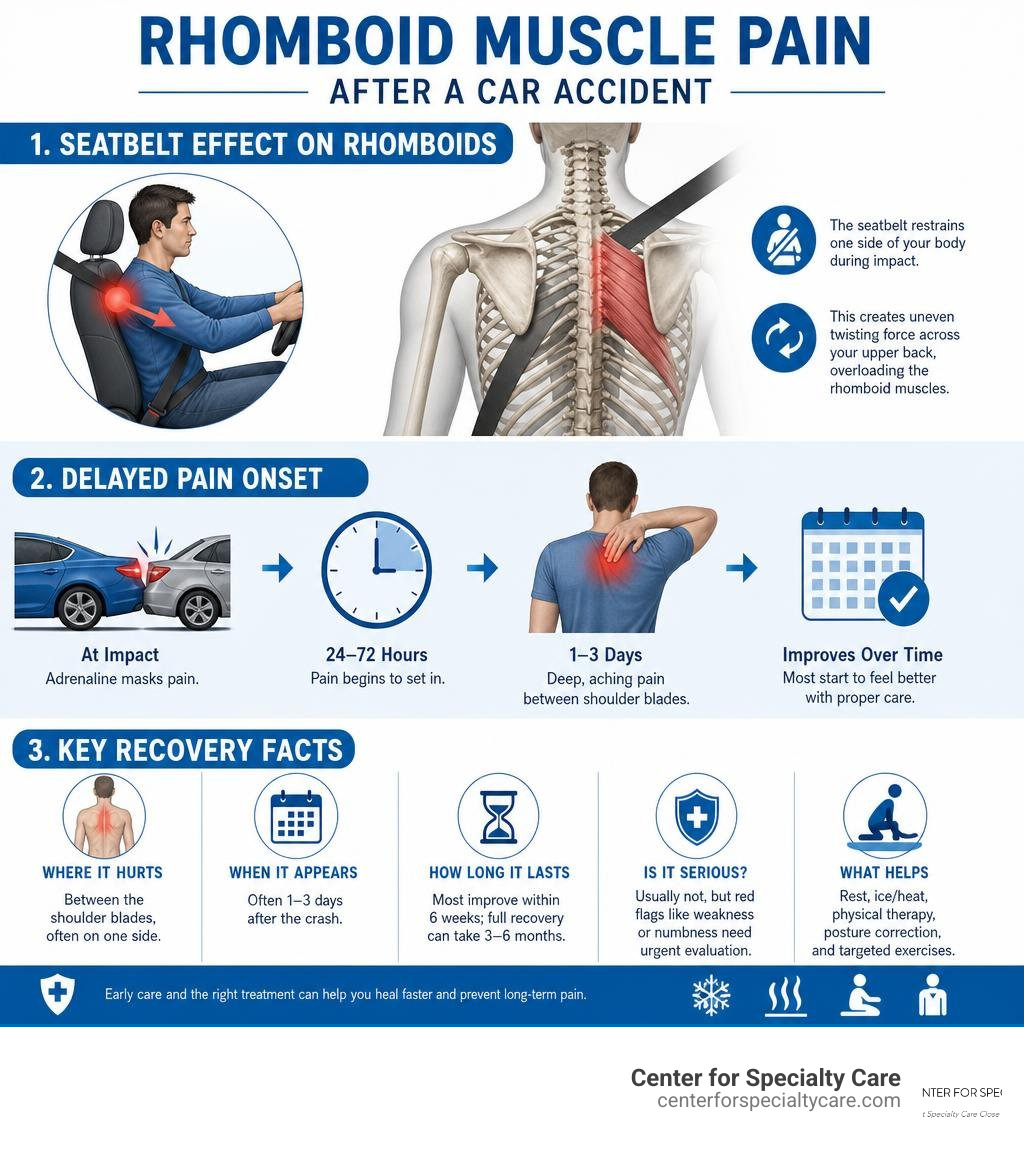
- The sudden jolt of a collision — rear-end, T-bone, or frontal impact — overstretches or tears the rhomboid muscles in your upper back
- The seatbelt restrains one side of your body, creating an uneven twisting force across your upper back and shoulders
- Gripping the steering wheel tightly at impact (“the bracing instinct”) overloads the same muscles
- Pain is often delayed 24–72 hours because adrenaline masks it at the scene
Key facts at a glance:
| Question | Short Answer |
|---|---|
| Where does it hurt? | Between the shoulder blades, often on one side |
| When does pain appear? | Often 1–3 days after the crash |
| How long does it last? | Most improve within 6 weeks; full recovery can take 3–6 months |
| Is it serious? | Usually not, but red flags like weakness or numbness need urgent evaluation |
| What helps? | Rest, ice/heat, physical therapy, posture correction, and targeted exercises |
This kind of injury is easy to dismiss — but ignoring it can turn a short-term strain into a long-term problem.
I’m Dr. Corey Welchlin, a board-certified orthopedic surgeon and sports medicine physician with over 30 years of experience treating musculoskeletal injuries, including rhomboid muscle pain after car accidents and other upper-back trauma. In this guide, I’ll walk you through exactly what’s happening in your body, how to know if your pain is serious, and what actually works to get you better.
Anatomy of the Upper Back: How the Rhomboids Function
To understand why your upper back hurts so much after a crash, it helps to look at the anatomy of the shoulder girdle and thoracic spine.
The rhomboid muscles consist of two flat, diamond-shaped muscles located in your upper back:
- Rhomboid Minor: The smaller, upper portion that originates from the lower cervical spine (C7) and upper thoracic spine (T1).
- Rhomboid Major: The larger, lower portion that originates from the upper thoracic spine (T2 to T5).
Both of these muscles insert directly into the medial (inner) border of your scapula (shoulder blade).
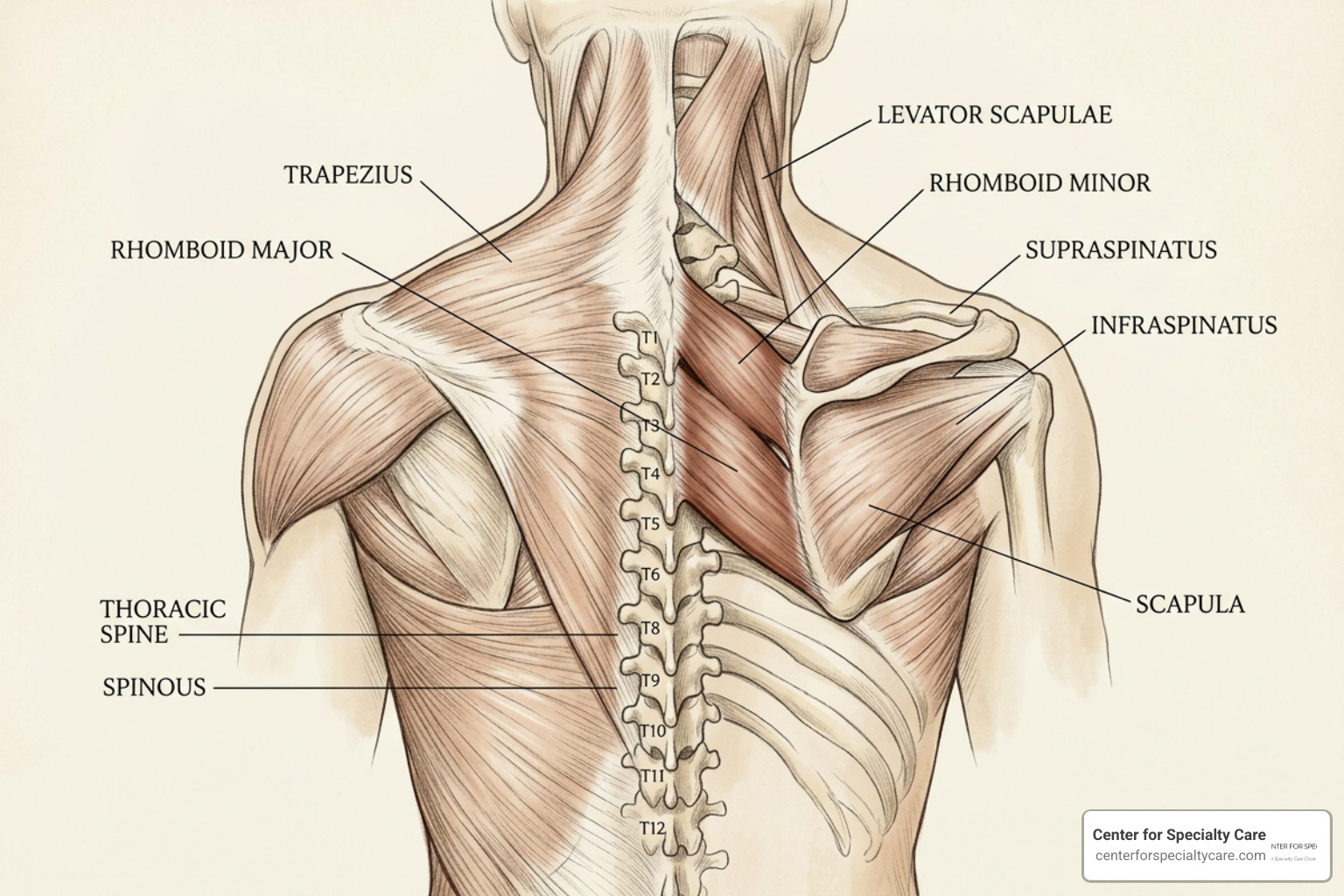
Together, the rhomboid major and minor serve several critical functions:
- Scapular Retraction: They pull your shoulder blades back and squeeze them toward your spine. This is the movement you make when you pull open a heavy door or stand up straight with your shoulders back.
- Shoulder Stability: They anchor the shoulder blades firmly against the rib cage, providing a stable foundation for your arm to move.
- Posture Support: They work in tandem with the trapezius and levator scapulae muscles to prevent your shoulders from rolling forward, helping you maintain an upright, neutral posture.
Because these muscles bridge the gap between your spine and your shoulder blades, they are constantly active during daily movements. When they are injured, even simple tasks like holding a steering wheel, sitting at a desk, or taking a deep breath can become incredibly painful. You can learn more about how these structures interact by reading our guide on Unlocking the Secrets of Spinal Anatomy: A Comprehensive Guide.
Understanding Rhomboid Muscle Pain After Car Accident Injuries
During a motor vehicle collision (MVC), your body is subjected to massive physical forces in a fraction of a second. Even in low-speed collisions of 10 to 20 mph, the kinetic energy transferred to your musculoskeletal system can easily cause significant soft-tissue damage.
There are three primary mechanisms that cause rhomboid muscle pain after a car accident:
1. The “Seatbelt Effect”
While three-point seatbelts are life-saving devices, their asymmetric design creates an uneven distribution of force during a crash. The diagonal shoulder strap restrains only one side of your upper body, while your opposite shoulder and torso are thrown forward. This creates a severe torsional twist (torque) and compression across your chest and upper back. This sudden deceleration can violently overstretch or micro-tear the rhomboid fibers on either side of your shoulder blades.
2. The Bracing Instinct
When you see an impact coming, your natural instinct is to brace yourself. You grip the steering wheel tightly (often called the “death grip”) and lock your elbows. When the crash occurs, the violent force of the impact travels directly up your arms, through your shoulders, and into your upper back. Because your rhomboids are actively contracting to stabilize your shoulders while you brace, the sudden shockwave forces them to absorb a massive eccentric load, leading to severe muscle strain or spasm.
3. Whiplash Trauma
Whiplash is not just a neck injury. The rapid back-and-forth “S-shape” snapping motion of the head and neck during a rear-end or T-bone collision sends shockwaves down the kinetic chain. Because the rhomboids attach to the lower cervical spine, they are forced to overstretch along with the neck muscles to prevent your head from whipping too far forward. For a detailed breakdown of how these forces impact your upper body, check out this article on Why You Have Shoulder or Upper Back Pain After a Car Accident.
Why Rhomboid Muscle Pain After a Car Accident is Often Delayed
It is incredibly common for patients to walk away from a car crash feeling completely fine, only to wake up 24 to 72 hours later in severe pain. This delay is a normal physiological response caused by several factors:
- Adrenaline and Endorphins: During a high-stress event like a collision, your body enters a “fight-or-flight” state, flooding your system with adrenaline and endorphins. These hormones act as natural painkillers, temporarily masking the severity of your injuries.
- Delayed-Onset Inflammation: Micro-tears in the muscle fibers do not hurt immediately. It takes several hours for the body’s inflammatory cascade to begin, bringing fluid and immune cells to the area to start the repair process. This tissue swelling is what causes the deep, throbbing ache and stiffness.
- Muscle Guarding: As your body realizes an injury has occurred, the surrounding muscles contract or “splint” to protect the area from further damage. This protective muscle guarding eventually turns into painful spasms and restricted motion.
Distinguishing Rhomboid Muscle Pain After a Car Accident From Cervical Radiculopathy
Because the upper back and neck are highly interconnected, it can be difficult to tell where your pain is actually coming from. It is crucial to distinguish a localized muscle strain from a more serious nerve-related injury, such as cervical radiculopathy (a pinched nerve in the neck) or a Rotator Cuff Tear.
Here is how you can tell the difference based on your symptoms:
- Rhomboid Muscle Strain: Typically feels like a dull, aching pain, localized tightness, or a “knot” directly between your shoulder blade and spine. The pain is usually aggravated by moving your arm, twisting your torso, or taking deep breaths, and the muscle is tender to the touch.
- Cervical Radiculopathy: Occurs when a nerve root in your neck is compressed or irritated by a herniated disc or bone spur. This pain is typically described as a sharp, burning, or electric shock-like sensation that radiates down your shoulder, arm, and sometimes into your fingers. It is often accompanied by numbness, tingling, or muscle weakness in the arm or hand.
Diagnosing and Treating Post-Crash Rhomboid Injuries
If you are experiencing persistent upper back pain after a crash, a proper medical evaluation is essential. At the Center for Specialty Care, our diagnostic process begins with a comprehensive physical exam.
During your visit, we will:
- Carefully palpate your upper back to locate specific points of tenderness and identify muscle spasms.
- Assess your range of motion in both your neck and shoulders.
- Perform targeted orthopedic and neurological tests to ensure your pain is not radiating from a spinal disc or nerve root.
While most soft-tissue injuries can be diagnosed through a physical exam alone, we may recommend diagnostic imaging (such as X-rays or an MRI) if we suspect a bone fracture, joint dislocation, or a severe ligament tear. For more information on how we evaluate these types of crash-related injuries, you can read about Car Accident Injury Care – Summit Orthopedics.
To help you understand your symptoms, here is a quick comparison of common post-accident upper body injuries:
| Condition | Primary Pain Location | Pain Type | Key Distinguishing Feature |
|---|---|---|---|
| Rhomboid Muscle Strain | Between the shoulder blade and spine | Dull ache, tight knot, localized spasm | Pain increases with scapular retraction or deep breathing; tender to the touch. |
| Rotator Cuff Tear | Outer shoulder, radiating down the upper arm | Deep ache, sharp pain when lifting | Inability to lift the arm overhead; severe shoulder pain at night. |
| Cervical Radiculopathy | Neck, radiating down the arm to the fingers | Burning, electric shocks, tingling | Accompanied by numbness or weakness in the arm/hand; neck movement triggers arm pain. |
Conservative Care and Home Remedies
For the first few days following an accident, the primary goal of treatment is to calm down inflammation and manage pain. We recommend starting with a modified RICE protocol (Rest, Ice, Compression, Elevation) and utilizing targeted temperature therapy.
Knowing when to apply ice or heat is critical for a speedy recovery:
- Ice (First 48 Hours): Apply ice packs to the painful area for 15 to 20 minutes every 2 to 3 hours. This constricts blood vessels, helping to reduce acute swelling and numb sharp pain.
- Heat (After 48 Hours): Once the initial swelling has subsided, transition to moist heat (such as a warm bath or heating pad). Heat dilates blood vessels, bringing fresh, oxygen-rich blood to the damaged tissue to accelerate healing and relax tight, spasming muscles.
For a deeper dive into choosing the right therapy for muscle strains, read our articles on Don’t Get Burned: Choosing Between Ice and Heat for Strains and Tendinitis Pain: Should You Apply Ice or Heat for Fast Relief?.
Professional Rehabilitation and Advanced Therapies
If conservative home care does not resolve your pain within a couple of weeks, professional rehabilitation is the next step. Active, guided recovery is far more effective than prolonged rest, which can lead to muscle weakness, joint stiffness, and poor postural compensation.
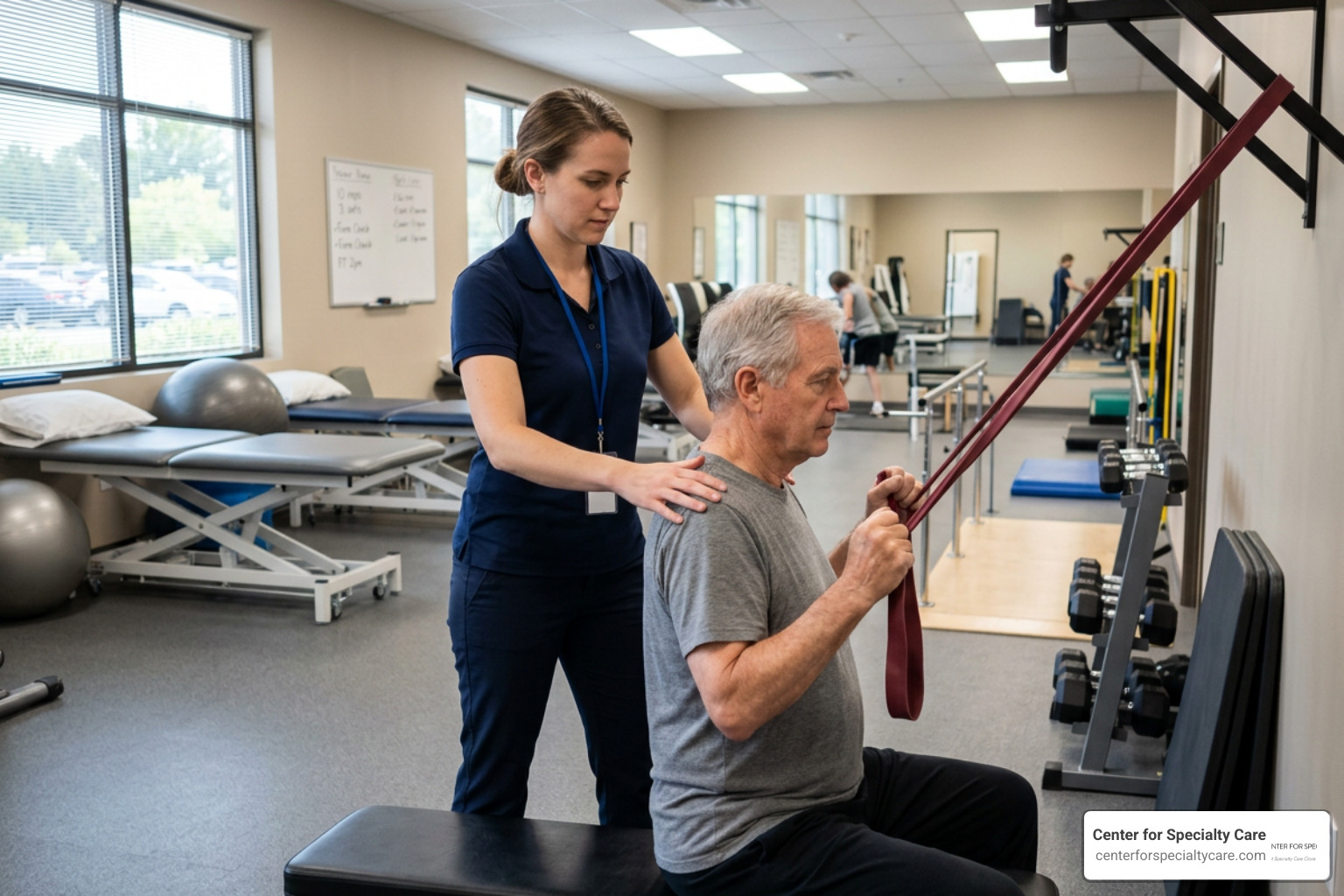
A comprehensive rehabilitation program typically includes:
- Manual Therapy: Hands-on techniques, such as myofascial release and trigger point massage, help break up scar tissue, reduce muscle guarding, and restore normal tissue mobility.
- Posture Correction: We help you address compensatory habits, such as rounded shoulders or a forward-head posture, which put excessive tension on your healing rhomboid muscles.
- Targeted Exercises: Progressive strengthening of the rhomboids, middle trapezius, and rotator cuff muscles helps restore scapular stability. Gentle stretching of the chest (pectoralis) muscles prevents the shoulders from pulling forward.
The effectiveness of structured, long-term rehabilitation for post-accident trauma is well-documented. For instance, a published case study demonstrated significant subjective and objective recovery in a patient suffering from severe post-crash chronic pain and spinal misalignment after undergoing targeted structural rehabilitation. You can read the full case details here: Subjective and Objective Improvement in a 39-Year-Old Male Suffering From Severe Chronic Pain and Disability Using Chiropractic BioPhysics® Protocols Following Rear-Impact Motor Vehicle Crash With a 10-Month Long-Term Follow-Up.
Recovery Timelines, Statistics, and Red Flags
Understanding what to expect during your recovery can give you peace of mind. Most patients with mild to moderate rhomboid strains begin to feel significantly better within about six weeks of starting conservative treatment. However, a full recovery — where you can return to heavy lifting, manual labor, or overhead sports without any lingering twinges — typically takes three to six months.
If your pain does not show any signs of improvement after three months of consistent physical therapy, it is highly recommended to check in with an orthopedic specialist for a reassessment.
To put spinal and back pain recovery into perspective, let’s look at some important clinical statistics:
- Natural Pain Improvement: In a 2024 systematic review and meta-analysis of 95 studies evaluating acute spinal and back pain cohorts, patients showed substantial improvement over time. The mean pain score (on a scale of 0 to 100) dropped from 56 at baseline to 26 at 6 weeks, demonstrating that the vast majority of acute back injuries respond exceptionally well to early, conservative care.
- Low Prevalence of Serious Pathology: A 2026 systematic review and meta-analysis found that the pooled prevalence of serious spinal pathology (such as fractures, infections, or tumors) among people seeking care for back pain was only 2.9% overall. This means that while your pain may feel severe, the likelihood of a dangerous underlying condition is very low.
- Spinal Fractures vs. Severe Nerve Issues: Within that same 2026 review, the reported prevalence of individual serious diagnoses ranged from just 0.3% for cauda equina syndrome to 2.4% for spinal fractures across the analyzed clinical settings.
- Nerve Block and Injection Efficacy: For patients whose upper back pain is referred from a pinched cervical nerve (radiculopathy), an American Academy of Neurology (AAN) systematic review published in 2025 showed that epidural steroid injections provide modest, time-limited relief. Specifically, 24% more people reported reduced pain and 16% more reported reduced disability for up to 3 months compared to those who did not receive an injection.
In rare cases where chronic back or neck pain persists and is linked to irritated facet joints in the spine, advanced interventional procedures may be considered. You can learn more about these options by reading about our Ablation Spine Procedure.
Frequently Asked Questions about Upper Back Pain After a Crash
How long does rhomboid muscle pain last after a car accident?
For a mild to moderate rhomboid strain, you can expect to start feeling much better within about six weeks. However, because we use our upper back muscles for almost every daily activity, complete healing of deeper tissue tears can take three to six months. If your pain does not improve after three months, or if it continues to interfere with your sleep and daily activities, it is time to consult an orthopedic specialist.
Can a seatbelt cause rhomboid muscle pain?
Yes, absolutely. While a three-point safety harness is essential for preventing fatal injuries, the diagonal strap restrains only one shoulder during a crash. This asymmetric restraint forces your torso to twist violently under extreme deceleration, compressing your chest and placing a massive, uneven stretching force on the rhomboid muscles behind your shoulder blades.
When should I see a specialist for upper back pain?
While muscle soreness is normal after a crash, you should seek immediate or urgent medical evaluation if you experience any of the following “red-flag” symptoms:
- Progressive weakness in your arm, hand, or fingers (such as dropping coffee mugs or struggling to turn doorknobs).
- Numbness, tingling, or a “pins-and-needles” sensation radiating down your arm.
- Severe, unrelenting pain that keeps you awake at night and does not improve with rest, ice, or heat.
- Difficulty walking, loss of balance, or any changes in bowel or bladder control (which can indicate a serious spinal cord emergency).
Conclusion
Rhomboid muscle pain after a car accident is a painful, disruptive injury, but with the right care, you can make a complete recovery. Rest alone is rarely enough to restore normal shoulder mechanics; a combination of early pain management, gentle mobilization, and targeted strengthening exercises is the key to preventing chronic, long-term upper back stiffness.
At the Center for Specialty Care, we are dedicated to helping you get back to the activities you love. We provide comprehensive orthopedic and pain management services, offering both advanced non-surgical therapies and surgical options tailored to your unique needs. Our practice is built on a commitment to 100% patient satisfaction, highly personalized care, and quick appointment availability so you don’t have to wait in pain.
If you are struggling with upper back, shoulder, or neck pain following a collision, let us help you find lasting relief. We proudly serve patients across our convenient locations in Fairmont, MN, St. James, MN, Estherville, IA, and Buffalo Center, IA.
Schedule an evaluation for your back pain with our experienced team today, and let’s take the first step toward your recovery.