

A Chilly Guide to Warming Up Your Rotator Cuff Recovery
July 23, 2026
No Prescription Needed: Best Over the Counter Orthotics for Flat Feet
July 28, 2026
Stomach Sleeper Problems: How to Stop Shoulder Pain in Your Sleep
Why Stomach Sleeping Wakes You Up in Pain
Shoulder pain from sleeping on your stomach is one of the most common — and most fixable — causes of morning joint discomfort. Here’s the short answer if you need it fast:
Quick Fix Summary:
- Stop sleeping on your stomach (it forces your shoulder into an internally rotated, compressed position for hours)
- Switch to back sleeping with a thin pillow supporting your affected arm
- If you can’t stop stomach sleeping yet, prop a pillow vertically under your torso to shift into a semi-side position
- Use a medium-firm mattress and a pillow sized to keep your neck level
- If pain persists beyond a few weeks or wakes you at night, see an orthopedic specialist
Your shoulder is the most mobile joint in your body. That mobility is a strength — but it also makes the shoulder vulnerable when it’s held in a bad position for six to nine hours straight.
Stomach sleeping does exactly that. It forces your neck to one side and rotates your shoulder inward, putting sustained pressure on the tendons, bursa, and rotator cuff. Over time, that nightly compression adds up.
You’re not alone in dealing with this. Over four million Americans face shoulder problems every year, and shoulder pain ranks as the third most common musculoskeletal complaint in the United States. A poor sleep position is one of the most overlooked causes.
I’m Dr. Corey Welchlin, a board-certified orthopedic surgeon and founder of the Center for Specialty Care in Fairmont, Minnesota, and over my 30+ years treating rotator cuff injuries and joint conditions, I’ve seen countless patients whose shoulder pain from sleeping on their stomach could have been prevented with the right positioning and support. In the sections below, I’ll walk you through exactly why this happens and what you can do about it tonight.
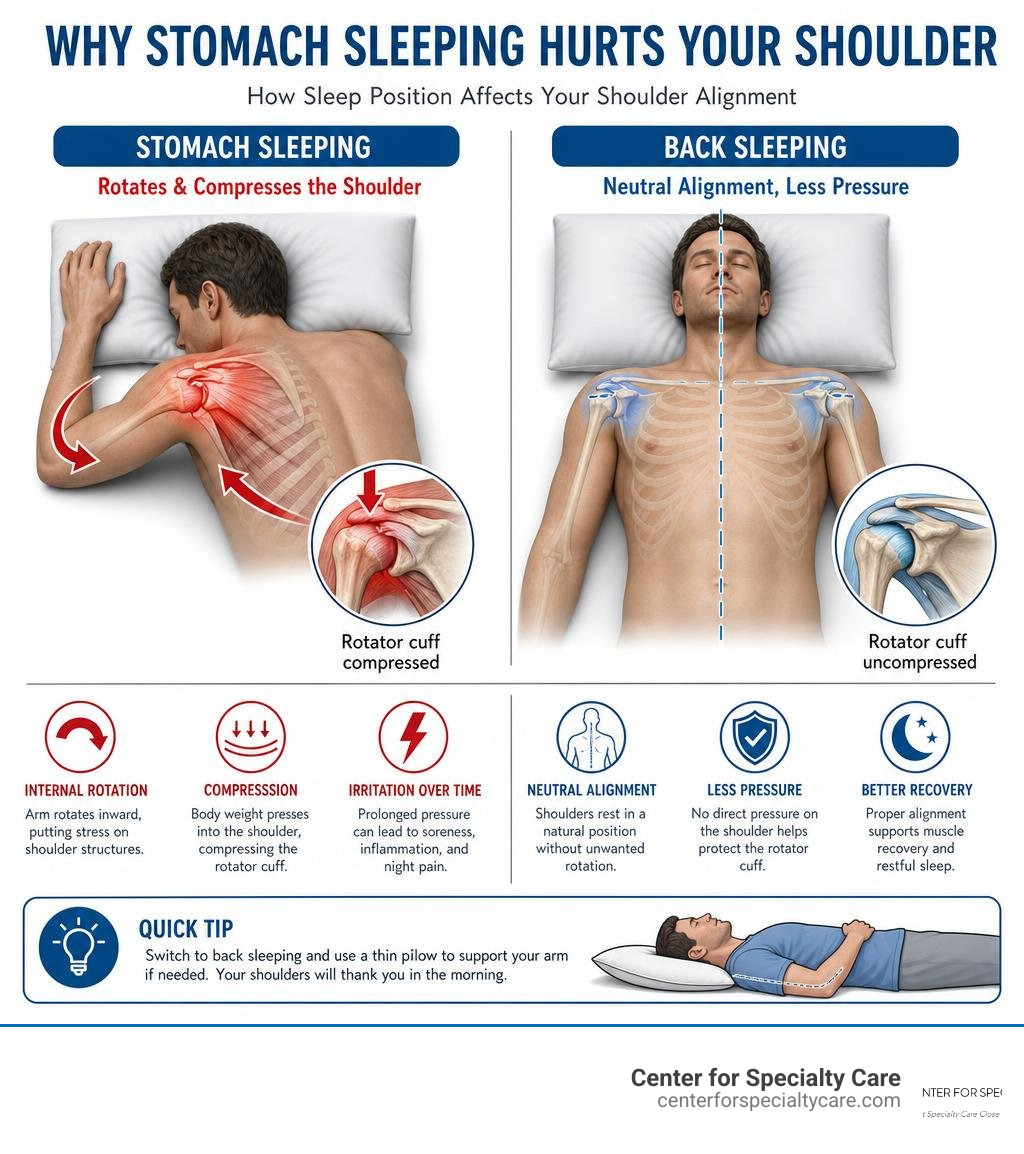
The Biomechanics of Shoulder Pain from Sleeping on Stomach
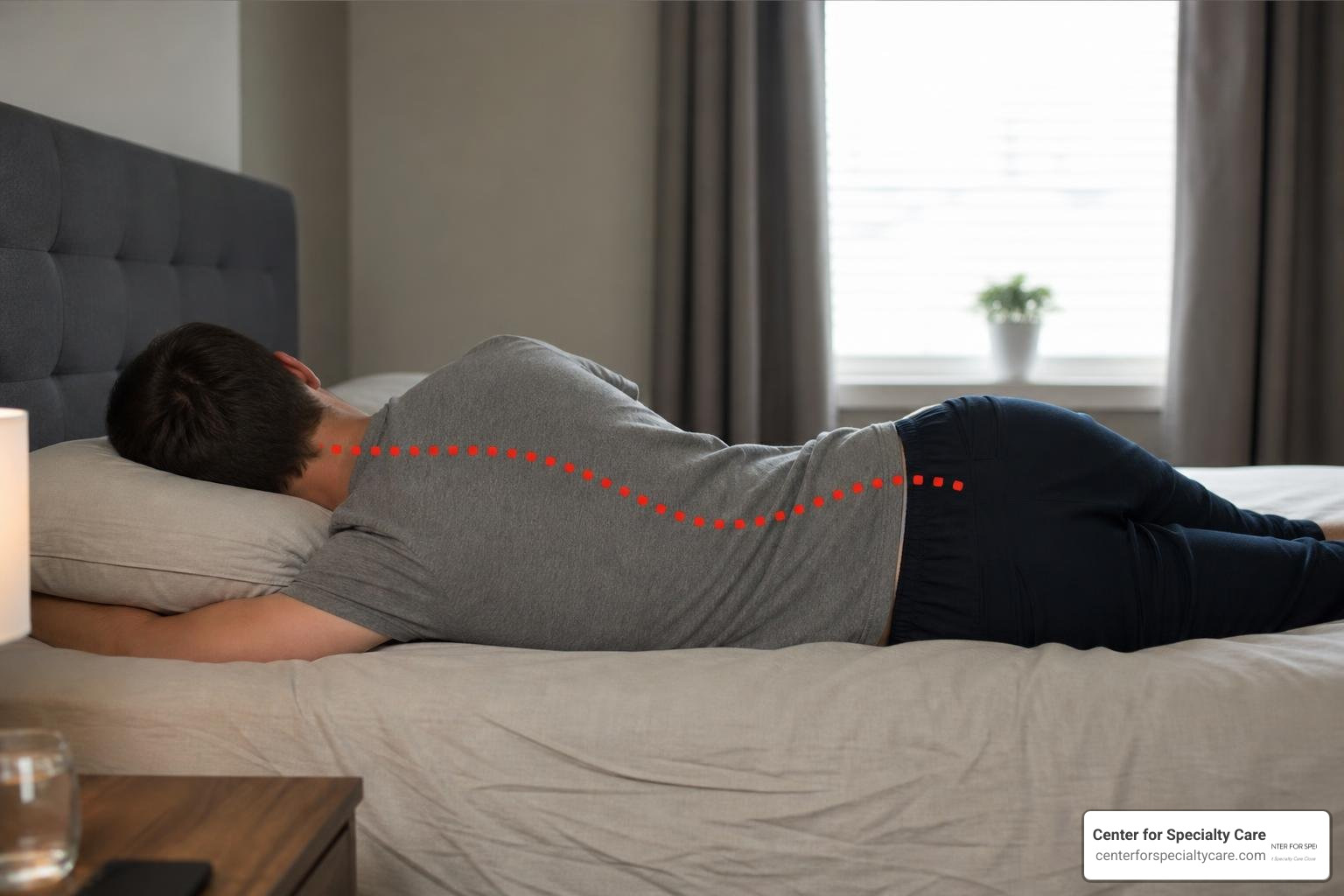
Stomach sleeping may feel comfortable at first, but your joints often disagree by morning.
When you sleep on your stomach, several things happen at once:
- Your neck rotates to one side so you can breathe.
- Your upper spine twists away from a neutral position.
- One or both shoulders often roll forward.
- Your arm may end up under your pillow, under your chest, or overhead.
- Your shoulder joint sits in an internally rotated, compressed position.
That combination is rough on the shoulder. It narrows the space where the rotator cuff tendons pass, increases pressure on the soft tissues, and can irritate the bursa, the small fluid-filled cushion that helps the shoulder glide smoothly.
Stomach sleeping also affects the spine. As Cleveland Clinic explains in its guide on why stomach sleeping is bad for your spine, lying on your stomach can flatten and twist the spine’s natural curve. That can create stress not only in the back and neck, but also through the shoulders.
Think of your body like a chain. If your neck is twisted, your upper back follows. If your upper back rotates, your shoulder blade changes position. If your shoulder blade is off, the shoulder joint has to compensate. Your shoulder is basically saying, “I did not sign up for this night shift.”
For a broader look at sleep-related shoulder discomfort, we also recommend reading our guide on shoulder pain from sleeping.
How Shoulder Pain from Sleeping on Stomach Develops Over Time
One night of stomach sleeping may cause temporary soreness. Months or years of it can create a pattern.
Here is how shoulder pain from sleeping on stomach often develops:
Internal rotation starts the problem.
When your shoulder rolls inward, the rotator cuff tendons can become crowded under the top of the shoulder blade.Sustained pressure keeps it irritated.
During the day, you move, stretch, and shift positions. At night, you may hold the same awkward position for hours.Blood flow decreases.
Compression can reduce circulation to irritated tissues. Tendons already have a limited blood supply compared with muscles, so prolonged pressure can slow recovery.Inflammation builds.
When you stop moving during sleep, your body loses some of the natural “pumping” effect that helps clear inflammatory fluid. That is one reason shoulder pain often feels worse at night or first thing in the morning.The bursa gets angry.
The bursa cushions the shoulder. When compressed repeatedly, it can become inflamed, leading to bursitis-like pain.
Poor sleep position can also create a cycle: pain disrupts sleep, poor sleep slows healing, and slow healing makes the shoulder more sensitive the next night. Fun? No. Common? Very.
An outside discussion of sleep position mechanics notes that stomach sleeping forces extreme neck and shoulder rotation, making it one of the least shoulder-friendly sleep positions; you can read more about how sleep position may cause shoulder pain. For more on night pain specifically, see our article on shoulder pain at night.
Rotator Cuff Strain and Shoulder Pain from Sleeping on Stomach
The rotator cuff is a group of muscles and tendons that stabilizes your shoulder and helps you lift and rotate your arm. One of the most commonly irritated tendons is the supraspinatus tendon, which runs through a narrow space near the top of the shoulder.
When you sleep on your stomach with your arm overhead or tucked under your pillow, the supraspinatus tendon can be compressed for long periods. Over time, this may contribute to:
- Tendon irritation
- Rotator cuff tendinitis
- Shoulder impingement
- Small micro-tears
- Worsening pain from an existing rotator cuff injury
Research has shown that many people with rotator cuff tears prefer side sleeping; one study found that 89.7% of patients with rotator cuff tears preferred sleeping on their side, which may increase pressure on already damaged tendons. Stomach sleeping can create a different but equally frustrating problem: rotation plus compression.
If your pain feels deep, sharp with reaching, or worse when lifting your arm, explore our resources on rotator cuff pain at night and what to do if you hurt your rotator cuff while sleeping.
Best Sleeping Positions to Relieve Nighttime Shoulder Pain
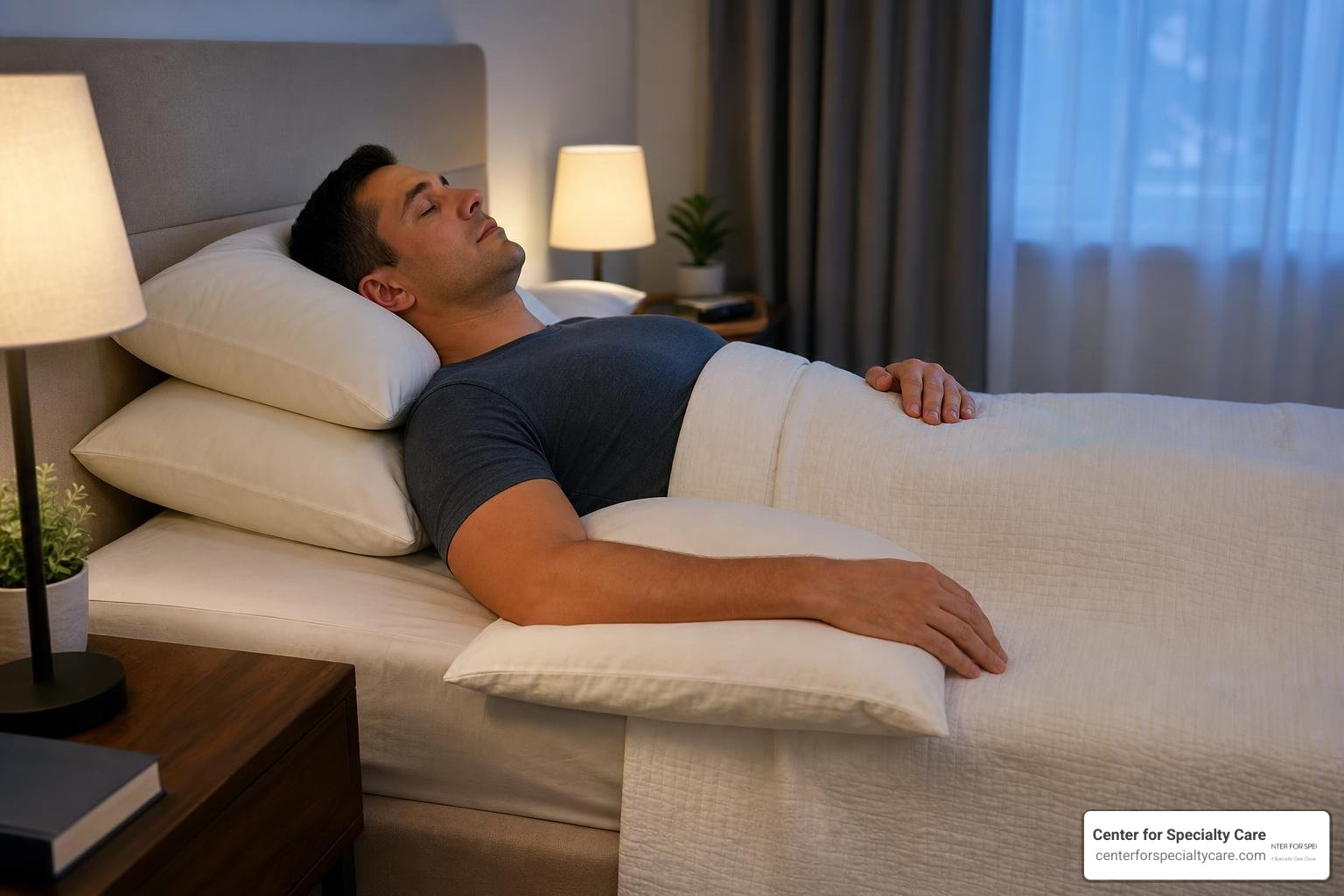
The best sleeping position for shoulder pain is usually the one that does three things:
- Removes direct pressure from the painful shoulder
- Keeps the neck and spine aligned
- Supports the arm so the shoulder is not hanging, twisting, or collapsing inward
For most people, that means back sleeping with arm support or modified side sleeping on the unaffected side.
Here is a quick comparison:
| Sleep position | Shoulder alignment | Best for | Watch out for |
|---|---|---|---|
| Back sleeping | Usually best; shoulders stay open and even | Rotator cuff pain, bursitis, impingement, general shoulder soreness | Arm may fall outward without pillow support |
| Side sleeping on unaffected side | Good if the painful arm is supported | People who cannot sleep on their back | Top shoulder may collapse forward without a body pillow |
| Side sleeping on affected side | Often irritating due to direct pressure | Usually not ideal during flare-ups | Compresses tendons and bursa |
| Stomach sleeping | Poor; neck and shoulder rotate awkwardly | Rarely recommended for shoulder pain | Can worsen neck, back, and shoulder pain |
For more practical night positioning tips, see our guide on how to relieve rotator cuff pain at night.
Back Sleeping with Arm Support
Back sleeping is often the best place to start because it reduces direct pressure on the shoulder.
Try this setup tonight:
- Lie on your back.
- Use a pillow that keeps your neck neutral, not pushed forward.
- Place a small pillow or folded towel under the painful arm.
- Keep the elbow slightly bent.
- Let the hand rest on your stomach or on the pillow.
- Add a pillow under your knees if your low back feels strained.
The goal is to keep the upper arm supported so the shoulder does not drop backward or pull forward. Even a small amount of elevation can help calm irritated tendons.
For many patients, this position is especially helpful for rotator cuff irritation, bursitis, and shoulder impingement. If night pain is keeping you awake, our article on nighttime rotator cuff pain explains additional ways to improve comfort.
Modified Side Sleeping on the Unaffected Side
If you are a committed side sleeper, switching completely to your back may feel like trying to learn a new language in your sleep. Fortunately, side sleeping can work if you support the shoulder properly.
Use this setup:
- Sleep on the side that does not hurt.
- Hug a body pillow or thick pillow in front of your chest.
- Rest the painful arm on that pillow so it stays level with your torso.
- Place a pillow between your knees.
- Keep your shoulders stacked instead of rolling forward.
The pillow between your knees matters more than most people think. It helps stabilize the pelvis, which helps align the spine, which helps the shoulder blade sit in a better position.
Avoid letting the painful arm dangle across your chest. That can pull the shoulder into internal rotation and recreate the same problem you are trying to escape.
For more ideas, read our guide on how to sleep with rotator cuff pain.
How to Transition Away from Stomach Sleeping
Changing your sleep position is possible, but we will be honest: it can feel awkward for the first few nights. Your body likes familiar habits, even when those habits are rude to your joints.
Most people need a gradual retraining period. Some notice improvement within a few nights, while more consistent relief often takes two to four weeks of sticking with the new setup.
Using Pillow Barriers
Pillow barriers are one of the simplest ways to stop rolling onto your stomach.
Try one of these methods:
- Body pillow in front: Hug a long pillow to keep your chest from rotating downward.
- Pillow behind your back: Place a firm pillow behind you when side sleeping to prevent rolling.
- Pillow wall: Use pillows on both sides to “bumper” yourself into position.
- Tennis ball technique: Place a tennis ball in a sock and pin or sew it to the front of a sleep shirt. If you roll onto your stomach, your body gets a gentle “nope” reminder.
- Semi-side transition: If stomach sleeping is hard to quit, place a pillow vertically under one side of your torso so you are halfway between stomach and side sleeping.
That last option is useful for lifelong stomach sleepers. It reduces the amount of neck and shoulder rotation while giving your body a familiar sense of pressure against the mattress.
Cognitive and Behavioral Adjustments
Sleep position is not just physical. It is also behavioral.
To make the change easier:
- Start in your new position every night, even if you do not stay there all night.
- Keep a consistent bedtime.
- Avoid screens and heavy meals right before bed.
- Use slow breathing or a short relaxation routine.
- Do gentle shoulder stretches before lying down.
- Give the new position at least two to three weeks before deciding it “doesn’t work.”
If you wake up on your stomach, do not treat it like failure. Just reset your position and go back to sleep. No guilt. No dramatic midnight speech. Just roll, support, repeat.
Optimizing Your Sleep Environment and At-Home Care
Your sleeping position matters, but your mattress, pillow, and evening routine matter too.
A mattress that is too firm can create pressure points at the shoulder. A mattress that is too soft can let the torso sink too far, twisting the spine and shoulder. For many people with shoulder pain, a medium-firm mattress offers the best balance of support and pressure relief.
A guide on shoulder ache from sleeping discusses how mattress firmness, pillow height, and sleep position can all contribute to morning shoulder discomfort. The key idea is simple: your shoulder needs enough cushioning to avoid compression, but enough support to stay aligned.
Also consider your daytime habits. Rounded shoulders from desk work, driving, phone use, or repetitive overhead activity can “pre-load” the shoulder before you even get into bed.
Helpful morning or evening stretches include:
- Shoulder blade squeezes
- Doorway chest stretch
- Cross-body shoulder stretch
- Pendulum stretch
- Gentle neck release
- Shoulder rolls
- Wall angels, if pain-free
For step-by-step movement ideas, visit our guide to exercises for shoulder pain.
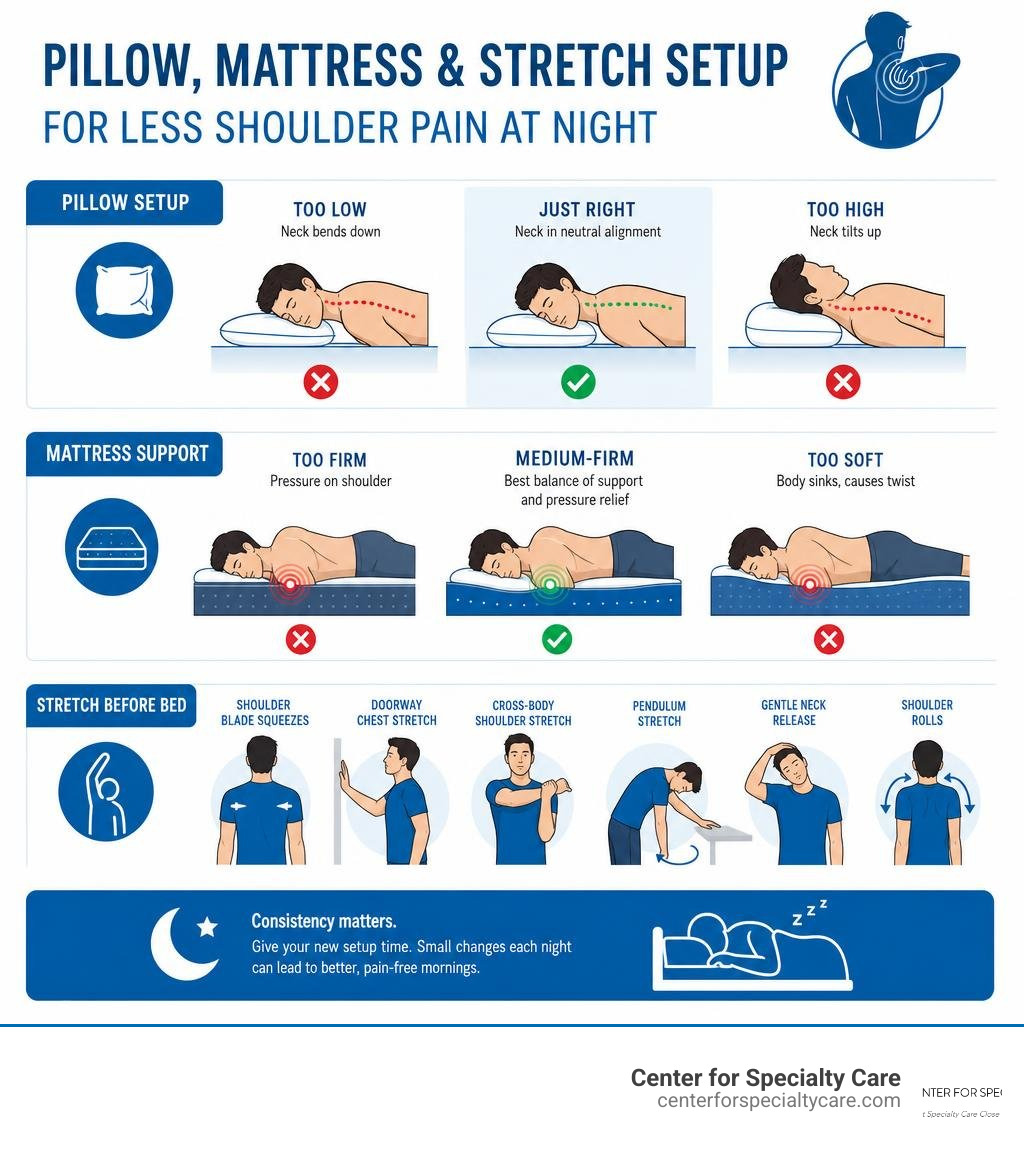
Choosing the Right Pillow Loft
“Pillow loft” means pillow height. It sounds fancy, but it simply asks: does your pillow keep your head level?
The right pillow should keep your neck in a neutral line with your spine.
For back sleepers:
- Use a thinner pillow under the head.
- Avoid pillows that push the chin toward the chest.
- Consider a small cervical contour if it feels comfortable.
- Support the painful arm with a separate pillow.
For side sleepers:
- Use a pillow thick enough to fill the space between your ear and shoulder.
- Your head should not drop toward the mattress.
- Your head should not tilt upward either.
- A body pillow can keep the top arm from collapsing inward.
Memory foam or orthopedic pillows can help some people maintain alignment, but there is no magic pillow that works for everyone. The best pillow is the one that keeps your neck level and your shoulder relaxed.
Gentle Stretching and Temperature Therapy
A short pre-bed routine can make a real difference. In fact, consistent pre-bed stretching has been associated with night pain reductions of up to 40% compared with stretching alone or inconsistent care.
Try this gentle routine:
Doorway stretch
Place your forearms on a doorway and step forward slightly until you feel a mild chest stretch. Hold 20 to 30 seconds.Pendulum stretch
Lean forward with your unaffected hand on a table. Let the painful arm hang and gently swing it in small circles.Cross-body stretch
Bring the painful arm across your chest and gently support it with the other arm. Hold without forcing.Shoulder blade squeeze
Pull your shoulder blades gently back and down. Hold for five seconds, then relax.Neck release
Slowly tilt one ear toward the same-side shoulder until you feel a light stretch. Keep it gentle.
Temperature therapy can also help:
- Use ice for newer pain, swelling, or inflammation.
- Use heat for chronic stiffness or tight muscles.
- Apply ice for about 10 to 15 minutes.
- Apply heat for about 15 minutes.
- Never sleep with a heating pad on.
If any stretch increases sharp pain, numbness, tingling, or weakness, stop and get evaluated.
When to See a Doctor for Sleep-Related Shoulder Pain
Many cases of sleep-related shoulder pain improve with position changes, pillow support, stretching, and better sleep ergonomics.
But not all shoulder pain is “just how you slept.”
You should schedule an orthopedic evaluation if you have:
- Pain lasting more than two to three weeks despite home care
- Pain that wakes you repeatedly at night
- Weakness when lifting the arm
- Loss of range of motion
- Pain after a fall, accident, or sudden injury
- Numbness or tingling down the arm
- Swelling, redness, warmth, or visible deformity
- Pain that affects work, sleep, dressing, driving, or daily activities
If you are unsure what is causing your symptoms, our guide Why Does My Shoulder Hurt? can help you understand common causes. If pain started after trauma, read more about shoulder pain after injury.
Identifying Underlying Conditions
Sleep position can trigger pain, but it can also reveal an underlying shoulder condition that was already developing.
Common causes include:
- Rotator cuff tendinitis or tear: Pain with reaching, lifting, or lying down.
- Shoulder impingement: Pinching pain when raising the arm.
- Bursitis: Aching pain from inflammation of the shoulder bursa.
- Frozen shoulder: Stiffness and progressive loss of motion.
- Osteoarthritis: Joint pain, stiffness, and grinding sensations.
- Cervical radiculopathy: Neck-related nerve irritation that can refer pain into the shoulder or arm.
Frozen shoulder is especially known for night pain and stiffness. Learn more in our article on frozen shoulder at night.
Clinical Treatment Options
At Center for Specialty Care, we evaluate shoulder pain with a personalized approach. We serve patients in Fairmont, MN; Estherville, IA; Buffalo Center, IA; St. James, MN; and surrounding Minnesota and Iowa communities.
Depending on your symptoms, treatment may include:
- Physical exam and range-of-motion testing
- Imaging when appropriate
- Activity modification
- Anti-inflammatory strategies
- Physical therapy
- Stretching and strengthening programs
- Injections when medically appropriate
- Surgical consultation if conservative care is not enough
Many patients improve without surgery. The goal is to reduce pain, restore function, and prevent the problem from returning every time you go to bed.
Physical therapy can be especially helpful because it addresses strength, posture, mobility, and shoulder blade mechanics. Learn more about shoulder treatment with physical therapy.
Frequently Asked Questions about Sleep Posture and Shoulder Pain
Why does my shoulder hurt when I wake up but not during the day?
Morning-only shoulder pain often points to sustained compression during sleep.
During the day, you move your arm, change positions, and keep circulation flowing. At night, your shoulder may stay compressed for hours. That can irritate the rotator cuff tendons, bursa, or joint capsule. Once you get up and move around, circulation improves and stiffness may ease.
If the pain starts lasting throughout the day, causes weakness, or wakes you at night, it may be more than simple sleep-position irritation.
Is it better to sleep on a hard or soft mattress for shoulder pain?
Usually, neither extreme is ideal.
A very hard mattress may press into the shoulder and increase pressure points. A very soft mattress may let your body sink too far, throwing the spine and shoulder out of alignment.
For many people, a medium-firm mattress works best because it supports the spine while allowing some shoulder cushioning. Side sleepers may need slightly more pressure relief than back sleepers, especially if they have broad shoulders.
Can a pillow really fix shoulder pain from sleeping?
A pillow can help if the pain is mostly positional. It can support the arm, reduce internal rotation, keep the neck level, and prevent rolling onto the painful shoulder.
But a pillow cannot repair a significant rotator cuff tear, reverse advanced arthritis, or fully treat frozen shoulder. If your pain persists despite better positioning, the pillow is not failing you. Your shoulder may simply need medical evaluation.
Conclusion
Shoulder pain from sleeping on stomach is common, but it is not something you have to accept as your new morning routine.
Start with the basics:
- Move away from stomach sleeping.
- Try back sleeping with arm support.
- Use body pillows to prevent rolling.
- Keep your neck and spine aligned.
- Choose a mattress and pillow that reduce pressure.
- Stretch gently before bed.
- Get medical care if pain persists, worsens, or limits function.
At Center for Specialty Care, we provide personalized orthopedic and pain management care, including both surgical and non-surgical treatment options. Our team is committed to quick appointment availability, individualized care, and patient satisfaction for the communities we serve in Minnesota and Iowa.
If shoulder pain is stealing your sleep, we are here to help you get answers and a plan that fits your life.