
Knot Today! How to Banish Those Pesky Muscle Knots Behind Your Shoulder Blade
March 13, 2026
Getting Zapped: Your Back Ablation Procedure Explained
March 16, 2026
Nighttime Rotator Cuff Pain? Here’s How to Finally Get Some Rest
Why Shoulder Pain Becomes Unbearable After Dark
How to stop rotator cuff pain at night is one of the most common concerns I hear from patients—and for good reason. Up to 93% of people with shoulder injuries report that their pain intensifies when they try to sleep, turning what should be a time of rest into hours of frustration and discomfort.
Quick Relief Strategies:
- Adjust your sleep position – Sleep on your back or uninjured side with pillow support
- Apply ice before bed – 15-20 minutes to reduce inflammation
- Use proper pillow placement – Support your arm to maintain a neutral shoulder position
- Take anti-inflammatory medication – NSAIDs about an hour before bedtime (if safe for you)
- Try gentle stretches – Pendulum swings and doorway stretches an hour before sleep
If you’ve injured or torn a rotator cuff muscle, you already know that manageable daytime discomfort can transform into severe pain the moment you lie down. Your shoulder throbs. You can’t find a comfortable position. You wake up multiple times throughout the night. This isn’t just frustrating—it’s preventing your body from healing properly, since quality sleep is essential for tissue repair and recovery.
The good news? There are proven strategies to break this pain-sleep cycle and finally get the rest you need.
I’m Dr. Corey Welchlin, a board-certified orthopedic surgeon who has spent over three decades helping patients in southern Minnesota and northern Iowa find relief from shoulder pain. Throughout my career, I’ve helped thousands of people find how to stop rotator cuff pain at night through a combination of conservative treatments, minimally invasive procedures, and—when necessary—advanced surgical techniques.
Simple guide to how to stop rotator cuff pain at night terms:
Why Rotator Cuff Pain Worsens at Night
It feels like a cruel trick of nature: you make it through a busy day at work in Fairmont or running errands in Estherville with only a dull ache, but the second your head hits the pillow, your shoulder starts screaming. Why does this happen?
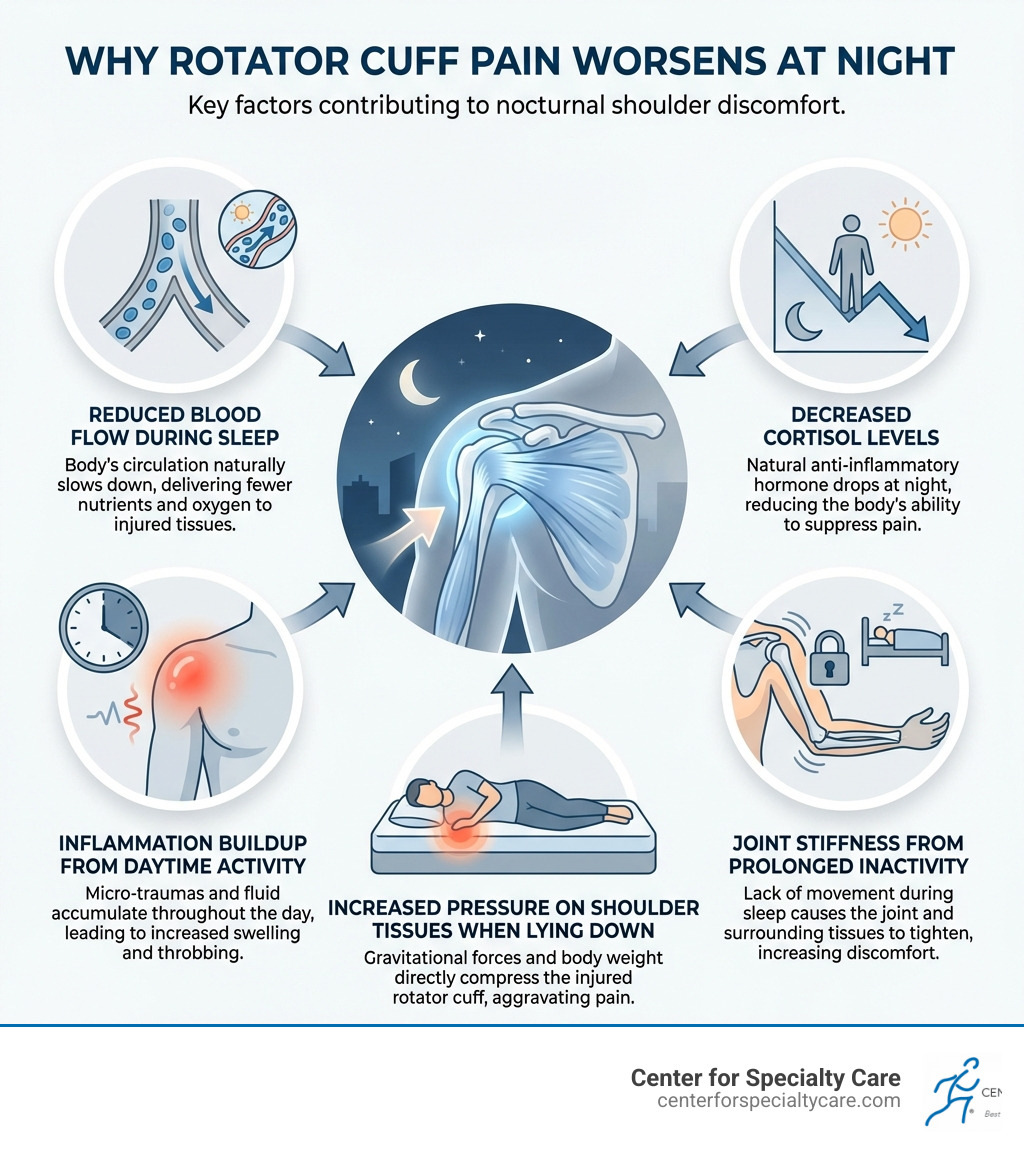
The primary culprit is often gravity. During the day, gravity helps pull your humerus (arm bone) down, creating a tiny bit of extra space in the shoulder joint. When you lie down, that gravitational pull disappears. This allows the structures to compress, which is particularly problematic if you have shoulder problems like impingement or a tear.
Furthermore, blood circulation changes when we sleep. Inactivity leads to decreased blood flow to the tendons, which can increase stiffness. At the same time, fluid tends to redistribute and pool around the injured area, leading to increased pressure.
There is also a hormonal component. Our bodies naturally produce cortisol, a hormone that helps regulate inflammation. Cortisol levels are typically at their lowest in the middle of the night. Without this natural anti-inflammatory “shield,” the inflammation buildup from your daytime activities becomes much more painful. According to Scientific research on rotator cuff treatment, these physiological shifts, combined with the lack of daily distractions, make you hyper-aware of every “loud” pain signal your shoulder sends.
How to Stop Rotator Cuff Pain at Night: Sleep Positions and Support
The way you position your body is perhaps the most significant factor in determining whether you’ll wake up refreshed or exhausted. If you’re searching for how to stop rotator cuff pain at night, your first step should be evaluating your “sleep architecture.”
The Gold Standard: Back Sleeping
Most orthopedic specialists recommend sleeping on your back. This position prevents you from putting direct weight on the injured joint. However, simply lying flat isn’t always enough.
- The “Pillow Prop”: Place a small pillow or a folded towel under the elbow of the affected arm. This prevents the elbow from dropping back toward the mattress, which can tug on the rotator cuff tendons.
- Wedge Pillows: If lying flat is too painful, try a wedge pillow to keep your torso at a slight incline. This reduces the pooling of inflammatory fluids and uses gravity to your advantage.
Side Sleeping: The “Pillow Wall” Strategy
If you absolutely cannot sleep on your back, you must sleep on your uninjured side. Never sleep directly on the painful shoulder, as this compresses the bursa and tendons, causing immediate flare-ups.
To stay comfortable on your good side, build a “pillow wall.” Hug a large body pillow or a firm bed pillow to your chest. Rest your injured arm on top of this pillow so it stays in a neutral position, midline with your body. This prevents the shoulder from “rolling forward,” a movement that often causes clicking and pain.

The Recliner Option
For those with severe tears or those in the early stages of physical therapy recovery, sleeping in a recliner chair for a few nights can be a lifesave. The semi-upright position is often the only way to achieve a truly neutral shoulder alignment.
| Sleep Position | Recommendation | Why it Helps |
|---|---|---|
| Back Sleeping | Use a pillow under the elbow | Keeps shoulder in neutral alignment |
| Side Sleeping | Sleep on the good side with a pillow hug | Prevents the injured shoulder from dropping forward |
| Stomach Sleeping | Avoid Completely | Puts the shoulder in an awkward, strained position |
| Reclined | Use a wedge pillow or recliner | Minimizes fluid pooling and joint pressure |
Home Remedies and Stretches for Nighttime Relief
Managing the pain before you get into bed is just as important as how you lie down. We often suggest a “pre-sleep ritual” to calm the nervous system and soothe irritated tissues.
Ice vs. Heat
This is a common question: which is better?
- Ice Therapy: Use an ice pack (wrapped in a thin towel) for 15-20 minutes right before bed. This is best for acute injuries or if your shoulder feels “hot” and swollen.
- Heat Therapy: If your shoulder feels primarily stiff and tight, a warm shower or a heating pad for 15 minutes can help loosen the muscles. However, be careful with heat if there is significant inflammation, as it can occasionally make swelling worse.
Medication Timing
Over-the-counter pain relievers can be very effective if used correctly. NSAIDs and pain relief medications like ibuprofen (Advil) or naproxen (Aleve) work by reducing the chemical signals of inflammation. For the best results, take your dose about an hour before you plan to sleep so it is at peak effectiveness when you are trying to drift off. Always consult with your doctor before starting a daily medication regimen.
Gentle Pre-Bed Stretches
Movement is medicine, but at night, the goal is “gentle” rather than “intense.” Perform these an hour before bed to ease tension:
- Pendulum Stretch: Lean over a table, supporting yourself with your good arm. Let the injured arm hang straight down. Gently swing it in small circles (about the size of a dinner plate).
- Doorway Stretch: Stand in a doorway and place your hands on the frame at shoulder height. Gently lean forward until you feel a light stretch in the front of your shoulders.
- Cross-Body Stretch: Use your good arm to gently pull the injured arm across your chest. Hold for 20 seconds.
Professional Treatment Options for Persistent Pain
If you’ve tried adjusting your pillows and icing your shoulder but still find yourself staring at the ceiling at 3 AM, it’s time to seek professional help. At the Center for Specialty Care, we believe in a “conservative-first” approach, but we offer the full spectrum of care to ensure you get your life back.
Physical Therapy
This is the cornerstone of recovery. A skilled therapist can help you strengthen the muscles around the rotator cuff, taking the load off the injured tendons. They can also provide manual therapy to reduce stiffness that contributes to nighttime throbbing.
Injections for Relief
When inflammation is the primary barrier to sleep, types of injections can provide significant relief. Corticosteroid injections act as a powerful, localized anti-inflammatory. For many patients, a single injection can reduce pain enough to allow them to participate more fully in physical therapy and finally sleep through the night.
Surgical Intervention
If conservative treatments fail, surgery may be the best path forward.
- Arthroscopic Repair: This minimally invasive procedure uses tiny incisions and a camera to repair rotator cuff tears.
- Reverse Shoulder Replacement: For severe, “irreparable” tears—especially in older adults or those with significant arthritis—a reverse shoulder replacement can restore function by allowing the deltoid muscle to take over for the damaged rotator cuff.
The impact on sleep is profound. Statistics show that while only a small percentage of patients sleep well before surgery, 89% report significantly better sleep one year after their procedure.
Frequently Asked Questions about Nighttime Shoulder Pain
What is the fastest way to stop rotator cuff pain at night?
The fastest way to achieve relief is a “combo attack.” Apply ice for 20 minutes, take an over-the-counter anti-inflammatory (if approved by your doctor), and then set up your “pillow fort” to sleep on your back with your elbow supported. This addresses the inflammation, the chemical pain, and the mechanical pressure all at once. For more expert tips, consistent habit-building is key.
Can a mattress or pillow choice affect my shoulder pain?
Absolutely. A mattress that is too soft can cause your spine to misalign, putting extra pressure on your shoulders. A medium-firm mattress is generally recommended for orthopedic health. Similarly, a pillow that is too high or too low can strain the neck and shoulder muscles. The goal is to keep your neck and shoulders in a “neutral” line.
When should I see a doctor for how to stop rotator cuff pain at night?
You should seek care if you experience:
- Pain that wakes you up every single night for more than two weeks.
- Noticeable weakness (e.g., you can’t lift a coffee mug or reach for a seatbelt).
- A “locking” or “catching” sensation in the joint.
- Pain that radiates down your arm or into your hand.
Conclusion
You don’t have to accept sleepless nights as your “new normal.” Whether you are in Fairmont, MN, or Estherville, IA, the team at the Center for Specialty Care is here to help. We pride ourselves on 100% patient satisfaction and personalized care that treats you like a neighbor, not just a chart number.
From teaching you the best stretches to performing advanced arthroscopic repairs, our goal is to get you back to the activities you love—and the restful sleep you deserve.
Don’t wait for the pain to get worse. Schedule a consultation for shoulder relief with our team today and take the first step toward a pain-free night.