

Vertebrogenic Pain: A Paradigm Shift in Diagnosis and Treatment
October 2, 2025
From Trauma to Treatment: Your Options for Shoulder Recovery
October 6, 2025
Shoulder pain at night: Top 3 Relief Tips
Why Nighttime Shoulder Pain Disrupts Your Life
Shoulder pain at night affects millions of people, turning what should be a period of restful recovery into hours of tossing and turning. This isn’t just a minor inconvenience; it’s a significant disruption to your health and well-being. Research shows that over four million Americans seek medical care for shoulder problems each year, with a vast majority reporting that their pain becomes significantly worse when they lie down to sleep.
This lack of restorative sleep doesn’t just leave you groggy; it can impact your mood, concentration, and ability to perform everyday tasks like driving, working, or even lifting a coffee cup. The chronic pain and fatigue create a vicious cycle that can significantly diminish your quality of life.
Quick Relief Overview for Shoulder Pain at Night:
- Immediate relief: Adjust your sleeping position. Try sleeping on your back or on your non-painful side, using pillows to support your arm and prevent it from falling into a painful position.
- Common causes: The most frequent culprits include rotator cuff injuries, bursitis, tendinitis, and shoulder impingement.
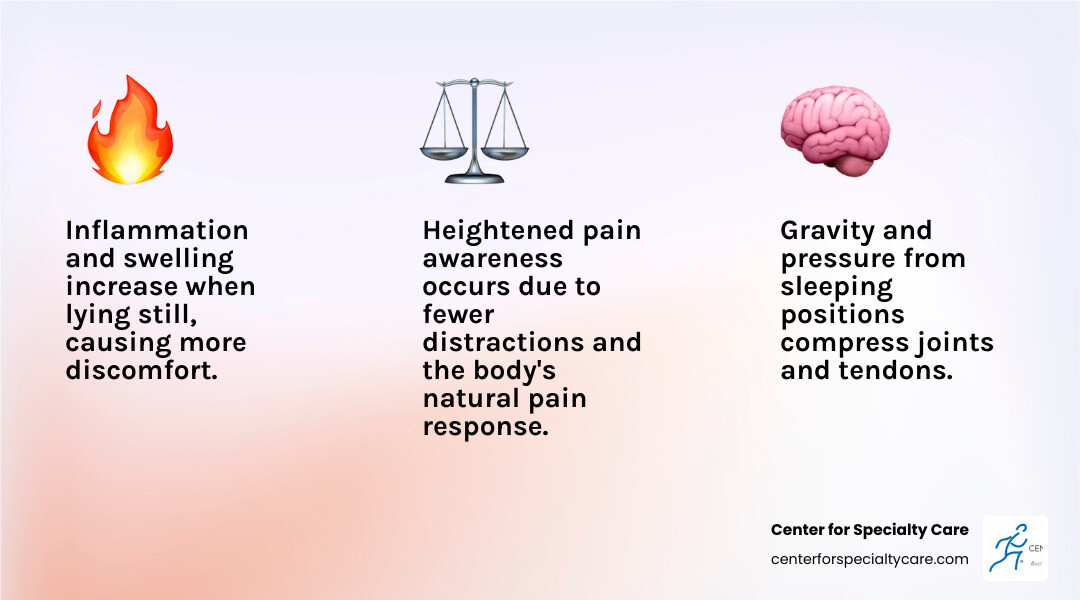
- Why it’s worse at night: A combination of factors is at play. When you lie down, inflammation can settle in the joint, gravity pulls on damaged tendons, and the lack of daytime distractions makes your brain more aware of the pain signals.
- When to see a doctor: If your pain persists for more than two weeks, is accompanied by weakness, or disrupts your sleep every single night, it’s time to seek professional medical advice.
The frustration is real and widespread. As one orthopedic specialist notes: “One very common complaint I hear from patients with shoulder problems is ‘doc my shoulder pain wakes me up at night’.” You constantly shift positions hoping for a moment of relief, but the deep, nagging discomfort lingers, draining your energy and affecting your mood and daily activities.
The good news? Most nighttime shoulder pain has identifiable causes and can be managed with effective solutions. Understanding why your shoulder hurts more at night is the crucial first step toward finding lasting relief and getting the restful sleep you deserve.
I’m Dr. Corey Welchlin, a board-certified orthopedic surgeon with over three decades of experience treating shoulder pain at night and other musculoskeletal conditions at the Center for Specialty Care in Fairmont, Minnesota. Throughout my career, I’ve helped thousands of patients in Minnesota and Iowa overcome nighttime shoulder pain through both conservative treatments and, when necessary, advanced surgical techniques, always with a focus on personalized care.
Why Does Shoulder Pain Get Worse at Night?
If you’ve ever wondered why your shoulder seems to save its worst behavior for bedtime, you’re not alone. Shoulder pain at night has a frustrating way of turning what should be peaceful rest into hours of uncomfortable tossing and turning. There’s a clear physiological reason for this nightly spike in pain.
The truth is, several factors conspire to make your shoulder pain more noticeable and intense at night. During your busy day, your mind is occupied with work, family, and daily tasks. This natural distraction acts as a filter, helping your brain tune out low-level pain signals. But when you finally settle into a quiet, dark room, those distractions vanish. Your brain is no longer preoccupied, allowing the pain signals from your shoulder to take center stage and feel much more prominent.
Research confirms that shoulder pain is a common problem, affecting millions of people who find their symptoms worsen dramatically once they lie down. The combination of reduced blood flow, the pooling of inflammatory fluid, and direct pressure from lying in one position creates the perfect storm for nighttime discomfort. To better understand the various conditions that might be causing your pain, you can explore more info about shoulder conditions.
The Role of Inflammation and Gravity
Your shoulder works hard all day, and this activity can trigger your body’s natural inflammatory response to repair microscopic damage. During the day, your movement and circulation help keep inflammatory fluids moving, preventing them from concentrating in one spot.
But at night, the situation changes. When you lie still for hours, your circulatory system slows. This allows inflammatory fluids, rich in substances like cytokines, to accumulate in the injured shoulder tissues instead of being flushed out. This pooling of fluid increases pressure within the joint capsule, compressing sensitive nerve endings and turning a dull ache into a sharp, throbbing pain.
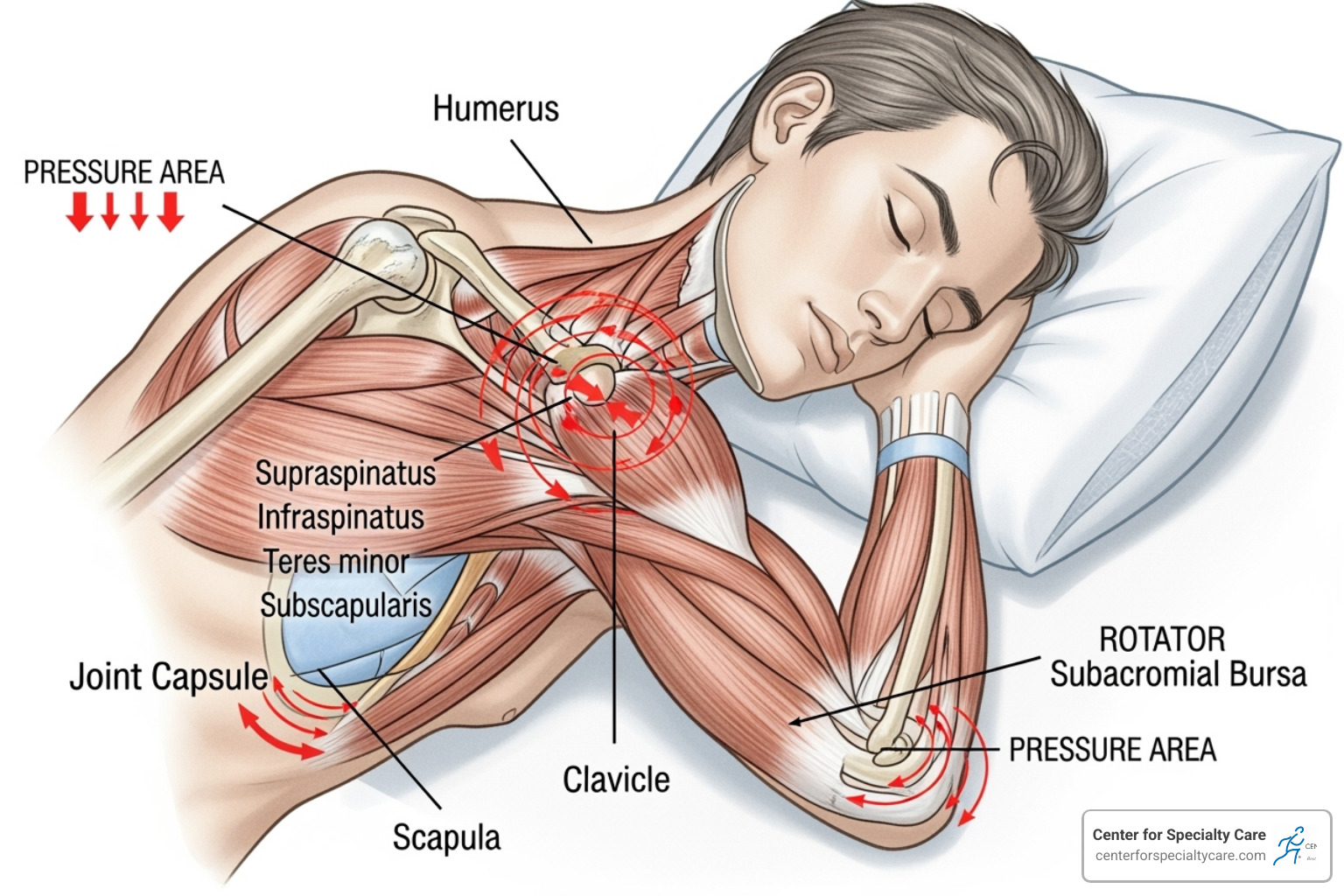
Gravity also becomes a nighttime adversary. When you’re standing or sitting, gravity’s pull is aligned with your body, distributing pressure more evenly across the shoulder joint. However, lying down alters this dynamic. If you have an injured supraspinatus tendon (a common part of the rotator cuff), gravity can pull your arm downward, tugging on the already compromised tendon and compressing the joint space, which leads to increased pain.
How Sleeping Position Affects Your Shoulder
Your preferred sleeping position can be the difference between a restful night and one filled with pain. Side sleeping is often the biggest culprit, especially if you lie directly on your affected shoulder. This position places hours of sustained, direct pressure on your shoulder joint, compressing the bursa (a fluid-filled sac that cushions the joint) and aggravating inflamed tendons.
Even sleeping on your unaffected side can cause problems. Without proper support, your painful arm can fall forward across your body, placing the shoulder in a state of internal rotation and stretching the posterior capsule. This sustained, awkward posture can strain the rotator cuff and worsen conditions like bursitis or shoulder impingement.
Back sleeping with your arm positioned overhead might feel relieving at first, but this position can stretch and strain your rotator cuff tendons and joint capsule throughout the night. Stomach sleeping is perhaps the worst position, as it forces you to twist your neck to one side. This misaligns your spine and creates significant muscle tension that can radiate from your neck into your shoulder, compounding the problem.
Understanding how these positions impact your shoulder is key to finding relief. For more detailed information about shoulder discomfort and related symptoms, you might find our guide on shoulder clicking and pain: causes, effective relief particularly helpful.
Common Culprits Behind Nighttime Shoulder Pain
Many factors can contribute to shoulder pain at night, ranging from simple overuse from a weekend project to more complex anatomical issues that develop over time. Whether it’s a sudden traumatic injury or the gradual wear and tear that comes with age, understanding the underlying cause is crucial for finding the most effective treatment. We often see patients who have experienced shoulder pain after a car accident, which can also be a significant cause of discomfort and requires specific recovery strategies.
Common Causes of Shoulder Pain at Night
Let’s dig into the most frequent reasons your shoulder might be keeping you awake:
- Rotator Cuff Injuries: The rotator cuff is a critical group of four muscles and their tendons that form a “cuff” around the shoulder joint, providing stability and allowing you to lift and rotate your arm. Injuries can range from inflammation (tendinitis) to partial or full-thickness tears. The pain is often a deep, dull ache that worsens when you lie on the affected side, as this compresses the injured tissue. At night, gravity can also pull on the tendon, increasing tension and pain.
- Tendinopathy (Tendinitis): This term describes the inflammation or, more commonly, the degeneration (tendinosis) of a tendon from overuse or repetitive motions. In the shoulder, this frequently affects the rotator cuff or biceps tendon. As we age, tendons lose some elasticity and blood supply, making them more prone to injury. The pain can be sharp with movement but often settles into a persistent dull ache at rest, which intensifies at night as inflammatory fluids pool and blood flow decreases.
- Bursitis: Bursae are small, fluid-filled sacs that act as cushions between bones and soft tissues, reducing friction. The subacromial bursa, located on the top of the shoulder, is the one most commonly affected. When it becomes inflamed (bursitis), it swells with fluid. Lying on that shoulder at night creates direct, intense pressure on this swollen sac, often causing a sharp, searing pain that makes sleep impossible. Patients often describe this as a “hot knife” sensation.
- Shoulder Impingement: This syndrome occurs when the space between the top of your arm bone (humerus) and the bone at the top of your shoulder (acromion) narrows. This narrowing can cause the rotator cuff tendons and the bursa to get pinched or “impinged,” especially when you lift your arm. Lying on the affected side can worsen this by mechanically reducing the space even further, leading to increased irritation and pain throughout the night.
Here’s a quick comparison of these common shoulder conditions:
| Condition | Primary Symptom | Affected Tissue(s) | Nighttime Pain Factor |
|---|---|---|---|
| Bursitis | Sharp, localized pain, especially with direct pressure. | Bursa (fluid-filled sac). | Direct compression from lying on the shoulder, squeezing the inflamed sac. |
| Tendinopathy | A dull ache that can become sharp with movement. | Tendon tissue (e.g., rotator cuff, biceps). | Pooling of inflammatory fluids and reduced blood flow when lying still. |
| Rotator Cuff Tear | Pain combined with noticeable weakness, especially when lifting the arm. | A tear in one or more rotator cuff tendons. | Gravity pulling on the arm, direct pressure, and inflammation. |