

Pain, Be Gone! Navigating Your Journey to Chronic Pain Solutions
February 17, 2026
Intracept Explained: Targeting Back Pain at its Source
February 19, 2026
Rotator Cuff Pain Sleeping Position: Top 3 Relief
Why Your Shoulder Wakes You Up at Night (And What You Can Do About It)
Rotator cuff pain sleeping position matters more than you might think. If you’ve been tossing and turning, searching for a comfortable way to rest your aching shoulder, you’re not alone. The good news? A few simple adjustments can make a world of difference.
Quick Answer: Best Sleeping Positions for Rotator Cuff Pain
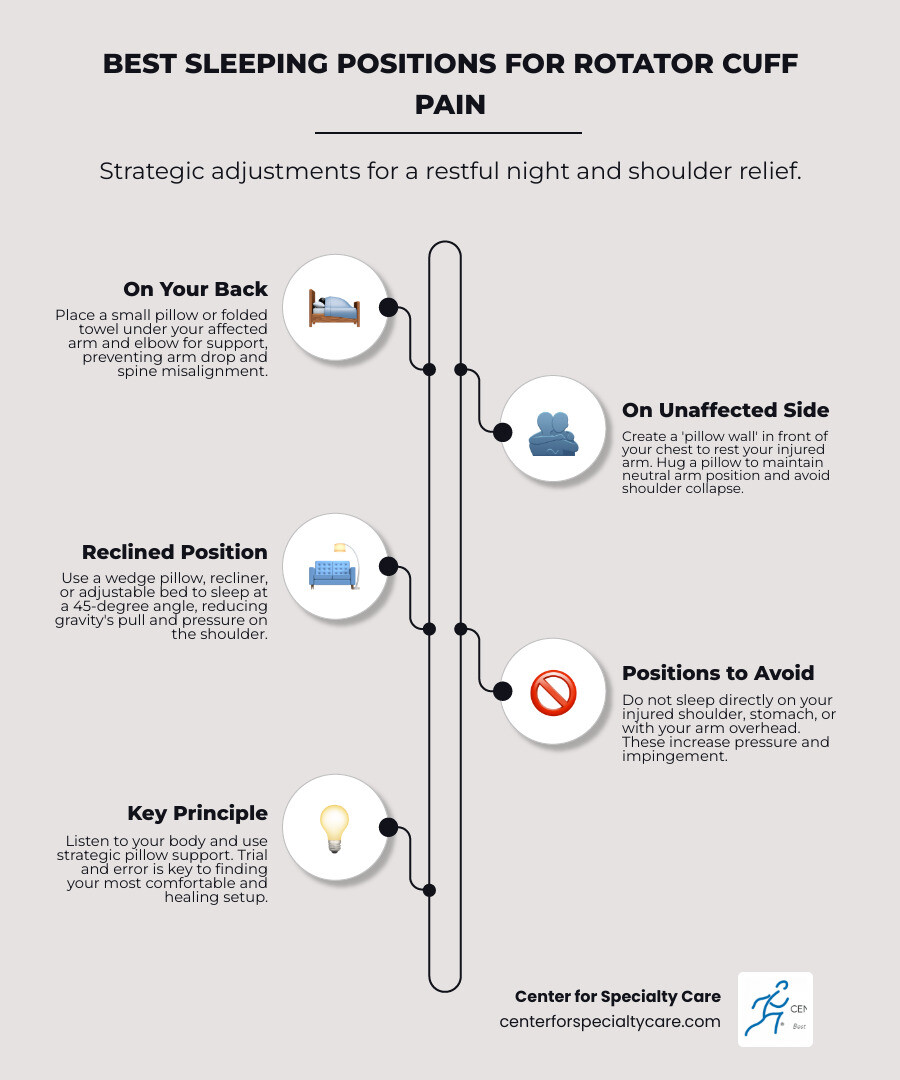
- On your back – Place a small pillow or folded towel under your affected arm and elbow to keep it supported
- On your unaffected side – Create a “pillow wall” in front of your chest to rest your injured arm on
- Reclined position – Use a wedge pillow, recliner, or adjustable bed to sleep at a 45-degree angle
Avoid: Sleeping on your injured shoulder, stomach sleeping, or placing your arm overhead.
Beware the night. If you’ve injured your shoulder, that familiar phrase probably sends a shiver down your spine. Research shows that nearly 90% of people with rotator cuff problems are side sleepers, and many report that their pain intensifies dramatically after the sun goes down. You’re not imagining it—lying down really does make shoulder pain worse.
When you settle into bed, gravity shifts. Blood flow changes. Your shoulder joint experiences different pressures than during the day. And without the distractions of daily life, that nagging ache becomes impossible to ignore. Studies confirm that individuals with rotator cuff tears experience greater sleep disturbances, poorer sleep quality, shorter sleep duration, and frequent awakenings compared to those without shoulder problems.
But here’s the encouraging part: the right rotator cuff pain sleeping position can dramatically reduce your nighttime discomfort. You don’t need expensive equipment or complicated routines. Often, strategic pillow placement and a few position adjustments are enough to transform your nights from restless to restful.
This guide walks you through exactly how to sleep when your shoulder hurts. You’ll learn which positions put the least stress on your rotator cuff, how to support your arm properly, and what simple strategies can ease pain before bed. We’ll also cover when shoulder pain signals something more serious that needs professional attention.
I’m Dr. Corey Welchlin, a board-certified orthopedic surgeon who has specialized in shoulder repairs—including rotator cuff reconstruction—for over 30 years in southern Minnesota. Throughout my career, I’ve helped thousands of patients find relief from nighttime shoulder pain by addressing their rotator cuff pain sleeping position alongside comprehensive treatment plans.
Relevant articles related to rotator cuff pain sleeping position:
Understanding Your Shoulder and Why It Hurts at Night
Before we dive into how to sleep better, let’s take a moment to understand what the rotator cuff is and why it’s so prone to causing trouble, especially when you’re trying to catch some Z’s. Your shoulder is a complex and highly mobile joint, and the rotator cuff plays a crucial role in its function. For more comprehensive information on joint care, you can always refer to our resources on Orthopedics.
What is the Rotator Cuff?
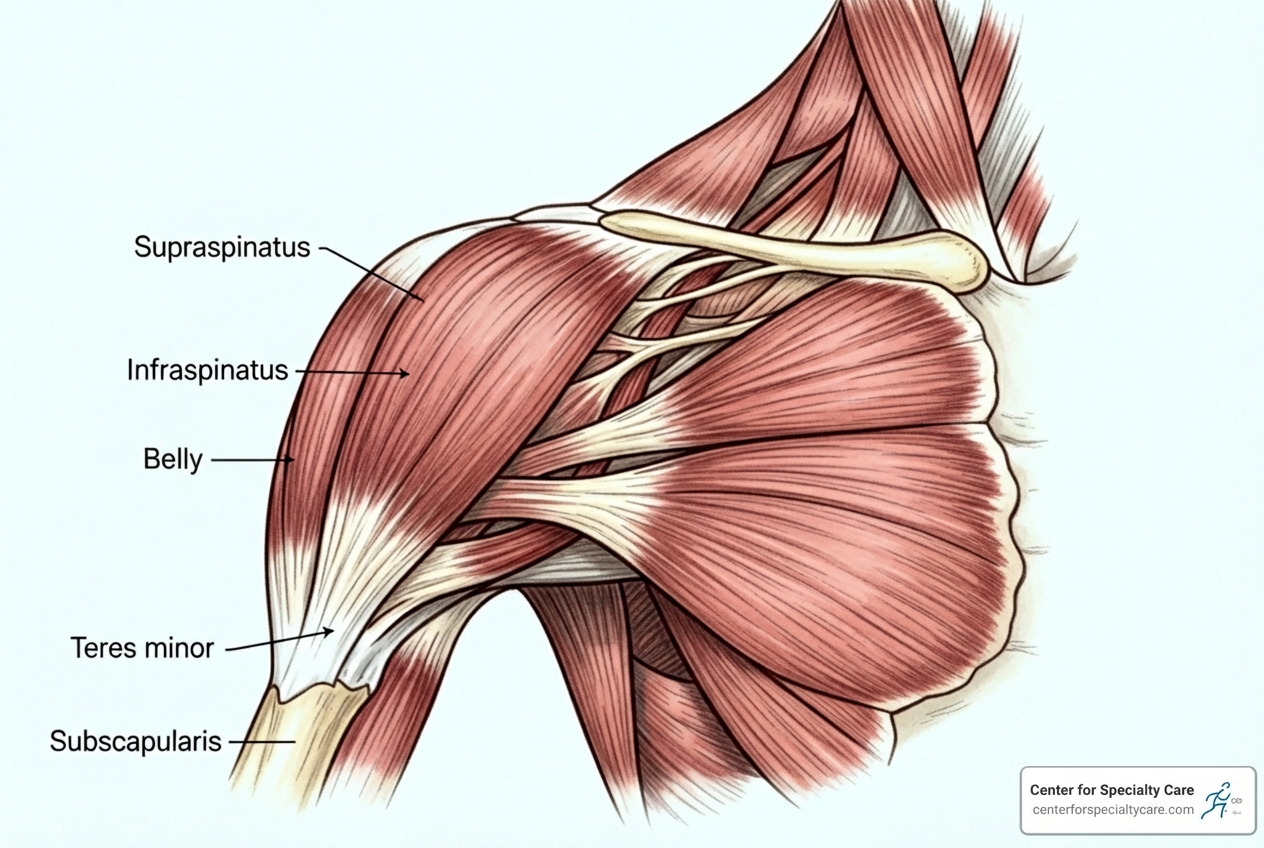
The rotator cuff isn’t just one muscle; it’s a group of four muscles and their corresponding tendons that surround the shoulder joint. Think of it as a protective and stabilizing sleeve. These four muscles are:
- Supraspinatus: Helps lift your arm out to the side.
- Infraspinatus: Assists in rotating your arm outward.
- Teres Minor: Also helps with outward rotation of the arm.
- Subscapularis: Aids in rotating your arm inward.
Together, these muscles and tendons work in harmony to keep the head of your upper arm bone (humerus) firmly centered in the shallow socket of your shoulder blade (scapula). This intricate design allows for an incredible range of motion, from reaching overhead to throwing a ball, but it also makes the rotator cuff vulnerable to injury.
Common Causes of Rotator Cuff Pain
Rotator cuff pain can stem from various issues, ranging from sudden injuries to gradual wear and tear. Understanding the cause can sometimes help us tailor our approach to pain management, including finding the best rotator cuff pain sleeping position.
Some of the most common culprits include:
- Tendinitis: This is inflammation of the rotator cuff tendons, often caused by repetitive overhead activities or overuse.
- Bursitis: The bursa is a fluid-filled sac that cushions the tendons and bones in your shoulder. When it becomes inflamed, a condition known as bursitis, it can cause significant pain and limit movement.
- Impingement Syndrome: Sometimes called “swimmer’s shoulder,” this occurs when the rotator cuff tendons get pinched between the bones of your shoulder. Bone spurs can contribute to this irritation, leading to pain and limited range of motion.
- Repetitive Strain: Activities that involve repeated overhead movements, common in sports or certain occupations, can gradually wear down the rotator cuff tendons over time.
- Acute Injury: A sudden fall, a direct blow to the shoulder, or attempting to lift something too heavy can lead to an acute rotator cuff injury, potentially resulting in a tear.
- Degenerative Tears: As we age, the blood supply to our tendons decreases, and they naturally weaken. This can lead to degenerative tears, which are more common in individuals over 50.
- Rotator Cuff Tears: A tear happens when a tendon connecting your shoulder muscle to your skeletal frame pulls away from your bone. These can be partial or a complete detachment. While some tears occur due to accidents, most develop over time with repetitive movement. For more information on this, you can refer to resources on torn a rotator cuff muscle and Shoulder Joint Pain, Popping: Causes, Effective Relief.
The Nighttime Pain Puzzle: Why It’s Worse When You Lie Down
It’s a frustrating reality for many with shoulder pain: the moment your head hits the pillow, the pain seems to amplify. Why does this happen? We’ve identified several factors that contribute to this nighttime phenomenon:
- Gravity and Increased Pressure: During the day, movement helps keep blood flowing and prevents stiffness. But when you lie down, especially on the affected side, gravity can increase the pulling and tugging on an injured rotator cuff. This direct pressure can restrict blood flow and irritate already tender tissues. Studies have even shown that subacromial pressures are significantly lower in supine (back-sleeping) positions compared to side or prone (stomach-sleeping) positions, highlighting the impact of position on the shoulder.
- Reduced Blood Flow: While you sleep, your body’s metabolic rate slows down, which can affect blood circulation to the injured area. Reduced blood flow means fewer healing nutrients and oxygen reaching the tissues, potentially leading to increased pain and stiffness.
- Inflammation: Proinflammatory proteins tend to increase during sleep, which can exacerbate shoulder discomfort. This natural inflammatory response, combined with reduced movement, can make the shoulder feel much worse at night.
- Inactivity and Stiffness: Lying in one position for extended periods, especially without the natural movements that occur during waking hours, can cause the shoulder joint to become stiff. This stiffness can make any movement, even subtle shifts in position, more painful.
- Increased Pain Perception: Without the distractions of daily life—work, family, hobbies—your brain becomes more attuned to internal sensations. That nagging ache that might have been a background hum during the day can become a loud, insistent throb at night, making you more aware of the pain.
The Link Between Sleep Habits and Shoulder Health
It’s not just about managing existing pain; your sleep habits can actually contribute to rotator cuff pathology. Recent research has shed light on this connection:
- Side Sleeping Prevalence: A significant study found a strong correlation between side sleeping and rotator cuff pathology. Out of 58 subjects with rotator cuff tears, 52 (89.7%) were side sleepers. Another study noted that 83.9% of patients with rotator cuff pathology preferred the lateral decubitus (side-sleeping) position, compared to 61.3% in a control group. This suggests a strong relationship between habitually sleeping on your side and the development or worsening of rotator cuff issues.
- Subacromial Pressure: As mentioned, sleeping on your side can significantly increase subacromial pressure, which is the pressure within the space where your rotator cuff tendons reside. Prolonged pressure in this area can lead to perfusional changes within the tendons, potentially causing or aggravating tears over time.
- Sleep Disturbance and Tears: It’s well-documented that rotator cuff pathology often disrupts sleep. Individuals with full-thickness rotator cuff tears report greater sleep disturbances, poorer sleep quality, shorter sleep duration, and frequent awakenings. This creates a vicious cycle: pain disrupts sleep, and poor sleep can intensify pain and hinder healing.
- Age and Tears: The prevalence of rotator cuff tears naturally increases with age, particularly as individuals enter their sixth decade. This age-related degeneration, combined with certain sleeping patterns, can further increase vulnerability.
- Scientific Research: The scientific community is increasingly recognizing the importance of sleep position. A study titled “Rotator Cuff Tears Are Related to the Side Sleeping Position” provides compelling evidence for this connection, highlighting that prolonged pressure from side sleeping may contribute to degenerative changes in the rotator cuff.
The Best Rotator Cuff Pain Sleeping Position: A Step-by-Step Guide
Finding the ideal rotator cuff pain sleeping position is often a process of trial and error, but we can guide you toward the most effective strategies. The goal is to minimize pressure on the injured shoulder, maintain neutral alignment, and allow for proper blood flow and healing. Small adjustments with pillows can make a huge difference in reducing strain and promoting comfort.
Sleeping on Your Back: The Gold Standard
For many with rotator cuff pain, sleeping on your back is the most recommended position. This position naturally keeps pressure off the shoulder and helps maintain a neutral spine alignment.
To optimize back sleeping for shoulder pain:
- Lie Flat: Start by lying flat on your back.
- Pillow for Head: Use a comfortable pillow that supports the natural curve of your neck without elevating your head too much.
- Support the Affected Arm: This is crucial. Place a small pillow or a folded towel directly under your affected arm and elbow. The goal is to slightly lift the arm so that your elbow doesn’t drop, which can strain the shoulder. This keeps your arm in a relaxed, midline position relative to your body.
- Consider a Second Pillow: If your shoulder still feels unsupported, you can place a thin pillow or rolled towel along the side of your torso, tucking it under your affected arm for additional stability.
- Prevent Rolling: If you tend to roll onto your side during sleep, you can place pillows on either side of your body to act as barriers, keeping you comfortably on your back.

Side Sleeping: A Guide to the Best Rotator Cuff Pain Sleeping Position
While sleeping on your back is often ideal, we understand that many people are committed side sleepers. If you must sleep on your side, do so strategically to protect your rotator cuff.
Here’s how to modify side sleeping:
- Sleep on Your Unaffected Side: Always, always, always sleep on the side that doesn’t have rotator cuff pain. Sleeping directly on the injured shoulder will exacerbate pain and hinder healing.
- Create a “Pillow Wall”: Once you’re comfortably on your unaffected side, take a pillow (or even a body pillow) and place it in front of your chest. This creates a “pillow wall” where you can rest your injured arm.
- Hug a Pillow: Gently hug the pillow with your injured arm. This keeps your arm slightly bent at the elbow and liftd, preventing it from collapsing forward or backward, which could strain the shoulder. The pillow helps maintain a neutral and supported position.
- Pillow Between Knees: To further align your spine and reduce rotational stress that could affect your shoulder, place a pillow between your knees.
- Avoid Shoulder Collapse: Ensure the pillow you’re hugging is firm enough to prevent your injured shoulder from dropping or rolling forward onto the mattress. The goal is to keep it relaxed and supported, not compressed.
The Reclined Position: Your Secret Weapon
For some, especially after an acute injury or surgery, lying completely flat can be too painful. In these cases, a reclined position can be a game-changer. This position uses gravity to your advantage, taking pressure off the shoulder.
- Recliner Chair: Sleeping in a recliner is often very comfortable for individuals with shoulder pain. The semi-upright posture reduces the gravitational pull on the shoulder joint.
- Adjustable Bed: If you have an adjustable bed, elevating the head of the bed to a 45-degree angle can provide similar relief.
- Wedge Pillow: If you don’t have a recliner or adjustable bed, a large wedge pillow can be placed under your upper body in your regular bed. This lifts your head and torso, creating an inclined sleeping surface that mimics a recliner.
- Propped Up with Pillows: While less stable than a wedge pillow or recliner, you can also prop yourself up with several regular pillows. Just ensure they provide firm and consistent support to prevent sagging and maintain the inclined position throughout the night.
The reclined position is particularly beneficial for post-surgery recovery, as it helps prevent accidental rolling and keeps the shoulder in a stable, protected position.
Positions to Avoid at All Costs
Just as there are beneficial sleeping positions, there are others that can significantly worsen your rotator cuff pain and impede healing. If you currently sleep in any of these ways, we strongly recommend making a conscious effort to change.
- Sleeping Directly on the Affected Shoulder: This is perhaps the worst rotator cuff pain sleeping position. It puts direct, prolonged pressure on the injured tendons and bursa, compressing them and restricting blood flow. This can lead to increased inflammation, pain, and further damage.
- Stomach Sleeping: While stomach sleeping doesn’t put direct pressure on the shoulder, it often forces your head and neck to be turned to one side for extended periods. This can create tension in your neck and upper back, which can refer pain to your shoulders. Additionally, stomach sleepers often place their arms in awkward positions, such as overhead or under the pillow, which can strain the rotator cuff.
- Sleeping with Your Arm Overhead: Whether on your back or side, sleeping with your arm stretched above your head can compress the rotator cuff tendons and nerves in the shoulder. This position can lead to impingement and increased pain.
- Arm Under Pillow: Tucking your arm under your pillow, common for side and stomach sleepers, puts the shoulder in an unnatural and strained position.
- Awkward Angles: Any position that causes your shoulder to feel twisted, stretched, or crunched should be avoided. Listen to your body; if a position feels uncomfortable, it’s likely causing undue stress on your rotator cuff.
Beyond Positioning: More Strategies for Nightly Relief
While finding the best rotator cuff pain sleeping position is paramount, it’s just one piece of the puzzle. A holistic approach to managing nighttime pain involves several other strategies that can complement your positional adjustments. We’ve compiled expert tips for better sleep in our guide How to Relieve Rotator Cuff Pain at Night: Expert Tips for Better Sleep.
Hot and Cold Therapy: Your Pre-Bedtime Ritual
Applying heat or cold to your shoulder before bed can significantly reduce pain and inflammation, helping you relax and fall asleep more easily. The choice between hot and cold often depends on the nature of your pain.
| Therapy | When to Use | Benefits