
How Foot Pads for Flat Feet Can Save Your Soles
June 9, 2026
Getting Knots Out of Your Shoulder: A Step-by-Step Stretching Guide
June 11, 2026
Rhomboid Muscle Pain: Is a Spinal Cord Stimulator Right for You?
When Rhomboid Pain Won’t Go Away: Could a Spinal Cord Stimulator Help?
A rhomboid muscle pain spinal cord stimulator may be worth considering if your upper-back pain has lasted months, failed conservative treatment, and has a nerve-related component — but it is not a first-line solution for most people.
Quick answer: Is SCS right for your rhomboid pain?
| Your Situation | Likely Next Step |
|---|---|
| Pain started recently (weeks) | Rest, heat/ice, stretching, physical therapy |
| Pain lasting 1–3 months | Physical therapy, posture correction, trigger point care |
| Pain lasting 3+ months, not improving | Specialist evaluation, diagnostic nerve blocks |
| Nerve-mediated pain, failed injections and PT | SCS trial may be appropriate |
| Active infection, untreated depression, or unclear diagnosis | SCS is not yet appropriate |
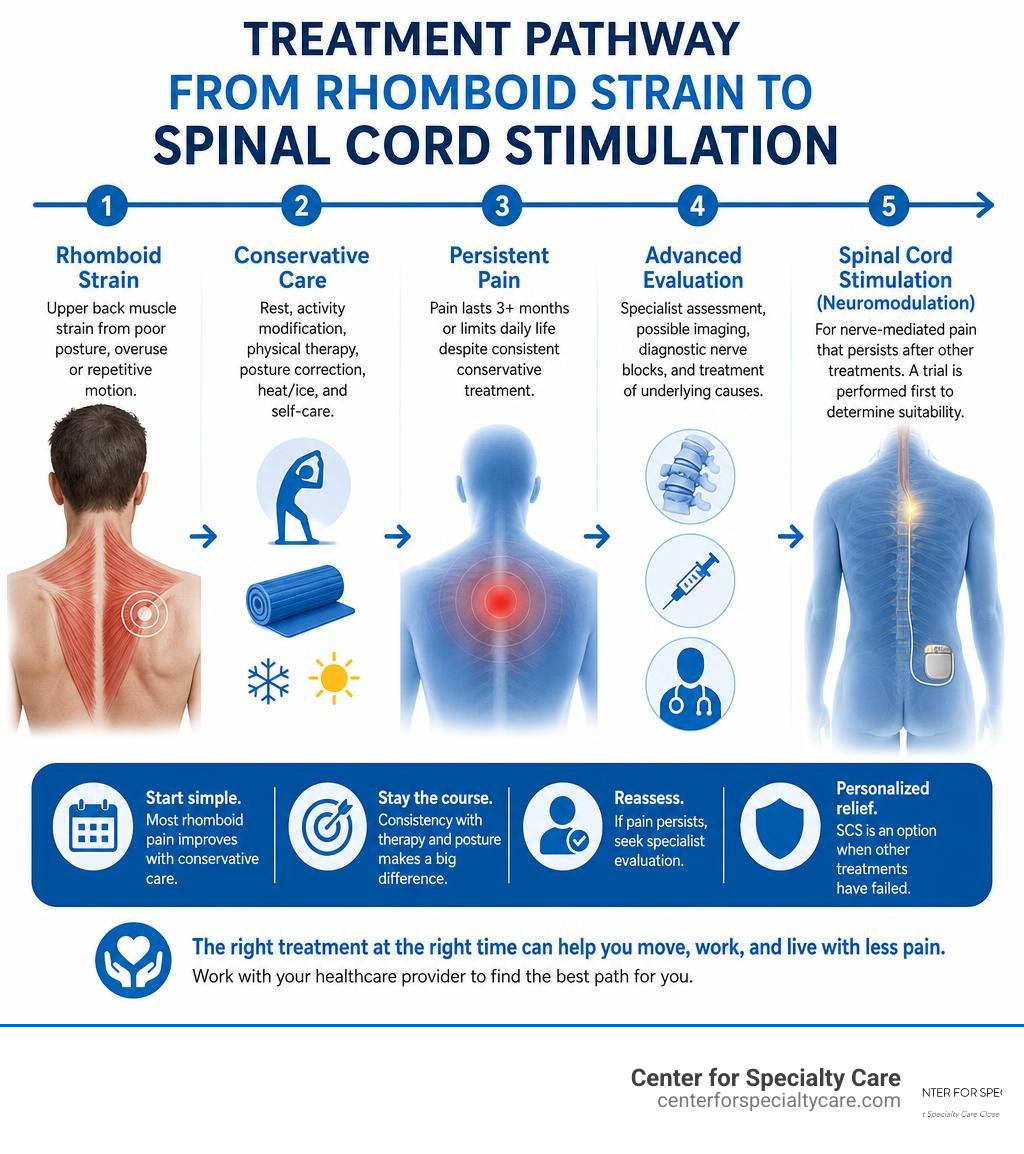
Most rhomboid pain responds well to conservative care. The upper-back muscles between your shoulder blades are often strained by poor posture, desk work, or repetitive motion — and those causes are very treatable without advanced procedures.
But for a smaller group of patients — those with refractory, nerve-driven pain that hasn’t improved after months of proper treatment — spinal cord stimulation (SCS) can offer meaningful, lasting relief.
This guide walks you through everything you need to know to make that decision clearly and confidently.
I’m Dr. Corey Welchlin, a board-certified orthopedic surgeon and founder of the Center for Specialty Care in Fairmont, Minnesota, with over 30 years of experience treating complex musculoskeletal and chronic pain conditions — including patients exploring rhomboid muscle pain spinal cord stimulator options after other treatments have fallen short. My goal here is to give you an honest, evidence-based look at when SCS makes sense, when it doesn’t, and what your full range of options really looks like.
What Rhomboid Muscle Pain Is – and Why It Can Become Chronic
Your rhomboid muscles sit in the upper back between your spine and shoulder blade. You have a rhomboid major and rhomboid minor on each side. Their job is to help pull the shoulder blade toward the spine, stabilize the scapula, and support smooth shoulder movement.
When these muscles are strained, overloaded, irritated, or affected by nearby nerves, pain can show up between the shoulder blade and spine. Many people describe it as a deep ache, knot, burning spot, or “stuck” feeling under the shoulder blade.
Rhomboid pain often overlaps with broader chronic upper-back pain syndromes, including:
- Myofascial pain syndrome
- Thoracic spine joint irritation
- Scapular dyskinesis, or poor shoulder blade mechanics
- Trigger point pain
- Thoracic radicular pain
- Dorsal scapular nerve irritation
- Postural overload from desk work or repetitive tasks
For a deeper overview of causes and early treatment, see our guide to rhomboid muscle pain.
Common Symptoms That Feel Like “Rhomboid Pain”
Rhomboid-region pain does not always come from the rhomboid muscle itself. Nearby joints, nerves, ribs, and fascia can all refer pain to the same area. Common symptoms include:
- Pain between the shoulder blade and spine
- Tenderness along the inner border of the shoulder blade
- Tight bands or trigger points
- A knot that feels like it will not release
- Burning, tingling, or electric pain
- Reduced shoulder or neck range of motion
- Pain with deep breathing
- Pain that radiates around the chest wall or into the shoulder
- Weakness or fatigue with posture
- Popping, grinding, or catching near the shoulder blade
If your main issue is a stubborn knot, our article on a knot in rhomboid explains why those trigger points can be so persistent.
Why Some Rhomboid Pain Does Not Go Away
Most rhomboid strains improve with time and proper care. When pain keeps coming back, we look for reasons the tissue is not calming down.
Common reasons include:
- Poor posture that keeps the rhomboids on constant stretch
- Muscle imbalance between the chest, neck, shoulder, and upper back
- Repetitive overhead work or pulling motions
- Thoracic joint stiffness
- Rib irritation
- Dorsal scapular nerve irritation
- Intercostal nerve irritation
- Scar tissue after injury
- Chronic myofascial trigger points
- Central sensitization, where the nervous system becomes overprotective
- A neuropathic component, meaning the pain is driven partly by nerve signaling
This is where diagnosis matters. If the pain is mostly mechanical or muscular, rehabilitation is usually the priority. If the pain is nerve-mediated and refractory, advanced options may enter the conversation.
First-Line Treatments Before Advanced Procedures
Before we consider spinal cord stimulation, we usually want to see that appropriate conservative and intermediate treatments have been tried.
These may include:
- Rest and activity modification
- Ice early after injury, then heat for tightness
- Anti-inflammatory medicines when medically appropriate
- Physical therapy
- Posture correction
- Thoracic mobility work
- Shoulder blade strengthening
- Massage or myofascial release
- Trigger point injections
- Nerve blocks
- Rhomboid intercostal block
- Medication optimization
- Pain psychology or stress management when chronic pain has affected sleep, mood, and function
Research on ultrasound-guided rhomboid intercostal block for myofascial pain found meaningful short-term improvement: median pain scores decreased from 5 to 2 over 6 weeks, and most patients reported satisfaction with treatment. That does not mean every patient needs a block, but it shows why targeted, less invasive treatments often come before SCS.
For movement-based care, see our guide to rhomboid pain relief exercises that actually work.
When a Rhomboid Muscle Pain Spinal Cord Stimulator May Be Considered
Spinal cord stimulation is an advanced neuromodulation therapy used for selected chronic pain conditions, especially chronic neuropathic pain. It involves placing small leads in the epidural space near the spinal cord. These leads deliver controlled electrical pulses that modify pain signaling before it reaches the brain.
A rhomboid muscle pain spinal cord stimulator may be considered when:
- Pain has lasted longer than expected, often 3 to 6 months or more
- Conservative care has been properly attempted
- Injections or blocks have not provided lasting relief
- Pain has nerve-like features, such as burning, tingling, shooting, or electric sensations
- Function is significantly limited
- Imaging and exam support a diagnosis that may respond to neuromodulation
- A temporary SCS trial provides meaningful benefit
For a clinical overview, see Spinal Cord Stimulation – StatPearls.
How Spinal Cord Stimulation Works
Traditional SCS targets the dorsal columns of the spinal cord. One explanation is the “gate control” theory: stimulation of large A-beta nerve fibers can reduce transmission of pain signals carried by smaller pain fibers.
Modern SCS is more flexible than early systems. Depending on the device and programming, it may use:
- Paresthesia-based stimulation, where patients feel a gentle tingling over the painful area
- Sub-perception stimulation, where patients do not feel the stimulation
- Burst stimulation
- High-frequency stimulation
- Differential target multiplexed stimulation
- Closed-loop systems that adjust output based on physiologic feedback
The goal is not to “fix” a torn muscle. The goal is to calm pain signaling enough that you can sleep, move, work, and participate in rehabilitation with less pain.
Why SCS Is Not Usually the First Treatment for Rhomboid Pain
Most rhomboid pain is not a spinal cord stimulator problem. It is a posture, strength, mobility, tissue irritation, or trigger point problem.
SCS is not usually first-line because:
- Muscle strains often heal without implants
- Myofascial pain may respond to physical therapy or injections
- Mechanical pain should be treated mechanically
- Diagnosis must be clear before implanting a device
- SCS requires maintenance, programming, and follow-up
- Implantation has risks, even when performed carefully
- Expectations must be realistic
If pain is chronic and complex, we may combine several options as part of a chronic pain treatment plan.
Rhomboid Muscle Pain Spinal Cord Stimulator Trial: What Success Looks Like
A trial is one of the most important safety checks. Temporary leads are placed, connected to an external stimulator, and tested for several days. You go home and track how you feel during normal activities.
A successful trial often includes:
- At least 50% pain reduction, or
- At least 50% functional improvement
- Better sleep
- Better tolerance for walking, sitting, reaching, or working
- Reduced reliance on pain medication when appropriate
- Stimulation that feels comfortable or is not felt at all
- Coverage of the painful region
Consensus guidelines recommend trial stimulation before permanent implantation for most chronic non-cancer pain indications. You can read the evidence-based SCS trial guidelines.
Who Is a Good Candidate – and Who Should Avoid SCS
Good outcomes start with careful patient selection. At Center for Specialty Care, we evaluate the diagnosis, prior treatment, imaging, nerve involvement, function, medical history, and goals before discussing SCS.
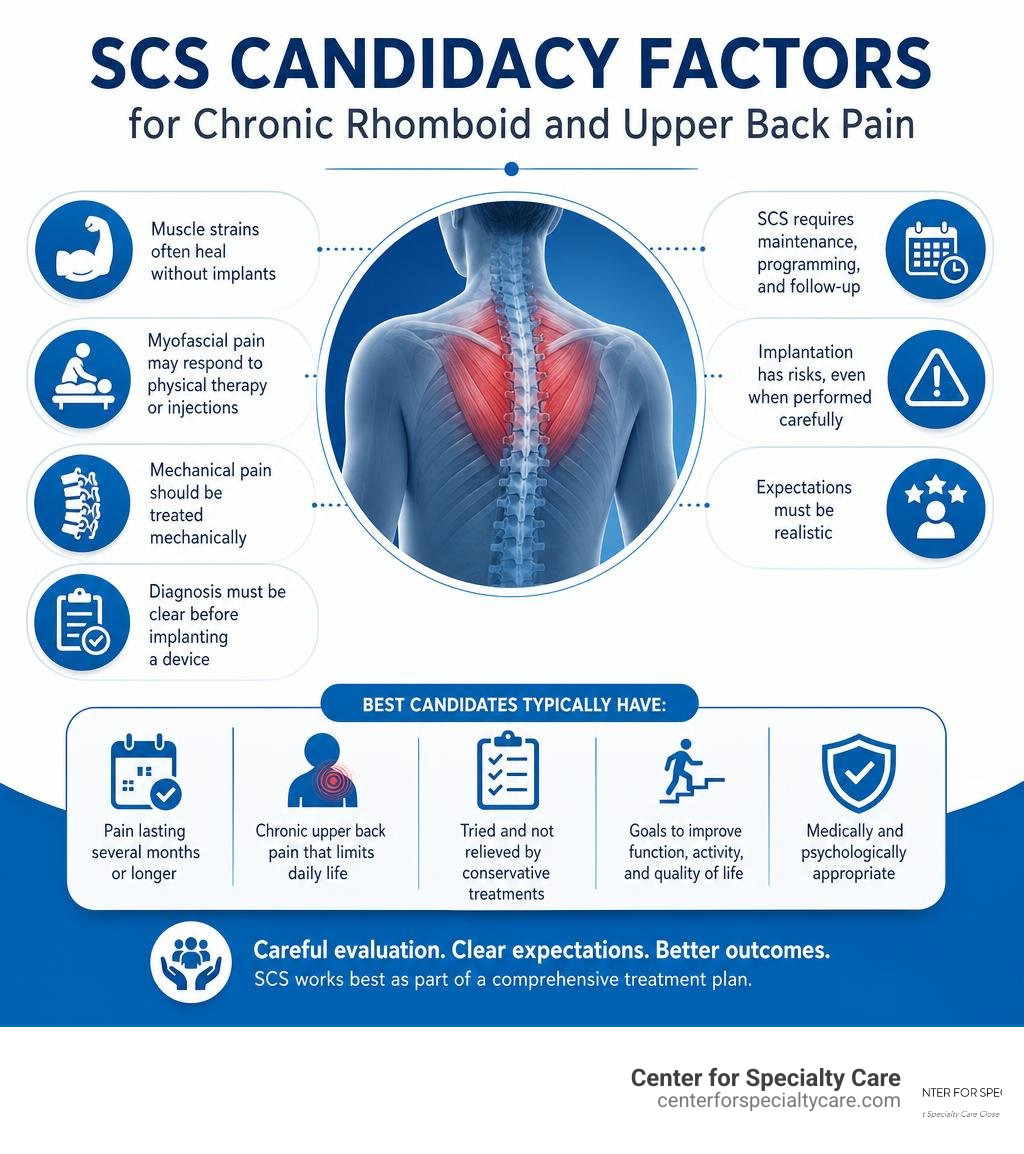
Rhomboid Muscle Pain Spinal Cord Stimulator Candidacy Checklist
You may be a possible candidate if you have:
- Pain lasting several months or longer
- Failed appropriate conservative care
- Persistent functional limitation
- Burning, shooting, tingling, or nerve-like pain
- Suspected dorsal scapular, intercostal, thoracic radicular, or post-injury nerve pain
- Diagnostic blocks suggesting nerve-mediated pain
- Thoracic imaging when needed
- No active infection
- Safe medication and anticoagulation status
- Psychological readiness and realistic expectations
- Ability to operate and charge the device if needed
- A successful temporary trial
For broader care options, visit our page on comprehensive pain treatment.
Main Indications for SCS in Upper-Back or Thoracic Pain
SCS has stronger evidence for certain chronic pain conditions than for isolated rhomboid muscle pain. For upper-back or thoracic-region symptoms, we consider SCS most carefully when the pain resembles conditions already known to respond to neuromodulation, such as:
- Refractory neuropathic pain
- Persistent spine pain syndrome after surgery
- Thoracic radicular pain
- Complex regional pain syndrome
- Peripheral neuropathy
- Post-surgical nerve pain
- Nerve-mediated rhomboid-region pain after failed less invasive care
The key phrase is “nerve-mediated.” A sore muscle from slouching over a laptop is not the same as chronic neuropathic pain. Your back should not need a battery just because your desk chair is winning the war.
Contraindications and Reasons to Delay Implantation
SCS may be unsafe or inappropriate in certain situations, including:
- Active infection
- Uncontrolled bleeding disorder
- Unsafe anticoagulation status
- Severe untreated depression
- Uncontrolled anxiety
- Untreated substance misuse
- Unstable medical conditions
- Pregnancy-related concerns
- Inability to manage the device
- Unrealistic expectations
- Unclear pain diagnosis
- Pain unlikely to respond to neuromodulation
Psychological screening is not a judgment. It is a safety step. Depression, anxiety, trauma, and chronic pain often overlap, and treating the whole person improves outcomes.
What Happens During SCS Lead Placement: Awake, Sedated, or General Anesthesia?
SCS treatment usually has two stages: a trial and, if successful, a permanent implant.
During placement, leads are positioned in the epidural space using imaging guidance, often fluoroscopy. The leads connect to an implantable pulse generator, usually placed under the skin. For thoracic or upper-back pain, lead targeting depends on the pain pattern and the spinal levels involved.
General Anesthesia vs Awake/Sedation Techniques
SCS lead placement has historically been done with the patient awake or lightly sedated so they can report where they feel stimulation. Newer mapping techniques allow some implants to be performed under general anesthesia while still checking lead position physiologically.
| Approach | Advantages | Disadvantages |
|---|---|---|
| Awake or light sedation | Patient can describe coverage; useful for paresthesia mapping | Discomfort, anxiety, movement risk, limited tolerance in prone position |
| General anesthesia | More comfort; no need for patient feedback; may reduce movement | Requires neuromonitoring; patient cannot describe sensations during placement |
| Sedation | Middle ground for comfort and feedback | Too much sedation can make feedback unreliable and airway management harder |
Awake mapping can be helpful, but patient responses may be affected by pain, anxiety, sedation level, and positioning. General anesthesia can improve comfort, but accuracy depends on imaging and neurophysiological mapping.
How CMAPs Help Guide Lead Placement Under General Anesthesia
CMAP stands for compound muscle action potential. During SCS placement under general anesthesia, the surgical team can stimulate the lead and record muscle responses using EMG.
For thoracic mapping, muscles may include:
- Rhomboid or nearby paraspinal muscles
- Trapezius
- Erector spinae
- Rectus abdominis
- Lower-extremity muscles depending on lead level
CMAP mapping helps identify:
- Physiologic midline
- Left-right lead position
- Whether stimulation is favoring one side
- Whether the lead should be adjusted
Research on neuromonitoring for SCS lead placement has reported EMG lateralization success rates around 89% to 93.5%, higher than some SSEP collision techniques. Studies also suggest that neurophysiologic assessment may add only a small amount of time while improving confidence in lead positioning.
How SSEP Collision Mapping Improves Accuracy
SSEP stands for somatosensory evoked potential. SSEP collision mapping tests sensory pathway activity in the dorsal columns. By seeing how stimulation interacts with sensory signals, the team can estimate whether the lead is centered and balanced.
SSEP collision mapping can be useful as an adjunct, especially when EMG responses are unclear. It may help with:
- Side-to-side balance
- Dorsal column targeting
- Reduced reliance on patient feedback
- Neuroprotection during placement
It is not perfect. Reported success rates for lateralization are often lower than CMAP mapping, but using both tools can improve decision-making.
Why Physiologic Mapping Matters for Rhomboid-Region Pain
Anatomic midline and physiologic midline are not always identical. In some patients, the spinal cord may sit slightly off-center within the canal. That matters when we are trying to cover a focal pain area like the rhomboid region.
Accurate mapping can help:
- Improve overlap between stimulation and painful areas
- Reduce unwanted stimulation
- Guide lead steering
- Decrease the need for repositioning
- Improve long-term programming flexibility
High-resolution thoracic mapping research suggests that intraoperative neuromonitoring can help define physiologic midline and improve targeting. See the study on high-resolution thoracic SCS mapping research.
Evidence, Benefits, Risks, and Alternatives to SCS for Rhomboid-Region Pain
The evidence for SCS is strongest in chronic neuropathic pain conditions, persistent spine pain, complex regional pain syndrome, and certain refractory pain syndromes. Evidence for isolated rhomboid muscle pain is limited, so careful diagnosis is essential.
What Research Says About SCS for Similar Chronic Pain Syndromes
Although rhomboid-specific SCS trials are limited, related chronic pain studies show why SCS may be considered when pain is refractory and nerve-mediated.
In a randomized trial of differential target multiplexed SCS for chronic refractory axial low back pain, responder rates were significantly higher for DTM SCS than conventional SCS at the 3-month endpoint, with benefits sustained through 12 months. Read the DTM SCS randomized trial.
The COMBO randomized trial found that combination SCS therapy achieved an 88% responder rate at 3 months versus 71% with monotherapy, with responder rates remaining high at 1 and 2 years. See the COMBO SCS randomized trial.
For failed back surgery syndrome with predominant back pain, multicolumn SCS plus optimized medical management has shown improvements in pain, disability, and quality of life in selected patients. See the study on multicolumn spinal cord stimulation.
These studies do not prove that SCS works for every rhomboid pain case. They show that neuromodulation can help selected chronic pain patients when the mechanism fits.
What We Know Specifically About Rhomboid or Thoracic Myofascial Pain
For rhomboid-region pain, the evidence is more limited and often includes smaller studies, case reports, or extrapolation from related thoracic pain syndromes.
What we do know:
- Myofascial rhomboid pain often responds to trigger point care, physical therapy, or fascial plane blocks.
- Ultrasound-guided rhomboid intercostal block has shown short-term improvement in thoracic myofascial pain.
- Peripheral nerve stimulation may help selected cases involving damaged peripheral nerves, such as dorsal scapular or intercostal nerve pain.
- SCS may be considered when pain is chronic, refractory, and nerve-mediated, especially if less invasive options fail.
This is why we do not jump straight to an implant. We match treatment to the pain generator.
Potential Benefits of SCS
For the right patient, SCS may offer:
- Meaningful pain reduction
- Better function
- Improved sleep
- Less reliance on pain medication
- A reversible therapy
- A trial before permanent implantation
- Adjustable programming
- Paresthesia-free options
- Multiple programs for different activities
- Long-term relief potential
Many patients value the trial because it lets them “test drive” therapy before committing. If only cars, shoes, and mattresses always worked that way.
Potential Complications and How to Minimize Them
SCS is generally considered safe when properly performed, but it is still an implanted device procedure.
Potential complications include:
- Infection
- Bleeding
- Dural puncture and headache
- Lead migration
- Hardware failure
- Loss of pain coverage
- Uncomfortable stimulation
- Pocket pain at the battery site
- Allergic reaction to materials
- Need for revision surgery
- Rare neurologic injury
Ways to reduce risk include:
- Careful patient selection
- Preoperative infection screening
- Antibiotics when indicated
- Sterile technique
- Imaging guidance
- Neuromonitoring when appropriate
- Holding blood thinners safely according to medical guidelines
- Clear activity restrictions after implantation
- Early follow-up for wound checks
- Prompt reporting of fever, drainage, weakness, or new neurologic symptoms
Alternatives to Consider Before or Instead of SCS
Depending on the diagnosis, alternatives may include:
- Physical therapy
- Rhomboid and scapular strengthening
- Posture retraining
- Thoracic mobility exercises
- Myofascial release
- Trigger point injections
- Rhomboid intercostal block
- Peripheral nerve stimulation
- Radiofrequency ablation for appropriate spine or nerve pain
- Medication optimization
- Behavioral pain care
- Workstation and activity modification
If your pain may be facet- or nerve-mediated, learn more about a nerve ablation procedure for back pain.
Postoperative Programming and Long-Term Follow-Up
Implantation is not the finish line. It is the start of a programming and recovery process. Long-term success depends on device adjustment, activity progression, rehabilitation, and ongoing reassessment.
The First 6-12 Weeks After Implantation
The first weeks are focused on healing and lead stabilization.
Patients are commonly asked to:
- Keep incisions clean and dry as instructed
- Watch for redness, drainage, fever, or worsening swelling
- Avoid bending, twisting, and heavy lifting
- Limit overhead reaching if instructed
- Walk regularly
- Avoid sudden movements that may shift leads
- Attend wound checks
- Track pain and function in a diary
- Return for programming adjustments
Pain relief may change as swelling improves and the device is fine-tuned.
Programming Strategies for Upper-Back and Rhomboid Coverage
Programming is personalized. We may adjust:
- Amplitude
- Pulse width
- Frequency
- Contact combinations
- Paresthesia-based coverage
- Sub-perception settings
- Programs for sitting, sleeping, walking, or activity
- Settings for flares
For rhomboid-region pain, the goal is to match stimulation coverage to the painful upper-back area without causing uncomfortable chest wall, arm, or neck sensations. Patient feedback is essential, even when the implant itself was placed under general anesthesia.
Follow-Up That Improves Long-Term Outcomes
Long-term follow-up should include:
- Pain score tracking
- Functional goal review
- Medication review
- Physical therapy integration
- Posture and ergonomic planning
- Device checks
- Battery planning
- MRI compatibility review
- Mental health support when needed
- Flare management strategies
If your pain radiates or changes pattern, our guide on managing radiating pain tips for relief may help you understand what to report.
Frequently Asked Questions About Rhomboid Muscle Pain and Spinal Cord Stimulators
Can a spinal cord stimulator treat rhomboid muscle pain?
Yes, but only in selected cases. SCS is not usually used for a simple rhomboid strain. It may be considered when pain is chronic, refractory, and nerve-mediated, and when a trial shows meaningful benefit.
The most important step is confirming whether the pain is truly muscular, joint-related, nerve-related, or mixed.
Is SCS better than injections or physical therapy for rhomboid pain?
It depends on the diagnosis. For most rhomboid pain, physical therapy, posture correction, strengthening, and targeted injections are tried first. SCS is usually reserved for chronic nerve-driven pain that has not responded to less invasive treatment.
Often, the best plan is not either-or. It may be a combination: reduce pain with an intervention, then rebuild strength and movement.
How long does a spinal cord stimulator last?
The leads can last many years, but batteries vary. Rechargeable implantable pulse generators may last up to about 10 years or longer depending on use and device type. Nonrechargeable batteries may need replacement sooner.
Programming updates, battery checks, and follow-up visits are part of long-term care. Some patients may need revision if leads move, hardware fails, or pain patterns change.
Conclusion: Is SCS the Right Next Step for Your Rhomboid Pain?
A rhomboid muscle pain spinal cord stimulator can be helpful for the right patient, but it is not the starting point for most upper-back pain. The right path begins with an accurate diagnosis: muscle strain, trigger point pain, thoracic joint irritation, nerve entrapment, radiculopathy, or a combination.
At Center for Specialty Care, we help patients in Fairmont, Estherville, Buffalo Center, St. James, and surrounding Minnesota and Iowa communities move from conservative care to advanced pain options when appropriate. Our approach is personalized, practical, and focused on helping you return to daily life with less pain.
If rhomboid pain has taken over your work, sleep, or ability to move comfortably, we can help you understand your options clearly. Schedule an evaluation for back pain care.