
From Trauma to Treatment: Your Options for Shoulder Recovery
October 6, 2025
Cool Down That Achilles: The Ultimate Ice Pack Guide
October 8, 2025
Knot in Rhomboid: 3 Proven Steps to Relief
Understanding That Persistent Pain Between Your Shoulder Blades
A knot in rhomboid muscle is a common cause of that nagging pain between your shoulder blades. If you’re experiencing this discomfort, you’re not alone. Here’s what you need to know.
Quick Relief for Rhomboid Knots:
- Self-massage: Use a tennis ball against a wall for 2-4 minutes.
- Stretch chest muscles: Hold doorway stretches for 15-30 seconds.
- Apply heat: Use a warm compress for 20 minutes to increase blood flow.
- Strengthen your back: Perform scapular squeezes and rows.
- Fix your posture: Keep shoulders back and your monitor at eye level.
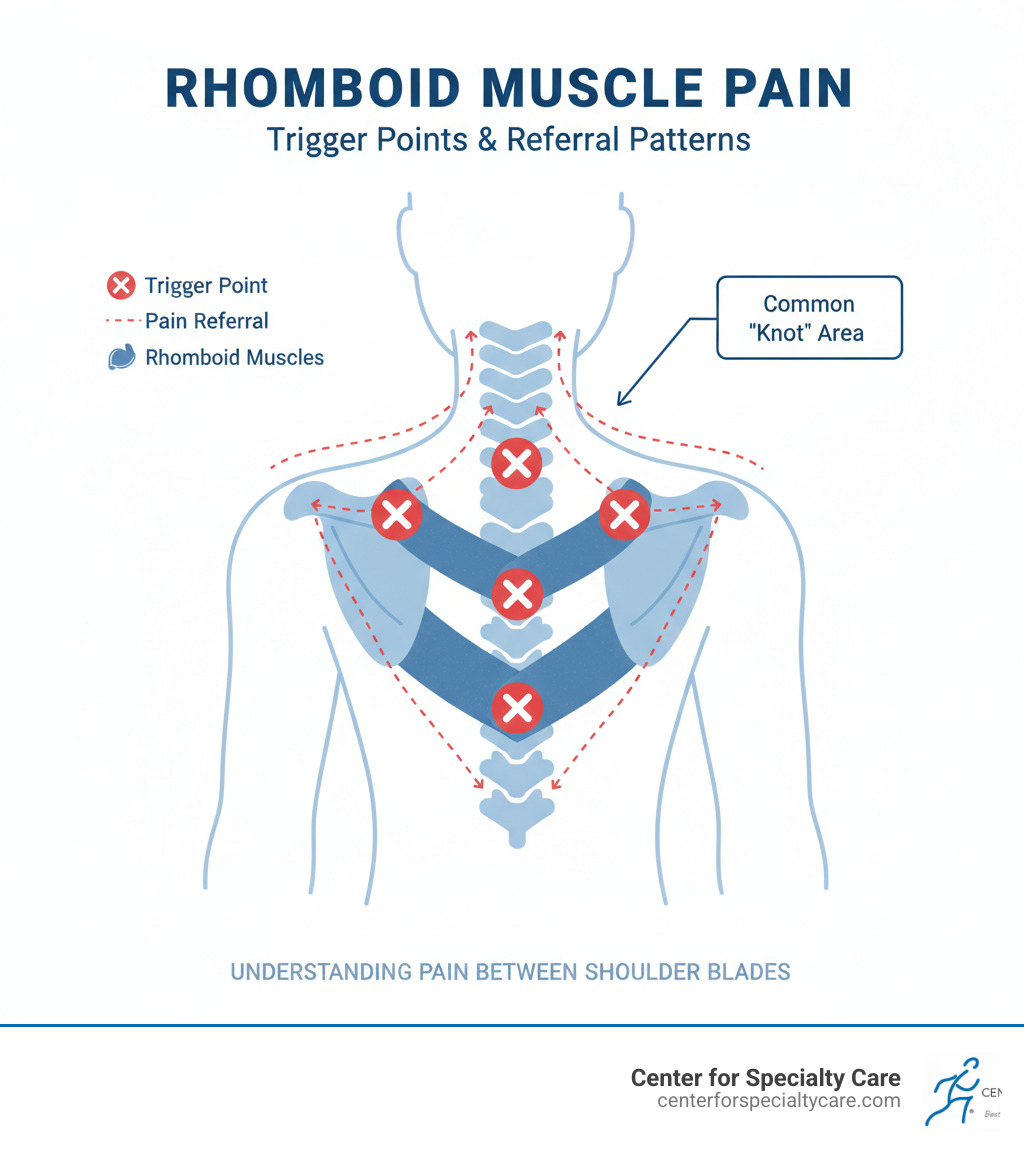
The rhomboid muscles, located between your spine and shoulder blades, can develop tight trigger points (knots) when overstretched from poor posture, like hunching over a computer. This creates an achy, burning sensation that often feels like it’s right under the shoulder blade, making it hard to find relief. The pain can be persistent, affecting daily activities and sleep.
As Dr. Corey Welchlin, I’ve treated countless patients with rhomboid knots during my three decades as an orthopedic surgeon and sports medicine physician in Fairmont, Minnesota. At the Center for Specialty Care, I’ve developed effective strategies to help patients understand and eliminate their knot in rhomboid pain using both conservative treatments and professional interventions when needed.
Key knot in rhomboid vocabulary:
Understanding the Knot in Your Rhomboid: Causes and Symptoms
When you feel that persistent ache between your shoulder blades, you’re likely dealing with a knot in rhomboid muscle. Your rhomboids are diamond-shaped muscles under your trapezius that connect your shoulder blades to your spine. Their main job is to pull your shoulder blades together, playing a key role in good posture. You can learn more about the Anatomy, Function and Dysfunction of Rhomboid Muscles. For a quick anatomy overview, see the rhomboid major muscle.
A “knot” is a trigger pointa tight, irritated spot in the muscle that feels like a small lump. This is a feature of Myofascial Pain Syndrome, where tight muscle fibers hold onto tension.
Why do these knots form? The causes often stem from modern life:
- Poor Posture: Hunching over a computer or phone (“tech neck”) constantly stretches your rhomboids, causing them to fatigue and form knots.
- Desk Jobs & Muscle Imbalances: Sitting with rounded shoulders shortens chest muscles and overstretches back muscles, creating an imbalance that strains the rhomboids.
- Repetitive Motions: Activities like overhead painting, cycling, or even prolonged writing can overwork the rhomboids.
- Stress and Tension: We often carry emotional stress in our shoulders, leading to chronic muscle tension in the upper back.
- Injury or Sleeping Position: A direct impact, sudden awkward movement, or sleeping on your side without proper support can also trigger knots.
For more information about related spinal conditions, see our guide on Common Spinal Conditions: Causes, Symptoms, and Treatment Options.
Common Symptoms of Rhomboid Knots
- Aching or burning pain between the shoulder blades, often feeling like it’s “under” the bone.
- Stiffness and tightness in the upper back.
- Reduced range of motion when reaching or twisting.
- Tenderness to touch and a palpable hard nodule in the muscle.
- Snapping or grinding sounds when moving the shoulder blade.
- Referred pain that may travel to the lower back, neck, or arm.
How Poor Posture Creates a Knot in the Rhomboid

Imagine your head is a 10-12 pound bowling ball. With good posture, it’s balanced. When you slouch, your head juts forward, and your shoulders round. This “tech neck” posture puts your rhomboids under constant stretch, like a taut rubber band. Eventually, the muscle fibers fatigue and seize up into painful knots.
This creates a frustrating cycle of pain. The overstretched rhomboids weaken, while the chest muscles tighten from the rounded position. These tight chest muscles pull the shoulders even further forward, putting more strain on the rhomboids. Over time, this leads to chronic muscle strain and recurring knots in rhomboid muscles. Understanding this cycle is the first step to breaking it.
A 3-Step Guide to Releasing Rhomboid Knots at Home
A knot in rhomboid can be frustrating, but you can find relief at home with this simple three-step approach. Each step builds on the last to provide immediate relief and help prevent future knots.
Step 1: Self-Massage and Heat Therapy
Start with self-massage (self-myofascial release) to break up tight muscle fibers and improve blood flow.
The tennis ball technique is a simple and effective method. Stand with your back to a wall, place the ball on the tender spot between your shoulder blade and spine, and lean in gently. Apply steady pressure with small circular motions or by rolling slowly up and down. A firmer lacrosse ball can also be used. Spend 2-4 minutes on the area, but don’t exceed 20 minutes total to avoid irritation.

Heat therapy relaxes tight muscles and reduces pain. Apply a warm compress, heating pad, or take a hot shower for 15-20 minutes several times a day. Some people find alternating between heat and cold provides the best results.
Step 2: Effective Stretches for Rhomboid Pain Relief
After loosening the muscle, strategic stretching can help restore balance. The goal is to stretch both the rhomboids and the tight muscles pulling your shoulders forward.
- Doorway Stretch: This targets tight chest muscles, a common culprit. Stand in a doorway with forearms on the frame, elbows at 90 degrees. Lean forward until you feel a stretch across your chest. Hold for 15-30 seconds and repeat 2-4 times.
- Cat-Cow Stretch: On your hands and knees, alternate between arching your back (cow) and rounding your spine (cat) to mobilize your back muscles.
- Rhomboid Stretch: Clasp your hands in front of you and reach forward, allowing your upper back to round slightly until you feel your shoulder blades stretch apart.
- Shoulder Blade Squeeze: Gently squeeze your shoulder blades together as if holding a pencil between them. This engages the rhomboids and stretches the chest.
For more on relieving muscle tension, see our guide on Muscle Kink in Shoulder Blade: Causes, Effective Relief.
Step 3: Strengthening Exercises to Prevent Recurrence
Strengthening is key to preventing knots from returning by correcting the underlying muscle imbalances.
- Scapular Retraction: Sit or stand tall and pull your shoulder blades back and down. Hold for a few seconds, then release. This directly targets your rhomboids.
- Resisted Rows: Use a resistance band anchored at chest height. Pull the handles toward you, keeping elbows close to your body and squeezing your shoulder blades together.
- Y-T-A Exercises: Lie face down and lift your arms to form a Y (overhead), a T (to the sides), and an A (toward your hips) to target different upper back muscles.
- Face Pulls: Use a resistance band to pull the handles toward your face, leading with your elbows and squeezing your shoulder blades.

Aim for 8-12 repetitions of each exercise, focusing on consistency over intensity. Building strength, combined with good posture, is your best defense against future rhomboid knots. For a personalized program, our Physical Therapy team can provide expert guidance.
Lifestyle Adjustments for Long-Term Prevention
Treating a knot in rhomboid is only half the battle; preventing it from returning requires adjusting daily habits. Proactive changes to your environment and routines are key to breaking the pain cycle.
Optimizing Your Daily Posture and Ergonomics
Since poor posture is a primary cause of rhomboid knots, optimizing your workspace is essential.
- Desk Setup: Position your monitor at eye level to avoid “tech neck.” Keep your keyboard and mouse close enough that your elbows bend at about 90 degrees, allowing your shoulders to relax.
- Chair Support: Use a chair with good lumbar support that helps maintain your spine’s natural curve. Your feet should rest flat on the floor or a footrest.
- Proper Lifting: Always bend at your knees, not your waist, and keep heavy objects close to your body to protect your back muscles.
- Regular Breaks: Stand up, stretch, and walk around at least once an hour. Movement prevents muscles from getting stuck in a strained position.
The Impact of Sleeping Positions on a Knot in the Rhomboid
How you sleep can either help or hinder your recovery from a knot in rhomboid. An unsupportive sleeping position can leave you waking up stiff and sore.
- Back Sleeping: This is often the best position, as it keeps your spine in a neutral alignment. Use a supportive pillow that cradles your neck without pushing your head too far forward.
- Side Sleeping: If you’re a side sleeper, place a pillow between your knees to align your spine. Placing another small pillow under your top armpit can prevent your shoulder from rolling forward and compressing the rhomboids.
- Stomach Sleeping: This is the worst position for upper back pain, as it forces your head to twist, straining your neck and back. If you must sleep on your stomach, use a very thin pillow or no pillow at all.
A supportive mattress and pillow are crucial. An old, sagging mattress can cause muscle tension as your body tries to compensate. For more tips on waking up pain-free, read our guide on How to Relieve a Stiff Neck After Waking Up.
When to Seek Professional Help for Rhomboid Pain
While self-care is effective for many cases of knot in rhomboid, sometimes professional help is necessary. Ignoring persistent pain or red flag symptoms can lead to more significant issues.
Signs You Need to See a Specialist
Consult a specialist if you’ve tried home remedies for a few weeks without improvement, or if you experience any of the following:
- Persistent or Severe Pain: Your pain is constant, worsening, or significantly impacting your quality of life.
- Numbness or Tingling in Arm/Hand: This is a red flag that could indicate nerve compression, such as a pinched nerve in your neck (cervical radiculopathy).
- Weakness in Shoulder or Arm: Noticeable weakness could point to a nerve issue or more severe muscle dysfunction.
- Pain That Disrupts Sleep: If pain consistently wakes you up or prevents you from sleeping, it’s a sign you need professional evaluation.
- Accompanying Symptoms: Seek immediate medical attention if your pain is accompanied by fever, unexplained weight loss, or changes in bowel/bladder function.
For guidance on when back pain is urgent, see our guide: Should I Go to Urgent Care for Back Pain? Signs, Treatment Options.
How Professional Treatment Can Help
At the Center for Specialty Care, our specialists provide a comprehensive approach to diagnosing and treating your knot in rhomboid pain.

- Accurate Diagnosis: We perform a thorough evaluation to find the root cause of your pain, ruling out other conditions like a herniated disc or locked rib joints.
- Physical Therapy: Our Physical Therapy team designs personalized exercise programs, using manual therapy and targeted exercises to correct muscle imbalances and improve function.
- Chiropractic Care: Our chiropractors can perform spinal adjustments to address joint dysfunction and use soft tissue techniques to relieve pain.
- Orthopedic Specialists: For complex cases, our orthopedic surgeons evaluate all non-surgical and surgical options to ensure you receive the most appropriate care.
- Pain Management: Our Pain Management experts offer interventions like trigger point injections or medication management for persistent pain.
Our goal is to provide personalized care and quick appointment availability to help you on your journey to a pain-free life. We serve patients in Fairmont MN, Estherville IA, Buffalo Center IA, and St. James MN. Learn more about finding expert care at Finding the Best Sports Doctor Near Me: A Complete Guide.
Frequently Asked Questions about Rhomboid Knots
It’s normal to have questions about that stubborn knot in rhomboid. Here are answers to the most common concerns I hear from patients at the Center for Specialty Care.
How long does it take for a rhomboid knot to go away?
The timeline varies. With consistent self-care (daily stretching, massage, heat, and posture correction), a newer knot in rhomboid may improve within a few days to two weeks. However, chronic knots that have been present for months or years are more stubborn and often require professional treatment to fully resolve. Consistency is key—the habits that created the knot developed over time, and it will take dedicated effort to undo the damage.
Can stress cause knots between the shoulder blades?
Absolutely. Emotional stress often translates into physical tension. When you’re stressed, your shoulders tend to rise toward your ears, and your upper back muscles tighten. This is part of the body’s “fight or flight” response. When this tension is prolonged, the fatigued muscles can develop painful trigger points, or knots. Managing stress through techniques like deep breathing, walking, or consciously relaxing your shoulders can significantly help relieve your knot in rhomboid.
What is the difference between a muscle knot and a trigger point?
For practical purposes, these terms are interchangeable. “Muscle knot” is the common term for what clinicians call a “trigger point.” Both refer to the same thing: a hyperirritable, tight spot in a muscle that feels like a small, hard lump. This spot is tender to the touch and can cause both local and referred pain. Whether you call it a knot or a trigger point, the treatment approach is the same.
Take Control of Your Upper Back Pain
Living with a knot in rhomboid doesn’t have to be your reality. That nagging pain between your shoulder blades is a signal from your body, asking for a change in your daily habits and posture.
We’ve armed you with the tools to fight back. Your journey to relief starts with consistent application of self-massage, stretching, and strengthening exercises. These techniques provide the daily maintenance your muscles need to recover from years of poor posture and strain.
Lifestyle adjustments are your long-term insurance policy against future knots. Ergonomic workspace setups, regular movement breaks, and supportive sleeping positions are small changes that yield significant, lasting relief.
However, sometimes self-care isn’t enough. If you experience persistent pain, numbness or tingling in your arm, or if home treatment isn’t working, it’s time to seek professional help. This is your body’s cue that it needs expert guidance.
At the Center for Specialty Care, we understand that every knot in rhomboid has a unique cause. Our team of orthopedic specialists, physical therapists, and pain management experts creates personalized treatment plans to address the root of your pain. We are committed to helping you live a life free from this nagging discomfort.
If at-home care isn’t providing the relief you need, our team can help. Learn more about our advanced shoulder care options and take the first step toward reclaiming your comfort and mobility.