
Foot Tendons Explained: What You Need to Know
April 16, 2026
Signs You Might Have a Torn Rotator Cuff
April 18, 2026
How to stop your shoulders from acting like a boulder
Why Your Shoulders Deserve More Than Just Stretching
Foam roller shoulder work is one of the most effective ways to reduce muscle tightness, improve mobility, and relieve pain in the shoulder region — without any equipment beyond a foam cylinder.
Here’s a quick overview of what foam rolling your shoulders can do for you:
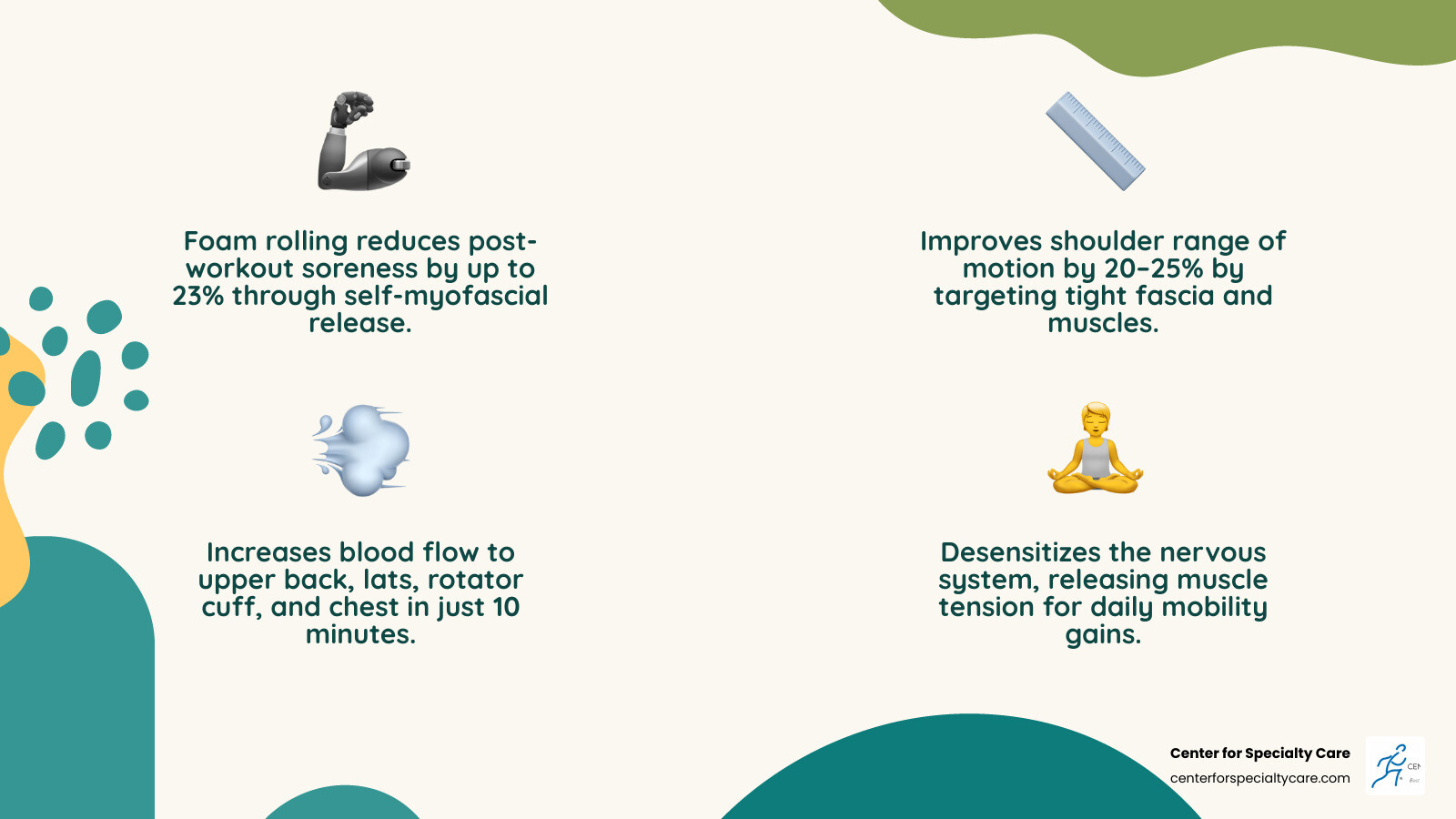
- Reduces post-workout soreness by up to 23%
- Inproves range of motion by 20–25% in some individuals
- Releases tight muscles around the upper back, lats, rotator cuff, and chest
- Takes as little as 10 minutes per session
- Can be done daily or 2–3 times per week for best results
If your shoulders feel stiff after a long day at a desk, ache after a workout, or just never seem to loosen up no matter how much you stretch — you’re not alone. Tight shoulders are one of the most common complaints we see, and they often stem from muscles that are overworked, underused, or simply starved of blood flow.
The good news? A foam roller can make a meaningful difference. It works by applying pressure to soft tissue, which helps relax tense muscles, increase circulation, and reduce sensitivity in the nervous system. Think of it as a massage you can give yourself — targeted, affordable, and available any time.
I’m Dr. Corey Welchlin, a board-certified orthopedic surgeon and sports medicine physician with over 30 years of experience treating shoulder injuries and conditions, and I’ve seen how incorporating a consistent foam roller shoulder routine can support recovery and long-term shoulder health. In this guide, I’ll walk you through exactly how to do it right.
Learn more about foam roller shoulder:
The Science and Benefits of Using a Foam Roller for Shoulder Health
When we talk about using a foam roller shoulder technique, we are technically discussing self-myofascial release (SMR). Fascia is the thin, connective tissue that wraps around every muscle in your body. Think of it like a tight-fitting suit; if the suit is bunched up in one spot, it restricts how well you can move your arms and legs.
The science behind the “roll” is multi-faceted. First, there is the mechanical effect: the pressure helps increase blood flow to the area and improves the elasticity of muscle tissue and fascia. This is crucial for recovery, as Scientific research on foam rolling and recovery indicates that this process can significantly reduce muscle stiffness.
But there is also a “brain-to-muscle” component called nervous system desensitization. When you roll over a tender spot, you’re essentially telling your brain that it’s okay to let that muscle relax. This neuromuscular activation primes your muscles for movement, making it a staple in our sports medicine services.
The statistics are hard to ignore:
- Flexibility: Foam rolling can increase flexibility by up to 10% in athletes.
- Recovery: It can cut post-workout soreness by 23%, helping you get back to your routine faster.
- Immediate Gains: Range of motion improvements can be as high as 25%, though these effects typically last about 30 minutes, providing a perfect “window” to perform deeper stretches or strengthening exercises.
Essential Foam Roller Shoulder Exercises for Mobility and Stability
To get the most out of your foam roller shoulder routine, you need to target the muscles that actually control the joint. The shoulder isn’t just one joint; it’s a complex system involving the shoulder blade (scapula), the collarbone, and the humerus.
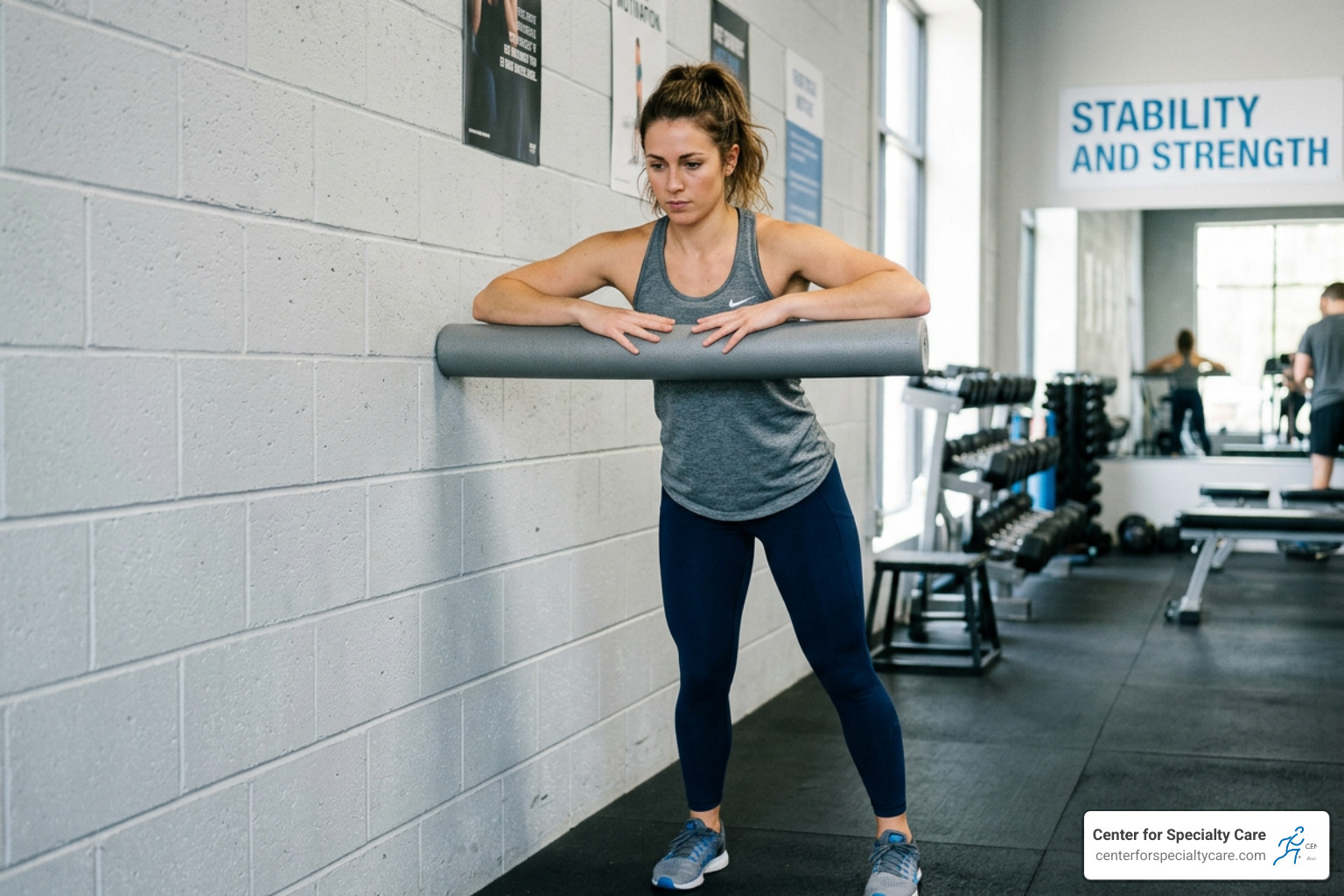
Foam Roller Wall Slide
This is one of our favorite exercises for improving shoulder stability and addressing conditions like “scapular winging.” It specifically targets the serratus anterior—the muscle that holds your shoulder blade against your rib cage.
- Place a foam roller horizontally against a wall at about chest height.
- Place your forearms against the roller, keeping them parallel.
- Push your elbows into the roller, feeling your shoulder blades “spread” across your back (protraction).
- Maintain this pressure as you slowly roll the foam roller upward toward the ceiling and then back down.
Upper Back (Thoracic) Rolling
If you sit at a desk in Fairmont or Estherville all day, your upper back likely rounds forward. This “hunched” posture limits how high you can lift your arms. According to Research on shoulder function and myofascial exercises, improving thoracic extension is key to shoulder health.
- Lie on your back with the foam roller positioned horizontally under your shoulder blades.
- Support your head with your hands (don’t pull on your neck!).
- Keep your feet flat on the floor and gently roll from the middle of your back to the top of your shoulders.
- Pro Tip: Avoid rolling your lower back, as it lacks the rib cage protection of the upper back.
For those dealing with chronic tension, these moves are a great first step in a comprehensive pain management plan.
Beginner Tips for Your Foam Roller Shoulder Routine
If you’re new to foam roller shoulder work, it might feel a bit like “productive pain.” Here is how to make it more comfortable:
- Use Static Pressure: If you find a spot that feels particularly tight (a trigger point), don’t just roll over it quickly. Stop and hold the pressure there for 30 seconds.
- Breathe Deeply: Inhale through your nose and exhale through your mouth. This helps signal your nervous system to relax.
- Slow the Tempo: Aim for a speed of about one inch per second. Rushing through the movement won’t give the fascia enough time to respond.
- Start Soft: Use a medium-density roller first. You can find more details on how to foam roll the shoulders and neck for relief if you’re feeling particularly “crunchy” in the neck area.
Advanced Foam Roller Shoulder Techniques
Once you’ve mastered the basics, you can move on to more targeted tools and positions.
- The Peanut Roller: This is essentially two lacrosse balls taped together (or a specialized foam tool). It’s perfect for rolling the muscles on either side of the spine without putting direct pressure on the bone.
- Vibrating Rollers: These use high-frequency vibration to penetrate deeper into the muscle tissue, which can be especially helpful for stubborn rotator cuff tension.
- Side-Lying Lat Roll: This targets the latissimus dorsi. Lie on your side with the roller under your armpit. Slowly roll down toward your ribs and back up. To increase the intensity, gently rotate your trunk forward and backward.
If your chest feels tight, you can also perform pec stretches on a roller by lying on the roller vertically (so it supports your head and your tailbone) and letting your arms fall out to the sides like a “T.”
Targeting Specific Muscles: From Lats to the Rotator Cuff
To truly “un-boulder” your shoulders, we have to look at the surrounding muscles that pull the joint out of alignment.
The Lats (Latissimus Dorsi)
Your lats are your “wings.” When they are tight, they pull the shoulders down and forward, making overhead movement difficult. Because they connect to the lower back via the thoracolumbar fascia, tight lats can even cause back pain.
The Rotator Cuff Twist
The rotator cuff consists of four small muscles that stabilize the shoulder joint. A great way to release the posterior (back) part of the cuff is the “twist”:
- Lie on your side with the roller just below your armpit.
- Extend your bottom arm straight out.
- Gently rock your body forward and backward, “massaging” the back of the shoulder blade.
The Pectorals (Chest)
Tight chest muscles are a primary cause of shoulder pain because they pull the humerus into an internally rotated position. Using a foam roller to “open up” the chest can provide immediate relief. Research on foam rolling for back stiffness suggests that releasing these anterior muscles is just as important as working on the back.
Addressing Posture and Injury with Targeted Rolling
Many people come into our Fairmont and Estherville clinics with “Upper Cross Syndrome.” This is a fancy way of saying your shoulders are rounded, your head is forward, and your upper back is weak. This posture is a recipe for shoulder impingement, where the tendons of the rotator cuff get “pinched” in the shoulder joint.
By using a foam roller shoulder strategy, you can:
- Address Scapular Dyskinesis: Helping the shoulder blade move smoothly.
- Relieve Tendonitis: While foam rolling doesn’t “cure” tendonitis, it can alleviate the muscle tension that makes the condition worse. You might also wonder, does heat help tendonitis?—the answer is often yes, when combined with myofascial release.
- Loosen the Thoracolumbar Fascia: This massive sheet of connective tissue links your shoulders to your hips. Rolling the mid-back can actually improve how your shoulders feel!
Equipment Selection and Safety Precautions
Not all foam rollers are created equal. Choosing the wrong one can lead to unnecessary bruising or simply no results at all.
| Roller Type | Density | Best For |
|---|---|---|
| White Foam | Soft | Beginners, sensitive areas, and those with high pain levels. |
| Blue/Black Foam | Medium | General use; the “gold standard” for most people. |
| Textured/Grid | Firm | Deep tissue work; mimics a massage therapist’s fingers. |
| Peanut Roller | Firm | Targeted work around the spine and neck. |
Safety First
While foam rolling is generally safe, there are a few “no-go” zones:
- Avoid Joints: Never roll directly over the “point” of your shoulder or your neck bones. Stay on the “meaty” parts of the muscle.
- Skip the Lower Back: Rolling the lumbar spine with a large roller can cause the muscles to seize up to protect the spine. Stick to the upper and mid-back.
- Bone Check: If you feel a “thumping” sensation, you’re likely rolling over a bone. Shift your position.
- Pain vs. Discomfort: A “good hurt” is fine. Sharp, stabbing, or radiating pain is a sign to stop immediately.
For more on maintaining joint health, check out our guide on enhancing hand and joint function.
Frequently Asked Questions about Foam Rolling Shoulders
How often should I foam roll my shoulders for best results?
For most people, 2–3 times a week is plenty to maintain mobility. However, if you have a very sedentary job, daily 10-minute sessions can prevent tension from building up. Research on consecutive days of foam rolling shows that rolling for three days in a row can significantly reduce muscle fatigue.
Is it better to foam roll before or after a workout?
Both!
- Pre-workout: Use it to “wake up” the muscles and increase blood flow. This improves neuromuscular activation.
- Post-workout: Use it to flush out metabolic waste and reduce the severity of Delayed Onset Muscle Soreness (DOMS).
When should I see a professional for shoulder pain?
Foam rolling is a maintenance tool, not a miracle cure for structural injuries. You should consult a professional like Thomas Carpenter DO or our orthopedic team if you experience:
- Sharp, stabbing pain that doesn’t go away.
- Numbness or tingling down your arm.
- Visible swelling or bruising.
- A “popping” or “locking” sensation in the joint.
Conclusion
At the Center for Specialty Care, we believe that your health is a partnership. Whether you are visiting us in Fairmont, MN, or Estherville, IA, our goal is 100% patient satisfaction through personalized, expert care. While a foam roller shoulder routine is a fantastic way to manage daily aches and improve your gym performance, we are here for the moments when you need a little more help.
If your “boulder shoulders” aren’t responding to home care, don’t wait for the pain to become chronic. We offer quick appointment availability and a range of both surgical and non-surgical options to get you back to the activities you love.
Ready to move freely again? Schedule a consultation for shoulder health at one of our locations in Minnesota or Iowa today.