
Why Your Rotator Cuff Injury Hurts More at Night
May 14, 2026
The Skeleton Crew Guide to Bone Meds
May 21, 2026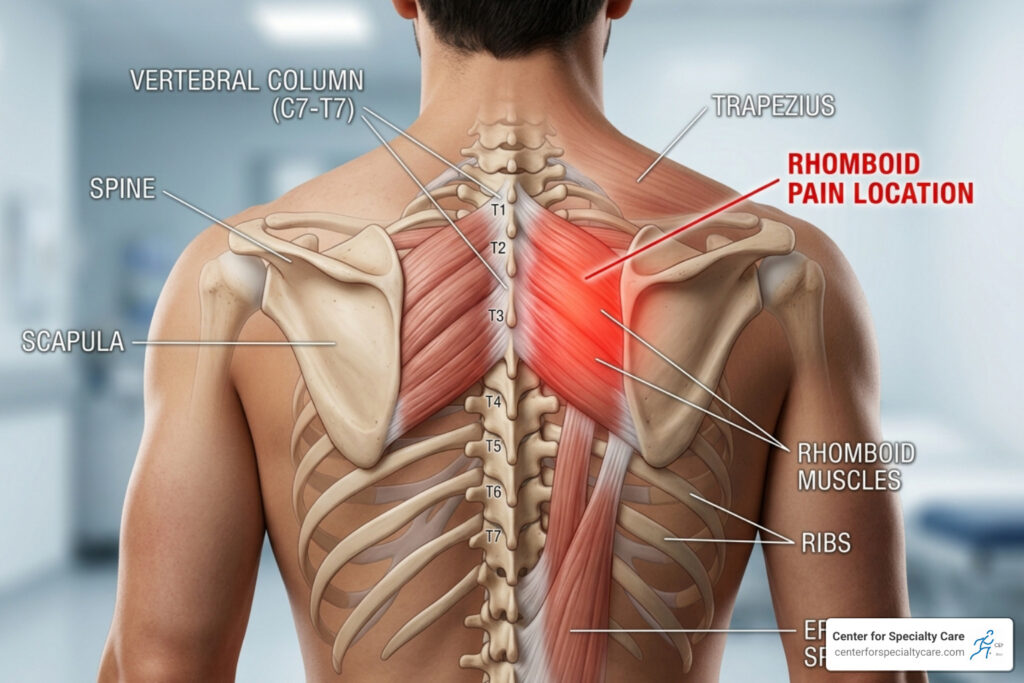
The Complete Guide to Relieving Rhomboid Pain
Understanding Rhomboid Pain: Symptoms and Anatomy
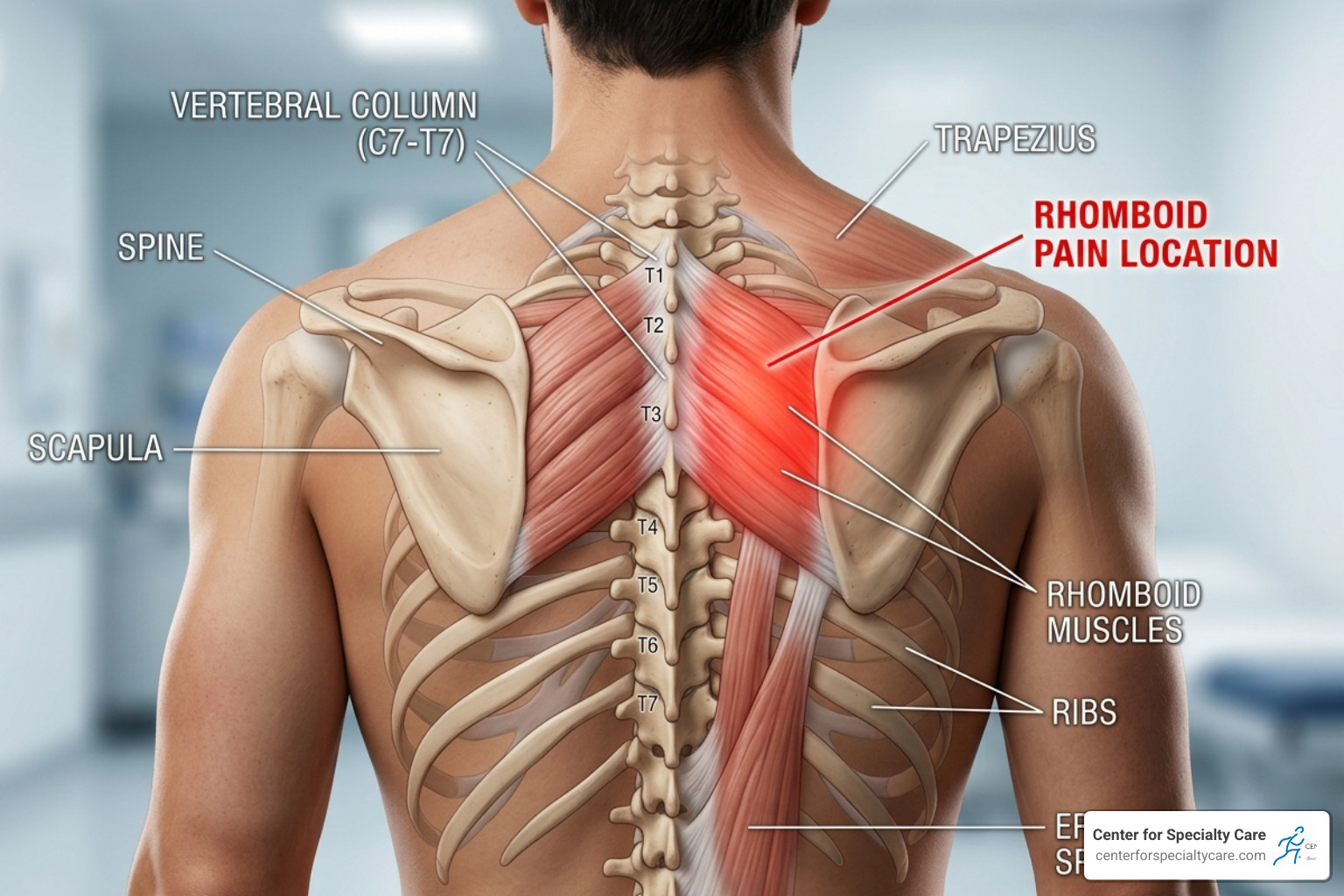
To effectively treat rhomboid pain, we first need to understand the anatomy of the “engine room” of your upper back. The rhomboids are a collective group of muscles consisting of the rhomboid major and the rhomboid minor. These diamond-shaped muscles sit deep beneath your trapezius muscle, connecting the inner edge of your scapula (shoulder blade) to your spine.
Their primary job is scapular retraction—essentially pulling your shoulder blades together toward your spine. They also help rotate the shoulder blade downward and provide vital stability for the entire shoulder girdle. Every time you pull a door open, reach back to put on a coat, or sit up straight, your rhomboids are hard at work.
When these muscles become irritated or strained, the symptoms are hard to miss. Patients often describe a deep, nagging aching or tenderness in the space between the spine and the shoulder blade. You might also experience:
- Stiffness that makes it hard to move your neck or shoulders.
- A popping noise or grinding sensation (crepitus) when you move your shoulder blade.
- Pain with breathing deeply, as the rhomboids sit over the rib cage and assist with thoracic expansion.
- Visible swelling or a physical “knot” that is tender to the touch.
For more details on how these muscles function, you can explore this guide on Rhomboid Muscle Functions and Symptoms.
Identifying a Rhomboid Strain vs. Spasm
It is important for us to distinguish between a muscle strain and a muscle spasm, as the immediate care can differ slightly.
A rhomboid strain occurs when the muscle fibers or tendons are overstretched or torn. This usually happens during a sudden movement or from repetitive overexertion. You’ll likely feel a sharp pull followed by a lingering ache and inflammation.
A rhomboid spasm, on the other hand, is an involuntary contraction of the muscle. It feels like the muscle is “locked” or “knotted.” These spasms often create trigger points—hyper-irritable spots that can refer pain to the neck or shoulders. If you feel a hard, painful lump in the muscle that won’t relax, you are likely dealing with a spasm. In some cases, localized swelling can occur; for more complex joint-related swelling, we sometimes utilize Fluid Dynamics: Understanding Joint Aspiration to diagnose underlying issues.
Referred Pain and Cervical Spine Issues
One of the most fascinating (and frustrating) things about rhomboid pain is that the source isn’t always the muscle itself. In many cases, the pain is “referred” from the cervical spine (your neck).
Research shows that pain related to cervical nerve roots is non-dermatomal in over two-thirds (69.7%) of cases. Furthermore, 50% of patients with cervical nerve root issues report pain specifically in the scapula area. This means that a bulging disc or joint inflammation in the neck—specifically around the C5-C7 vertebrae—can send pain signals straight to your rhomboids.
This is why we often look at the neck during an evaluation. If your “rhomboid” pain is accompanied by arm numbness or weakness, it may actually be cervical radiculopathy. Our team specializing in Rheumatology and spine health can help differentiate between a simple muscle pull and a more complex nerve issue.
Common Causes of Discomfort in the Upper Back
Why do our rhomboids give us so much trouble? In April 2026, the leading cause remains our modern lifestyle.
- Poor Posture and “Tech Neck”: When we slouch at a desk or hunch over a smartphone, our head juts forward. Since the average head weighs 10–12 pounds, this “forward head posture” puts immense strain on the rhomboids, stretching them like a taut rubber band for hours at a time.
- Repetitive Motion: Activities like rowing, tennis (especially serving), and overhead reaching can lead to overuse. Even carrying heavy backpacks over one shoulder can cause a significant muscle imbalance.
- Weakness: Ironically, most rhomboid pain comes from the muscles being too weak and overstretched, rather than too tight.
- Emotional Stress: We tend to carry our stress in our shoulders. The “fight-or-flight” response causes us to shrug our shoulders toward our ears, leading to chronic tension and knots.
| Feature | Acute Rhomboid Injury | Chronic Postural Strain |
|---|---|---|
| Onset | Sudden (e.g., during a lift) | Gradual (develops over weeks) |
| Pain Type | Sharp, stabbing, then aching | Dull, burning, nagging |
| Cause | Tear or overstretch | Slouching, weak muscles |
| Recovery | Days to weeks | Requires habit/ergonomic changes |
If your upper back pain is interfering with your sleep, you might find our tips on How to Relieve Rotator Cuff Pain at Night helpful, as shoulder and rhomboid issues often overlap.
Effective Strategies for Rhomboid Pain Relief
If you’ve just tweaked your back, the first 48 to 72 hours are crucial. We recommend the RICE method:
- Rest: Stop the activity that caused the pain. Avoid heavy lifting or repetitive reaching.
- Ice: Apply ice packs for 20-minute intervals every 3-4 hours. This helps manage inflammation and numbs the sharp pain.
- Compression: While difficult to “wrap” the upper back, wearing a snug athletic shirt can sometimes provide a sense of support.
- Elevation: Keep your chest up and shoulders back to prevent the muscle from being stretched further.
After the initial 72 hours, you can introduce heat therapy to relax the muscle and improve blood flow. Over-the-counter NSAIDs (like ibuprofen) or topical analgesics (like diclofenac gel) can also provide significant relief.
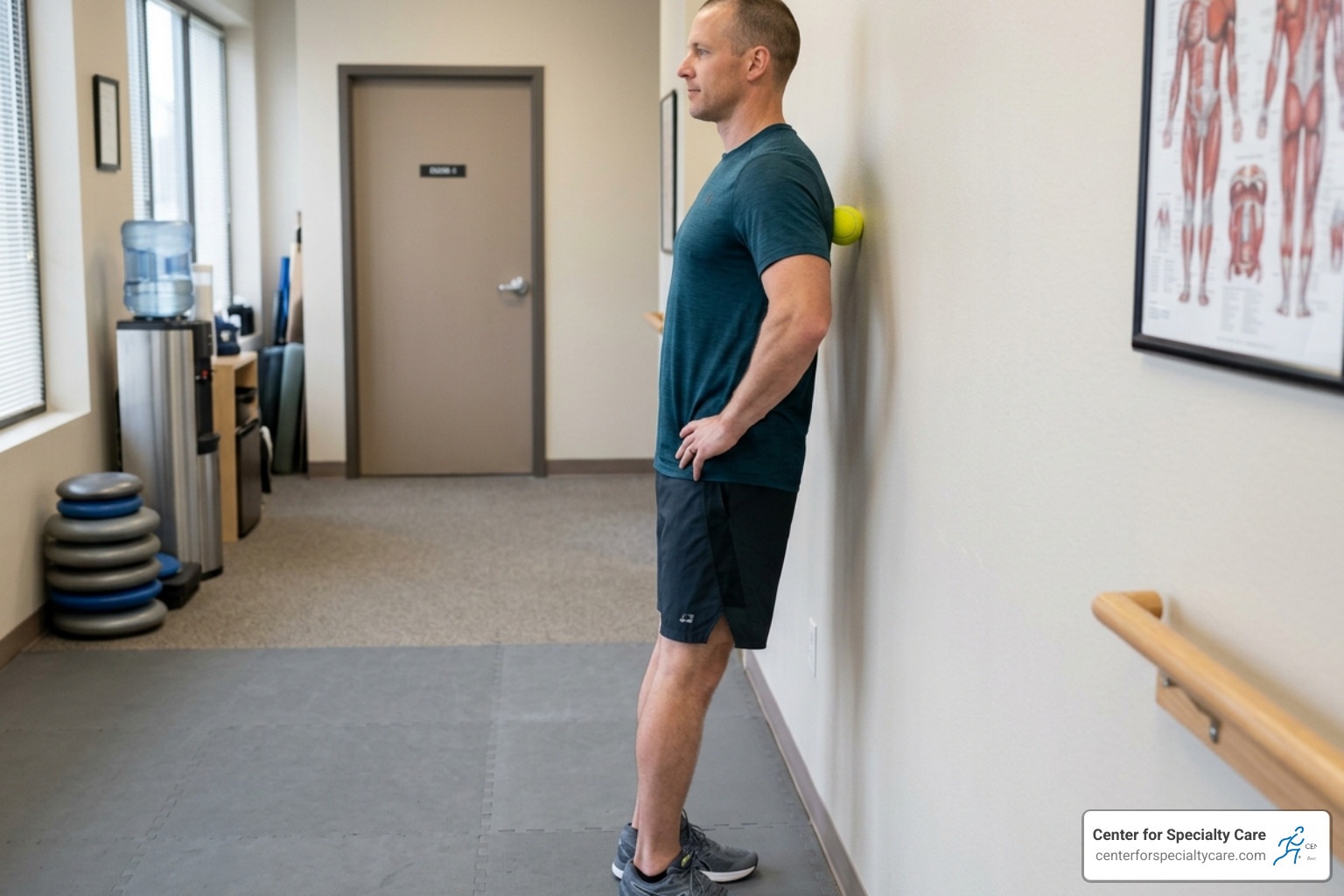
For “knots” or trigger points, self-massage is a game changer. Placing a tennis ball or foam roller between your shoulder blade and a wall and applying gentle pressure for 2-4 minutes can help the muscle release. You can find more self-care tips in this article on Identifying and Treating Rhomboid Muscle Pain.
Professional Treatment Options
Sometimes, at-home care isn’t enough. If your pain is persistent, professional intervention can speed up the process.
- Physical Therapy: This is the gold standard. Hinge Health members, for example, experience an average 68% reduction in pain within the first 12 weeks of their program. A physical therapist can identify your specific muscle imbalances and give you a personalized roadmap.
- Chiropractic Care: Adjustments to the thoracic spine can improve mobility and reduce the mechanical stress on the rhomboids.
- Injections: For severe spasms or referred nerve pain, we may recommend trigger point injections or Understanding Epidural Steroid Injections if the issue originates in the cervical spine.
Whether you need a specialized plan or Sports Medicine expertise, we focus on non-surgical solutions first.
Best Stretches and Exercises for Recovery
Movement is medicine, but it must be the right movement. When dealing with rhomboid pain, we want to focus on a mix of stretching the chest (which is often too tight) and strengthening the back (which is often too weak).
Strengthening Exercises for Rhomboid Pain
Strengthening provides the stability needed to prevent the injury from coming back. Aim for 8-12 repetitions of the following:
- Scapular Squeezes: Sit or stand tall. Imagine there is a pencil between your shoulder blades and try to squeeze it. Hold for 5 seconds and release.
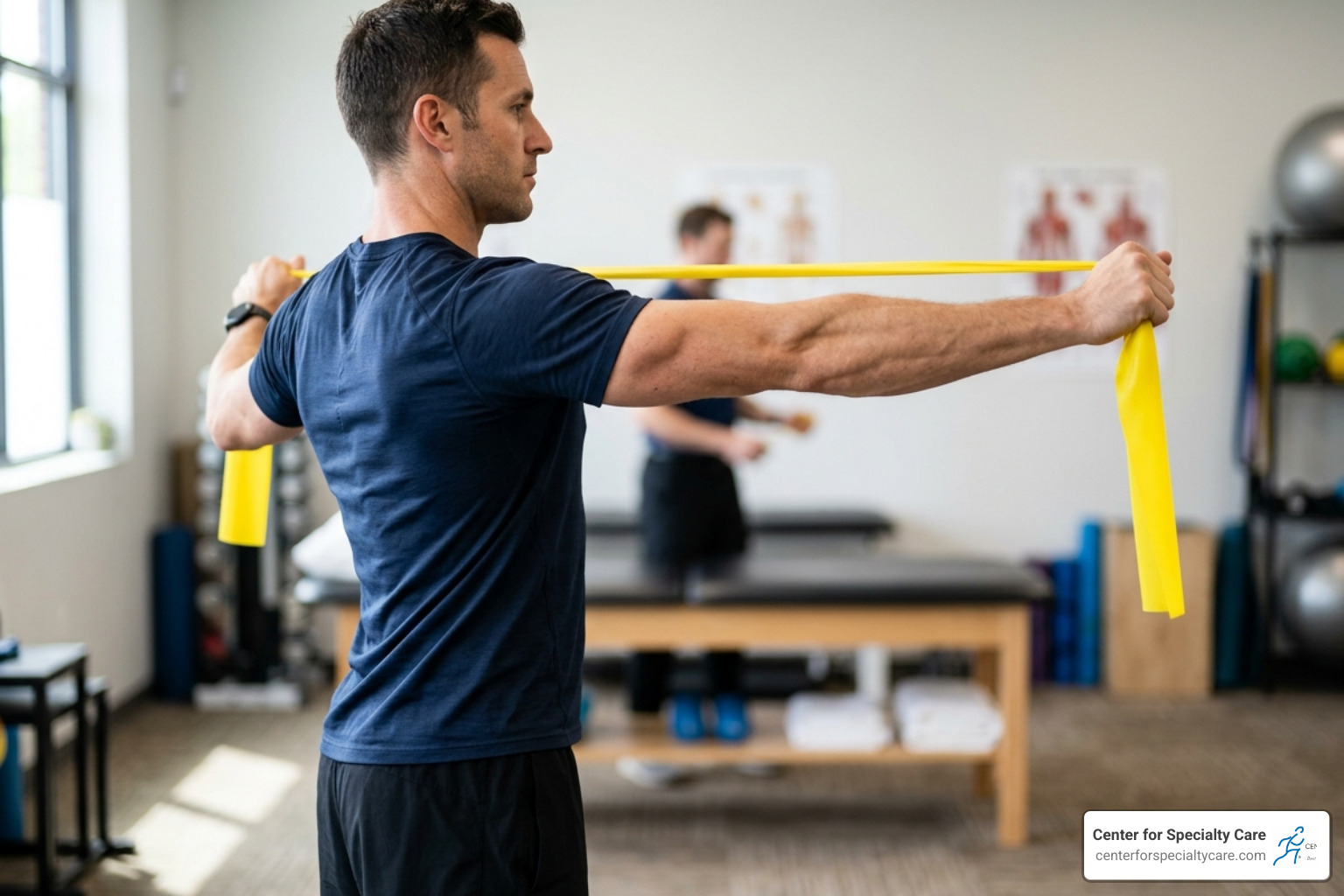
- Banded Pull-Aparts: Hold a resistance band in front of you at shoulder height. Pull the band apart by moving your arms out to the sides, squeezing your shoulder blades together.
- Bent-Over Rows: Using a light weight or resistance band, pull your elbow toward your hip while keeping your back flat.
Gentle Stretches to Alleviate Rhomboid Pain
Stretching helps restore range of motion. Always hold stretches for 15-30 seconds and never bounce.
- Doorway Chest Stretch: Stand in a doorway with your forearms on the frame. Lean forward gently to stretch the front of your chest. This takes the “pull” off your rhomboids.
- Thoracic Rotation: Lie on your side with knees bent. Open your top arm like a book, trying to touch the floor behind you.
- Cat-Cow: On all fours, alternate between arching your back toward the ceiling and letting your belly sink toward the floor.
- Yoga Poses: Poses like Cow Face pose and Locust pose are excellent for opening the upper back and strengthening the posterior chain.
For a deeper dive into these movements, see Rhomboid Muscle Pain: Symptoms and Treatment.
Recovery Timelines and Prevention Strategies
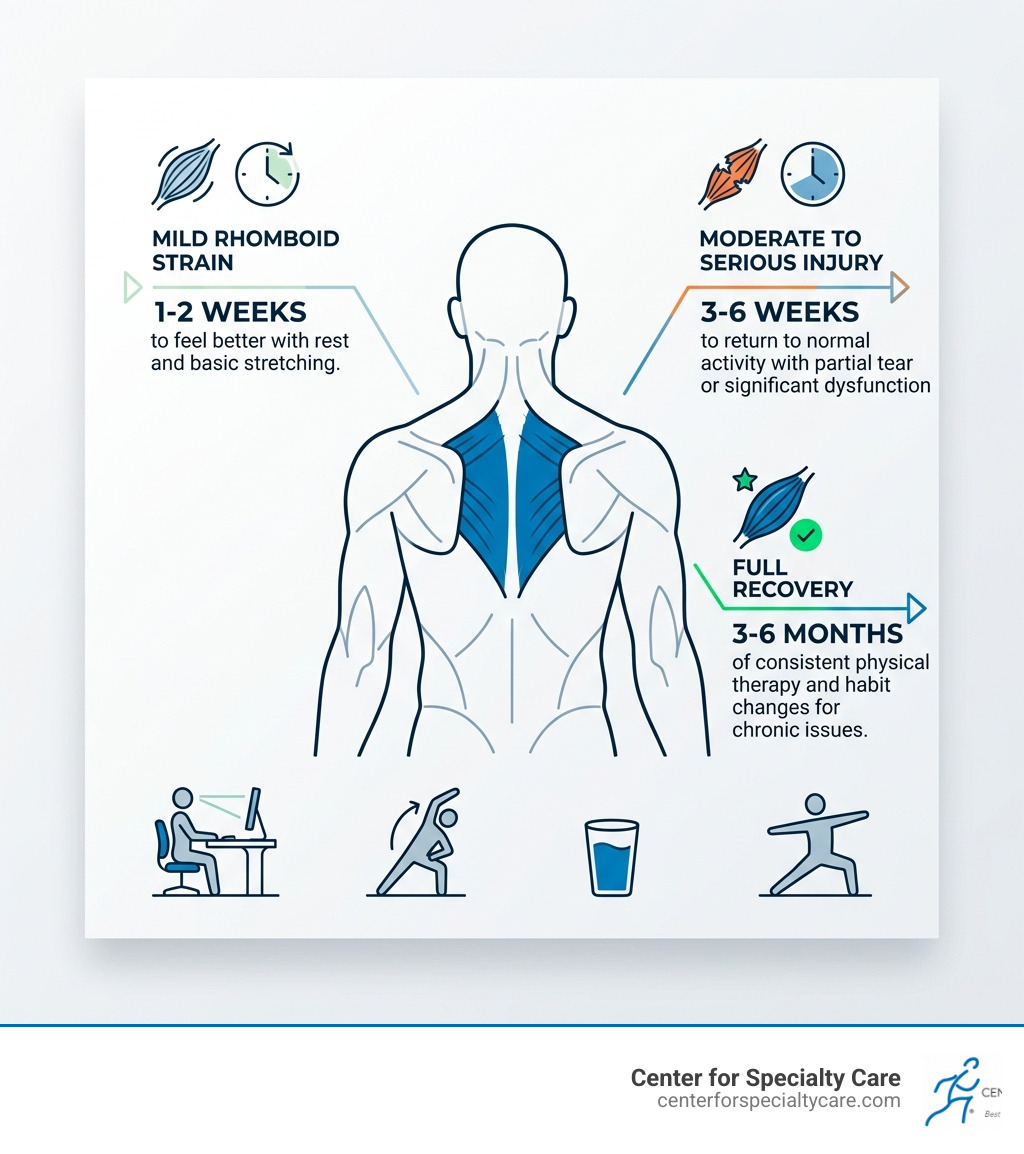
“How long will this take to heal?” is the question we hear most. The answer depends on the severity:
- Mild Rhomboid Strain: Most people feel better within 1-2 weeks with rest and basic stretching. A mild strain can heal in as little as a few weeks.
- Moderate to Serious Injury: If there is a partial tear or significant postural dysfunction, it may take 3-6 weeks to return to normal activity.
- Full Recovery: For chronic issues, full recovery can take three to six months of consistent physical therapy and habit changes.
Prevention: Fixing the Root Cause
To keep rhomboid pain away for good, you must address your environment:
- Ergonomic Desk Setup: Ensure your monitor height is at eye level so you aren’t looking down. Use a chair with proper lumbar support.
- Movement Breaks: Set a timer to stand up and stretch every 30–45 minutes.
- Hydration: Dehydrated muscles are more prone to spasms and “knots.”
- Warm-up Routines: Never jump straight into a heavy workout or a game of tennis without at least 5-10 minutes of dynamic movement to wake up your muscles.
For more expert insights on recovery, check out What to Know About Rhomboid Muscle Pain.
Frequently Asked Questions about Rhomboid Pain
How long does it typically take for rhomboid pain to heal?
As mentioned, most people start to feel better within about six weeks, though the total journey to full strength often takes 3-6 months. Mild “knots” from a bad night’s sleep might disappear in just a few days with heat and massage.
Can stress and anxiety cause pain between the shoulder blades?
Absolutely. When you are stressed, your body enters a fight-or-flight response, causing you to unconsciously tense your upper back and neck muscles. Over time, this leads to chronic knots and tension that feel exactly like a physical injury.
When should I see a doctor for upper back pain?
You should schedule a consultation if:
- The pain is persistent and hasn’t improved after 2-3 weeks of home care.
- You reach the 3-month threshold of chronic discomfort.
- You experience arm numbness, tingling, or weakness.
- The pain is so severe it wakes you up at night or makes it difficult to breathe.
Conclusion
At the Center for Specialty Care, we know that rhomboid pain is more than just a minor ache—it’s a disruption to your quality of life. Whether you are an athlete in Estherville or an office worker in Fairmont, our mission is to provide you with the most effective, personalized orthopedic care available.
We pride ourselves on 100% patient satisfaction and quick appointment availability at our locations in Fairmont, MN, Estherville, IA, Buffalo Center, IA, and St. James, MN. You don’t have to live with that nagging pain between your shoulder blades. From advanced physical therapy to non-surgical pain management, we have the tools to help you reclaim your mobility.
If you’re ready to put an end to your discomfort, Schedule a consultation for expert back pain relief with our team today. We look forward to helping you get back to the activities you love, pain-free.