
Finding Your Way Out of Chronic Pain: A Treatment Roadmap
November 14, 2025
Tendinitis Pain: Should I Apply Ice or Heat?
November 18, 2025
Rotator Cuff Tear: 2025 Expert Guide to Relief
Why Shoulder Pain Matters: Understanding Your Rotator Cuff
A rotator cuff tear is an injury to the muscles and tendons that stabilize your shoulder, affecting over 2 million Americans annually. It can disrupt everything from daily chores to getting a good night’s sleep. Fortunately, many tears respond well to treatment, with about 80% of partial tears improving without surgery.
Quick Overview: Rotator Cuff Tear Essentials
- What it is: A rip in the tendons connecting shoulder muscles to bone.
- Types: Partial (damaged) or complete (fully detached) tears.
- Causes: Repetitive motion, falls, heavy lifting, or age-related wear.
- Symptoms: Dull shoulder ache, night pain, arm weakness, and difficulty reaching.
- Treatment: Rest, physical therapy, injections, or surgery.
- Recovery: 4-12 months for non-surgical cases; 4-18 months with surgery.
This guide covers everything from symptoms to treatment, helping you make informed decisions about your care. I’m Dr. Corey Welchlin, a board-certified orthopedic surgeon and founder of the Center for Specialty Care. With over three decades of experience, I provide comprehensive rotator cuff tear diagnosis and treatment for our communities in southern Minnesota and northern Iowa.
Handy rotator cuff tear terms:
Understanding a Rotator Cuff Tear: Causes and Symptoms
Your shoulder’s incredible flexibility also makes it vulnerable to injury, particularly to the rotator cuff.
What is a Rotator Cuff Tear?
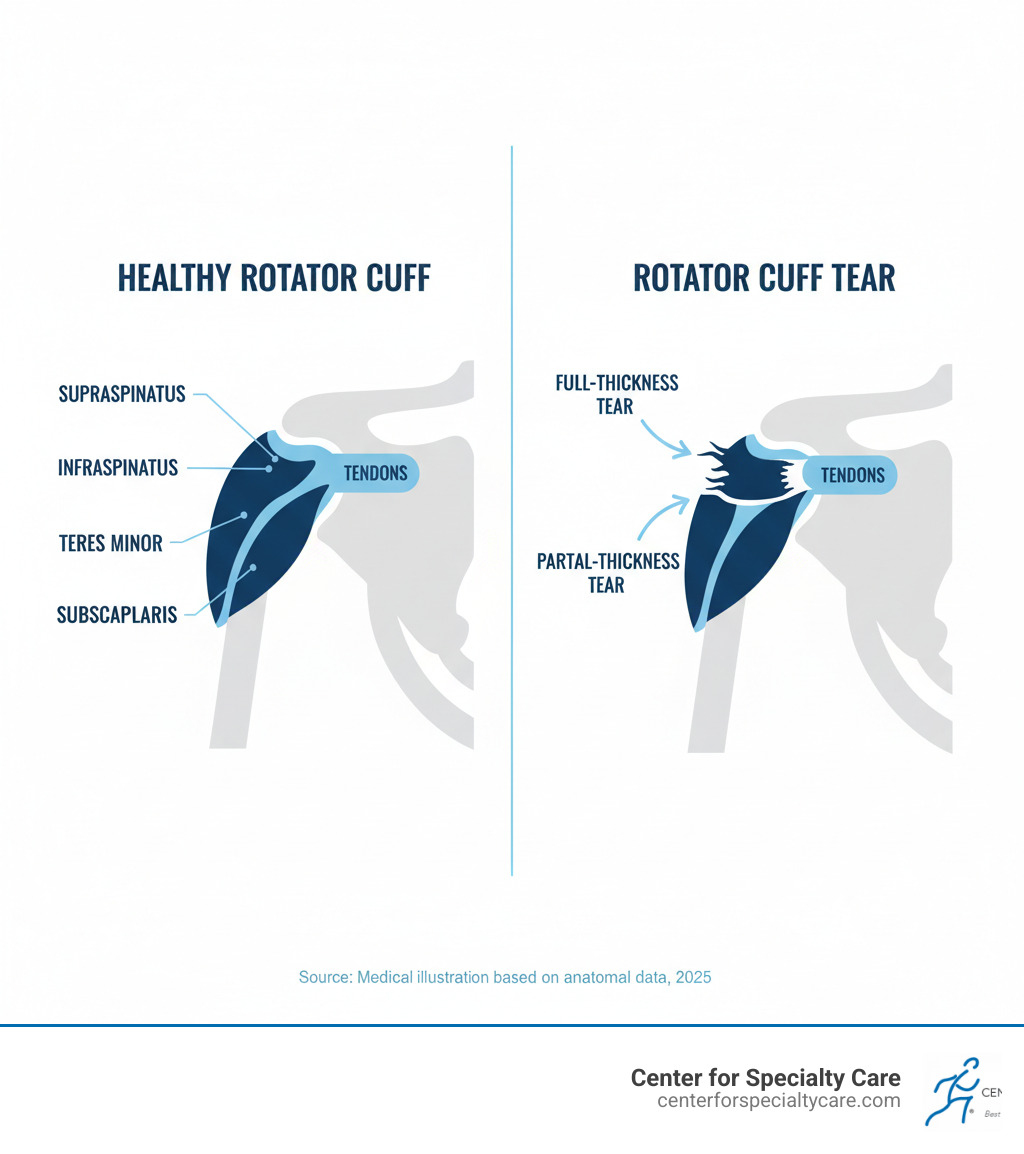
Your rotator cuff is a group of four muscles and their tendons (supraspinatus, infraspinatus, teres minor, and subscapularis) that keep your upper arm bone centered in the shoulder socket. These tendons stabilize and move the shoulder. A rotator cuff tear occurs when one or more of these tendons are damaged.
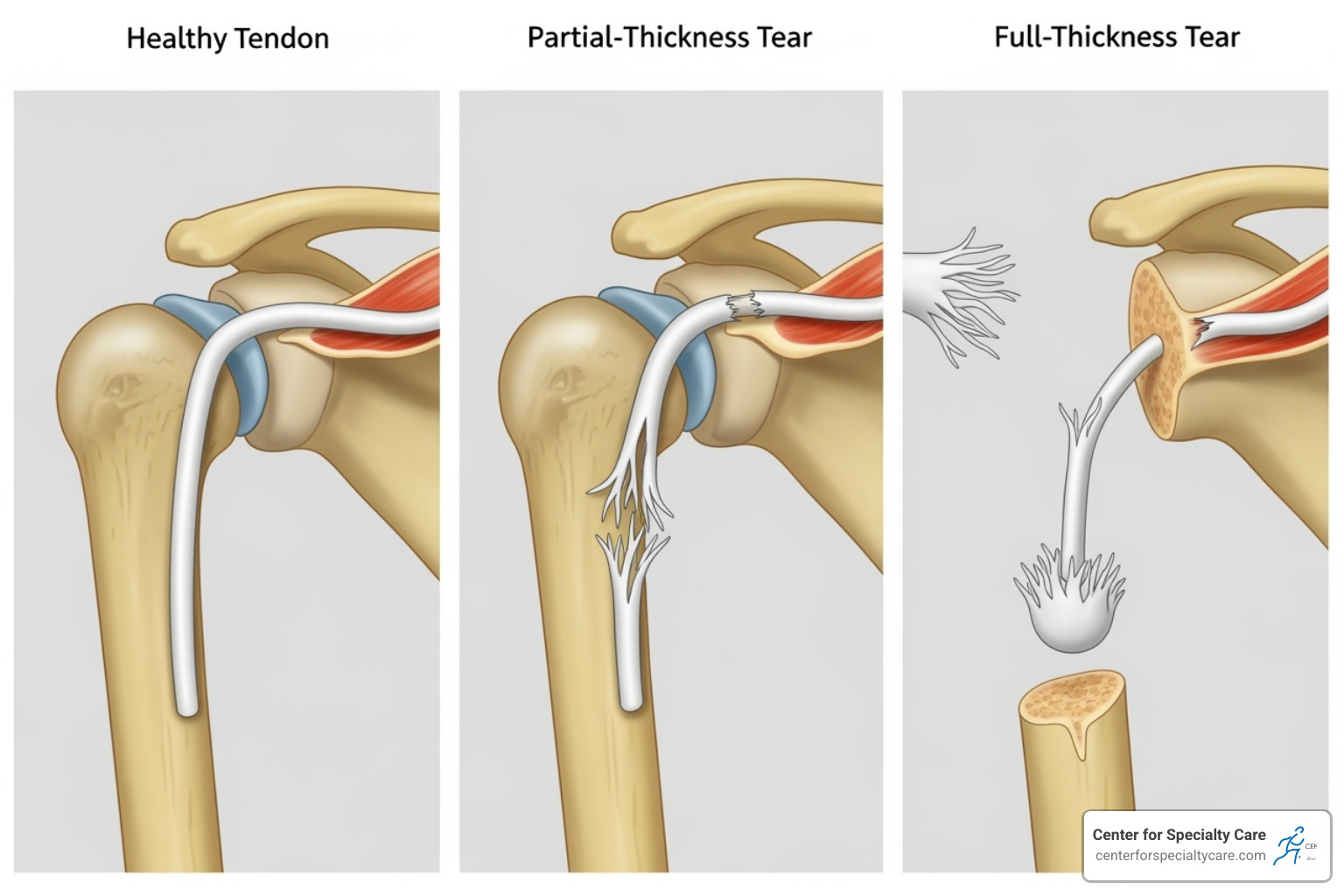
- A partial-thickness tear means the tendon is frayed but still attached to the bone.
- A full-thickness tear (or complete tear) means the tendon has fully detached from the bone.
Interestingly, up to 40% of people may have a rotator cuff tear without any symptoms. For many others, however, a tear causes significant pain and disability.
Main Causes: From Injury to Wear and Tear
Rotator cuff tears happen in two main ways: suddenly (acute) or gradually (degenerative).
Acute tears result from a specific event, such as a fall on an outstretched arm, lifting a heavy object with a jerking motion, or a sudden injury like a direct blow. Car accidents are another common cause; if you have shoulder pain after a collision, see our guide on Shoulder Pain After Car Accident: Causes, Recovery Tips.
Degenerative tears, which are more common, develop slowly from wear and tear. Key factors include:
- Repetitive overhead motion: Jobs or sports like painting, carpentry, or swimming put consistent stress on the tendons.
- Aging: After age 40, tendons lose elasticity and blood supply, making them more fragile. Most tears occur in people over 50.
- Bone spurs: Bony growths can rub against the rotator cuff tendons, eventually causing a tear.
- Genetics: A family history of rotator cuff problems can increase your risk.
Recognizing the Symptoms
The signs of a rotator cuff tear can be subtle at first but often include:
- A dull ache deep in the shoulder that is persistent and nagging.
- Pain that worsens at night, often disrupting sleep. Lying on the affected shoulder can be impossible. For tips, read our article on How to Relieve Rotator Cuff Pain at Night: Expert Tips for Better Sleep.
- Arm weakness, making it difficult to lift your arm or carry objects.
- Difficulty with daily activities like combing your hair or reaching behind your back.
- Limited range of motion or a feeling of stiffness in the shoulder.
- Clicking or popping sounds when moving the shoulder. Learn more in our guide to Shoulder Clicking and Pain: Causes, Effective Relief.
An acute tear may cause immediate, intense pain, while a degenerative tear might start as mild discomfort that worsens over months. Paying attention to these signals is the first step toward getting help.
Diagnosis and When to See a Doctor
If you have persistent shoulder pain, a proper diagnosis is the first step toward recovery. The sooner you know the cause, the sooner you can begin the right treatment.
How is a Rotator Cuff Tear Diagnosed?
Diagnosing a rotator cuff tear involves a comprehensive approach to pinpoint the problem.
- Medical History: We start by discussing your symptoms, when the pain began, and whether a specific injury occurred. This helps determine if the tear is acute or degenerative.
- Physical Examination: Our orthopedic shoulder specialists will test your shoulder’s range of motion and strength. Specific maneuvers help identify which rotator cuff muscles may be damaged.
- Imaging Tests: While a physical exam is revealing, imaging provides a definitive look. An X-ray can rule out other issues like fractures or bone spurs. An ultrasound allows us to see the tendons in real-time as you move your arm. For the most detailed view of soft tissues, an MRI is the gold standard. It shows the exact size and location of the tear and helps us create a precise treatment plan.
At the Center for Specialty Care, our orthopedic shoulder specialists use this process to ensure an accurate diagnosis custom to your situation.
When to Seek Medical Attention
It’s easy to dismiss shoulder pain, but ignoring it can allow a small problem to become a big one. You should seek medical attention for:
- Persistent pain that doesn’t improve with a few days of rest.
- Pain that disrupts your sleep. If you’re waking up at night from shoulder pain, it’s time to get it checked. (See our tips on relieving rotator cuff pain at night.)
- Difficulty performing daily activities like dressing or reaching for items.
- Sudden, intense pain after an injury, which could signal an acute tear needing prompt evaluation.
- Significant arm weakness that makes it hard to lift your arm.
At the Center for Specialty Care, we offer quick appointment availability because we know you can’t wait weeks when you’re in pain. If you’re unsure whether to see a specialist, our guide on choosing a doctor for shoulder problems can help. Trust your instincts—if something feels wrong, we’re here to help.
Exploring Treatment Options for a Rotator Cuff Tear
A rotator cuff tear doesn’t automatically mean surgery. At the Center for Specialty Care, we always explore non-surgical options first, tailoring treatment to your specific needs and lifestyle. Our goal is to get you back to your life, pain-free.
Non-Surgical Treatments
Encouragingly, about 80 percent of people with partial tears improve without surgery. Even some complete tears can be managed conservatively. This approach combines several methods to reduce pain and restore function.
- Rest and Activity Modification: This involves avoiding activities that aggravate your shoulder, like overhead reaching or heavy lifting. A sling may be used briefly for initial rest.
- Ice and Anti-inflammatories: Applying ice for 15-20 minutes can reduce pain and inflammation. Over-the-counter NSAIDs like ibuprofen can also help manage symptoms.
- Physical Therapy: This is the cornerstone of non-surgical treatment. A physical therapist guides you through exercises to restore range of motion and strengthen the muscles supporting your shoulder. Our article on Shoulder Treatment with Physical Therapy: Recovery, Pain Relief details this approach. Our Physical Therapy center offers custom programs for your recovery.
- Corticosteroid Injections: When pain interferes with physical therapy, an injection can reduce inflammation, creating a “window of opportunity” for you to engage in strengthening exercises. Learn more in our guide to Types of Injections for Shoulder Pain Relief: Treatment Options. Our Pain Management team can help determine if this is right for you.
- Stretching Exercises: Maintaining flexibility is crucial for recovery and preventing future issues. This information on stretching exercises provides helpful guidance.
Surgical Treatments
Surgery may be the right choice for complete tears in active individuals, or when non-surgical treatment fails to provide relief. We thoroughly evaluate your tear, age, and activity level before recommending a procedure.
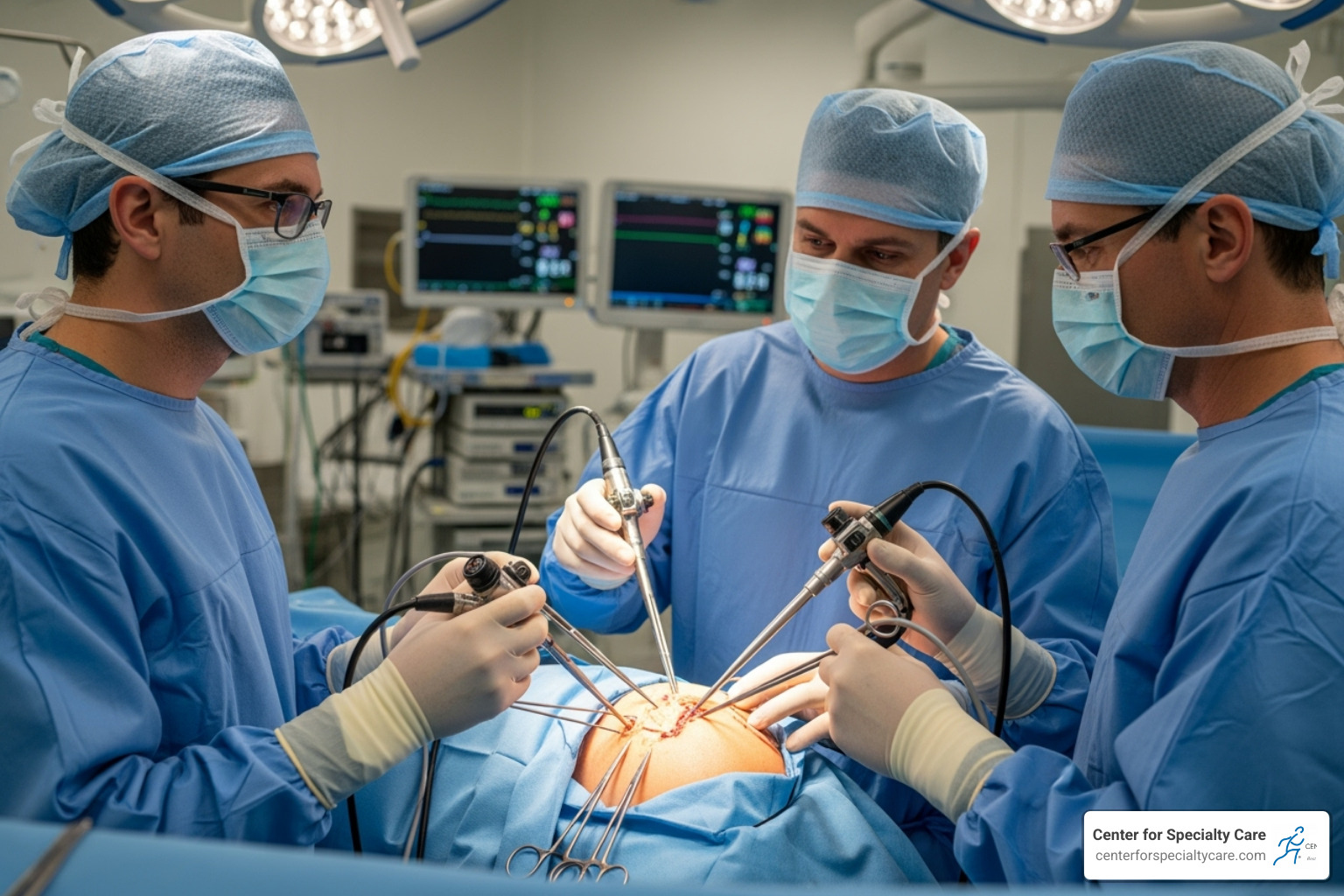
- Arthroscopic Repair: This is the most common, minimally invasive technique. Using a tiny camera and specialized instruments inserted through small incisions, we reattach the torn tendon to the bone with suture anchors. This method typically results in less pain and a faster initial recovery.
- Open Repair: For very large or complex tears, a larger incision may be needed to provide direct access for the repair.
- Tendon Transfer: In cases of massive, irreparable tears, a healthy tendon from a nearby muscle can be transferred to restore shoulder function.
- Reverse Total Shoulder Replacement: For patients with a massive tear and severe arthritis, this procedure reverses the shoulder’s ball-and-socket anatomy, allowing the deltoid muscle to lift the arm. It can be a life-changing option for the right patient. For more details, review this overview of rotator cuff injuries.
Our team at the Center for Specialty Care is committed to your recovery. Learn more at our Orthopedics page and our Best Therapy for Shoulder Pain: Expert Solutions & Relief resource.
Recovery, Prognosis, and Prevention
Recovering from a rotator cuff tear requires patience and commitment. Understanding the timeline and how to protect your shoulder long-term is key to a successful outcome.
The Road to Recovery: Timelines and Expectations
Recovery time varies based on the tear’s severity and the treatment method. Consistency with your rehabilitation program is the most important factor.
- Non-Surgical Recovery: Improvement is gradual. Pain often eases within a few weeks, with functional improvements in three to six months. Full recovery with consistent physical therapy can take up to a year. Our Physical Therapy team will guide you through this process.
- Surgical Recovery: This timeline is more structured. You’ll wear a sling for four to six weeks to protect the repair. Passive range-of-motion exercises begin early, followed by active strengthening exercises around the six-to-eight-week mark. Most patients regain significant function within four to six months, but a full return to demanding activities may take 12 to 18 months.
| Treatment Type | Initial Recovery | Functional Recovery | Full Recovery |
|---|---|---|---|
| Non-Surgical | Weeks to months for pain control | 3-6 months to regain strength & motion | Up to 1 year |
| Surgical | Sling for 4-6 weeks, passive PT | Active PT for 2-6 months | 12-18 months |
Rehabilitation can feel slow, but our team will be with you at every step, adjusting your plan and celebrating your progress.
Long-Term Outlook (Prognosis)
The long-term outlook for a rotator cuff tear is generally positive. Most people achieve significant pain relief and return to their favorite activities. Success depends on the tear size, your age, and, most importantly, your adherence to rehabilitation. Untreated tears, however, can worsen over time, leading to larger tears, muscle atrophy, and the development of severe arthritis (rotator cuff arthropathy). Early diagnosis and treatment at our Orthopedics clinics in Fairmont MN, Estherville IA, Buffalo Center IA, and St James MN can prevent these complications.
How to Prevent Future Tears
Once you’ve recovered, reducing the risk of a future rotator cuff tear is crucial. Key prevention strategies include:
- Strengthening: Regular exercises targeting the shoulder, shoulder blades, and upper back create a stable joint.
- Flexibility: Daily stretching keeps muscles and tendons pliable and less prone to injury.
- Proper Lifting Technique: Use your legs, keep objects close to your body, and avoid twisting.
- Gradual Progression: Slowly increase the intensity of new activities or workouts to allow your body to adapt.
- Ergonomics: If your job involves repetitive overhead work, take frequent breaks and ensure your workspace is set up properly.
- Listen to Your Body: Don’t push through pain. Early intervention for minor issues can prevent major ones.
For more expert guidance, explore our Best Therapy for Shoulder Pain: Expert Solutions & Relief page.
Frequently Asked Questions about Rotator Cuff Tears
Here are answers to some of the most common questions we hear from patients dealing with a rotator cuff tear.
Will a torn rotator cuff heal on its own?
No, a complete rotator cuff tear, where the tendon is fully detached, cannot heal on its own due to poor blood supply. However, this doesn’t always mean surgery is necessary. Many people with partial and even some complete tears can manage their symptoms effectively through non-surgical treatments like physical therapy. The goal is to become pain-free and functional, even if the tear is still visible on an MRI. For more details, read: Will a Torn Rotator Cuff Heal on Its Own? Key Recovery Facts.
What does a rotator cuff tear feel like?
The most common symptom is a dull, deep ache in the shoulder. Other key signs include pain that worsens at night, especially when lying on the affected side, and pain with specific movements like reaching overhead. You may also notice significant arm weakness and hear or feel clicking or popping sensations. An acute tear from an injury often causes sudden, sharp pain, while a degenerative tear may start as a minor annoyance that gradually worsens.
Can I still work with a rotator cuff tear?
This depends on your job’s physical demands and the severity of your tear. If you have a desk job, you can often continue working with ergonomic adjustments and regular breaks. However, for manual labor involving heavy lifting or repetitive overhead motion, working can be difficult and may worsen the tear. In these cases, modified light-duty work or time off for recovery may be necessary. At Center for Specialty Care, we can assess your situation and provide clear work restriction guidance to ensure a safe return to your duties.
Conclusion: Taking the Next Step for Your Shoulder Health
You now understand what a rotator cuff tear is, what causes it, and how it can be treated. While this common injury can be disruptive, the good news is that effective treatments are available. The path to healing varies for everyone, from physical therapy and injections to minimally invasive surgery.
What matters most is getting a personalized diagnosis and treatment plan. At the Center for Specialty Care, we are committed to this approach. Our team serves communities across southern Minnesota and northern Iowa, with locations in Fairmont MN, Estherville IA, Buffalo Center IA, and St James MN. We pride ourselves on quick appointment availability and a commitment to 100% patient satisfaction.
You don’t have to live with shoulder pain. Whether you want to get back to your golf game or simply sleep through the night, we are here to help you move freely and live without limits.
Ready to take the next step? Learn more about our comprehensive shoulder care and let us help you get back to doing what you love.