
Why Your Shoulder Blade Hurts and How to Fix It
April 29, 2026
Emergency Room Guide for a Dislocated Shoulder
May 1, 2026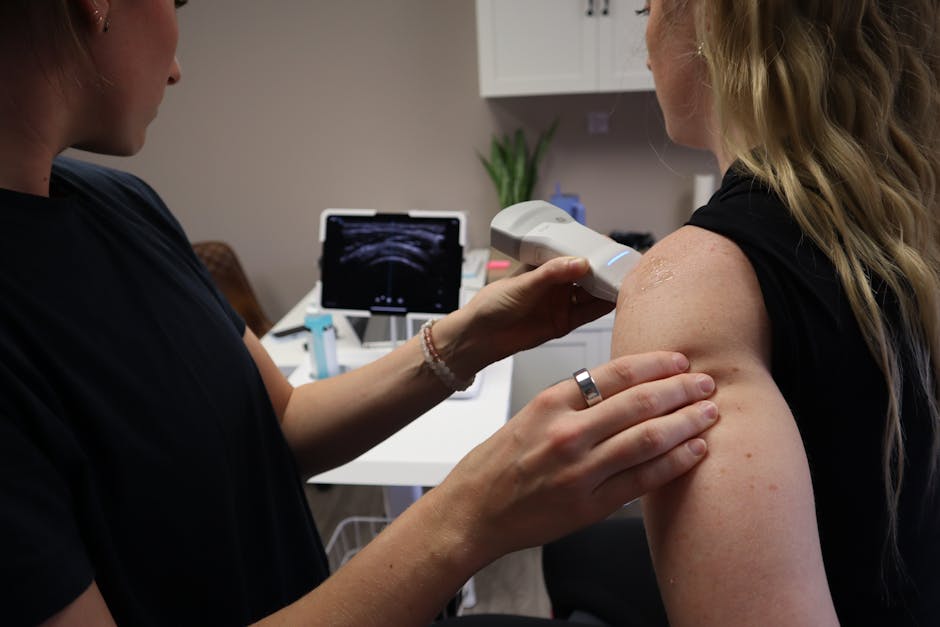
The Shoulder Joint’s Secret Support Squad
The Most Mobile Joint in Your Body Needs the Most Support
Shoulder ligaments and tendons are the connective tissues that hold your shoulder together and make it move. Here’s a quick overview:
| Structure | Type | Main Role |
|---|---|---|
| Glenohumeral ligaments | Ligament (bone to bone) | Prevent dislocation of the ball-and-socket joint |
| Coracoclavicular ligaments | Ligament (bone to bone) | Keep the collarbone anchored to the shoulder blade |
| Acromioclavicular ligament | Ligament (bone to bone) | Stabilize the AC joint at the top of the shoulder |
| Rotator cuff tendons (×4) | Tendon (muscle to bone) | Control arm rotation and hold the humeral head in place |
| Biceps tendons | Tendon (muscle to bone) | Support elbow flexion and shoulder stability |
Your shoulder is the most flexible joint in your body. It can flex, extend, rotate, and swing in a full circle. But that extreme range of motion comes with a trade-off — the joint is inherently unstable. The ball of your upper arm bone (humerus) sits in a socket (glenoid) that’s about as shallow as a golf tee. Without a strong network of ligaments and tendons working together, the joint would slip out of place constantly.
That’s exactly why shoulder ligaments and tendons matter so much — and why injuries to them are among the most common reasons people experience shoulder pain and loss of function.
I’m Dr. Corey Welchlin, a board-certified orthopedic surgeon with over 30 years of experience treating shoulder conditions — including rotator cuff repairs and complex ligament instability — at the Center for Specialty Care in Fairmont, Minnesota. Understanding the anatomy of shoulder ligaments and tendons is the foundation for understanding why these injuries happen and how to treat them effectively.
Anatomy of Shoulder Ligaments and Tendons
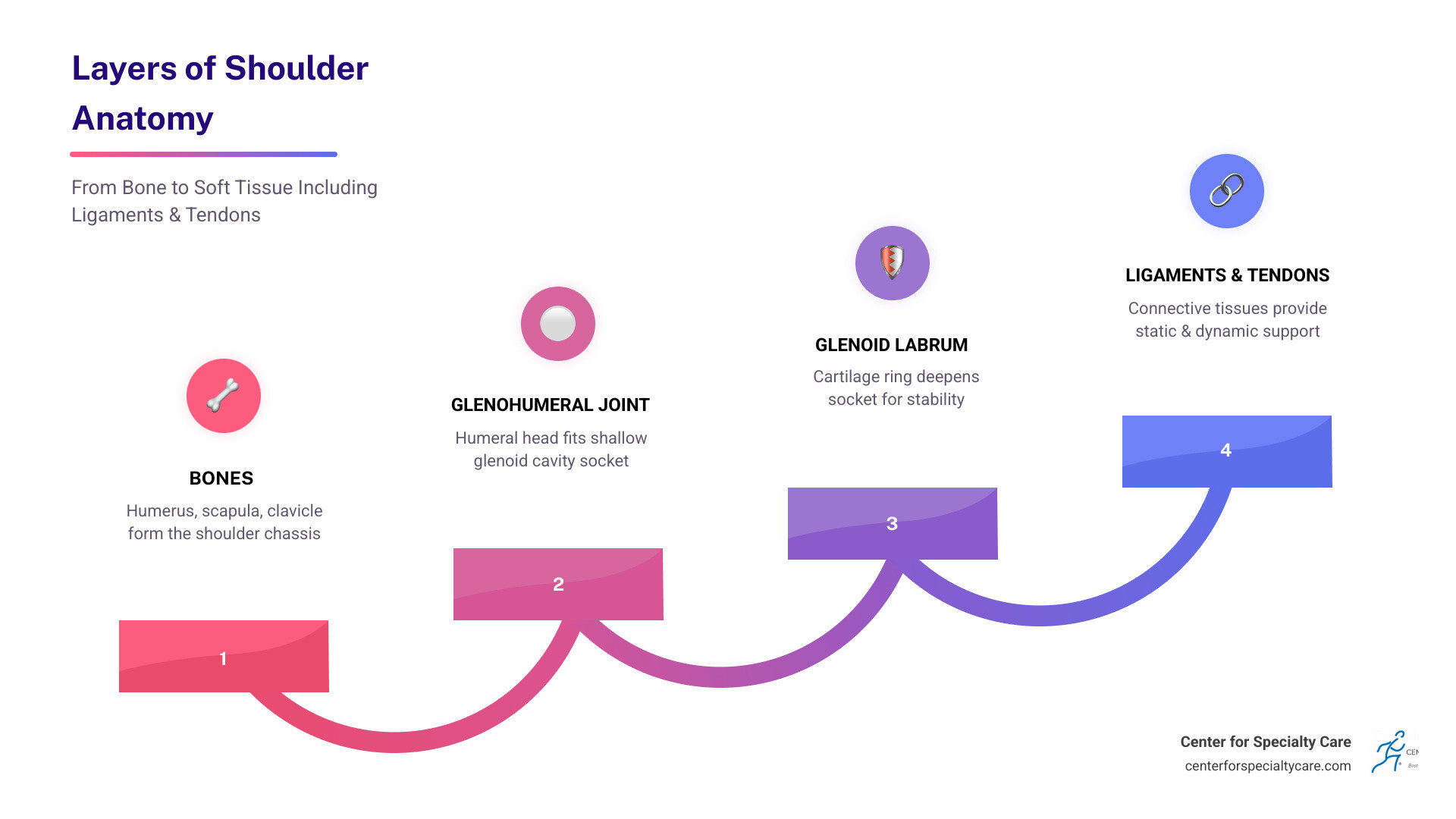
To understand how the shoulder works, we first have to look at the “chassis.” The shoulder complex isn’t just one joint; it is a sophisticated arrangement of three bones: the humerus (upper arm bone), the scapula (shoulder blade), and the clavicle (collarbone).
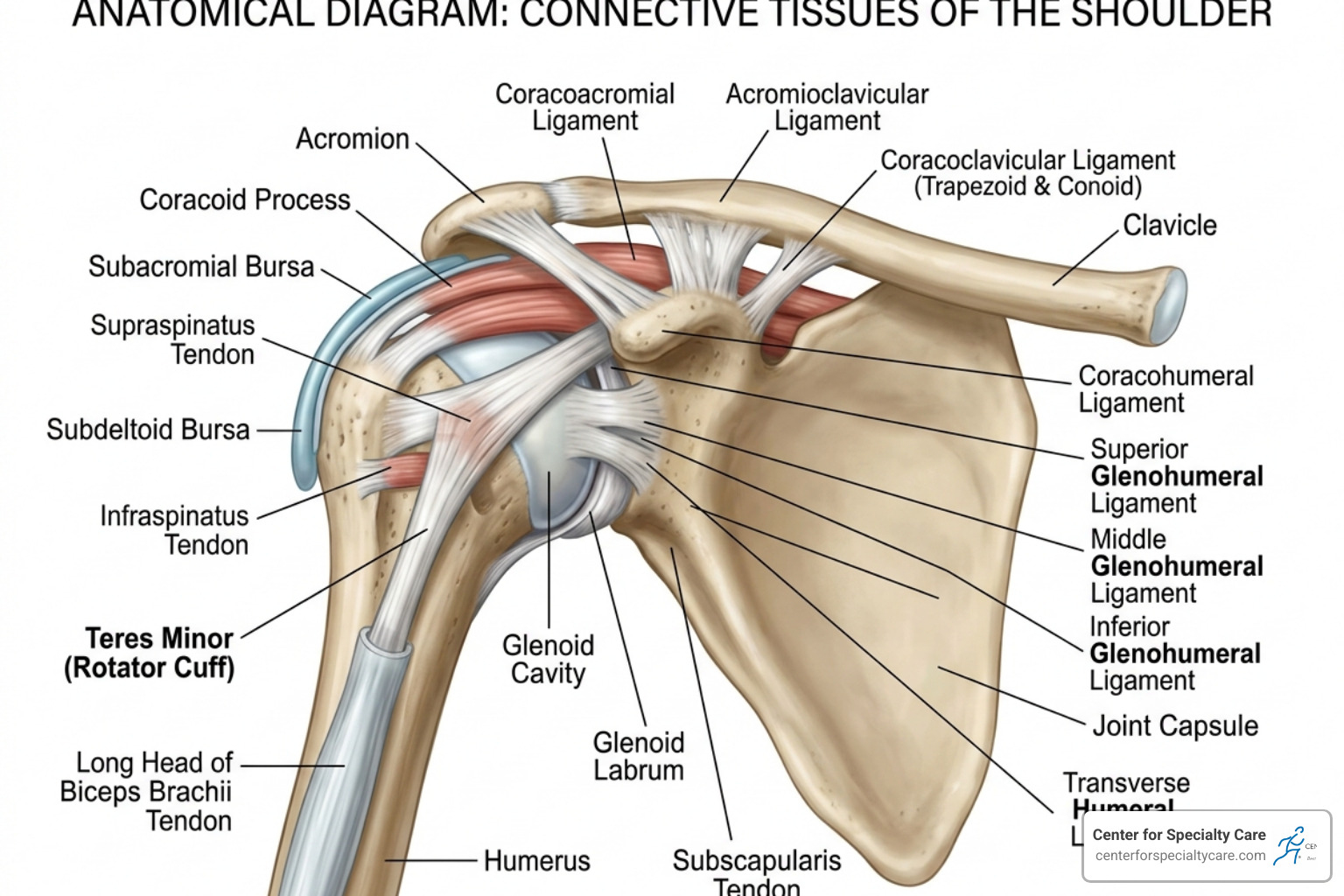
The primary meeting point is the glenohumeral joint, where the head of the humerus fits into the glenoid cavity of the scapula. Because this socket is so shallow, it relies on a specialized ring of cartilage called the glenoid labrum to deepen the “cup” and provide a better fit for the humeral head.
Surrounding this bony architecture are the Human Shoulder Anatomy – Muscles, Ligaments, Tendons & Joints that act as the glue and the motors. Ligaments (bone-to-bone) provide the “static” stability—they are the emergency brakes that keep things from flying apart. Tendons (muscle-to-bone) provide “dynamic” stability—they move the bones and compress the joint together during activity. When these structures are compromised, patients often report Shoulder Clicking And Pain Causes Effective Relief as the joint loses its smooth tracking.
The Static Stabilizers: Primary Shoulder Ligaments
Ligaments are dense, fibrous tissues designed to withstand multi-directional forces. In the shoulder, they are often named after the two bones they connect. According to Shoulder Anatomy – Orthogate, the most critical include:
- Glenohumeral Ligaments (GHL): These consist of the superior, middle, and inferior bands. Together, they form a watertight joint capsule that acts as the primary defense against dislocation. The inferior GHL is particularly important as it becomes taut during overhead movements to prevent the arm from slipping out of the bottom of the socket.
- Coraco-clavicular (CC) Ligaments: Comprised of the trapezoid and conoid ligaments, these are incredibly strong. They anchor the clavicle to the coracoid process of the scapula, keeping your shoulder “square.”
- Acromio-clavicular (AC) Ligament: This stabilizes the joint at the very top of your shoulder where the collarbone meets the acromion.
- Coraco-acromial Ligament (CAL): Interestingly, this ligament connects two parts of the same bone (the scapula). It forms a protective arch over the humeral head, but if it becomes too tight or thickened, it can contribute to impingement syndrome.
- Transverse Humeral Ligament (THL): This small band acts like a seatbelt, holding the long head of the biceps tendon securely in its groove on the humerus.
The Dynamic Movers: Key Shoulder Tendons
While ligaments provide the structural boundaries, tendons are the workhorses. The most famous group is the rotator cuff, a collection of four muscles and their corresponding tendons that wrap around the humeral head like a sleeve.
- Supraspinatus: The most commonly injured tendon; it helps lift the arm out to the side.
- Infraspinatus: Allows you to rotate your arm outward (external rotation).
- Teres Minor: Also assists with external rotation and stabilizes the back of the joint.
- Subscapularis: The largest and strongest cuff tendon, located on the front of the shoulder, responsible for internal rotation.
Beyond the rotator cuff, the biceps tendon plays a dual role. The “long head” of the biceps travels through the joint and attaches to the top of the glenoid. This unique positioning means the biceps actually helps keep the humeral head centered in the socket during heavy lifting. Understanding these Anatomy, Shoulder and Upper Limb, Shoulder Muscles – StatPearls – NCBI Bookshelf is vital because a tear in one often places undue stress on the others. Patients frequently ask, Will A Torn Rotator Cuff Heal On Its Own Key Recovery Facts; the answer depends largely on which of these specific tendons is involved and the severity of the gap.
How Static and Dynamic Stabilizers Support the Joint
The shoulder works through a delicate balance of “static” and “dynamic” forces. Think of the static stabilizers as the guardrails and the dynamic stabilizers as the driver steering the car.
| Feature | Static Stabilizers | Dynamic Stabilizers |
|---|---|---|
| Components | Ligaments, Labrum, Joint Capsule | Rotator Cuff, Biceps, Scapular Muscles |
| Function | Limits end-range motion | Compresses joint during movement |
| Activation | Passive (always “on”) | Active (requires muscle contraction) |
| Key Mechanism | Negative intra-articular pressure | Force couples & Scapulohumeral rhythm |
One of the most fascinating aspects of shoulder mechanics is the scapulohumeral rhythm. For every 2 degrees the humerus moves, the scapula must rotate 1 degree (a 1:2 ratio). If the tendons of the rotator cuff or the muscles stabilizing the shoulder blade are weak, this rhythm breaks down, leading to Shoulder Joint Pain Popping Causes Effective Relief needs.
Research from Anatomy, Shoulder and Upper Limb, Glenohumeral Joint – StatPearls – NCBI Bookshelf highlights the “rotator cable,” a thick band of fibers within the rotator cuff that helps distribute loads across the tendons. This system, combined with the suction-like effect of negative pressure inside the joint capsule, keeps the “golf ball” centered on the “tee” even during a 90-mph fastball or a heavy bench press.
Common Injuries to Shoulder Ligaments and Tendons
Because the shoulder is so mobile, it is prone to a variety of “wear and tear” and traumatic injuries. In primary care, rotator cuff conditions are the leading cause of shoulder-related visits.
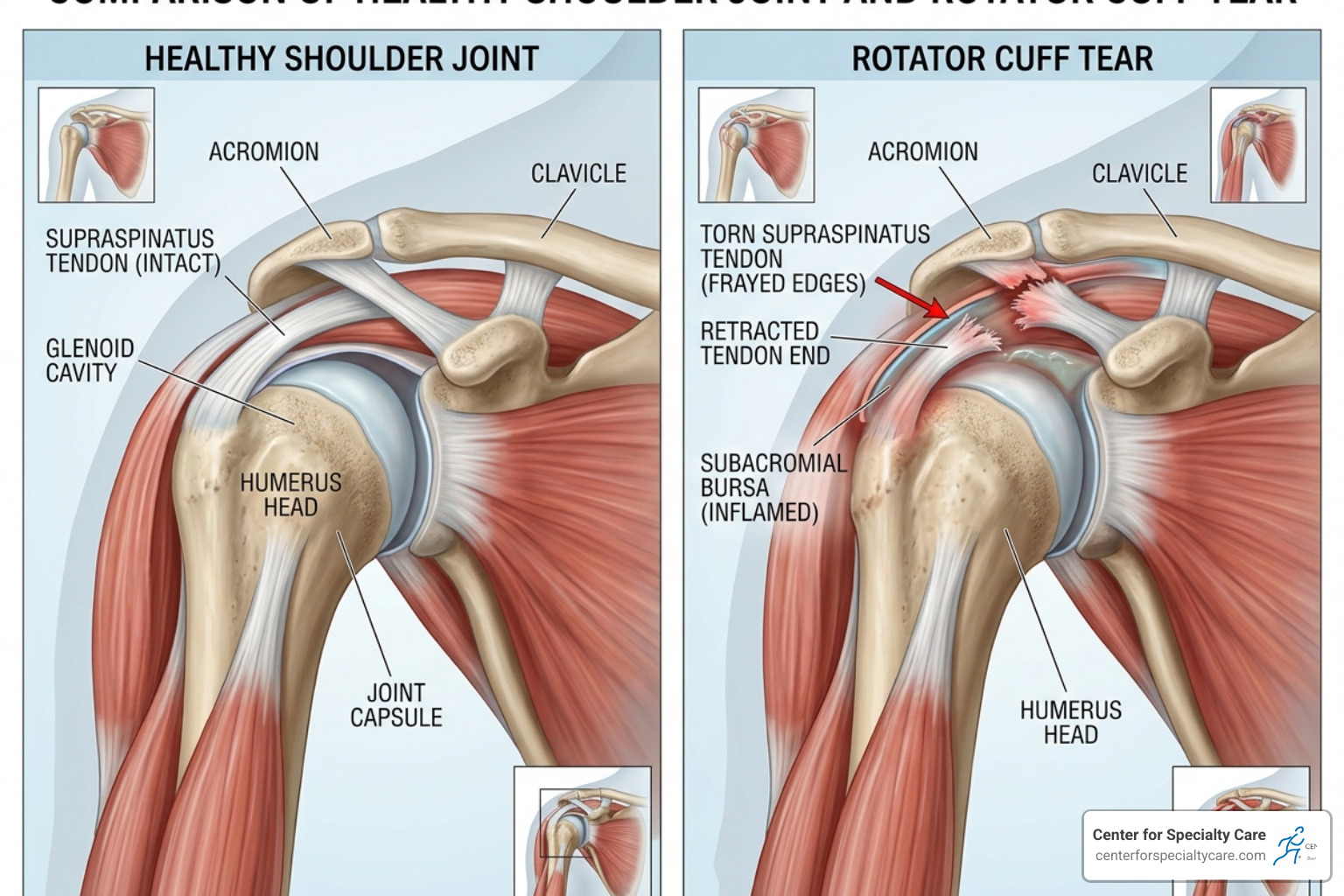
- Rotator Cuff Tears: Can be acute (from a fall) or degenerative (from age). The supraspinatus is the “usual suspect” here.
- Impingement Syndrome & Subacromial Bursitis: This occurs when the space between the acromion and the rotator cuff narrows, “pinching” the tendons and the fluid-filled bursa sac.
- Bicipital Tendinitis: Inflammation of the long head of the biceps tendon, often causing pain at the front of the shoulder.
- SLAP Tears: Standing for “Superior Labrum Anterior to Posterior,” these occur where the biceps tendon attaches to the labrum. This is a common injury for “overhead athletes” like pitchers or volleyball players.
- Shoulder Dislocation: The glenohumeral joint accounts for 45% of all body dislocations. Statistically, 96% of these are anterior dislocations (the ball pops out the front).
- Adhesive Capsulitis (Frozen Shoulder): A condition where the joint capsule (ligaments) becomes thick, stiff, and inflamed. It affects about 3% of the population, mostly women aged 40 to 70.
Whether you are dealing with Shoulder Pain After Car Accident Causes Recovery Tips or you are wondering Why Is My Shoulder Popping Common Causes Solutions, the root cause is almost always a disruption in the synergy between these ligaments and tendons.
Diagnosis and Treatment for Shoulder Damage
If you’re experiencing persistent pain, the first step is a thorough evaluation. At our clinics in Fairmont and St. James, we start with a physical exam using provocative tests. The Hawkins-Kennedy and Neer’s tests help us identify impingement, while the Apprehension test can signal ligamentous laxity or instability.
Imaging is the next piece of the puzzle:
- X-rays: Great for seeing bone spurs or arthritis but won’t show a torn tendon.
- MRI: The “gold standard” for visualizing shoulder ligaments and tendons.
- Musculoskeletal Ultrasound: A dynamic way to see tendons moving in real-time.
Getting an accurate diagnosis from an Iowa Health specialist or our local experts is essential to avoid long-term joint degradation. If you are struggling to find answers, we can help you in Finding The Best Orthopedic Shoulder Specialist Near Me.
Non-Surgical Interventions
We believe in a “conservative first” approach. Many ligament and tendon issues respond beautifully to non-invasive care:
- Activity Modification: Learning to lift and move in ways that don’t aggravate the injury.
- Physical Therapy: Strengthening the “dynamic stabilizers” to take the pressure off injured ligaments. We offer specialized Shoulder Treatment With Physical Therapy Recovery Pain Relief.
- Medications: NSAIDs like ibuprofen or naproxen to manage inflammation.
- Injections: Cortisone can provide rapid relief for bursitis, while other Types Of Injections For Shoulder Pain Relief Treatment Options may support tissue health.
- Deep Tissue Laser Therapy: Available at our Estherville location, this helps accelerate the natural healing of soft tissues.
Surgical Repair Options
When conservative measures fail, or if a tear is complete, surgery may be the best path to restoring function. Modern shoulder surgery is typically minimally invasive.
- Arthroscopy: Using tiny cameras and instruments to repair tissues through “keyhole” incisions.
- Rotator Cuff Repair: Reattaching the torn tendon to the humerus using specialized anchors.
- Biceps Tenodesis: Relocating a damaged biceps tendon to a new attachment point on the humerus to relieve pain.
- Labral Repair: Re-anchoring the labrum to stabilize the joint after a dislocation.
- Debridement: Cleaning out frayed tissue and bone spurs that cause friction.
If you need a Rotator Cuff Surgeon Near Me Find Trusted Specialists In Your Area, we provide advanced surgical care right here in Southern Minnesota and Northern Iowa.
Recovery Timeline and Prevention Strategies
Recovery is a marathon, not a sprint. Ligaments and tendons have a relatively poor blood supply compared to muscles, meaning they take longer to knit back together.
Typical Recovery Phases:
- Phase 1 (Weeks 0-6): Protection and immobilization. Most patients wear a sling for 4-6 weeks to allow the initial “biological glue” to set.
- Phase 2 (Weeks 6-12): Passive range of motion. We start moving the joint without using the muscles.
- Phase 3 (Months 3-6): Strengthening. Gradually reintroducing resistance to build up the dynamic stabilizers.
- Phase 4 (Months 6+): Return to sports or heavy labor.
Prevention is always better than repair. To keep your shoulder ligaments and tendons healthy, focus on:
- Ergonomics: Ensure your workstation doesn’t force you into a “hunched” posture that pinches the rotator cuff.
- Posterior Capsule Stretching: Keeping the back of the shoulder flexible prevents the humeral head from shifting forward and up.
- Rotator Cuff Strengthening: Simple “internal and external rotation” exercises with light bands can prevent a world of hurt.
- Warm-ups: Never jump into overhead lifting or throwing without a proper warm-up.
For more detailed guidance, check out our Shoulder Treatment Physical Therapy Tips For Fast Recovery.
Frequently Asked Questions about Shoulder Ligaments and Tendons
What is the difference between a shoulder ligament and a tendon?
A ligament connects bone to bone (providing stability), while a tendon connects muscle to bone (allowing for movement). Think of ligaments as the “ropes” that keep the joint from coming apart and tendons as the “cables” that pull the bones to create motion.
How do I know if I tore a ligament or a tendon in my shoulder?
Tears in tendons (like the rotator cuff) usually cause weakness and pain when lifting the arm. Ligament injuries (like a labral tear or sprain) often feel like the shoulder is “loose,” “giving way,” or “clunking” during movement. However, because they are so close together, only a professional exam and an MRI can tell for sure.
Can shoulder ligament tears heal without surgery?
Small partial tears and “stretches” (sprains) can often heal with rest and physical therapy. However, complete ruptures or tears in the labrum that cause repeated dislocations usually require surgical intervention to restore stability.
Conclusion
The shoulder is a masterpiece of anatomical engineering, but its reliance on shoulder ligaments and tendons makes it uniquely vulnerable. Whether you are an athlete in Fairmont, a farmer in Buffalo Center, or a retiree in St. James, maintaining the health of your “Secret Support Squad” is the key to a pain-free life.
At the Center for Specialty Care, we are committed to 100% patient satisfaction and personalized care. We understand how disruptive shoulder pain can be, and we offer quick appointment availability to get you back to the activities you love. From non-surgical laser therapy to advanced arthroscopic repair, we have the tools to help.
If you’ve recently experienced an injury, don’t wait for the damage to become permanent. Review our guide on Shoulder Pain After Car Accident Causes Recovery Tips or contact us today to schedule a consultation with our specialists in Fairmont, Minnesota, or our surrounding locations.