How to roll your way out of a sticky muscle situation
April 22, 2026
The Ultimate Rhomboid Muscle Strain Recovery Plan
April 24, 2026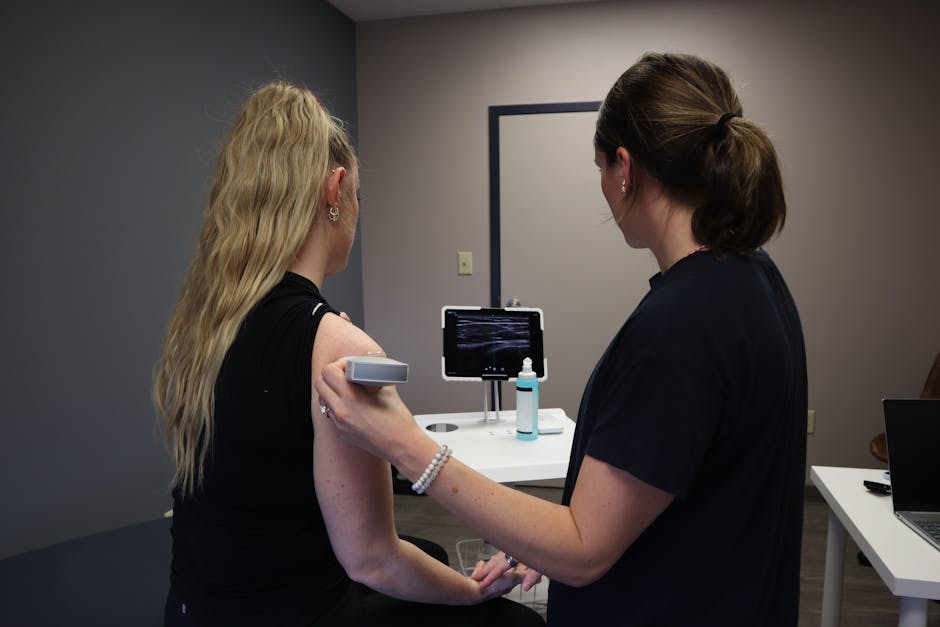
Simple Tests to Check for a Rotator Cuff Injury
When Shoulder Pain Stops You: What a Rotator Cuff Injury Test Can Tell You
A rotator cuff injury test is a quick physical assessment used to check whether the muscles and tendons around your shoulder joint are damaged. Here are the three most reliable tests you can try at home:
- Empty Can Test – Raise your arm to shoulder height with your thumb pointing down, then resist downward pressure. Pain or weakness points to a supraspinatus problem.
- Drop Arm Test – Lift your arm to 90 degrees, then slowly lower it. If it drops suddenly or feels very weak, this may signal a full-thickness tear.
- Lift-Off Test – Place the back of your hand against your lower back and try to push it away. Inability to do so suggests a subscapularis injury.
Shoulder pain can sneak up on you. One day you’re reaching for something on a shelf. The next, you can’t lift your arm without wincing.
More than 4.5 million people visit a doctor in the U.S. every year for rotator cuff pain. Yet many people wait too long before getting answers — often because they’re not sure whether what they’re feeling is serious.
That’s exactly what these tests are for. They won’t replace a professional diagnosis, but they give you a starting point — a way to understand what might be hurting and why.
I’m Dr. Corey Welchlin, a board-certified orthopedic surgeon with over 30 years of experience treating rotator cuff injuries through both surgical and conservative care at the Center for Specialty Care in Fairmont, Minnesota. I’ve used and refined rotator cuff injury test protocols throughout my career to help patients get faster, more accurate answers about their shoulder pain.

Rotator cuff injury test terminology:
Understanding Your Shoulder and the Rotator Cuff Injury Test
To understand why a rotator cuff injury test works, we first need to look at the “SITS” muscles. Think of your shoulder joint like a golf ball sitting on a tee. The golf ball is the head of your upper arm bone (humerus), and the tee is the socket (glenoid). Because the socket is very shallow, the ball would roll right off if it weren’t for the rotator cuff.
The rotator cuff is a group of four muscles and their tendons that act like a sleeve, pulling the ball tightly into the socket. These muscles are:
- Supraspinatus: This is the most commonly injured muscle. It helps you lift your arm out to the side (the first 15 degrees of movement).
- Infraspinatus: Located on the back of the shoulder blade, it helps you rotate your arm outward (like hitchhiking).
- Teres Minor: A small muscle that works with the infraspinatus to assist in external rotation.
- Subscapularis: Located on the front of the shoulder blade, it handles internal rotation (reaching toward your belly or behind your back).

When we perform a rotator cuff injury test, we are essentially “isolating” these muscles one by one to see which one “gives out” or causes pain.
Identifying Common Causes of Shoulder Pain
Injuries to the rotator cuff generally fall into two categories: acute trauma and chronic degeneration.
- Acute Trauma: This happens suddenly. You might fall on an outstretched arm, or try to lift something way too heavy with a jerking motion. You might even hear a “pop” followed by immediate weakness.
- Chronic Degeneration: This is the “wear and tear” that happens over time. As we age, the blood supply to these tendons decreases, making it harder for the body to repair mini-tears.
By age 60, about 30% of adults have a rotator cuff tear, and by age 80, that number jumps to 62%. Many of these individuals are “asymptomatic,” meaning they have a tear but don’t feel pain yet. However, repetitive motions—like those used by painters, carpenters, or baseball players—can turn a silent tear into a painful disability. Bone spurs can also narrow the space where the tendons sit, causing “impingement” or pinching every time you lift your arm.
For more detailed scientific reading on these specific muscles, you can explore the anatomy of the supraspinatus or the function of the subscapularis.
Common Symptoms and When to Test Your Shoulder
How do you know if that “twinge” in your shoulder is just a minor strain or a full-blown tear? While only imaging can tell for sure, the symptoms often differ in intensity.
| Symptom | Rotator Cuff Strain | Full-Thickness Tear |
|---|---|---|
| Pain Level | Dull ache, often improves with rest | Sharp pain, especially with overhead use |
| Night Pain | Occasional if sleeping on it | Frequent; often wakes you from sleep |
| Weakness | Mild; arm feels “heavy” | Significant; unable to lift the arm |
| Range of Motion | Mostly preserved, but painful | Limited; “hitching” the shoulder to lift arm |
| Sounds | Minimal | Clicking, popping, or “crepitus” (grinding) |
If you are experiencing pain that radiates down your arm (but usually stops before the elbow) or if you find yourself unable to reach for your wallet or brush your hair, it is time to perform a rotator cuff injury test.
We also see many patients who confuse shoulder pain with elbow issues. If your pain extends further down, you might want to read about specialized treatment for elbow pain to see if the source is actually lower in the arm.
Recognizing Red Flags for Professional Care
While at-home testing is a great first step, some “red flags” mean you should skip the self-assessment and call us immediately at Center for Specialty Care:
- Inability to lift the arm at all: This often indicates a massive, full-thickness tear.
- Sudden “Pop” and Weakness: If you felt a snap during a lift or fall and now the arm feels useless.
- Muscle Atrophy: If the muscles around your shoulder blade look smaller or “sunken” compared to the other side.
- Numbness or Tingling: This could indicate nerve involvement or a neck issue rather than a simple rotator cuff injury.
Step-by-Step Guide: How to Perform a Rotator Cuff Injury Test at Home
Before you start, a word of caution: Never force a movement that causes sharp pain. These tests are designed to reproduce symptoms, but “pushing through” can worsen a partial tear.
When clinicians talk about the accuracy of a rotator cuff injury test, we use two terms: sensitivity and specificity.
- Sensitivity means the test is good at catching a tear if it’s there.
- Specificity means the test is good at confirming it’s actually a rotator cuff issue and not something else (like bursitis).
Research published by the AAFP on diagnostic test accuracy suggests that combining these tests is much more accurate than doing just one.
The Empty Can Rotator Cuff Injury Test (Supraspinatus)
Also known as Jobe’s Test, this is the gold standard for checking the supraspinatus tendon.
How to do it:
- Stand or sit upright.
- Raise your injured arm out to the side and slightly forward (about 30 to 45 degrees in front of your body). This is called the “scapular plane.”
- Turn your hand so your thumb points toward the floor—as if you are emptying a can of soda.
- Have a friend or family member apply gentle downward pressure on your arm while you try to resist and keep the arm level.
What it means:
- Pain only: Suggests tendonitis or a minor strain.
- Weakness (arm drops): Suggests a mechanical injury or tear. If you can’t hold the arm up against even light pressure, the test is positive.
The Drop Arm Rotator Cuff Injury Test (Full-Thickness Tears)
This test is specifically designed to detect significant, full-thickness tears of the supraspinatus. It has a sensitivity of about 73% and a high specificity of 77%.
How to do it:
- Have a partner passively lift your arm out to the side until it is at a 90-degree angle (parallel to the floor).
- Your partner then lets go.
- You attempt to slowly lower your arm back to your side in a controlled manner.
What it means:
- A positive result occurs if your arm drops suddenly and uncontrollably, or if you experience severe pain and weakness as you try to lower it. This often indicates the tendon is too damaged to hold the weight of the arm. For more technical details, you can view the Physiopedia guide on the Drop Arm Test.
The Lift-Off Test for Subscapularis Integrity
This test (Gerber’s Test) checks the muscle on the front of your shoulder.
How to do it:
- Place the back of your hand against the small of your back (lumbar spine).
- Try to lift your hand away from your body, moving it toward the wall behind you.
- If you can do this, have your partner push against your hand while you try to keep it away from your back.
What it means:
- If you cannot lift your hand off your back at all, or if it snaps back against your spine when resistance is applied, it indicates a subscapularis tear. If you lack the flexibility to get your hand behind your back, an alternative is the Bear Hug Test: Place the hand of the painful shoulder on the opposite shoulder and try to lift the elbow while a partner resists.
Professional Diagnosis and Advanced Treatment Options
If your at-home rotator cuff injury test was positive, don’t panic. Many people assume surgery is the only answer, but that’s not the case. At Center for Specialty Care, we start with a comprehensive professional exam.
The Diagnostic Process
While your home tests are helpful, we use more advanced tools:
- Physical Exam: We check for “lag signs” (where the arm can’t hold a position) and point tenderness.
- X-rays: These don’t show the rotator cuff, but they do show bone spurs or arthritis that might be causing the pain.
- Diagnostic Ultrasound: This is a fantastic “dynamic” tool. It allows us to look at the tendon while you move your shoulder in real-time.
- MRI: The gold standard for seeing the size and location of a tear. However, we interpret these carefully—remember, Mayo Clinic research shows that many people over 50 have MRI abnormalities that don’t actually require surgery.
Conservative Management and Home Recovery
Most rotator cuff injuries can be managed without a trip to the operating room.
- RICE Protocol: Rest, Ice, Compression, and Elevation. Ice is best for the first 24-72 hours of an acute flare-up.
- NSAIDs: Over-the-counter anti-inflammatories like ibuprofen can reduce swelling.
- Physical Therapy: This is our most powerful tool. A therapist can help you strengthen the other muscles around the shoulder to take the load off the injured tendon. Check out our physical therapy services for more info.
- Pendulum Swings: A gentle exercise where you lean over a table and let your arm dangle, making small circles. This keeps the joint from becoming “frozen” without straining the cuff.
- Injections: Cortisone can provide temporary relief to help you get through physical therapy, though we use it sparingly as it can weaken tendons over time.
Surgical Solutions for Severe Tears
If conservative care fails after 6 to 12 months, or if you have a massive acute tear, surgery may be the best path to 100% satisfaction.
- Arthroscopic Repair: We use tiny cameras and instruments to reattach the tendon to the bone. This is minimally invasive and has a faster recovery than “open” surgery.
- Tendon Transfer: If a tendon is too damaged to be reattached, we can sometimes use a nearby muscle (like the latissimus dorsi) to do the work.
- Reverse Shoulder Arthroplasty: For older patients with massive tears and severe arthritis, we “reverse” the ball and socket. This allows the deltoid muscle to lift the arm instead of the rotator cuff.
Frequently Asked Questions about Rotator Cuff Testing
Can a rotator cuff tear heal without surgery?
Partial tears and tendonitis often heal with rest and physical therapy. However, a full-thickness tear (where the tendon is completely severed) will not “knit” back together on its own. The good news is that many people with full tears can still regain excellent function and become pain-free through dedicated physical therapy.
What is the most accurate rotator cuff injury test?
There isn’t just one. The most accurate diagnosis comes from a “cluster” of tests. For example, if you have a positive Empty Can Test, a positive Drop Arm Test, and pain with external rotation, there is a 98% probability you have a rotator cuff tear.
Why does my rotator cuff hurt more at night?
When you lie down, the humerus (arm bone) can shift slightly upward due to gravity and the lack of muscle engagement, pinching the already inflamed tendon. Additionally, the lack of daytime distractions makes you more aware of the dull, throbbing ache common with cuff injuries.
Conclusion
A rotator cuff injury test at home is the first step toward reclaiming your active lifestyle. Whether you’re a golfer in Fairmont or a busy parent in Estherville, shoulder pain shouldn’t be your “new normal.”
At Center for Specialty Care, we pride ourselves on personalized care and quick appointment availability. We serve patients across Southern Minnesota and Northern Iowa, including Fairmont, St. James, Buffalo Center, and Estherville. Our goal is 100% patient satisfaction through a combination of cutting-edge surgical techniques and compassionate conservative care.
Don’t let a “positive” home test discourage you—it’s simply the data you need to take the next step. If you’re ready to find out exactly what’s going on with your shoulder, schedule a consultation for shoulder pain with us today. We’ll help you get back to lifting, reaching, and sleeping without pain.