

How to Survive the Night with a Torn Rotator Cuff
April 8, 2026
Heat Therapy for Tendonitis: Your Guide to Soothing Aches and Promoting Healing
April 10, 2026
Choosing between Intracept and standard nerve ablation
Choosing Between the Intracept Procedure vs Radiofrequency Ablation for Chronic Back Pain
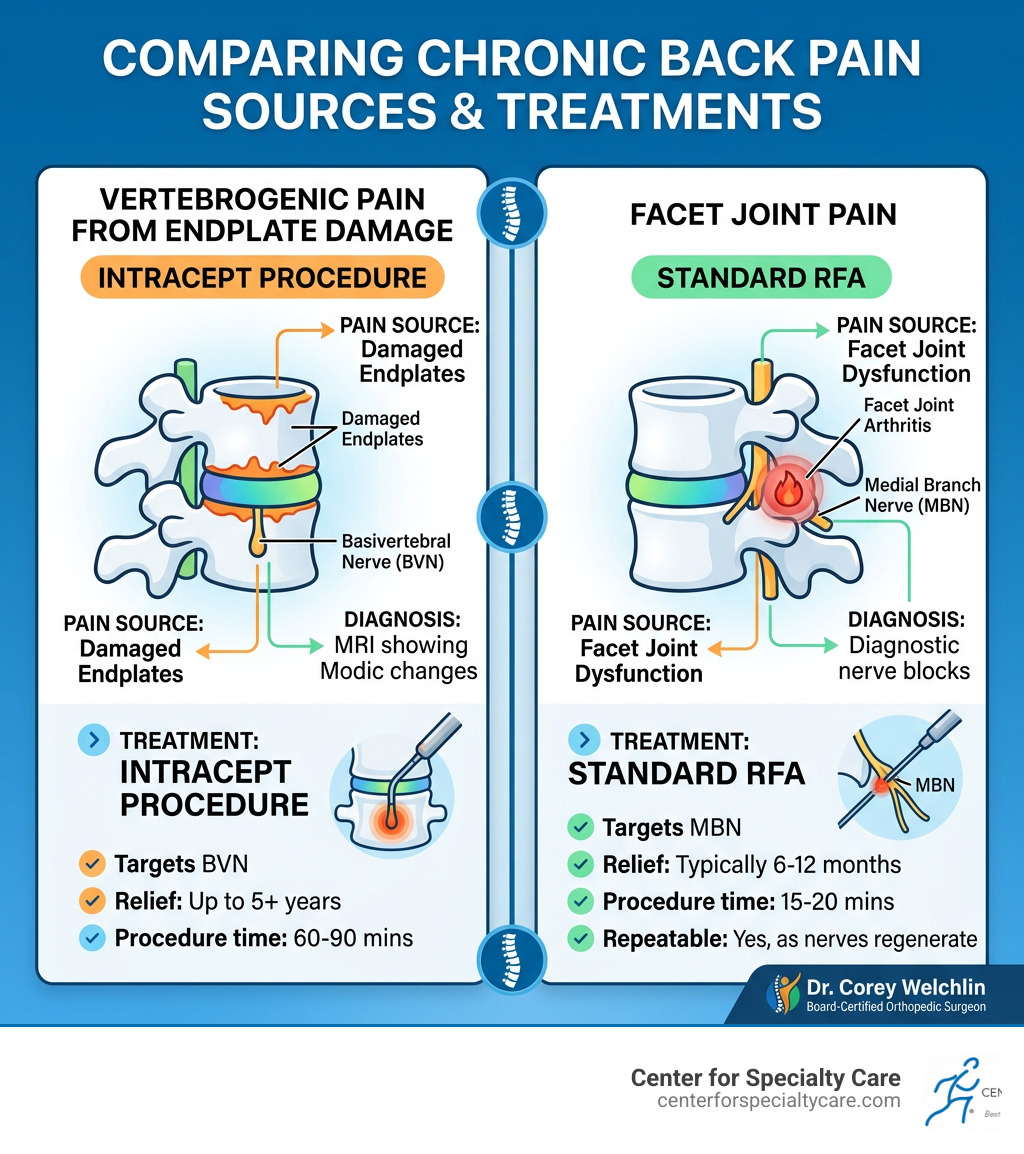
The intracept procedure vs radiofrequency ablation comes down to one key difference: where your back pain is coming from.
Here is a quick comparison to help you understand which may apply to you:
| Feature | Intracept Procedure | Standard RFA |
|---|---|---|
| Target nerve | Basivertebral nerve (inside vertebra) | Medial branch nerve (around facet joint) |
| Pain source | Vertebrogenic pain (damaged endplates) | Facet joint arthritis or dysfunction |
| Diagnosis tool | MRI showing Modic changes | Diagnostic nerve blocks |
| Relief duration | Up to 5+ years | Typically 6-12 months |
| Procedure time | 60-90 minutes | 15-20 minutes |
| Repeatable? | Generally not needed | Yes, as nerves regenerate |
Both are minimally invasive, outpatient procedures that use radiofrequency energy to disrupt pain signals. But they treat different pain sources — and using the wrong one means little to no relief.
Chronic low back pain affects the majority of adults at some point in their lives. When conservative treatments like physical therapy, medications, and injections stop working, procedures like these become the next step. Knowing which one fits your specific condition is critical to getting lasting results.
I’m Dr. Corey Welchlin, a board-certified orthopedic surgeon with over 30 years of experience treating musculoskeletal conditions — including minimally invasive spine procedures like those compared in the intracept procedure vs radiofrequency ablation discussion. In the sections below, I’ll walk you through exactly how each procedure works, who qualifies, and how to make the right choice for your situation.
Quick intracept procedure vs radiofrequency ablation definitions:
Understanding the Intracept Procedure vs Radiofrequency Ablation
When we talk about “nerve ablation,” we are essentially talking about using heat to “turn off” a nerve that is sending pain signals to your brain. However, the spine is a complex highway of nerves. Choosing the right exit—or in this case, the right nerve—is what determines if you walk out of our clinic pain-free.
The Intracept procedure is a highly specialized form of radiofrequency ablation (RFA). While traditional RFA has been around for decades, Intracept is a newer, FDA-cleared technology specifically designed to target the basivertebral nerve (BVN). This nerve lives deep inside the bone of your vertebrae.
Standard RFA, on the other hand, typically targets the medial branch nerves. These nerves are located on the outside of the vertebrae and carry pain signals from the facet joints—the small joints that link your vertebrae together.
Here is a detailed breakdown of the technical differences:
| Specification | Intracept (BVN Ablation) | Standard RFA (Medial Branch) |
|---|---|---|
| Anatomical Location | Inside the vertebral body | Outside the vertebral joints |
| Energy Delivery | Targets the “trunk” of the nerve | Targets peripheral nerve branches |
| Nerve Regeneration | Rare; the bone environment limits regrowth | Common; nerves usually regrow in 6-12 months |
| Primary Goal | Treat vertebrogenic (bone-based) pain | Treat mechanical (joint-based) pain |
At Center for Specialty Care, we believe that understanding your anatomy is the first step toward recovery. If your pain is coming from the bone itself, standard RFA won’t touch it. Conversely, if your pain is purely from arthritic joints, Intracept isn’t the right tool. This is why a consultation with a bone specialist doctor near me is so vital for an accurate diagnosis.
For a deeper dive into the clinical mechanics of these procedures, you can review this Basivertebral Nerve Ablation research.
Targeted Pain Sources: Vertebrogenic vs. Facet Joint Pain
To understand intracept procedure vs radiofrequency ablation, we have to look at the “pain generator.” Your spine is made of bones (vertebrae) separated by discs. Connecting these bones in the back are facet joints.
Vertebrogenic pain originates from the vertebral endplates. These are the layers of bone and cartilage that sit between the vertebral body and the spinal disc. Over time, due to wear and tear or injury, these endplates can become inflamed and damaged. When this happens, the basivertebral nerve inside the bone starts sending chronic pain signals. This is often described as a deep, aching pain in the middle of the lower back that gets worse with sitting, leaning forward, or lifting.
Facet joint pain, or facet syndrome, is more like “back arthritis.” These joints allow your spine to bend and twist. When they become inflamed, the pain is often felt to the side of the spine and may even radiate into the buttocks or thighs. This pain usually gets worse when you lean backward or twist your torso.
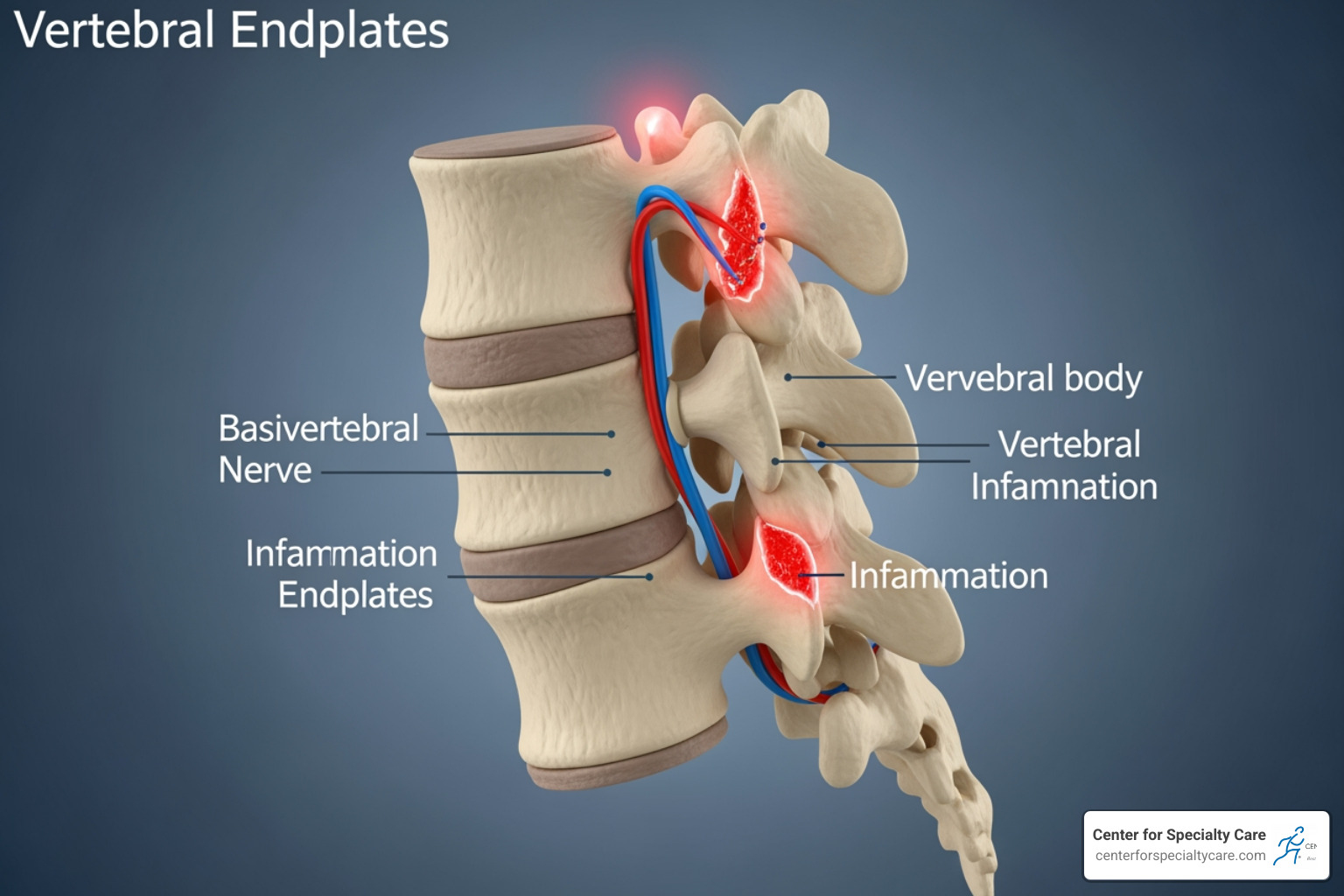
A key clinical marker for vertebrogenic pain is something called Modic changes. These are specific signs of inflammation and damage in the vertebral endplates that can only be seen on an MRI. If your MRI shows Modic Type 1 or Type 2 changes, you are likely dealing with vertebrogenic pain rather than just simple “muscle strain” or “disc issues.” You can learn more about these Vertebrogenic pain symptoms and causes to see if they match your experience.
When to choose the Intracept procedure vs radiofrequency ablation for endplate damage
We recommend the Intracept procedure when we have clear evidence that the vertebral endplates are the culprit. In our Fairmont and Iowa locations, we look for three specific criteria:
- Chronic low back pain lasting at least six months.
- Failure to find relief through conservative care (PT, meds).
- An MRI that confirms Modic Type 1 or Type 2 changes at the symptomatic levels.
If you are an athlete or a highly active individual in Minnesota or Iowa, you might mistake this for a sports injury. However, if the pain is “axial”—meaning it stays in the center of your back and doesn’t shoot down your leg like sciatica—it is often vertebrogenic. Consulting a sports injury specialist near me can help differentiate between soft tissue injuries and these bone-based pain sources.
Identifying candidates for standard radiofrequency ablation
Standard RFA is the “gold standard” for patients with facet joint syndrome. We consider you a candidate for this if:
- Your pain is worse when arching your back or twisting.
- You have localized tenderness over the spinal joints.
- You have had a “diagnostic nerve block” where we numbed the medial branch nerves, and you experienced significant, albeit temporary, relief.
Standard RFA is a great option for those who aren’t quite ready for surgery but need more than just a temporary injection. While we often discuss this in the context of the back, similar ablation techniques are used for other joints. For example, if you have referred pain or separate issues in your upper extremities, you might also be looking for a shoulder doctor near me to discuss joint-related relief.
Procedure Process and Recovery Expectations
Both procedures are performed in our outpatient facilities, meaning you get to go home the same day. We use fluoroscopic guidance (a real-time X-ray) to ensure the utmost precision. We don’t like guessing; we like seeing exactly where the probe is.
For Standard RFA, the process is quick (about 15-20 minutes). We use a needle-like probe to reach the medial branch nerves outside the bone and apply heat for about 60-90 seconds per site.
For the Intracept procedure, the process is a bit more involved (60-90 minutes). Because the nerve is inside the bone, we create a small path through the pedicle of the vertebra to reach the basivertebral nerve trunk. Once the probe is in the center of the bone, the ablation takes about 7 to 10 minutes per level.
Regardless of the procedure, we prioritize your comfort. Most patients receive local anesthesia and light sedation. You’ll be awake but relaxed—and hopefully, cracking a few jokes with us while we work!
After the procedure, we provide detailed guidance on physical therapy tips for recovery to help you regain your strength and mobility safely.
Comparing recovery times for Intracept procedure vs radiofrequency ablation
One of the most common questions we get at Center for Specialty Care is, “When can I get back to my life?”
Standard RFA Recovery:
- Downtime: 24 to 48 hours of rest.
- Soreness: You might feel like you have a “sunburn” or a bruise at the injection site for a few days.
- Results: Pain relief usually kicks in within 1 to 2 weeks as the nerve dies off.
- Activity: Most patients return to work within 2 days.
Intracept Recovery:
- Downtime: We ask you to take it easy for about 48 hours. No heavy lifting or strenuous exercise.
- Soreness: Since we are entering the bone, you may feel some localized aching for a week or two.
- Results: Some feel immediate relief, but for most, the “magic” happens between 2 weeks and 3 months as the inflammation subsides.
- Activity: You can usually return to light office work in 2-3 days, but full activity resumption is typically cleared within 2 weeks.
While you wait for the ablation to take full effect, we may discuss other types of injections for pain relief to manage any transitional discomfort.
Success Rates and Long-Term Outcomes
This is where the intracept procedure vs radiofrequency ablation comparison gets really interesting.
Standard RFA is effective, with about 70-80% of patients reporting significant relief. However, nerves are persistent little things—they like to grow back. Because the medial branch nerves are in soft tissue, they typically regenerate every 6 to 12 months. This means most RFA patients come back once a year for a “tune-up.”
Intracept is designed to be a “one-and-done” solution. Because we are ablating the nerve trunk inside the bone, the nerve rarely regenerates. The clinical data is impressive:
- Five-Year Relief: A major study of 249 patients showed that relief lasted up to 5.6 years post-procedure.
- Pain Reduction: Roughly 66% of patients reported their pain was cut in half, and 33% were 100% pain-free after five years.
- Activity: 70% of Intracept patients were able to return to the activity levels they enjoyed before their back pain started.
- Recent Success: A 2023 study found that 65% of patients had at least a 50% reduction in pain only six months after the procedure.
For many of our patients in Fairmont and throughout Minnesota and Iowa, the prospect of 5+ years of relief is a game-changer. You can find more Intracept clinical study outcomes that highlight these long-term benefits.
Frequently Asked Questions about Nerve Ablation
Is the Intracept procedure permanent?
While “permanent” is a strong word in medicine, Intracept is considered a long-term solution. Unlike traditional RFA where the nerve is expected to grow back, the Intracept procedure targets the nerve at the trunk within the bone. Data shows that for the vast majority of patients, the relief is durable for at least 5 to 6 years, and for many, it may never need to be repeated.
Does insurance cover these ablation procedures?
Yes, both are generally covered, but the requirements differ. Standard RFA is widely covered by Medicare and most commercial plans, provided you’ve had successful diagnostic blocks.
The Intracept procedure is now covered by Medicare and an increasing number of commercial insurance providers. However, insurance companies are strict about the “Modic changes” requirement. We must be able to show them an MRI from the last 12 months that clearly identifies these changes in your vertebral endplates. Our team at Center for Specialty Care is very experienced in navigating these insurance hurdles for our patients.
What are the risks of basivertebral nerve ablation?
Safety is our top priority. Intracept has a very high safety profile, with a serious complication rate of less than 0.3% in clinical trials. The risks are similar to any minimally invasive spine procedure:
- Temporary soreness at the site.
- Risk of infection (minimized by our sterile techniques).
- Nerve injury (extremely rare due to real-time X-ray guidance).
- Bleeding.
We always review your full medical history to ensure you aren’t at higher risk due to blood thinners or other health conditions.
Conclusion
Choosing between the intracept procedure vs radiofrequency ablation doesn’t have to be a guessing game. At Center for Specialty Care, we use advanced imaging and diagnostic techniques to pinpoint exactly which nerve is causing your misery.
Whether you are dealing with facet joint arthritis that requires a yearly RFA or deep vertebrogenic pain that calls for the long-lasting relief of the Intracept procedure, our goal is the same: 100% patient satisfaction and a quick return to the life you love.
We serve patients across Fairmont, MN, Estherville, IA, and our surrounding communities with personalized, compassionate care. You don’t have to just “live with” back pain anymore.
Ready to find out which procedure is right for you? Schedule an Intracept consultation with our team today and let’s get you back on your feet.