
Shoulder the Burden No More: A Guide to Constant Pain Relief
April 7, 2026
Choosing between Intracept and standard nerve ablation
April 9, 2026
How to Survive the Night with a Torn Rotator Cuff
Why Torn Rotator Cuff Pain at Night Feels Worse
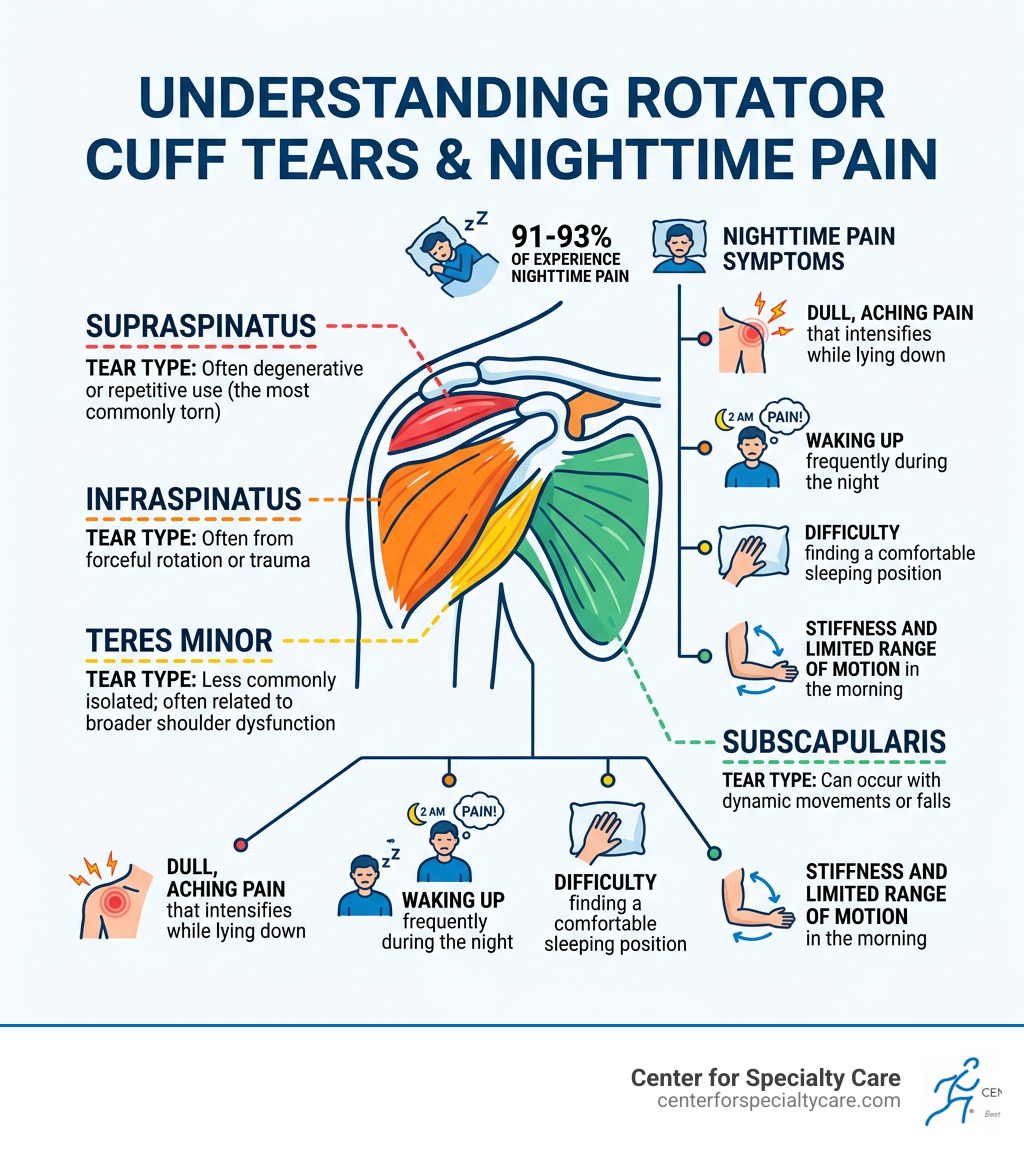
Torn rotator cuff pain at night is one of the most disruptive symptoms of a shoulder injury — and if you’re waking up at 2 a.m. unable to find a comfortable position, you’re far from alone. Research shows that 91–93% of people with rotator cuff tears experience nighttime pain, and only 11% report sleeping normally.
Here are the most effective ways to manage it tonight:
- Sleep on your back with a pillow tucked under your injured arm’s elbow
- Sleep on your unaffected side and hug a body pillow to keep your shoulder neutral
- Try a reclined position using a wedge pillow or recliner to reduce shoulder pressure
- Apply ice or heat for 15–20 minutes before bed to calm inflammation
- Take an OTC anti-inflammatory like ibuprofen about an hour before sleep
- Do gentle stretches — like pendulum swings — to reduce stiffness before lying down
The rotator cuff is made up of four muscles and their tendons: the supraspinatus, infraspinatus, teres minor, and subscapularis. Together, they stabilize your shoulder joint and allow your arm to lift and rotate. When one or more of these tendons tears — whether from a sudden injury or years of wear — the result is pain that often feels manageable during the day but becomes intense once you lie down.
Why does lying down make it worse? A quieter body, pooled inflammation, reduced blood flow, and direct pressure on the injured tissue all combine to turn nighttime into the hardest part of your day.
Up to 80% of people with chronic pain experience a cycle where poor sleep amplifies pain, which then makes sleep even harder. For rotator cuff injuries, this cycle can feel relentless.
I’m Dr. Corey Welchlin, a board-certified orthopedic surgeon with over 30 years of experience treating torn rotator cuff pain at night and the shoulder injuries behind it. In this guide, I’ll walk you through exactly what’s happening in your shoulder while you sleep — and what you can do about it, starting tonight.
Quick torn rotator cuff pain at night terms:
If you’ve ever wondered why your shoulder feels “mostly fine” while you’re busy at work but starts screaming the moment your head hits the pillow, you aren’t imagining things. There are several biological and mechanical reasons why torn rotator cuff pain at night intensifies.
The Science of Shoulder Pressure
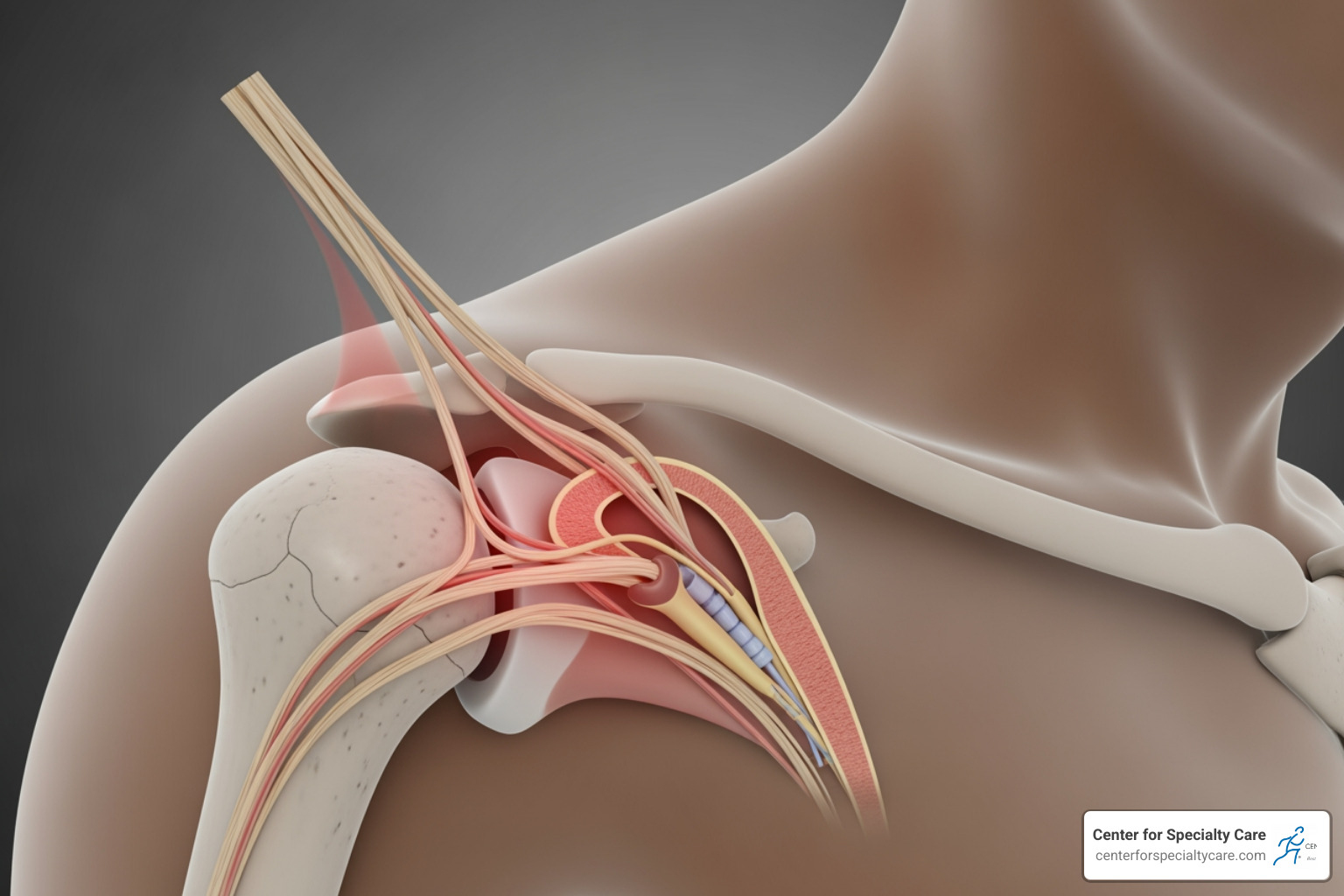
Scientific research on shoulder pressure and sleep position indicates that the physical act of lying down changes the internal environment of the joint. When you are upright, gravity helps pull the humerus (arm bone) down, creating a bit of space in the subacromial area. When you lie flat, that gravitational “assist” vanishes. The humerus can shift, compressing the already irritated tendons and the subacromial bursa—the fluid-filled sac that acts as a cushion.
Inflammation and Circadian Rhythms
Our bodies operate on a biological clock. At night, certain pro-inflammatory cytokines peak, and our natural levels of anti-inflammatory hormones, like cortisol, drop to their lowest point. This creates a perfect storm where inflammation in the shoulder joint pools and becomes more painful.
The “Quiet Effect”
During the day, your brain is bombarded with stimuli—emails, conversations, the radio, the physical sensation of walking. These act as natural “noise” that drowns out pain signals. At night, in a dark, quiet room, those distractions disappear. Your brain becomes hyper-focused on the only signal left: the throbbing in your shoulder.
Reduced Blood Flow and Stiffness
Inactivity is the enemy of a healing tendon. When you stop moving for several hours, blood flow to the rotator cuff—which is already notoriously poor in that specific area of the body—decreases even further. This leads to joint stiffness. Then, when you finally roll over in your sleep, that sudden movement on a stiff, “cold” joint causes a sharp, waking pain.
Best Sleeping Positions for a Torn Rotator Cuff
The goal of a good sleeping position is to keep the shoulder in a “neutral” state—meaning the tendons aren’t being stretched, pinched, or compressed. Scientific research on rotator cuff tears emphasizes that protecting the repair or the injury site is paramount to recovery.
The Back Sleeper (The Gold Standard)
Sleeping on your back is generally the most recommended position. To make this work for torn rotator cuff pain at night, place a small pillow or a rolled-up towel under the elbow of the injured arm. This props the arm up slightly, preventing it from falling backward and pulling on the rotator cuff tendons.
The Reclined Position
Many of our patients find that they simply cannot sleep flat on a mattress during the first few weeks after an injury or surgery. Sleeping in a recliner chair or using a wedge pillow to stay at a 45-degree angle can be a lifesaver. This position uses gravity to keep the shoulder joint “seated” properly and reduces the pressure on the subacromial bursa.
Sleeping on the Unaffected Side
If you must sleep on your side, sleep on the “good” shoulder. However, don’t just let the injured arm dangle across your body; this pulls on the rotator cuff. Instead, hug a large body pillow. This keeps the injured shoulder “stacked” directly above the other one and maintains a neutral alignment.
Positions to Avoid
Whatever you do, try to avoid stomach sleeping. This position often forces the arms into an overhead or “high-five” position, which is the most stressful angle for a rotator cuff tear. It essentially pinches the tendon between the bones of the shoulder.
Managing torn rotator cuff pain at night while side sleeping
For dedicated side sleepers, we recommend building what we call a “pillow wall.” If you roll onto your injured side in your sleep, the pain will likely wake you up. By placing a long pillow behind your back, you create a physical barrier that prevents you from rolling onto the painful side. How to relieve rotator cuff pain at night often involves these small, environmental tweaks that protect the joint from accidental movement.
At-Home Strategies for Immediate Relief
Beyond how you lie down, what you do in the hour before bed can dictate whether you get four hours of sleep or eight.
Ice vs. Heat Therapy
This is one of the most common questions we hear at the Center for Specialty Care. As a general rule:
- Use Ice if the injury is new (acute) or if the shoulder feels hot and swollen. Ice numbs the area and constricts blood vessels to reduce swelling.
- Use Heat if the pain is chronic or related to stiffness. Heat increases blood flow and relaxes the muscles around the cuff.
| Feature | Ice Therapy | Heat Therapy |
|---|---|---|
| Best For | Acute injury, swelling, sharp pain | Chronic stiffness, dull aches |
| Timing | 15-20 minutes before bed | 15-20 minutes before bed |
| Mechanism | Numbs nerves, reduces inflammation | Relaxes muscles, boosts circulation |
Safety Tip: Never fall asleep with a heating pad or ice pack directly on your skin, as this can cause burns or frostbite.
Medication Timing
If you are using over-the-counter NSAIDs (like ibuprofen or naproxen) or Tylenol, timing is everything. Don’t wait until you are already in bed and hurting. Taking your dose about 30 to 60 minutes before you plan to sleep allows the medication to reach peak effectiveness just as you are trying to drift off. Always consult with us or your primary doctor before starting a regular medication regimen, especially if you have heart or kidney concerns.
Posture and Sleep Hygiene
Your “shoulder health” doesn’t start at 10 p.m. If you spend all day hunched over a computer, your chest muscles tighten and your shoulder blades roll forward. This “slumped” posture narrows the space in the shoulder joint, making torn rotator cuff pain at night much worse. We often suggest looking for a rotator cuff surgeon near me not just for surgery, but for professional guidance on ergonomics and posture correction.
Pre-bed stretches for torn rotator cuff pain at night
Gentle movement before bed can “warm up” the joint and prevent that midnight stiffness. These should be pain-free; if it hurts, stop.
- Pendulum Swings: Lean over a table, supporting yourself with your good arm. Let the injured arm hang straight down and gently swing it in small circles.
- Doorway Stretch: Stand in a doorway, place your forearm on the frame, and gently lean forward to stretch the chest.
- Scapular Squeezes: Simply pinch your shoulder blades together as if trying to hold a pencil between them. This resets the joint position.
- Forward Table Slide: While sitting, place your hand on a towel on a table and slowly slide it forward, feeling a gentle stretch in the shoulder.
When to Move Beyond Home Care
While pillows and ice packs are great for management, they aren’t always a cure. If you find that you are losing significant sleep for more than two weeks, it is time for a professional evaluation.
Signs You Need an Orthopedic Consultation
- Persistent Weakness: You can’t lift a gallon of milk or reach into a cupboard.
- Loss of Motion: You can’t reach behind your back or put on a jacket.
- Trauma: The pain started after a fall or a sudden “pop.”
- Night Pain Persistence: None of the positions or remedies listed above are providing relief.
At the Center for Specialty Care, we believe in a tiered approach. We don’t jump straight to the operating room. Many patients (about 8 out of 10 with partial tears) find relief through:
- Physical Therapy: Strengthening the surrounding muscles to take the load off the tear.
- Corticosteroid Injections: Powerful anti-inflammatories delivered directly into the bursa to “reset” the pain levels.
- PRP Therapy: Using your body’s own platelets to encourage healing in the tendon.
- Surgical Options: If conservative care fails, we utilize minimally invasive arthroscopic repair or debridement to fix the tear and remove bone spurs.
Frequently Asked Questions about Nighttime Shoulder Pain
Will a torn rotator cuff heal on its own?
A full-thickness tear (where the tendon is completely severed) will not “knit” back together on its own because the muscle pulls the two ends apart. However, many partial tears can become asymptomatic with the right physical therapy. The goal isn’t always to make the tear disappear on an MRI; the goal is to make the pain disappear and restore function.
How long does it take to recover from rotator cuff surgery?
Recovery is a marathon, not a sprint.
- Weeks 0-6: You’ll likely be in a sling to protect the repair. Sleep management is most critical here.
- Months 4-6: You’ll regain functional strength for daily tasks.
- Months 12-18: This is when “full” recovery occurs, and the shoulder feels like its old self again.
Can a mattress cause rotator cuff pain?
A mattress won’t cause a tear, but a sagging or overly soft mattress can worsen the pain. If your mattress doesn’t support your spine, your shoulders have to work harder to stabilize your body while you sleep. A medium-firm mattress is generally best for maintaining proper alignment of the neck and shoulders.
Conclusion
Surviving the night with a rotator cuff injury requires a combination of the right mechanics, the right timing, and sometimes, the right professional help. You don’t have to accept “tired and hurting” as your new normal.
At the Center for Specialty Care, we are dedicated to helping our neighbors in Fairmont, MN, and throughout Northern Iowa and Southern Minnesota reclaim their quality of life. Whether you need a personalized physical therapy plan or an advanced surgical repair, our goal is 100% patient satisfaction and getting you back to a full, painless night’s sleep.
Don’t let another night of tossing and turning go by. Schedule an appointment for shoulder care today and let’s get to the bottom of your pain.