

Finding Relief Fast: A Guide to Podiatry Offices Near Me
April 4, 2026
How to Survive the Night with a Torn Rotator Cuff
April 8, 2026
Shoulder the Burden No More: A Guide to Constant Pain Relief
Why Constant Shoulder Pain Deserves Your Attention
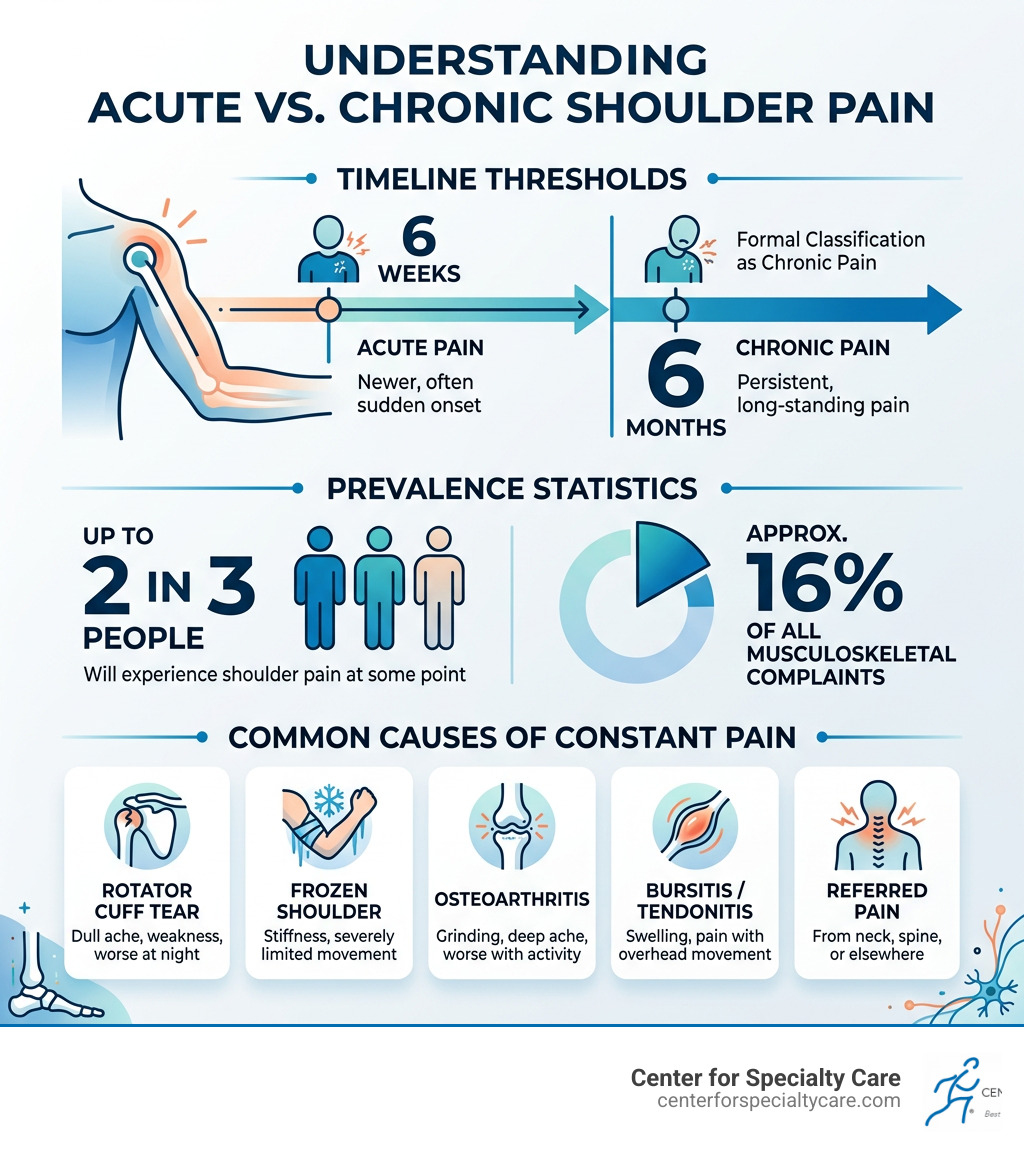
Constant shoulder pain is persistent discomfort in or around the shoulder joint that lasts longer than six weeks — and when it stretches beyond six months, it is formally classified as chronic pain.
Quick answer: What causes constant shoulder pain?
| Common Cause | Key Feature |
|---|---|
| Rotator cuff tear | Dull ache, weakness, worse at night |
| Frozen shoulder | Stiffness, severely limited movement |
| Osteoarthritis | Grinding, deep ache, worse with activity |
| Bursitis / Tendonitis | Swelling, pain with overhead movement |
| Referred pain | From neck, spine, or even heart |
Shoulder pain is far more common than most people realize. Up to 2 in 3 people will experience it at some point in their lives, and it accounts for roughly 16% of all musculoskeletal complaints.
Why so common? The shoulder is one of the most complex joints in your body. Three bones — the humerus, scapula, and clavicle — work together with muscles, tendons, and ligaments to give you an enormous range of motion. That same complexity makes it vulnerable.
And when pain becomes constant, it stops being a minor inconvenience. It disrupts sleep, limits daily tasks, and — if left untreated — can worsen significantly over time.
I’m Dr. Corey Welchlin, a board-certified orthopedic surgeon with over 30 years of experience diagnosing and treating constant shoulder pain through both conservative and surgical approaches. As the founder of the Center for Specialty Care in Fairmont, Minnesota, I’ve helped countless patients in southern Minnesota and northern Iowa get back to full function — and I’ll walk you through everything you need to know.
Constant shoulder pain further reading:
Understanding the Causes of Constant Shoulder Pain
When we talk about constant shoulder pain, we aren’t just talking about a “sore muscle” from yesterday’s yard work. We are looking at conditions that have settled in for the long haul. Because the shoulder is the most movable joint in the body, it is also the most unstable. The “ball” of your upper arm (humerus) is actually larger than the “socket” of your shoulder blade (scapula), much like a golf ball sitting on a tee.
According to Johns Hopkins Medicine, most chronic issues stem from the soft tissues—the muscles, tendons, and ligaments—rather than the bones themselves. Here are the heavy hitters:
- Rotator Cuff Disorders: This is the most frequent culprit. Whether it is tendonitis (inflammation) or a tear, problems here cause a dull ache deep in the shoulder. It often makes it hard to comb your hair or reach behind your back.
- Osteoarthritis: While common in knees, Mayo Clinic notes that shoulder arthritis involves the breakdown of cartilage, leading to a “grinding” sensation and stiffness.
- Frozen Shoulder (Adhesive Capsulitis): This condition involves the thickening and tightening of the shoulder capsule. It doesn’t just hurt; it physically locks the joint, sometimes for a year or more.
- Subacromial Bursitis: Your shoulder has small, fluid-filled sacs called bursae that act as cushions. When these become inflamed due to repetitive motion, every lift of the arm feels like a pinch.
- Impingement Syndrome: This happens when the top of your shoulder blade puts pressure on the soft tissues underneath when you lift your arm.
- Bicep Tendonitis: Pain at the front of the shoulder that travels down the arm, often caused by wear and tear on the tendon that attaches your bicep muscle to the shoulder.
It is also important to note that shoulder pain isn’t always from the shoulder. Referred pain from the cervical spine (neck), or systemic issues like diabetes and heart disease, can manifest as persistent shoulder discomfort.
When to Seek Immediate Medical Attention
Most constant shoulder pain is a “slow burn,” but there are times when you shouldn’t wait for a scheduled appointment. The shoulder is a common site for “referred pain” from life-threatening conditions.

Seek emergency care immediately if you experience:
- Heart Attack Signs: Sudden left shoulder pain accompanied by chest tightness, shortness of breath, or pain radiating to the jaw or neck.
- Severe Trauma: A visible deformity (the shoulder looks “out of place”), inability to move the arm at all, or intense swelling and bruising following an injury.
- Infection Signs: Persistent shoulder pain accompanied by a high fever, chills, or redness and heat around the joint.
- Neurological Red Flags: Sudden, profound weakness in the arm or hand, or a complete loss of sensation.
For non-emergencies that still require professional eyes, Healthdirect suggests seeing a doctor if your pain hasn’t improved after two weeks of home care or if it prevents you from sleeping.
How Chronic Shoulder Issues are Diagnosed
At the Center for Specialty Care, we don’t guess—we assess. Diagnosing constant shoulder pain requires a systematic approach to separate a simple strain from a structural tear.
| Diagnostic Tool | What It Sees | Best For |
|---|---|---|
| Physical Exam | Range of motion, strength, and pain triggers | Initial assessment and “provocative tests” |
| X-ray (Radiograph) | Bone structure, spacing, and spurs | Arthritis, fractures, and bone alignment |
| Ultrasound | Real-time movement of tendons and bursae | Rotator cuff tears and inflammation |
| MRI | Detailed images of soft tissues, labrum, and cartilage | Complex tears and internal joint damage |
During your visit, we perform “provocative tests.” For example, the Hawkins-Kennedy test helps us identify impingement, while the Empty-Can test isolates the supraspinatus muscle to check for rotator cuff tears. We also look at your medical history—did you know that patients over 40 are significantly more likely to have rotator cuff wear, or that 54% of people over 60 have a tear they don’t even know about?
As Penn Medicine explains, advanced imaging is vital because many shoulder conditions mimic one another. Our goal is to find the exact source so we can tailor the right treatment.
Non-Surgical Management and Home Care
The good news? Most constant shoulder pain does not require surgery. We often start with “conservative management” to reduce inflammation and retrain the muscles.
- The 15-Minute Rule: Apply ice to the shoulder for 15 minutes on and 15 minutes off, several times a day. This is especially effective after activity or at the end of a long work day.
- Medications: Over-the-counter NSAIDs (like ibuprofen) can help manage the “chemical” part of the pain—the inflammation.
- Corticosteroid Injections: For intense flare-ups, a targeted injection can provide a “window of relief” that allows you to participate in physical therapy.
- Physical Therapy: This is the cornerstone of recovery. A therapist helps you strengthen the “scapular stabilizers”—the muscles that hold your shoulder blade in place—to take the pressure off the joint.
Managing Constant Shoulder Pain at Home
You can make significant strides by adjusting your daily habits:
- Posture Correction: Avoid “slumping.” When your shoulders roll forward, the space in the joint narrows, leading to impingement.
- Sleep Positioning: If you have constant shoulder pain, avoid sleeping directly on the affected side. Use a pillow to support the arm and keep the joint in a “neutral” position.
- Ergonomics: If you work at a desk in Fairmont or St. James, ensure your keyboard and mouse are at a height that allows your shoulders to remain relaxed, not shrugged.
How long does constant shoulder pain last?
The timeline depends on the diagnosis. A mild case of tendonitis might resolve in 6 to 8 weeks with proper rest. However, Frozen Shoulder is a different beast. It typically moves through three stages—Freezing, Frozen, and Thawing—and can take 12 to 18 months to fully resolve. Patience and consistent physical therapy are key during these long-term cycles.
Advanced Treatments and Surgical Options
When conservative measures fail to provide relief after several months, or if there is a significant mechanical tear, we discuss surgical options. Modern shoulder surgery is remarkably advanced and often minimally invasive.
- Arthroscopy: We use tiny incisions and a camera (arthroscope) to repair rotator cuff tears, trim away bone spurs (subacromial decompression), or repair a torn labrum. This results in less tissue damage and a faster trip home.
- Shoulder Replacement: For severe arthritis, we can replace the worn-out joint surfaces with smooth metal and plastic.
- Reverse Shoulder Replacement: This is a brilliant solution for patients with both severe arthritis and a completely non-functional rotator cuff. By “reversing” the ball and socket, we allow the deltoid muscle to take over the job of lifting the arm.
As noted by the Cleveland Clinic, the goal of surgery isn’t just to stop the pain—it’s to restore the function you need for your job, your hobbies, and your life.
Frequently Asked Questions about Constant Shoulder Pain
Can neck problems cause constant shoulder pain?
Absolutely. This is called “referred pain.” If a nerve in your neck is pinched (cervical radiculopathy), you might feel pain in your shoulder blade or down your arm. A key clue: if moving your neck changes the pain, but moving your shoulder doesn’t, the problem might be in your spine.
What are the risk factors for developing chronic shoulder pain?
- Age: Being over 40 increases wear-and-tear risks.
- Occupation: Jobs involving repetitive overhead reaching (like painting, construction, or stocking shelves).
- Medical Conditions: Diabetes and thyroid disorders are strongly linked to an increased risk of frozen shoulder.
- Sports: Years of swimming, pitching, or tennis can lead to “overuse” injuries.
Is surgery always necessary for a rotator cuff tear?
No. In fact, many people live with partial or even full-thickness tears without significant pain. If the shoulder remains strong and the pain is manageable through physical therapy, we often opt for the non-surgical route. Surgery is typically reserved for active patients, those with significant weakness, or those whose pain doesn’t respond to other treatments.
Conclusion
You don’t have to just “live with” constant shoulder pain. Whether you are a farmer in Estherville dealing with a rotator cuff strain or an office worker in Fairmont struggling with “tech neck” radiating to your shoulder, there is a path to relief.
At the Center for Specialty Care, our multidisciplinary team—including orthopedic surgeons and pain management specialists—is dedicated to 100% patient satisfaction. We pride ourselves on personalized care and quick appointment availability across our locations in Minnesota and Iowa.
Don’t let shoulder pain hold you back from the activities you love. Schedule a consultation for shoulder pain relief today and let us help you shoulder the burden.