The Fairmont Guide to Expert Foot and Ankle Care
March 11, 2026
Knot Today! How to Banish Those Pesky Muscle Knots Behind Your Shoulder Blade
March 13, 2026
No More Waiting for Relief with This Clinic Access Guide
Understanding the Path to Pain Relief
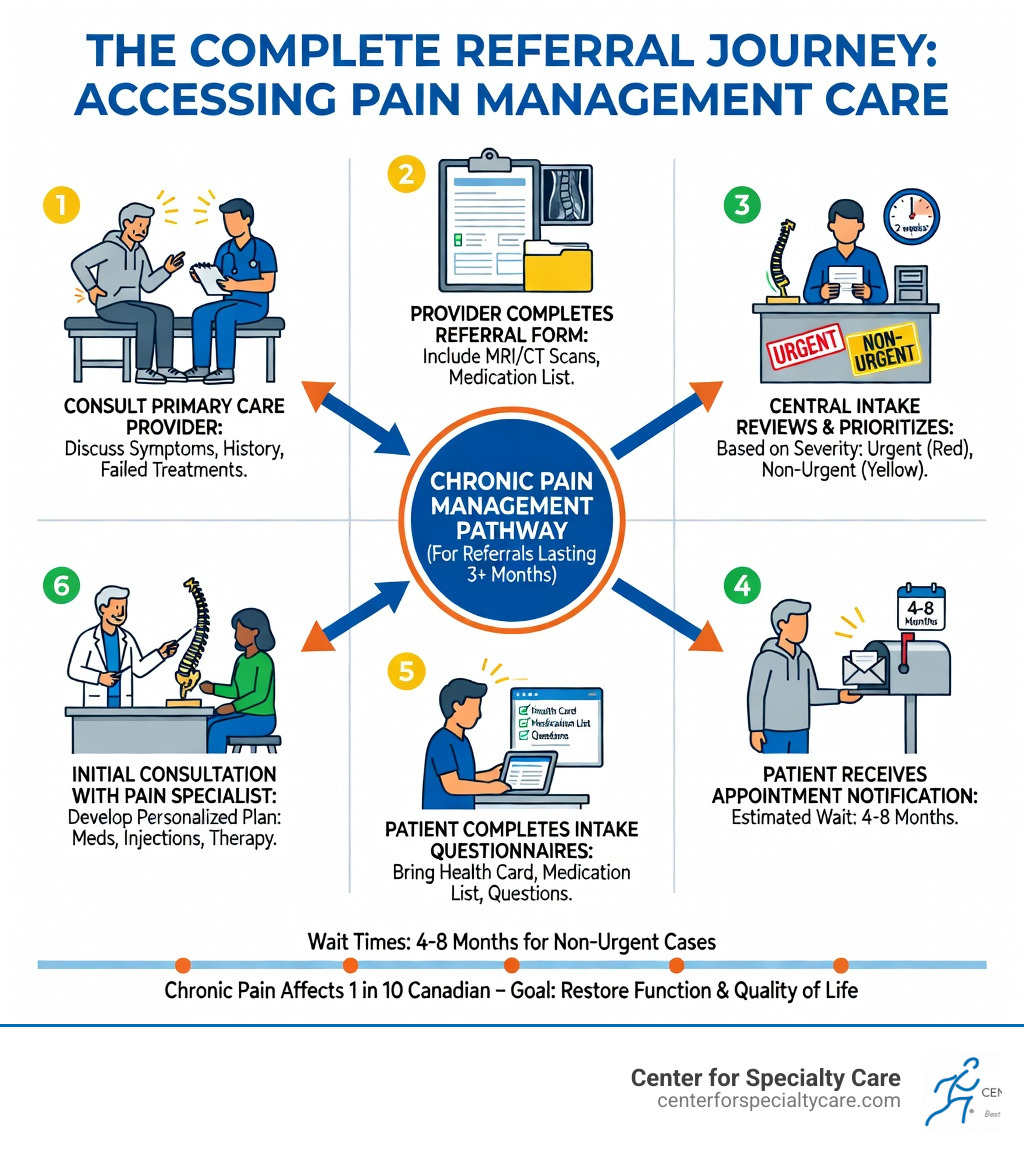
How to get into a pain management clinic typically requires a referral from your primary care physician or nurse practitioner. Here’s the essential process:
- Schedule an appointment with your family doctor or primary care provider
- Discuss your chronic pain symptoms, history, and failed treatments
- Request a referral to a pain management specialist
- Provide complete documentation including recent imaging (MRI, CT scans), medication history, and medical records
- Wait for triage assessment where the clinic prioritizes your case based on severity and urgency
- Prepare for your first appointment by gathering your health card, medication list, and questions
Most pain management clinics do not accept self-referrals or walk-in patients. The referral process exists to ensure continuity of care, appropriate specialist matching, and comprehensive medical history review.
Chronic pain affects roughly 1 in 10 Canadians and millions more worldwide. It can stem from ongoing illness, nerve damage, arthritis, cancer, or injuries that never fully healed. Unlike short-term pain that resolves with treatment, chronic pain persists for months or even years—interfering with work, relationships, sleep, and daily activities.
Pain management clinics offer specialized, multidisciplinary care that goes beyond what primary care providers can deliver. These clinics combine medication management, interventional procedures like nerve blocks and injections, physical therapy, psychological support, and self-management education. The goal isn’t just pain reduction—it’s restoring function and quality of life.
Wait times can be significant. Research shows that non-urgent cases may wait 4 to 8 months for their first appointment at many clinics. Understanding how to get into a pain management clinic efficiently can help you access care sooner and begin your journey toward relief.
I’m Dr. Corey Welchlin, a board-certified orthopedic surgeon who has guided thousands of patients through how to get into a pain management clinic and develop effective treatment plans since founding the Center for Specialty Care in 1990. My team and I work closely with referring physicians to ensure smooth access to comprehensive pain relief and rehabilitation solutions.
How to get into a pain management clinic terminology:
How to Get Into a Pain Management Clinic: A Step-by-Step Guide

When you are living with persistent discomfort, knowing how to get into a pain management clinic can feel like trying to solve a puzzle while you’re exhausted. We want to make that puzzle much easier to solve. In Minnesota and Iowa, the process is structured to ensure that by the time you see a specialist, they have every piece of information they need to help you.
The journey starts with your Primary Care Provider (PCP) or a Nurse Practitioner. Think of them as the “quarterback” of your healthcare team. Because pain management clinics are highly specialized, they rely on your PCP to confirm that more conservative treatments (like rest, basic physical therapy, or over-the-counter medications) haven’t provided enough relief.
At the Center for Specialty Care, we focus on comprehensive pain management services that span from Fairmont, MN to Estherville, IA. Once your doctor faxes a referral, it enters a “central intake” or triage system. This is where medical professionals review your file to determine how urgently you need to be seen. Cases involving severe functional decline or post-surgical complications are often prioritized to ensure those in the most distress get help quickly.
Why a Referral is Necessary for How to Get Into a Pain Management Clinic
You might wonder, “Why can’t I just call and book an appointment myself?” There are several critical reasons for this gatekeeping:
- Comprehensive Medical History: A specialist needs to know what has already been tried. Your PCP has your records on previous surgeries, underlying conditions like diabetes or heart disease, and a full list of your current medications.
- Continuity of Care: Pain management isn’t a one-and-done deal. Once we develop a treatment plan for you, your PCP will often be the one managing your day-to-day care and long-term prescriptions.
- Insurance Requirements: Many insurance providers in Minnesota and Iowa simply will not pay for specialist visits without a formal referral.
- Specialist Matching: Chronic pain is diverse. Some clinics focus on pediatric chronic pain, while others specialize in geriatric or sports-related injuries. A referral ensures you end up at the right desk.
Meeting the Requirements for How to Get Into a Pain Management Clinic
Not everyone with a “twinge” in their back is a candidate for a specialized pain clinic. Generally, clinics look for specific criteria:
- Duration: Most programs require that your pain has persisted for at least 3 to 6 months.
- Functional Decline: Is the pain preventing you from working, sleeping, or performing basic daily tasks like dressing yourself?
- Psychological Stress: Chronic pain and mental health are closely linked. Clinics often assess if the pain is causing significant distress or depression.
- Opioid Management: If you are seeking help with weaning off high-dose opioids or managing complex medication regimens, a pain clinic is the safest place to do so.
- Age Restrictions: Many adult clinics only accept patients 18 and older, while specialized children’s hospitals handle younger patients.
Essential Documentation and Preparation for Your Referral
To speed up the process of how to get into a pain management clinic, you need to be your own best advocate by ensuring your paperwork is perfect. If a clinic receives a referral without the necessary imaging or notes, they will often send it back, which adds weeks to your wait time.
Diagnostic Imaging is King. For most spine-related or joint pain, clinics require recent imaging—usually no older than 12 to 24 months. If you have radiating pain, an MRI or CT scan is essential to see if a nerve is being compressed. We often tell our patients that “an image is worth a thousand words” when it comes to diagnosing the source of radiating pain.
Medication History: You should request a 2-year medication history from your pharmacist. This shows the specialists exactly which anti-inflammatories, muscle relaxants, or nerve pain medications you’ve tried and at what dosages.
Intake Questionnaires: Be prepared to fill out a lot of forms. These aren’t just “busy work.” They help us understand the quality of your pain—is it burning, stabbing, or dull? Does it get worse with movement or rest?
Preparing for Your New Patient Consultation
Once you have your foot in the door, you want to make that first hour count. We recommend all our patients visit our new patient consult page to prepare.
- Track Your Symptoms: Keep a “pain diary” for a week before your visit. Note what time of day the pain is worst and what activities trigger it.
- Bring a Support Person: It’s easy to forget what the doctor said when you’re in pain or feeling overwhelmed. A friend or family member can take notes for you.
- The List of Questions: Don’t be shy! Ask about the risks of procedures, expected recovery times, and whether the goal is total pain elimination or functional improvement.
- Identification: Bring your health card, photo ID, and any WSIB or worker’s compensation claim information if your injury happened on the job.
What to Expect During Your First Appointment and Beyond
Your first visit is rarely about getting a treatment on the spot. Instead, it’s a deep dive into your health. You will likely meet with an interdisciplinary team that may include a physician, a nurse practitioner, and sometimes a physical therapist.
We will perform a physical assessment—checking your range of motion, reflexes, and strength. We’ll also review your patient information to see how your lifestyle factors, like sleep and stress, are impacting your physical symptoms.
The result of this visit is a Personalized Care Plan. This isn’t a “one-size-fits-all” approach. Depending on your diagnosis, we might suggest a combination of therapies.
| Treatment Type | Description | Common Examples |
|---|---|---|
| Interventional | Minimally invasive procedures to block pain signals. | Nerve blocks, Epidural injections, RFA. |
| Non-Surgical | Therapies that don’t involve needles or scalpels. | Physical therapy, CBT, Yoga, Bracing. |
| Medication Management | Optimizing prescriptions for safety and efficacy. | Anti-inflammatories, Nerve pain meds (Gabapentin). |
Common Treatments and Interventional Services
Many patients come to us specifically for interventional treatments. These are procedures designed to “interrupt” the pain message before it reaches your brain.
- Epidural Steroid Injections: These are incredibly common for treating sciatica or herniated discs. You can learn more about understanding epidural steroid injections on our dedicated guide.
- Nerve Blocks: This involves injecting a local anesthetic near a specific nerve or group of nerves to provide temporary relief.
- Radiofrequency Ablation (RFA): This uses heat to “turn off” a nerve’s ability to send pain signals. It can provide relief for 6 to 12 months.
- Joint Injections: Often used for arthritis in the knees, hips, or shoulders.
The Reality Check: It is important to know that interventional treatments have about a 50% success rate for significant improvement. Furthermore, medications typically only provide about 20-30% pain relief. This is why we use a multidisciplinary approach—combining these treatments with physical therapy and lifestyle changes offers the best chance at a pain-free life.
Navigating Wait Times and Self-Management Resources
One of the biggest hurdles in how to get into a pain management clinic is the wait. In many hospital-based systems, wait times can stretch from 4 to 8 months. This is often due to the high volume of referrals and the limited number of specialists.
At the Center for Specialty Care, we pride ourselves on quick appointment availability. We know that when you’re in pain, every day feels like a month. However, if you are stuck on a waitlist elsewhere, there are things you can do right now:
- Pacing: Don’t try to do all your chores on a “good day” only to be bedridden for the next three. Break tasks into small chunks.
- Mindfulness and CBT: Chronic pain changes the brain. Cognitive Behavioral Therapy (CBT) helps you “rewire” your emotional response to pain, which can actually lower the intensity of the sensation.
- Movement: Gentle movement, like “windshield wiper” leg stretches or chin tucks, can prevent stiffness.
- Virtual Orientation: Many clinics now offer webinars or virtual sessions to help you understand the “science of pain” while you wait for your physical assessment.
If your pain suddenly changes—for example, you lose bowel or bladder control or experience sudden weakness in your legs—don’t wait for a pain clinic appointment. You should seek immediate care. We have a guide on when to go to urgent care for back pain to help you decide.
Frequently Asked Questions About Pain Clinic Access
Do I need a referral to see a pain specialist?
In almost all cases in Minnesota and Iowa, yes. Most specialists require a referral to ensure they have your full medical history and that your insurance will cover the visit. There are very rare exceptions for certain private-pay regenerative medicine treatments, but for standard chronic pain care, your first step is always your primary doctor. You can check our patient information for more on these requirements.
How long will I have to wait for my first appointment?
Typical hospital-based clinics have a 6 to 8-month wait. Factors like the “urgency” assigned during triage and your geographic location play a role. However, our Fairmont and Estherville locations prioritize quick appointment availability to get you back on your feet faster.
Are pain clinic services covered by insurance or OHIP?
While we don’t use OHIP (which is the Ontario health plan), most of our services are covered by standard private insurance, Medicare, and Medicaid in Minnesota and Iowa. Some specialized treatments, like Platelet-Rich Plasma (PRP) or certain Botox protocols for migraines, may require “prior authorization” or may be out-of-pocket. Always call your insurance provider and our billing department before your first procedure to confirm coverage.
Conclusion
Navigating the path of how to get into a pain management clinic doesn’t have to be a solo journey. By working closely with your primary care provider, gathering your imaging and medication history early, and choosing a clinic that prioritizes your time, you can cut through the red tape.
At the Center for Specialty Care, we serve our neighbors in Fairmont, MN, Estherville, IA, and the surrounding areas with one goal: 100% patient satisfaction. We combine the expertise of orthopedic surgery with advanced pain management to offer you both surgical and non-surgical paths to relief.
Don’t let “wait and see” be your only strategy. If you’re ready to move from surviving to thriving, start your journey to relief today by speaking with your doctor about a referral to our team. We’re here to help you get back to the life you love.