
Ice or Heat for Jumper’s Knee? A Definitive Answer
September 24, 2025
Beyond the Tear: Effective Treatments for Rotator Cuff Injuries
September 26, 2025
Pain after intracept procedure: 1 Ultimate Relief Guide
What You Need to Know About Pain Following Your Intracept Procedure
Pain after intracept procedure is a common concern for patients who have undergone this minimally invasive treatment for chronic low back pain. While the Intracept procedure targets the basivertebral nerve to provide long-term relief from vertebrogenic pain, understanding what to expect during recovery can help ease your concerns and ensure proper healing.
Normal post-procedure pain typically includes:
- Mild soreness at the incision site (similar to a sunburn feeling)
- Minor bruising and swelling around the treatment area
- Temporary muscle spasms or stiffness
- Discomfort that responds well to over-the-counter pain relievers
- Pain that gradually decreases within 1-2 weeks
When to contact your doctor:
- Severe pain that doesn’t improve with medication
- Signs of infection (fever, increasing redness, drainage)
- Pain that gets worse after the first few days
- Numbness or tingling that persists beyond a few weeks
The journey to pain relief isn’t always immediate. As one patient shared in a recent forum discussion, “My doctor mentioned that for some people, it can take 5 months or more to see a difference” after their Intracept procedure. Research shows that 65% of people experience at least a 50% reduction in back pain, with many patients noticing significant improvements within the first few weeks to months.
I’m Dr. Corey Welchlin, a board-certified orthopedic surgeon with over three decades of experience treating pain after intracept procedure and other complex spinal conditions at the Center for Specialty Care in Fairmont, Minnesota. Through my extensive work with minimally invasive spinal treatments, I’ve guided countless patients through their recovery journey, helping them understand what’s normal and when additional care might be needed.
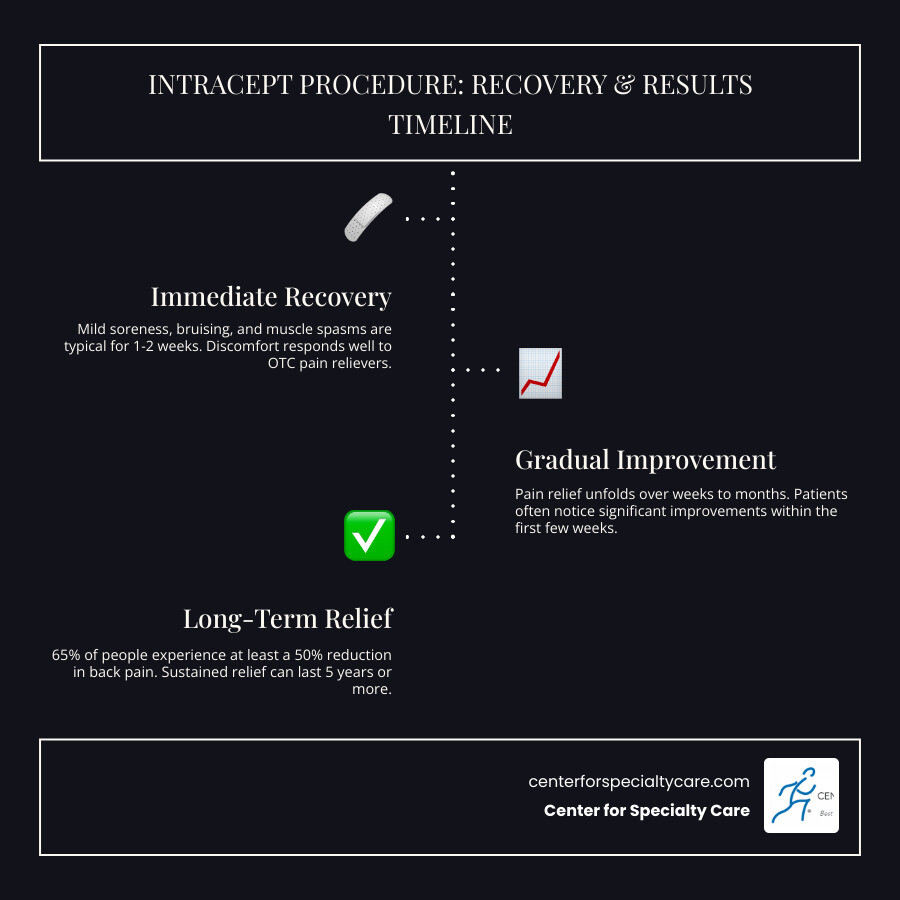
What to Expect: The Typical Intracept Recovery Timeline
If you’re feeling a bit nervous about what comes next after your Intracept procedure, you’re definitely not alone. It’s completely natural to wonder what the healing journey will look like, and having a clear picture of what to expect can make all the difference in feeling confident about your recovery.
The Intracept procedure is designed to be as gentle on your body as possible. This minimally invasive treatment targets the basivertebral nerve using radiofrequency energy to stop pain signals from damaged vertebral endplates. The best part? You’ll likely go home the same day, though we always recommend having someone drive you home, especially if you received any sedation.
Right after your procedure, you might notice some soreness at the incision site – this is completely normal and expected. Some bruising and swelling around the treated area is also typical, but don’t worry, it’s usually quite mild. Think of it like your body’s way of saying “something helpful just happened here, and I’m working on healing.”
The first 48 hours are all about rest and recovery. Your body is doing some important behind-the-scenes work, so give it the break it deserves. After this initial rest period, you’ll begin a gradual return to activity. Walking is actually encouraged – it’s one of the best things you can do to promote healthy circulation and prevent stiffness.
For comprehensive support throughout your recovery journey, our team offers specialized Pain Management services designed to help you heal comfortably and effectively.
What is Normal Pain After Intracept Procedure?
Let’s talk about what’s completely normal when it comes to pain after intracept procedure. Many patients describe feeling post-procedure soreness that’s similar to a sunburn sensation at the treatment site. You might also experience some muscle spasms or general stiffness in the area – your muscles are simply adjusting to the changes.
It’s important to understand the difference between normal discomfort and severe pain. The discomfort you’ll likely experience should be manageable and respond well to over-the-counter medication like acetaminophen or ibuprofen. This sunburn-like feeling is actually a positive sign that your body is healing.
Most patients find that this normal pain fades within the duration of 1-2 weeks. This temporary discomfort is part of your journey toward long-term relief. If you’re interested in learning more about the science behind recovery, there’s helpful scientific research on post-ablation recovery that explains the healing process.
Recommended Post-Procedure Care and Activity
Taking good care of yourself after your procedure doesn’t have to be complicated. Here’s how to set yourself up for the smoothest possible recovery.
Wound care is straightforward – if you have steri-strips over your small incisions, just leave them alone for about a week. They’ll usually fall off on their own when they’re ready. Any larger bandages can come off the next day.
Showering is fine starting the day after your procedure. Just be gentle around the incision area and avoid scrubbing directly over any steri-strips. Your regular diet and hydration routine can continue as normal – staying well-hydrated always helps with healing.
Gentle movement is your friend during recovery. Walking the day after your procedure is not just okay, it’s encouraged. Start with short, comfortable distances and listen to your body. However, there are some activity restrictions to keep in mind for the first two weeks – avoid heavy lifting (anything over 25 pounds), strenuous exercise, and excessive twisting or bending movements.
Your follow-up appointments are crucial for monitoring your progress. We’ll typically see you again in 10-14 days to check how you’re healing and discuss when you can gradually increase your activity levels. Think of these visits as checkpoints on your road to recovery – they help ensure everything is progressing exactly as it should.
Managing Discomfort: A Step-by-Step Guide
Even with a minimally invasive procedure like Intracept, some discomfort is expected as your body heals. The good news? There are simple, effective ways to manage this temporary soreness so you can focus on your recovery and look forward to the long-term relief ahead.

Pain medication is your first line of defense against post-procedure discomfort. We’ll provide you with a clear schedule for taking your medications, which might include over-the-counter options like ibuprofen or acetaminophen, or a short-term prescription for muscle relaxers if you’re experiencing spasms. The key is staying ahead of the pain – take your first dose about 2-3 hours after your procedure, even before the discomfort becomes bothersome.
Ice pack application works wonderfully alongside medication. Apply a covered ice pack (never directly on your skin) to the treated area for 15-minute intervals, a few times throughout the day. Think of it as giving your back a soothing, cool hug that helps reduce both swelling and pain signals.
Gentle stretching becomes important after the first 48 hours of rest. Simple movements like slow shoulder rolls or gentle neck stretches can help prevent stiffness from setting in. However, avoid any stretches that involve twisting or bending your back during these early weeks.
Proper posture makes a surprising difference in your comfort level. When sitting, keep your feet flat on the floor and your back supported. For sleeping, many patients find lying on their side with a pillow between their knees most comfortable. If you’re a back sleeper, try placing a pillow under your knees to reduce pressure on your lower back.
Light exercise can typically be resumed after about two weeks, but always check with us first. Walking remains the gold standard – it promotes healing without putting stress on the treated area. When you’re ready to do more, our Orthopedics team can help guide your return to more active pursuits.
When Does Pain After Intracept Procedure Signal a Problem?
While some pain after intracept procedure is completely normal, certain warning signs deserve immediate attention. Learning to recognize the difference between typical healing discomfort and potential complications can give you peace of mind and ensure your safety.
Worsening pain that doesn’t follow the expected pattern is concerning. Normal post-procedure pain should gradually improve over the first two weeks. If your pain actually increases after the first few days, or if it’s not responding to the medications we’ve prescribed, it’s time to give us a call.
Pain not relieved by medication is another red flag. The combination of proper pain management and ice therapy should make your discomfort manageable. If you’re taking medication as directed but still experiencing significant pain, we need to reassess your situation.
Signs of infection require immediate attention, though they’re quite rare with radiofrequency procedures. Watch for fever over 101°F, chills, increasing warmth or expanding redness around your incision site, any drainage from the wound, or swelling that gets worse after the third or fourth day rather than better.
Nerve damage symptoms can include persistent numbness, tingling, or unusual pain patterns that last more than a few weeks. While temporary nerve irritation is possible, symptoms that don’t gradually improve need evaluation.
Trust your instincts – you know your body better than anyone. If something feels “off” or different from what we’ve described as normal, don’t hesitate to reach out to us.
What to Do for Severe or Worsening Pain
If you experience severe or worsening pain after intracept procedure, your first step should always be contacting our team immediately. At Center for Specialty Care, we pride ourselves on being available when you need us most, and we’ll work quickly to address your concerns.
Contacting your healthcare provider immediately means calling our office during business hours or using our after-hours contact system for urgent situations. Don’t wait until your scheduled follow-up if you’re experiencing concerning symptoms.
Describing your symptoms accurately helps us provide the best guidance. When you call, be ready to explain the type of pain you’re feeling – is it sharp, throbbing, burning, or aching? Tell us exactly where it’s located, rate its severity on a scale of 1-10, and mention anything that makes it better or worse. Also share any other symptoms like fever, chills, or changes around your incision site.
Following medical advice precisely is crucial for your safety and recovery. If we recommend coming in for an evaluation, schedule that appointment as soon as possible. If we suggest adjusting your pain medication or activity level, follow those instructions carefully.
Emergency situations are rare but serious. If you develop a high fever with chills, signs of severe infection, or if you feel your symptoms are life-threatening, don’t hesitate to seek immediate medical attention at your nearest emergency room.
While serious complications occur in less than 1% of radiofrequency procedures, we’re always here to support you through any concerns. Our experienced team understands that recovery can feel overwhelming sometimes, and we’re committed to guiding you every step of the way. You can learn more about our dedicated professionals by visiting Meet Our Providers.
Understanding Your Results: Long-Term Relief and Success
The journey to pain after intracept procedure recovery is more like training for a marathon than sprinting to the finish line. While this might feel frustrating when you’re eager for relief, understanding this timeline can help set realistic expectations and celebrate the progress you’re making along the way.
Many patients start noticing meaningful changes within the first few weeks after their procedure. One patient shared that they felt significant changes around day 10, with their pain “completely gone” just a few weeks later. However, every person’s healing journey is unique. For some, the full benefits unfold gradually over 3 to 6 months, or even longer, as their body continues the healing process and adapts to life without those persistent pain signals.

Success with the Intracept procedure isn’t measured only by how much your pain decreases. We also look closely at how your daily function improves and whether you’re getting back to activities that matter to you. The clinical results are genuinely encouraging. Research shows that 65% of people experience at least a 50% reduction in back pain, while 36.2% achieve at least a 75% reduction. Even more remarkable, 22.4% of patients report complete pain relief six months after their procedure.
These numbers tell an important story. Even a 50% reduction in chronic pain can be life-changing. It might mean you can garden again without wincing, take those walks you’ve missed, or simply sleep through the night without constant discomfort interrupting your rest.
How Long Does Intracept Pain Relief Last?
Here’s where the Intracept procedure really shines – its potential for providing lasting relief. Clinical studies demonstrate that most patients maintain significant improvements in both function and pain levels for more than five years after a single treatment. For someone who has battled chronic low back pain for months or years, this kind of sustained relief can feel almost too good to be true.
The science behind this longevity is fascinating. During the Intracept procedure, the basivertebral nerve is ablated to stop those persistent pain signals. While nerves do have the ability to regrow over time, the effects of radiofrequency ablation typically last about 6 months to a year or longer before any regrowth might occur.
If your symptoms do eventually return, the good news is that the procedure can often be repeated safely, offering you continued relief. This flexibility makes Intracept a valuable long-term solution for managing chronic vertebrogenic pain. The clinical evidence on long-term outcomes continues to support these encouraging results.
Does Post-Procedure Pain Mean Intracept Was Unsuccessful?
This is one of the most common concerns we hear, and it’s completely understandable. Experiencing pain after intracept procedure doesn’t mean your treatment has failed. This distinction is crucial because feeling discouraged about initial discomfort can overshadow the real progress happening beneath the surface.
The pain you feel during recovery is typically related to your body’s natural healing response at the treatment site. This is completely different from the chronic vertebrogenic pain that brought you to us in the first place. Think of it like this – if you had a small cut on your hand, you wouldn’t expect it to feel perfectly normal the next day, even though the cut will heal beautifully.
We define success in pain management as achieving significant pain reduction (often at least 50%) combined with meaningful improvements in your daily function and quality of life. Our goal isn’t to promise you’ll never feel any discomfort again, but rather to reduce your pain to a level that lets you engage fully in work, hobbies, and time with family and friends.
Consider this scenario: if your original chronic back pain was consistently a 9 out of 10, and after your Intracept procedure and recovery, it’s now consistently a 3 out of 10, that represents a tremendous success. The procedure has effectively addressed the source of your pain, giving you back the freedom to live your life more fully.
We encourage open, honest conversations about your progress during follow-up visits. Every concern you have is valid, and we’re here to help you understand what you’re experiencing. For comprehensive information about our approach to Back and Spine care, you can explore our specialized services designed to support your long-term spinal health.
Frequently Asked Questions about Pain After Intracept Procedure
When you’re considering the Intracept procedure, it’s completely natural to have questions swirling around in your mind. We’ve been helping patients steer these decisions for years, and we find that addressing common concerns upfront helps everyone feel more confident about their treatment journey. Let’s explore the questions we hear most often in our Fairmont clinic.
Who is a good candidate for the Intracept procedure?
The beauty of the Intracept procedure lies in its precision – it’s specifically designed for people dealing with a particular type of chronic low back pain called vertebrogenic pain. Think of it as a targeted solution rather than a one-size-fits-all approach.
You might be an excellent candidate if you’ve been wrestling with chronic low back pain for more than six months and feel like you’ve tried everything without lasting success. We’re talking about the kind of pain that doesn’t budge with physical therapy, rest, medications, or even injections – the stubborn pain that just won’t quit.
The real key lies in what we see on your MRI scan. We look for specific changes in your vertebral endplates called Modic changes, particularly Type 1 or Type 2. These changes are like fingerprints that tell us the basivertebral nerve is likely the culprit behind your pain. Many patients describe their pain as sitting right in the middle of their low back, getting worse when they’re active, sitting for long periods, or bending forward.
During your consultation with our specialists here at Center for Specialty Care, we’ll take a comprehensive look at your medical history, imaging, and symptoms to determine if Intracept is your best path forward. We serve patients not just in Fairmont, MN, but also in Estherville, IA, Buffalo Center, IA, and St. James, MN.
What are the potential risks of the Intracept procedure?
Honesty is always our policy when discussing any medical procedure, and the Intracept procedure does carry some potential risks, though we’re pleased to report it has an excellent safety profile with serious complications being quite rare.
Because this is a minimally invasive procedure, the risks are generally much lower than what you’d face with traditional open spine surgery. However, we want you to be fully informed about what could potentially happen.
Infection is always a concern with any procedure, though it occurs in less than 1% of radiofrequency ablations like Intracept. We use strict sterile techniques and sometimes preventive antibiotics to minimize this risk. There’s also a small possibility of bleeding at the procedure site, though this is typically minor.
Very rarely, there could be nerve injury to surrounding structures, despite our use of advanced imaging guidance for precision. Some patients experience a temporary increase in back pain for a few days after the procedure – this is usually part of the normal healing process we discussed earlier.
Perhaps the most important risk to understand is that the procedure might not provide the level of pain relief you’re hoping for. While highly effective for many patients, individual results can vary, and we can never guarantee specific outcomes.
We’ll thoroughly discuss all these potential risks and benefits during your consultation, ensuring you have all the information you need to make the best decision for your situation.
How long until I feel the full effects of the Intracept procedure?
This might be the question we hear most often, and it’s completely understandable – when you’ve been living with chronic pain, you’re naturally eager to feel better! The honest answer is that individual results vary significantly, and patience becomes your most valuable companion during recovery.
Some of our patients notice meaningful improvements within the first few weeks after their procedure. Others find that their relief builds gradually over several months. The pain after intracept procedure that you might experience initially is often related to healing, not the procedure’s effectiveness.
What we typically tell patients is to expect continued improvement over three to six months. Your body needs time to heal from the procedure itself, and then the nerve signals need time to fully adjust to the changes we’ve made. Some patients in clinical studies have reported that it took up to five months or even longer to experience the full difference.
This timeline might feel frustrating when you’re eager for relief, but we’re working with your body’s natural healing processes. The gradual improvement often leads to more sustainable, long-lasting results. We encourage you to stay in close communication with us during your recovery, sharing your progress at follow-up appointments so we can support you every step of the way.
Your Path to a Pain-Free Life
Understanding what to expect with pain after intracept procedure is just the beginning of your journey toward lasting relief from chronic low back pain. While the initial weeks may bring some discomfort as your body heals, this temporary soreness is often a sign that the treatment is working to address the root cause of your vertebrogenic pain.
Patience truly is your best friend during this recovery period. Many patients feel discouraged when they don’t experience immediate relief, but the reality is that meaningful pain reduction often unfolds gradually over weeks and months. Your body needs time to respond to the basivertebral nerve ablation, and the full benefits may not become apparent for three to six months or even longer.
Following your post-procedure guidelines isn’t just a suggestion – it’s your roadmap to the best possible outcome. Those activity restrictions, wound care instructions, and follow-up appointments all play crucial roles in your healing process. Think of them as stepping stones leading you toward your goal of reduced pain and improved function.
Open communication with our team makes all the difference in your recovery experience. We want to hear from you, whether you’re celebrating small victories or concerned about unexpected symptoms. If your pain worsens instead of improving, doesn’t respond to the medications we’ve recommended, or if you notice any signs of infection like fever or unusual drainage, don’t hesitate to reach out. We’re here to support you every step of the way.
At Center for Specialty Care, we understand that chronic back pain affects every aspect of your life – from your ability to work and exercise to your relationships and overall happiness. That’s why we’re dedicated to providing personalized care and innovative treatments like the Intracept procedure to help you reclaim your quality of life. Our commitment to 100% patient satisfaction means we’ll work closely with you throughout your recovery, adjusting your care plan as needed and celebrating your progress together.
Your journey toward a more comfortable, active life is within reach. To learn more about how the Intracept procedure can help you take that next step, or to schedule a consultation at one of our convenient locations, visit Learn more about the Intracept Procedure at Center for Specialty Care. We’re here to help you write the next chapter of your story – one with less pain and more possibilities.