
How to Relieve Stress: Simple Strategies for a Serene Life
January 30, 2026
The Intracept Comeback: A Full Guide to Your Recovery Journey
February 3, 2026
Orthopedic shoulder pain: 2025 Ultimate Relief
Understanding Orthopedic Shoulder Pain: What You Need to Know
Orthopedic shoulder pain is a leading reason for medical visits, ranking as the third most common musculoskeletal complaint after back and knee pain. Each year, over 4 million Americans see a doctor for shoulder issues.
Common Causes of Orthopedic Shoulder Pain:
- Rotator cuff disorders (85% of all cases)
- Bursitis and tendinitis
- Shoulder instability or dislocation
- Arthritis and frozen shoulder
- Labral tears (SLAP lesions)
- Referred pain from the neck
When to Seek Medical Attention:
- Severe pain lasting more than a few days
- Inability to raise your arm
- Shoulder deformity or swelling
- Pain accompanied by chest tightness or breathing difficulty
- Numbness or weakness extending down your arm
Your shoulder is the body’s most movable joint, a complex structure of bones, muscles, and tendons. This mobility allows for a wide range of motion but also makes it vulnerable to injury from overuse, trauma, and wear-and-tear.
Understanding the cause of your shoulder pain is the first step toward relief. Effective treatments are available for everything from a dull ache to sharp pain or stiffness.
I’m Dr. Corey Welchlin, and I’ve been treating orthopedic shoulder pain in southern Minnesota and northern Iowa for over 30 years. From arthroscopic rotator cuff repairs to comprehensive shoulder replacements, I’ve helped thousands of patients return to the activities they love—often using minimally invasive techniques that get you home the same day.
Understanding Your Shoulder: Anatomy and Function
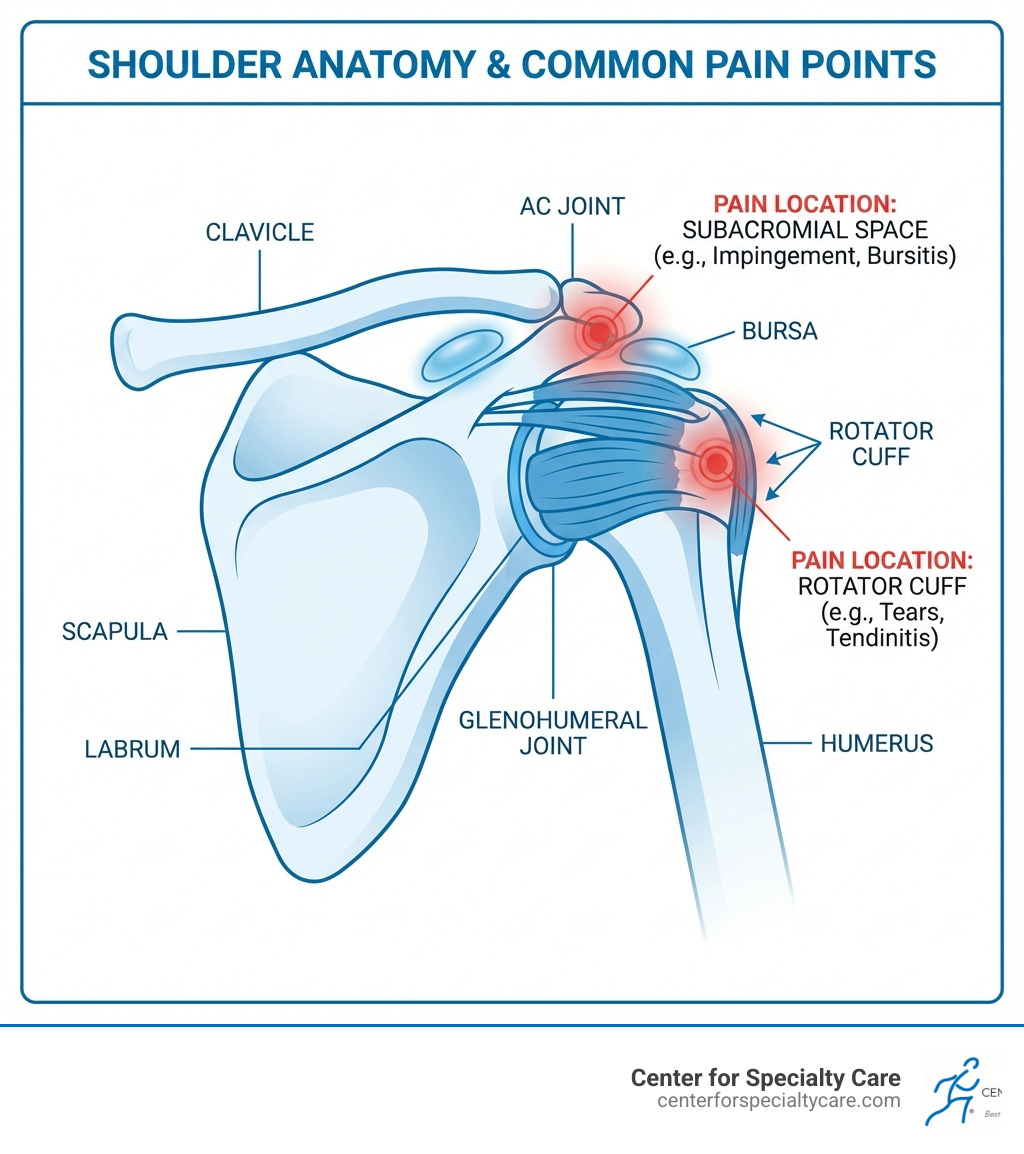
Understanding orthopedic shoulder pain starts with its anatomy. The shoulder isn’t a single joint but a complex network designed for maximum mobility. This flexibility, however, makes it one of the body’s most unstable and injury-prone joints.
Our shoulder is primarily made up of three bones:
- The humerus (upper arm bone).
- The scapula (shoulder blade).
- The clavicle (collarbone).
These bones form two main joints:
- The glenohumeral joint: The main ball-and-socket joint where most shoulder movement occurs.
- The acromioclavicular (AC) joint: Where the clavicle meets the highest point of the scapula.
A sophisticated system of soft tissues supports these bones and joints:
- Rotator Cuff Muscles and Tendons: Four muscles and their tendons that stabilize the shoulder and allow you to lift and rotate your arm.
- Labrum: A ring of cartilage that lines the socket, making it deeper and more stable.
- Bursa: Small, fluid-filled sacs that act as cushions to reduce friction.
- Ligaments: Strong connective tissues that connect bones to provide joint stability.
The shoulder’s ball-and-socket design grants it the widest range of motion of any joint. However, this mobility means it relies heavily on surrounding soft tissues for stability. When these tissues are injured, the shoulder can become unstable, painful, and dysfunctional. This trade-off between mobility and stability is at the root of many orthopedic shoulder pain issues.
For more information on the intricate workings of your shoulder, we recommend exploring resources like the American Academy of Orthopaedic Surgeons’ guide: Our knowledge of orthopaedics. Your best health..
Common Causes of Orthopedic Shoulder Pain
Orthopedic shoulder pain often relates to overuse, trauma, or degenerative conditions. While there are many ways to injure a shoulder, the most common causes are rotator cuff disorders, accounting for 85% of cases. Other contributors include glenohumeral joint disorders, AC joint pathology, and referred pain from the neck.
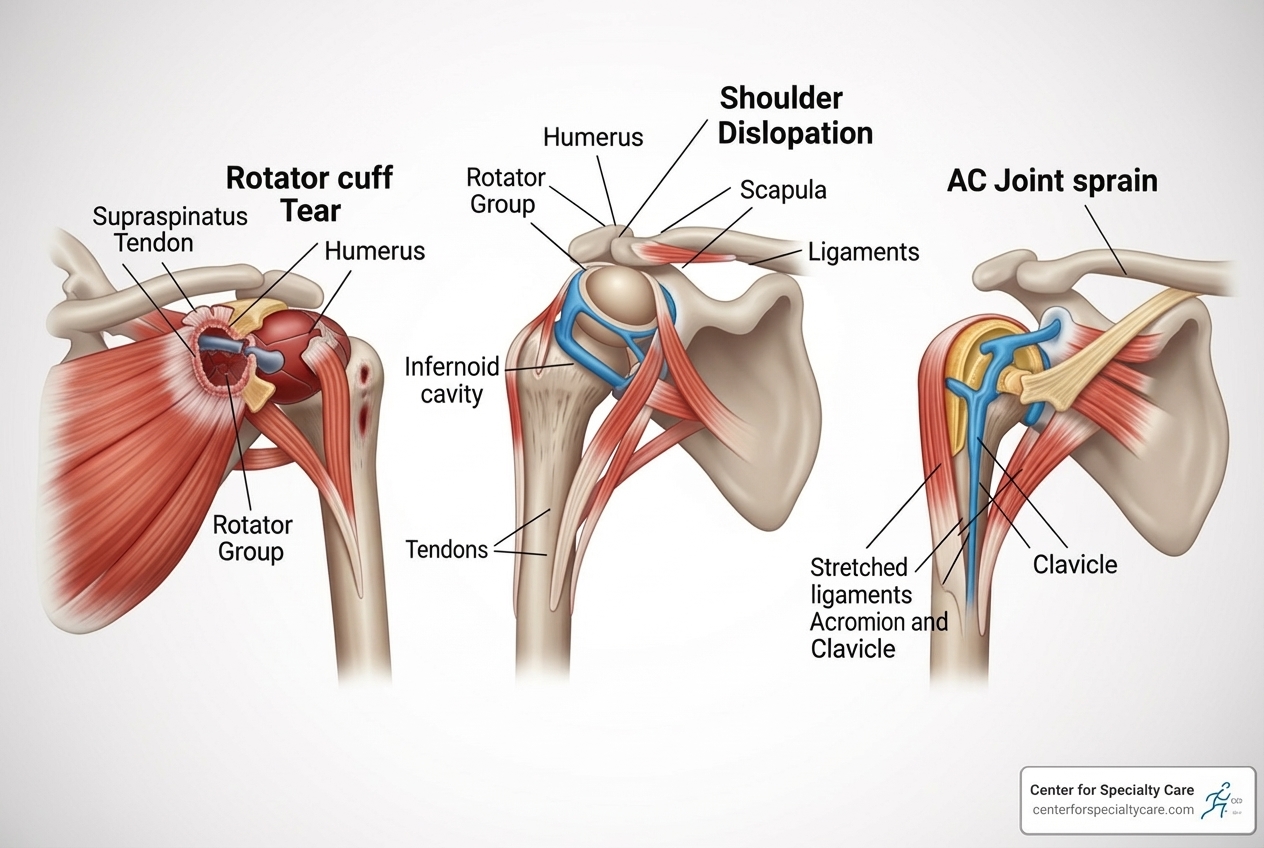
Shoulder injuries can develop gradually from repetitive motions or occur suddenly from an accident. Understanding the specific cause is crucial for effective treatment.
Rotator Cuff Injuries: Tears and Tendinitis
The rotator cuff is vital for shoulder stability and movement, and its problems are the most frequent source of orthopedic shoulder pain, typically categorized as tendinitis or tears.
Rotator cuff tendinitis, or inflammation of the tendons, usually results from repetitive overhead motions common in sports or certain jobs. It causes pain and tenderness and can also stem from a sudden injury.
A rotator cuff tear is a partial or complete tear of one or more tendons. It can result from gradual wear and tear (especially after 40) or a sudden injury like a fall. Risk factors include construction work, family history, and overhead sports.
Symptoms of a rotator cuff tear often include:
- A dull ache that worsens if you sleep on the affected shoulder.
- Weakness in the arm.
- Difficulty performing daily tasks like reaching behind your back or lifting objects overhead.
While some minor issues improve with rest, many require professional intervention. Learn more about recovery and managing pain: Will a Torn Rotator Cuff Heal on its Own? Key Recovery Facts and How to Relieve Rotator Cuff Pain at Night: Expert Tips for Better Sleep.
Shoulder Instability: Dislocation and Separation
The shoulder’s incredible mobility makes it the body’s most frequently dislocated major joint. Shoulder instability occurs when the humerus (upper arm bone) is forced out of its socket.
A dislocation can be partial (subluxation) or complete. After one dislocation, the shoulder is more prone to it happening again, leading to chronic shoulder instability. This can result from injury, overuse, or naturally loose ligaments, with athletes and workers performing overhead tasks at higher risk.
A shoulder separation is different, involving an injury to the AC joint where the collarbone meets the shoulder blade. Torn ligaments here can cause instability and weakness.
For more in-depth information on dislocation, you might find this resource helpful: Shoulder specialist Edward McFarland, M.D., talks about shoulder dislocation.
Inflammatory Conditions: Bursitis and Impingement
Bursitis and impingement syndrome are two other common, often related, causes of orthopedic shoulder pain.
Bursitis is the inflammation of bursae, the small, fluid-filled sacs that cushion the shoulder joint. Repetitive motion is a common cause. Subacromial bursitis leads to stiffness, swelling, and an ache that worsens with pressure or movement.
Shoulder impingement syndrome (or subacromial pain) occurs when the rotator cuff tendons or bursa are pinched during arm movements, causing pain when lifting the arm. The term “subacromial pain” is often preferred as the exact cause can be unclear.
Symptoms of impingement can include:
- Pain on the outer side of the shoulder, especially when lifting your arm.
- Pain that worsens at night.
- A grinding or popping sensation in the joint.
For more insight into joint sounds, visit: Shoulder Clicking and Pain: Causes, Effective Relief.
Other Common Conditions: Frozen Shoulder, Arthritis, and SLAP Tears
Several other conditions can cause significant orthopedic shoulder pain:
-
Frozen Shoulder (Adhesive Capsulitis): This condition causes gradually worsening pain and severe stiffness. It progresses through three stages: freezing (increasing pain), frozen (stiffness remains), and thawing (mobility improves). It typically resolves in 12-18 months, but physical therapy is key to recovering mobility. It’s more common in women over 40 and those with conditions that limit arm movement.
-
Arthritis: The shoulder can develop arthritis, most commonly osteoarthritis (“wear-and-tear” arthritis), which begins in middle age and causes pain, stiffness, and reduced motion. Other forms include post-traumatic arthritis, rheumatoid arthritis, and avascular necrosis.
-
SLAP Tears: A SLAP (Superior Labrum, Anterior to Posterior) tear is an injury to the labrum, the cartilage that stabilizes the shoulder socket. It can result from sudden trauma or repetitive overhead motions. Symptoms include pain when reaching overhead, instability, weakness, and a grinding or popping sensation.
Diagnosis and When to Seek Help
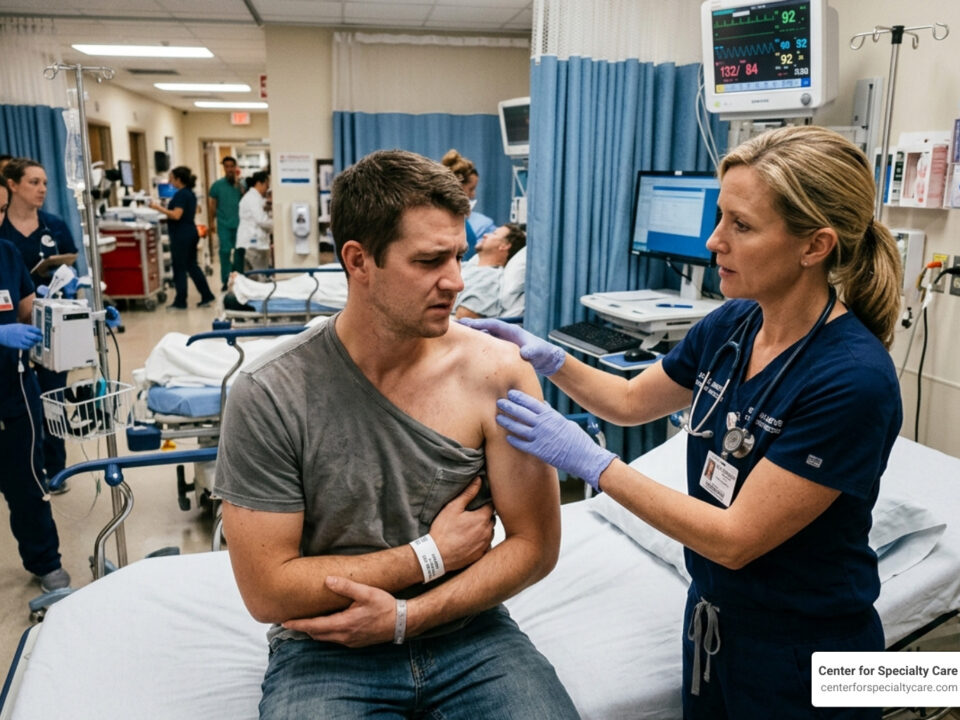
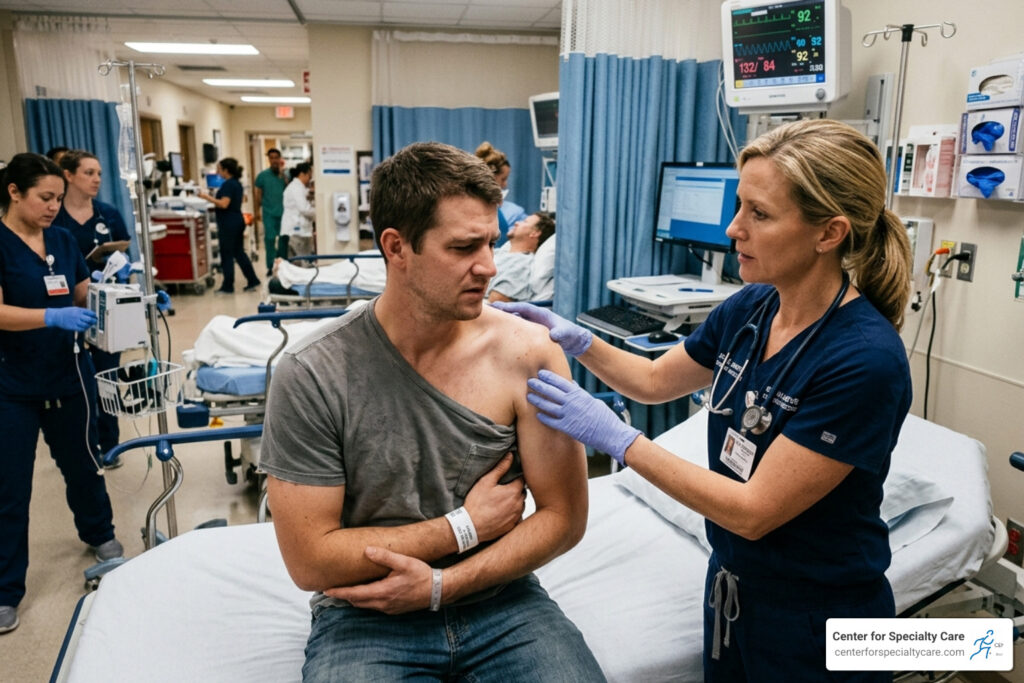
Knowing when to seek professional help for orthopedic shoulder pain is crucial. While minor aches may resolve with rest, persistent or severe pain warrants a visit to an orthopedic specialist.

For minor shoulder pain, you can initially try home care:
- Rest the affected shoulder, avoiding activities that worsen discomfort.
- Ice the area for 15 minutes at a time, several times a day.
- Over-the-counter pain relievers like ibuprofen can help manage pain.
However, seek medical attention promptly for these red flags:
- Sudden, severe pain.
- A joint that appears deformed.
- Inability to use the joint or move your arm.
- Intense pain or sudden swelling after an injury.
- Difficulty breathing or chest tightness with left shoulder pain – this could be a heart attack; call 911 immediately.
- Swelling, redness, or warmth around the joint.
- Numbness or weakness down your arm.
- Pain that persists for more than a few days or interferes with daily life.
If you experience any red flag symptoms, schedule an appointment promptly. For more guidance, see our article: Should I go to urgent care for shoulder pain? Signs, Treatment Options.
Your evaluation will begin with a thorough review, including:
- Medical History: We’ll discuss your pain’s onset and nature, aggravating factors, and your medical history.
- Physical Examination: We will examine your shoulder’s range of motion, stability, and strength, using specific tests to pinpoint the pain source.
- Imaging Tests: To confirm a diagnosis, we may recommend:
- X-rays: To visualize bones and identify fractures or arthritis.
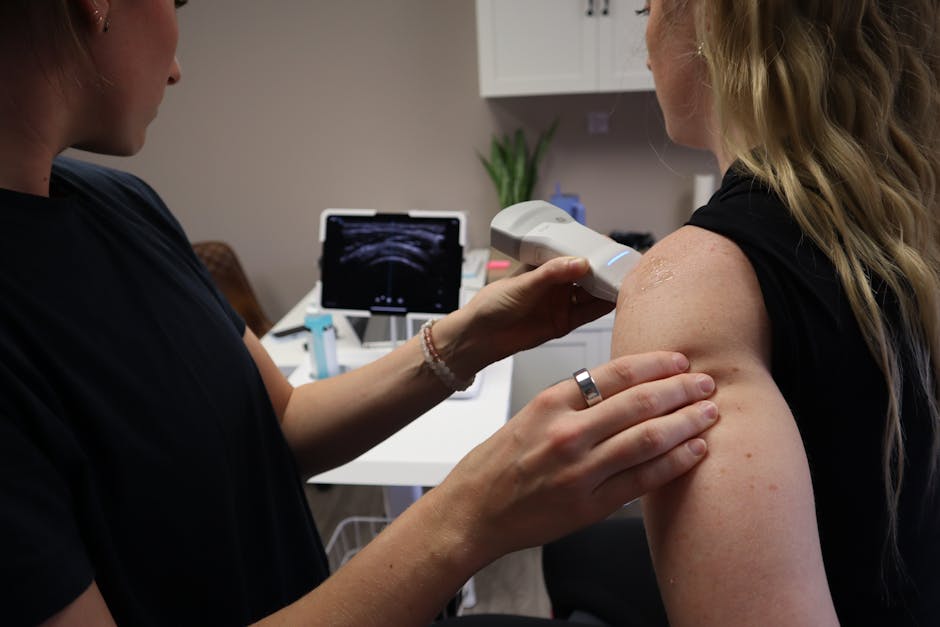
- Ultrasound: Used to evaluate soft tissues like tendons and bursae and accurately detect rotator cuff tears.
- MRI (Magnetic Resonance Imaging): Provides detailed images of soft tissues to detect tears or other issues. Since asymptomatic tears can appear on MRIs, we interpret imaging in the context of your physical exam and symptoms.
Understanding Your Diagnosis for Orthopedic Shoulder Pain
An accurate diagnosis is the cornerstone of effective treatment. Shoulder issues can be complex, making the expertise of an orthopedic specialist invaluable. Orthopedic specialists use your medical history, physical exam, and imaging results to provide a precise diagnosis.
Imaging doesn’t tell the whole story, as many people have asymptomatic tears. We focus on a comprehensive diagnosis based on your symptoms and their impact on your life. Early, accurate diagnosis significantly improves treatment outcomes.
If you’re seeking specialized care, we invite you to learn more about finding the right expert: Finding the Best Orthopedic Shoulder Specialist Near Me.
A Spectrum of Treatment Options
Once we diagnose the cause of your orthopedic shoulder pain, we create a personalized treatment plan. At Center for Specialty Care, we use a conservative-first approach, exploring non-surgical options before considering surgery, as many shoulder problems respond well to these treatments.
Lifestyle and occupational factors, such as jobs or sports with overhead motion, are significant. We’ll discuss how these contribute to your pain and what modifications can aid your recovery and prevent future issues.
Our goal is to alleviate your pain and restore function, getting you back to life in Fairmont, Estherville, Buffalo Center, or St. James. For a deeper dive into specialized care, check out: Doctor for Shoulder Problems: Your Guide to Specialized Care.
Non-Surgical Treatments for Shoulder Pain
Non-surgical treatments are highly effective for most cases of orthopedic shoulder pain. Our focus is on reducing inflammation, managing pain, and restoring strength and mobility.
-
Physical Therapy (PT): PT is a cornerstone of non-surgical treatment. A therapist guides you through exercises to strengthen shoulder muscles, improve range of motion, and correct posture. PT is crucial for conditions like frozen shoulder and can be continued at home for effective, long-term results. We offer comprehensive physical therapy to support your recovery: Best Therapy for Shoulder Pain – Expert Solutions & Relief.
-
Anti-inflammatory Medications: Over-the-counter NSAIDs like ibuprofen or naproxen can reduce pain and inflammation. We may prescribe stronger versions if needed.
-
Corticosteroid Injections: For significant pain from conditions like bursitis, a corticosteroid injection can provide powerful, direct anti-inflammatory relief. While effective for managing symptoms, they don’t always treat the underlying cause, and we use them judiciously. To learn more, visit: Types of Injections for Shoulder Pain Relief: Treatment Options.
Other approaches include activity modification, rest, and ice for acute pain.
Surgical Solutions for Severe Orthopedic Shoulder Pain
When conservative care fails to relieve persistent orthopedic shoulder pain, surgery may be the best option. Modern orthopedic surgery offers highly effective, often minimally invasive, solutions.
Surgery is considered if:
- Non-operative management fails.
- The injury won’t heal on its own (e.g., significant rotator cuff tears).
- You have chronic instability or recurrent dislocations.
- Severe arthritis limits your quality of life.
Common surgical options include:
-
Arthroscopic Surgery: This minimally invasive technique uses a tiny camera and small incisions to repair shoulder damage. It generally leads to less pain, smaller scars, and a faster recovery.
-
Rotator Cuff Repair: For significant tears causing weakness or pain, surgery can reattach the tendon to the bone, often arthroscopically.
-
Labral (SLAP) Repair: Surgery can repair labral tears to re-stabilize the joint, typically followed by physical therapy to restore motion and strength.
-
Shoulder Replacement: This is a highly effective option for severe pain and loss of motion from conditions like advanced arthritis or complex fractures when conservative treatments fail.
- Total Shoulder Replacement: Damaged joint parts are replaced with prosthetic components.
- Reverse Shoulder Replacement: For patients with severe arthritis combined with a massive rotator cuff tear. The ball and socket are reversed, allowing the deltoid muscle to lift the arm.
We have extensive experience with all shoulder replacement procedures. We ensure you understand the risks and benefits before making a decision and pride ourselves on achieving positive outcomes. For more on surgical options, visit: Rotator Cuff Surgeon Near Me – Find Trusted Specialists in Your Area.
Frequently Asked Questions about Shoulder Pain
We know you have questions, and we’re here to provide clear answers about orthopedic shoulder pain.
What is the most common cause of orthopedic shoulder pain?
The most common cause is rotator cuff disorders, which account for about 85% of cases. This includes tendinitis (tendon inflammation) and subacromial pain (impingement). Bursitis (inflammation of the cushioning sacs) is also a frequent contributor, often related to repetitive motions.
Can shoulder pain go away on its own?
Yes, minor shoulder pain often resolves with rest. About half of cases improve within six months, and conditions like frozen shoulder typically resolve in 12-18 months (though PT helps). However, persistent pain should not be ignored, as it can lead to chronic pain, decreased mobility, worsening of the condition, and increased risk of future injury.
How can I prevent shoulder pain?
Preventing orthopedic shoulder pain involves smart habits and listening to your body:
- Maintain Proper Posture: Good posture keeps your shoulder muscles and tendons aligned, reducing strain.
- Strengthening Exercises: Regularly strengthening the muscles around your shoulder improves stability.
- Avoid Overuse: If your job or hobbies involve repetitive overhead movements, take frequent breaks and use proper form.
- Proper Lifting Techniques: Lift with your legs and keep objects close to your body.
- Warm-ups for Sports: Always warm up your muscles before physical activity.
- Listen to Your Body: Don’t “play through” pain. Rest if you feel discomfort.
Take Control of Your Shoulder Health
Your shoulder’s incredible mobility makes it vulnerable to injury. Orthopedic shoulder pain, from rotator cuff issues to arthritis, can significantly impact your quality of life by limiting work, hobbies, and daily tasks.
The good news is you don’t have to live with this pain. By recognizing the signs and seeking timely medical attention, you can find relief. We offer a wide range of effective treatments, from physical therapy to minimally invasive surgery, all designed to get you back to your best.
At Center for Specialty Care, serving the communities of Fairmont, Estherville, Buffalo Center, and St. James, we pride ourselves on a personalized approach to your care. Your satisfaction is our priority, and we strive to offer quick appointment availability because we believe you shouldn’t have to wait for relief.
Don’t let orthopedic shoulder pain limit your life. We’re here to guide your recovery with expert, compassionate care.