Rhomboid Muscle Pain: Is a Spinal Cord Stimulator Right for You?
June 10, 2026
Step-by-Step: Navigating Foot Tendon Surgery Billing Questions
June 12, 2026
Getting Knots Out of Your Shoulder: A Step-by-Step Stretching Guide
That Nagging Knot Between Your Shoulder Blades Has a Fix
Knowing how to stretch shoulder blade knots is one of the fastest ways to get relief from that stubborn, aching tension in your upper back. Here’s a quick overview of what works:
Quick relief steps for shoulder blade knots:
- Shoulder rolls — Roll shoulders up, back, and down 10 times to loosen the upper trapezius.
- Rhomboid stretch — Clasp hands, drop chin, and round your upper back for 15–30 seconds.
- Doorway chest stretch — Place forearms on a door frame and lean forward gently for 20–30 seconds.
- Cat-Cow — Alternate arching and rounding your spine for 5–10 slow reps.
- Cross-body shoulder stretch — Pull one arm across your chest and hold 20–30 seconds per side.
- Tennis ball self-massage — Lean into a tennis ball against a wall on the tender spot for 30–60 seconds.
- Heat therapy — Apply a heating pad for 15–20 minutes before or after stretching.
That tight, achy spot under or between your shoulder blades is one of the most common complaints we see. It can range from a dull, constant ache to a sharp twinge every time you reach or turn your head. It often builds slowly — from hours at a desk, stress, or repetitive movement — until one day it feels like a pebble lodged under your skin.
The good news: most shoulder blade knots respond well to targeted stretching, self-massage, and small daily habit changes. You don’t need special equipment or a gym membership. A consistent 10-minute routine can make a real difference.
I’m Dr. Corey Welchlin, a board-certified orthopedic surgeon and sports medicine physician with over 30 years of experience treating musculoskeletal pain, including the shoulder and upper back conditions that drive people to search for how to stretch shoulder blade knots. As founder of Center for Specialty Care, I’ve worked with patients across southern Minnesota and northern Iowa who’ve found lasting relief through the approaches outlined in this guide.
What a Shoulder Blade Knot Is — and How to Tell It Apart From Soreness
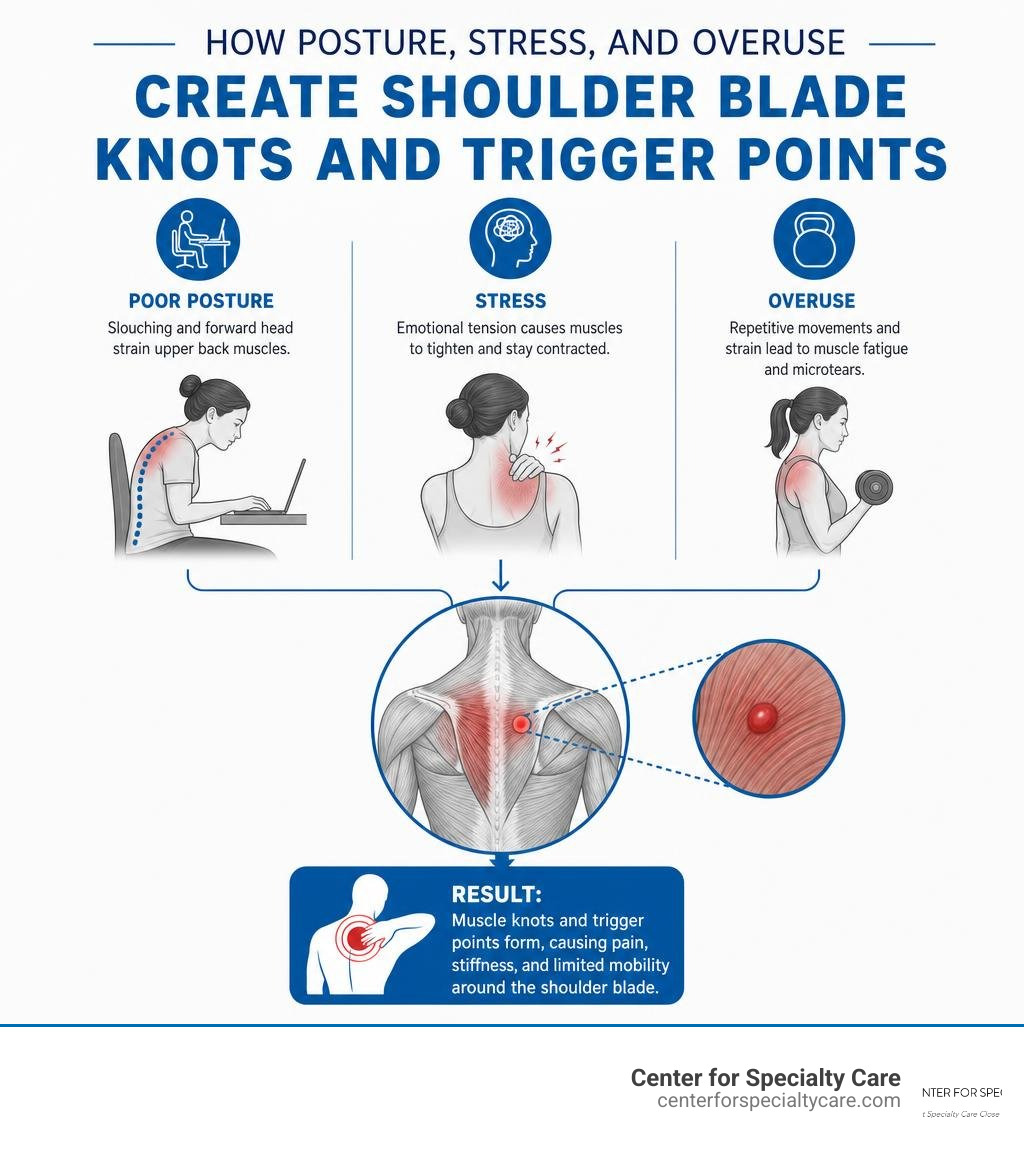
A shoulder blade knot is usually a myofascial trigger point: a focused, irritable spot in a tight band of muscle. It often shows up around the rhomboids, trapezius, levator scapulae, or other muscles that attach to and control the shoulder blade.
The shoulder blade is busy real estate. Seventeen muscles attach to it, connecting your neck, upper back, shoulder, ribs, and arm. That means the area can complain loudly when posture, stress, weakness, overuse, or neck irritation overloads the system.
General soreness is usually more spread out and often follows exercise or unusual activity. A knot is more specific. You can often point to it with one finger.
| Feature | Shoulder blade knot | General soreness | Possible nerve-related pain |
|---|---|---|---|
| Pain location | Small, specific tender spot | Broad muscle ache | Neck, shoulder blade, arm, or hand |
| Feel | Tight band, tender nodule, “small marble” sensation | Achy, tired, stiff | Burning, electric, shooting, or radiating |
| Pressure response | Tender when pressed; may refer pain | Mildly tender over a wider area | Pressure may not reproduce the main symptoms |
| Common triggers | Desk posture, stress, repetitive use, muscle imbalance | New workout, heavy lifting, long activity | Neck movement, pinched nerve, disc irritation |
| Other symptoms | Stiffness, limited reaching, headache referral | Improves with rest | Numbness, tingling, weakness, grip changes |
| Usual timeline | Days to weeks; chronic if cause persists | 24-72 hours after activity | Needs evaluation if persistent or worsening |
What Exactly Is a Muscle Knot Near the Shoulder Blade?
A muscle knot is not literally tied in a knot like a shoelace, although it can feel like your upper back is trying to knit a sweater without permission.
Medically, the term often used is trigger point. This is a hypersensitive area in muscle or fascia where muscle fibers stay contracted and irritated. That contraction can reduce local blood flow, increase tenderness, and cause the surrounding muscles to guard.
You may notice:
- A firm or rope-like band in the upper back
- A tender nodule that feels different from nearby tissue
- A dull ache that improves temporarily with pressure
- Pain that spreads toward the neck, shoulder, or head
- Stiffness when turning your neck or reaching forward
For more detail on safe trigger point pressure, this guide on how to massage shoulder trigger points safely explains common self-massage principles.
Common Symptoms of a Knot Between the Shoulder Blades
A shoulder blade knot may cause:
- Spot-specific pain between the shoulder blade and spine
- A dull ache that lingers during desk work
- A sharp twinge when reaching, lifting, or turning
- Tenderness when pressing on the area
- Neck tension or upper trapezius tightness
- Headache referral, especially from the upper trapezius or levator scapulae
- Trouble getting comfortable while sleeping
- Reduced range of motion in the shoulder, neck, or upper back
- A feeling that the shoulder blade is “stuck”
If pressing the tender spot recreates your familiar pain, a trigger point is more likely. If symptoms travel down the arm with numbness or weakness, it may be more than a knot.
When It May Be More Than a Knot
Self-care is helpful for many shoulder blade knots, but not every pain near the shoulder blade is a muscle knot.
Please seek professional evaluation if you have:
- Numbness, tingling, or burning down the arm
- Arm or hand weakness
- Loss of grip strength
- Pain that starts in the neck and shoots into the arm
- Severe night pain that does not improve with position changes
- Swelling, redness, warmth, fever, or unexplained weight loss
- A lump that is growing, hot, or visibly inflamed
- Chest pain, shortness of breath, sweating, or dizziness
- Pain after a fall, accident, or traumatic injury
Neck conditions, including cervical radiculopathy, can refer pain toward the shoulder blade. Rotator cuff problems, joint inflammation, and other shoulder issues can also mimic knot pain. When in doubt, we prefer to evaluate early rather than let symptoms linger.
How to Stretch Shoulder Blade Knots: A 10-Minute Step-by-Step Routine

The best routine for shoulder blade knots combines three things:
- Gentle mobility to reduce guarding
- Targeted stretching to open tight areas
- Strengthening to keep the knot from coming back
Many shoulder blade exercise programs use 15-30 second stretch holds, 2-4 repeats, and 8-12 repetitions for strengthening moves. You can review general shoulder blade exercise guidance, and we also cover related options in our guide to a stretch for knot in shoulder blade.
Before You Start: Safety Rules for Stretching Shoulder Blade Knots
Before stretching, remember: gentle beats heroic. This is not a contest with your nervous system.
Use these rules:
- Warm up first with a shower, heating pad, or light walking if the area feels stiff.
- Move slowly and breathe normally.
- Do not bounce.
- Keep discomfort mild to moderate, not sharp.
- Stop if pain shoots down your arm or causes numbness, tingling, or weakness.
- Keep your neck neutral unless the stretch specifically includes neck movement.
- Track symptoms over several days so you know what helps.
- Progress gradually.
A good stretch should feel like a release, not like you are negotiating with a hostage taker.
How to Stretch Shoulder Blade Knots With Shoulder Rolls and Neck Mobility
Start here to reduce tension in the upper trapezius, levator scapulae, and neck muscles.
Shoulder rolls
- Sit or stand tall.
- Let your arms hang relaxed.
- Roll both shoulders up toward your ears.
- Move them back, down, and forward in a smooth circle.
- Repeat 10 times.
- Reverse direction for 10 more.
Chin tucks
- Sit tall and look straight ahead.
- Gently glide your head backward, as if making a double chin.
- Keep your eyes level. Do not look down.
- Hold 2-3 seconds.
- Repeat 10 times.
Gentle neck side bend
- Sit tall with shoulders relaxed.
- Tilt one ear toward the same-side shoulder.
- Stop when you feel a gentle stretch along the opposite side of the neck.
- Hold 10-20 seconds.
- Repeat 2-3 times per side.
Hourly reset tip: If you work at a desk, look up several times a day. Your head acts like a heavy bowling ball when it drifts forward, and your upper back gets stuck doing the unpaid overtime.
How to Stretch Shoulder Blade Knots With the Rhomboid Upper-Back Stretch
This is one of the most useful stretches for knots between the shoulder blades.
- Sit or stand tall.
- Clasp your hands in front of you.
- Reach your arms forward as if pushing your shoulder blades apart.
- Tuck your chin slightly.
- Round your upper back gently.
- Breathe into the space between your shoulder blades.
- Hold 15-30 seconds.
- Repeat 2-4 times.
You should feel a broad stretch across the upper back, especially between the shoulder blades. If you feel sharp pain in the shoulder joint, ease off.
Doorway Chest Stretch to Reduce Pull on the Shoulder Blades
Tight chest muscles pull the shoulders forward. When the front of the body is tight, the muscles between the shoulder blades often work overtime trying to hold you upright.
- Stand in a doorway.
- Place your forearms on the door frame with elbows around shoulder height.
- Step one foot forward.
- Lean gently until you feel a stretch across your chest.
- Keep your ribs down and neck relaxed.
- Hold 20-30 seconds.
- Repeat 2-4 rounds.
You can also do this in a corner with one forearm on each wall. The goal is posture reversal: open the chest, reduce rounded shoulders, and take pressure off the shoulder blade muscles.
Cat-Cow and Child’s Pose for Upper-Back Mobility
These movements help the thoracic spine move better. When the upper back is stiff, the shoulder blades have to compensate.
Cat-Cow
- Start on hands and knees.
- Inhale and gently arch your back, lifting your chest.
- Exhale and round your upper back, spreading your shoulder blades.
- Move slowly through a comfortable range.
- Repeat 5-10 times.
Child’s Pose
- From hands and knees, sit your hips back toward your heels.
- Reach your arms forward.
- Let your chest soften toward the floor.
- Breathe slowly into the upper back.
- Hold 30-60 seconds.
If kneeling bothers your knees, place a pillow under them or skip Child’s Pose and repeat the rhomboid stretch instead.
Cross-Body Shoulder Stretch and Posterior Shoulder Release
This stretch targets the back of the shoulder and can reduce tension that feeds into the shoulder blade area.
- Bring one arm across your chest.
- Use the opposite hand to gently pull the arm closer.
- Keep the shoulder down, not shrugged.
- Keep your neck relaxed.
- Hold 20-30 seconds.
- Repeat 2-4 times per side.
Do not force the shoulder joint. You should feel a stretch in the back of the shoulder, not pinching in the front.
Strength Moves That Keep Knots From Coming Back
Stretching helps release tension. Strengthening helps prevent the same muscles from getting overloaded again.
Try these 3-4 days per week:
Shoulder-blade squeeze
- Sit or stand tall.
- Pull shoulder blades gently back and down.
- Hold 6 seconds.
- Repeat 8-12 times.
Do not shrug. Think “back pockets,” not “ears.”
Resisted row
- Anchor a resistance band at waist height.
- Hold one end in each hand.
- Pull elbows back while squeezing shoulder blades.
- Return slowly.
- Do 2-3 sets of 8-12 reps.
Bent-over Y
- Hinge at your hips with a flat back.
- Raise both arms diagonally into a Y shape.
- Keep thumbs up and shoulders away from ears.
- Lower slowly.
- Do 8-12 reps.
Wall slides
- Stand with your back near a wall.
- Bring arms into a goalpost position.
- Slide arms upward as far as comfortable.
- Keep ribs down and neck relaxed.
- Do 8-12 reps.
For more targeted strengthening, see our rhomboid pain relief exercises.
Add Self-Massage, Heat, and Recovery Timing for Faster Relief
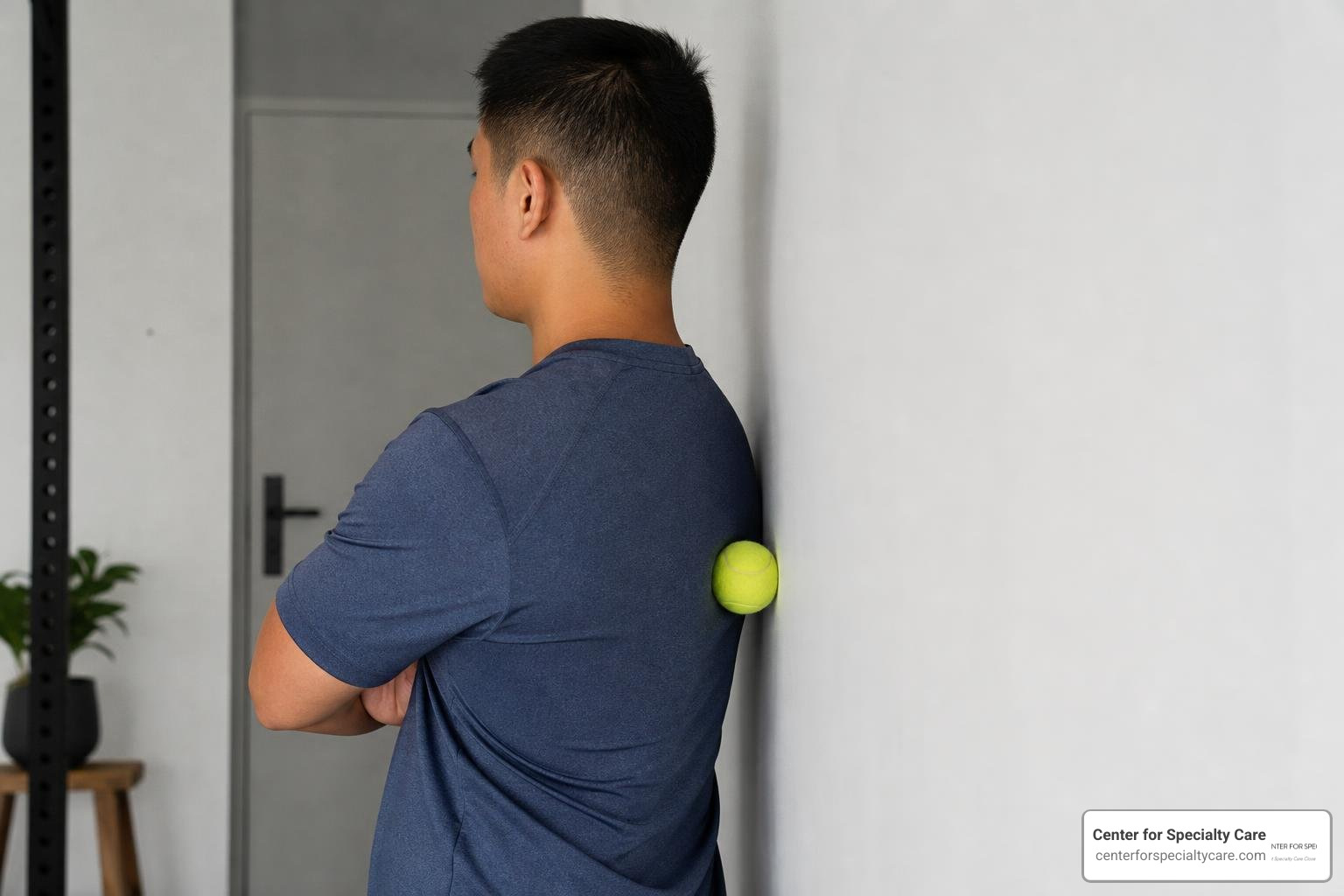
Stretching works even better when paired with self-massage, heat, and recovery habits. Think of it as convincing the muscle to relax instead of yelling at it. Muscles are better listeners when you are polite.
For more tool-specific guidance, we explain options in our article on using a foam roller for shoulder blade knots.
How to Use a Tennis Ball or Lacrosse Ball Safely
A tennis ball or lacrosse ball can reach spots your hand cannot. The wall method is usually safer and easier to control than lying on the floor.
- Stand with your back to a wall.
- Place the ball between the wall and the sore muscle.
- Avoid placing the ball directly on the spine or shoulder blade bone.
- Lean back gradually until you feel firm pressure.
- Hold steady pressure for 30-60 seconds.
- Breathe slowly.
- Add tiny circles if it feels helpful.
- Move to another tender spot if needed.
- Keep the total session under 15-20 minutes.
Use a pressure level no higher than about 7 out of 10. If you need to clench your jaw, hold your breath, or question your life choices, it is too much.
Avoid aggressive digging. Too much pressure can cause bruising, inflammation, and more muscle guarding.
When to Use Heat or Cold for Shoulder Blade Knots
For most chronic shoulder blade knots, heat is usually the better choice because it increases blood flow and tissue elasticity.
Use heat when:
- The area feels stiff or tight
- There is no visible swelling
- Symptoms came on gradually
- You are preparing to stretch
How to use it:
- Apply heat for 15-20 minutes.
- Use a protective layer between skin and heat source.
- Do not sleep with a heating pad on.
Use cold when:
- Pain follows a recent strain or injury
- There is swelling or inflammation
- The area feels acutely irritated
How to use it:
- Apply cold for 10-15 minutes.
- Wrap the cold pack in a towel.
- Let the skin return to normal temperature before repeating.
If pain does not improve after a short trial of appropriate self-care, it is time to get checked.
How Long It Usually Takes to Feel Relief
Relief depends on how long the knot has been there and what is causing it.
Typical timelines:
- Same day: Many people feel temporary easing after heat, stretching, and ball pressure.
- 3-7 days: Mild knots from a recent strain may calm down with consistent care.
- 2-6 weeks: Recurring knots often need better ergonomics, strengthening, and stress management.
- 4-8 weeks or longer: Chronic patterns may require a structured physical therapy or medical plan.
Physical therapy can make a meaningful difference. Research and clinical outcomes show that people with joint and muscle pain, including shoulder issues, may experience an average 68% reduction in pain within the first 12 weeks of physical therapy-guided care.
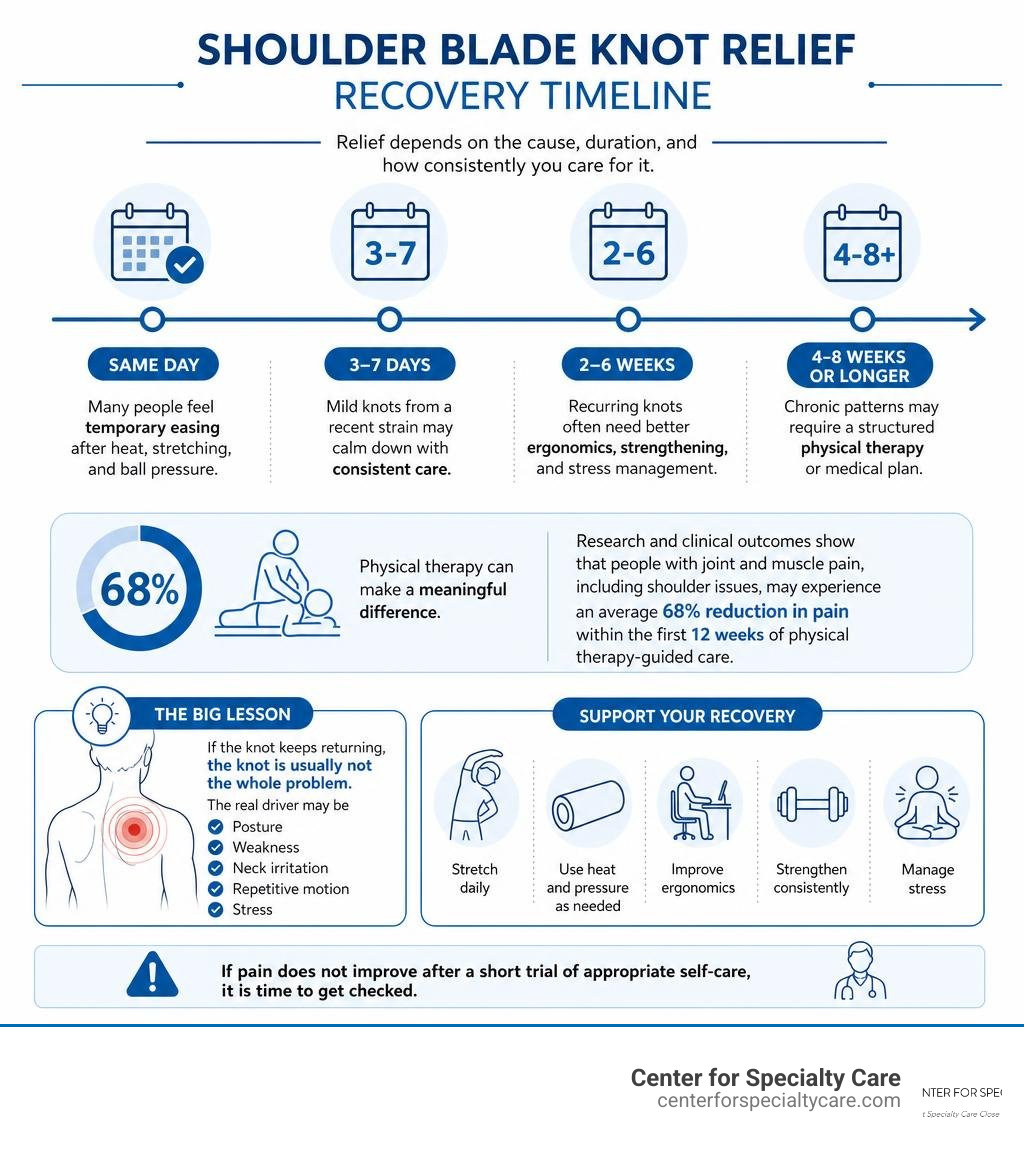
The big lesson: if the knot keeps returning, the knot is usually not the whole problem. The real driver may be posture, weakness, neck irritation, repetitive motion, or stress.
Why Shoulder Blade Knots Happen and How to Prevent Them From Returning
The most successful plan is not just “rub the knot until it surrenders.” We want to reduce the reasons it formed in the first place.
For a broader overview, read our guide on how to relieve a muscle knot in shoulder blade.
Most Common Causes of Knots Between the Shoulder Blades
Common causes include:
- Long hours at a desk
- Phone use with the head tilted down
- Forward head posture
- Rounded shoulders
- Emotional stress and jaw clenching
- Heavy bags carried on one side
- Overhead work, such as painting
- Repetitive sports, including racket sports, rowing, golf, or pickleball
- Gardening or tool use
- Driving with shoulders tense or arms too high
- Previous shoulder, neck, or upper back injury
- Weak scapular stabilizers or rotator cuff muscles
- Poor sleep position
- Dehydration or poor recovery habits
Small muscles can get tired during low-intensity tasks, too. Typing, mousing, and holding your head forward may not feel like a workout, but your upper back muscles may disagree by 3 p.m.
Daily Ergonomic Adjustments That Reduce Shoulder Blade Tension
Try these desk and driving adjustments:
- Keep your monitor at eye level.
- Keep the screen about an arm’s length away.
- Keep elbows around 90 degrees.
- Rest feet flat on the floor.
- Use lumbar support to avoid slumping.
- Keep shoulders relaxed, not rounded forward.
- Keep keyboard and mouse close enough that you do not reach.
- Avoid cradling the phone between shoulder and ear.
- Use a headset for long calls.
- Adjust the steering wheel so shoulders stay relaxed.
- Avoid gripping the wheel high for long drives.
Your workstation does not need to look like a spaceship. It just needs to stop making your neck and shoulder blades do acrobatics all day.
Movement Breaks and Habits That Matter Most
The body likes movement variety. Knots often form when muscles are asked to hold the same position too long.
Helpful habits:
- Take a movement break every 30-60 minutes.
- Use the 45-minute rule: do not sit longer than 45 minutes without changing position.
- Do 10 chin tucks during breaks.
- Do 8-12 scapular squeezes.
- Open the chest in a doorway for 20-30 seconds.
- Walk for a few minutes when possible.
- Drink water consistently.
- Aim for 7-9 hours of sleep.
- Sleep on your side or back with the neck supported.
- Avoid stomach sleeping if it twists your neck.
- Use slow breathing to downshift stress.
Stress matters. When your nervous system is on high alert, muscles often tighten. A short walk, breathing drill, or shoulder reset can be surprisingly powerful.
When Self-Treatment Is Not Enough
Self-care is a great first step, but persistent symptoms deserve a closer look.
Consider scheduling an evaluation if:
- Pain lasts more than two weeks despite self-care
- Symptoms keep returning
- Pain is worsening
- You have numbness, tingling, or weakness
- Pain limits work, sleep, exercise, or daily activity
- You cannot comfortably turn your neck or reach overhead
- You suspect the pain is coming from the neck
- The knot feels different from usual muscle tightness
At Center for Specialty Care, we offer personalized orthopedic and pain management care for patients in Fairmont, MN; Estherville, IA; Buffalo Center, IA; St. James, MN; and surrounding Minnesota and Iowa communities. Depending on your needs, care may include physical therapy guidance, manual therapy, trigger point treatment, imaging when appropriate, injections, or surgical consultation if a structural problem is present.
Our goal is simple: identify why the pain is happening, explain it clearly, and build a plan that fits your life.
Frequently Asked Questions About How to Stretch Shoulder Blade Knots
Can You Over-Massage a Shoulder Blade Knot?
Yes. Over-massaging can irritate the tissue and make the knot feel worse.
Too much pressure may cause:
- Bruising
- Inflammation
- Increased soreness
- Muscle guarding
- More tightness the next day
Use firm but tolerable pressure. A good rule is 2-5 minutes per spot, with the whole self-massage session capped at 15-20 minutes. If the area feels more painful afterward, take a rest day and use gentler stretching.
Should You Stretch a Knot Every Day?
Usually, yes, as long as the stretching is gentle and symptoms are not worsening.
A simple daily plan:
- 10 minutes total
- 15-30 second stretch holds
- 2-4 repeats per stretch
- Slow breathing
- No bouncing
- Strength work 3-4 days per week
- Stop if sharp pain, numbness, tingling, or weakness appears
Daily mobility is often better than one intense stretching session per week. Your shoulder blades appreciate consistency. They are not impressed by weekend warrior negotiations.
Can Neck Problems Cause Shoulder Blade Knots?
Yes. Neck stiffness, irritated joints, disc issues, or cervical radiculopathy can create pain that feels like a shoulder blade knot.
Signs the neck may be involved include:
- Pain that changes when you move your neck
- Pain spreading from the neck into the shoulder blade
- Numbness or tingling into the arm or hand
- Arm weakness
- Headaches at the base of the skull
- Symptoms that do not improve with local massage
Trigger points in neck muscles can also refer pain into the shoulder blade region. If your knot keeps coming back no matter how much you stretch it, we may need to evaluate the neck, shoulder mechanics, and nerve symptoms together.
Conclusion
Learning how to stretch shoulder blade knots can help you calm tight muscles, improve shoulder blade motion, and get back to normal daily activity. Start with the 10-minute routine: shoulder rolls, chin tucks, rhomboid stretch, doorway chest stretch, Cat-Cow, Child’s Pose, cross-body stretch, and a few strengthening moves.
Then support the routine with safe self-massage, heat, ergonomic changes, movement breaks, hydration, sleep, and stress management.
If the knot is stubborn, recurring, or paired with nerve symptoms, we are here to help. At Center for Specialty Care, we provide personalized care with quick appointment availability and both surgical and non-surgical options for shoulder, neck, and upper back pain.
To take the next step, explore shoulder pain relief options with our team.