
Don’t Just Endure: Locate Your Perfect Back Pain Doctor
November 26, 2025
When Your Shoulder Pops and Goes Numb: A Symptom Guide
November 28, 2025
Stretch for knot in shoulder blade: Ultimate 2025 Relief
Why That Nagging Shoulder Blade Knot Needs Your Attention
If you’re looking for a stretch for knot in shoulder blade pain, you’re not alone. That tight spot between your shoulder blade and spine can make daily activities miserable. The good news is that most shoulder blade knots respond well to targeted stretching and self-care you can do at home.
Quick Relief: Top Stretches for Shoulder Blade Knots
- Cross-Body Shoulder Stretch – Pull one arm across your chest and hold for 15-30 seconds.
- Doorway Pectoral Stretch – Place your forearm on a door frame and gently lean forward.
- Cat-Cow Pose – Alternate arching and rounding your upper back on your hands and knees.
- Child’s Pose – Kneel and reach your arms forward, letting your shoulders relax.
- Shoulder Rolls – Roll your shoulders backward in smooth circles 10-15 times.
These muscle knots, or myofascial trigger points, develop when muscle fibers bunch up and won’t relax. They’re commonly caused by poor posture, prolonged sitting, repetitive movements, and stress. Research shows that combining stretching with strengthening exercises provides the most effective relief, with many people seeing improvement within a week.
I’m Dr. Corey Welchlin, a board-certified orthopedic surgeon at the Center for Specialty Care. For over 30 years, I’ve helped patients in southern Minnesota and northern Iowa find relief from musculoskeletal pain. I’ve guided countless individuals through effective stretch for knot in shoulder blade protocols using evidence-based techniques and practical self-care strategies.
What’s Causing That Knot in Your Shoulder Blade?
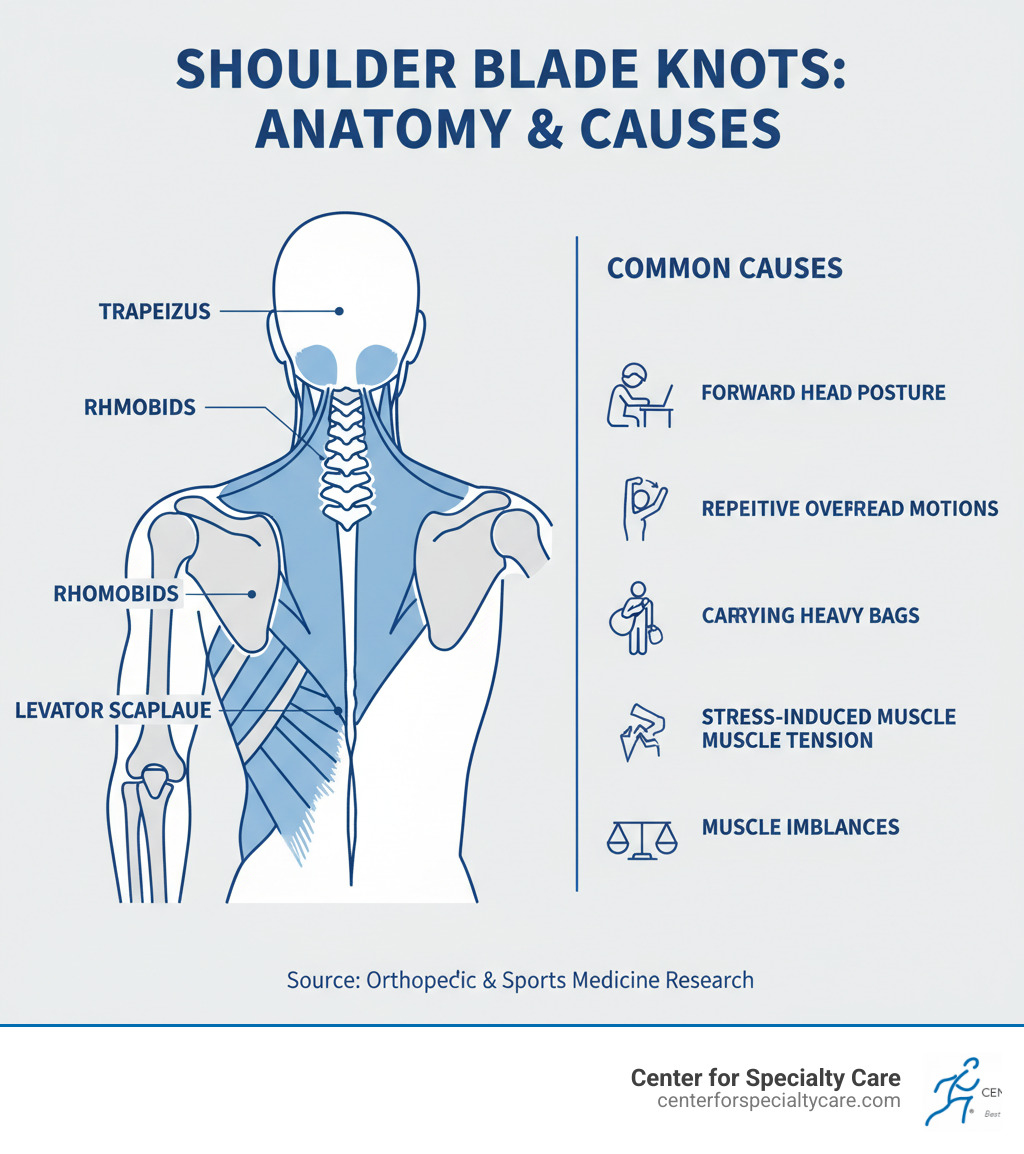
That stubborn ache near your shoulder blade is a myofascial trigger point—a tight, irritated area where muscle fibers have clenched up and won’t relax. The muscles around your shoulder blade, including the trapezius, rhomboids, and levator scapulae, are particularly vulnerable. With seventeen muscles attaching to each shoulder blade, this area is a high-traffic zone for tension.
Common causes include:
- Poor posture: Spending hours hunched over a laptop or phone forces your upper back muscles to overwork just to hold your head up. This constant strain creates chronic tension and painful knots.
- Repetitive motions: Activities like painting, gardening, or typing without breaks can fatigue muscles, leading to these stubborn contracted areas.
- Muscle imbalances: If your chest muscles are tight and your back muscles are weak, your shoulders get pulled forward. The weaker back muscles work extra hard to compensate, leading to fatigue and knots.
- Emotional stress: When you’re anxious, you may unconsciously hunch your shoulders. This keeps your upper back muscles contracted for extended periods, causing them to become hypersensitive and tight.
- Other factors: Dehydration can make muscles prone to cramping, and issues in your neck, like a pinched nerve, can refer pain to your shoulder blade area.
Understanding the cause is the first step toward finding a stretch for knot in shoulder blade that works. For more medical information, you can read about the Diagnosis and Management of Trigger Points or find More info on muscle kinks on our site.
Common Symptoms of Shoulder Blade Knots
Symptoms of a shoulder blade knot can range from annoying to disruptive. Look for:
- Localized pain and tenderness: A specific tender spot that may feel like a small bump and is painful to the touch.
- A dull ache or sharp pain: The pain can be a constant, dull ache or a sharp pain that flares up with certain movements.
- Stiffness and limited range of motion: The muscle may feel tight, making it difficult to lift your arm, rotate your shoulder, or turn your head.
- Radiating pain: Discomfort can travel to your neck, upper back, or down your arm, sometimes feeling like tingling or numbness.
These symptoms can make daily activities like getting dressed or sitting at a desk a challenge. If you also have clicking with your pain, our article on Shoulder clicking and pain may be helpful. Fortunately, most symptoms respond well to the right treatments.
The Best Stretch for Knot in Shoulder Blade Relief
Shoulder blade knots respond well to gentle, consistent stretching. The goal is to coax tight muscle fibers to lengthen and release. Before you start, remember these tips:
- Go slow: Ease into each stretch and never force a movement that causes sharp pain.
- Hold steady: Hold each stretch for knot in shoulder blade for 15-30 seconds without bouncing.
- Breathe deeply: Inhaling and exhaling slowly helps your muscles relax.
- Be consistent: Repeat each stretch 2-4 times. Consistency is more important than intensity.

Foundational Stretches for Immediate Relief
These simple, effective stretches can be done almost anywhere.
- Cross-Body Shoulder Stretch: Extend one arm across your chest. Use your opposite hand to gently pull the extended arm closer to your body, feeling a stretch in your shoulder and upper back. Hold for 20-30 seconds and repeat on each side.
- Doorway Pectoral Stretch: This stretch targets tight chest muscles that pull shoulders forward. Stand in a doorway and place your forearm on the frame with your elbow at a 90-degree angle. Step forward until you feel a stretch across your chest. Hold for 20-30 seconds and repeat on each side.

- Neck Tilts: Sit or stand tall and gently tilt your head, bringing your ear toward your shoulder. You’ll feel a stretch along the opposite side of your neck. Hold for 10-15 seconds and repeat three times per side.
- Shoulder Rolls: Sit or stand straight. Lift your shoulders toward your ears, roll them back, squeeze your shoulder blades, and then drop them down. Do this 10 times, then reverse for another 10 rolls.
A Deeper Stretch for a Knot in the Shoulder Blade
These yoga-inspired poses offer more comprehensive relief for stubborn tension.
- Cat-Cow Pose: Start on your hands and knees. Inhale as you drop your belly and look up (Cow). Exhale as you round your spine and tuck your chin (Cat). Flow between these poses for 5-10 breaths to mobilize your spine.
- Thread the Needle Pose: From a hands-and-knees position, slide one arm under your body, resting your shoulder and temple on the floor. You’ll feel a deep stretch across your upper back. Hold for 20-30 seconds, then switch sides.
- Eagle Arm Stretch: Sit tall and extend your arms forward. Cross one arm under the other, bend your elbows, and try to bring your palms together. Lift your elbows and gently pull your hands away from your face to stretch your upper back. Hold for 20-30 seconds, then switch arms.
- Child’s Pose: Kneel on the floor, fold forward, and rest your torso between your thighs. Extend your arms forward and let your forehead rest on the floor. Breathe and let your shoulders relax. Hold for 30-60 seconds.

Enhancing Relief with Complementary Techniques
While a stretch for knot in shoulder blade is foundational, pairing it with other approaches can accelerate relief. Combining techniques is often more effective than using just one.
Yoga Poses for Shoulder Blade Knots
Yoga builds body awareness, improves flexibility, and strengthens supporting muscles. In addition to the poses mentioned earlier, try these:
- Cow Face Pose (Gomukhasana Arms): Reach one arm overhead, bending it so your hand rests between your shoulder blades. Reach your other arm up your back from below, trying to clasp your hands. This creates a deep stretch. Hold for 20-30 seconds on each side.
- Ragdoll Pose: Stand with feet hip-width apart and fold forward from your hips, letting your head hang heavy. Grab opposite elbows and let gravity gently release tension in your neck, shoulders, and upper back.
- Side-lying Thoracic Rotation: Lie on your side with knees bent and arms extended in front of you, palms together. Keeping your bottom arm still, rotate your top arm open, following it with your eyes to feel a twist through your mid-back. Repeat 5-10 times per side.
Research shows that yoga and stretching can significantly reduce neck and shoulder pain and improve flexibility in just four weeks.
The Role of Self-Massage and Heat
Self-massage and heat therapy can provide immediate, targeted relief at home.
Self-massage applies direct pressure to knots, encouraging blood flow and release.
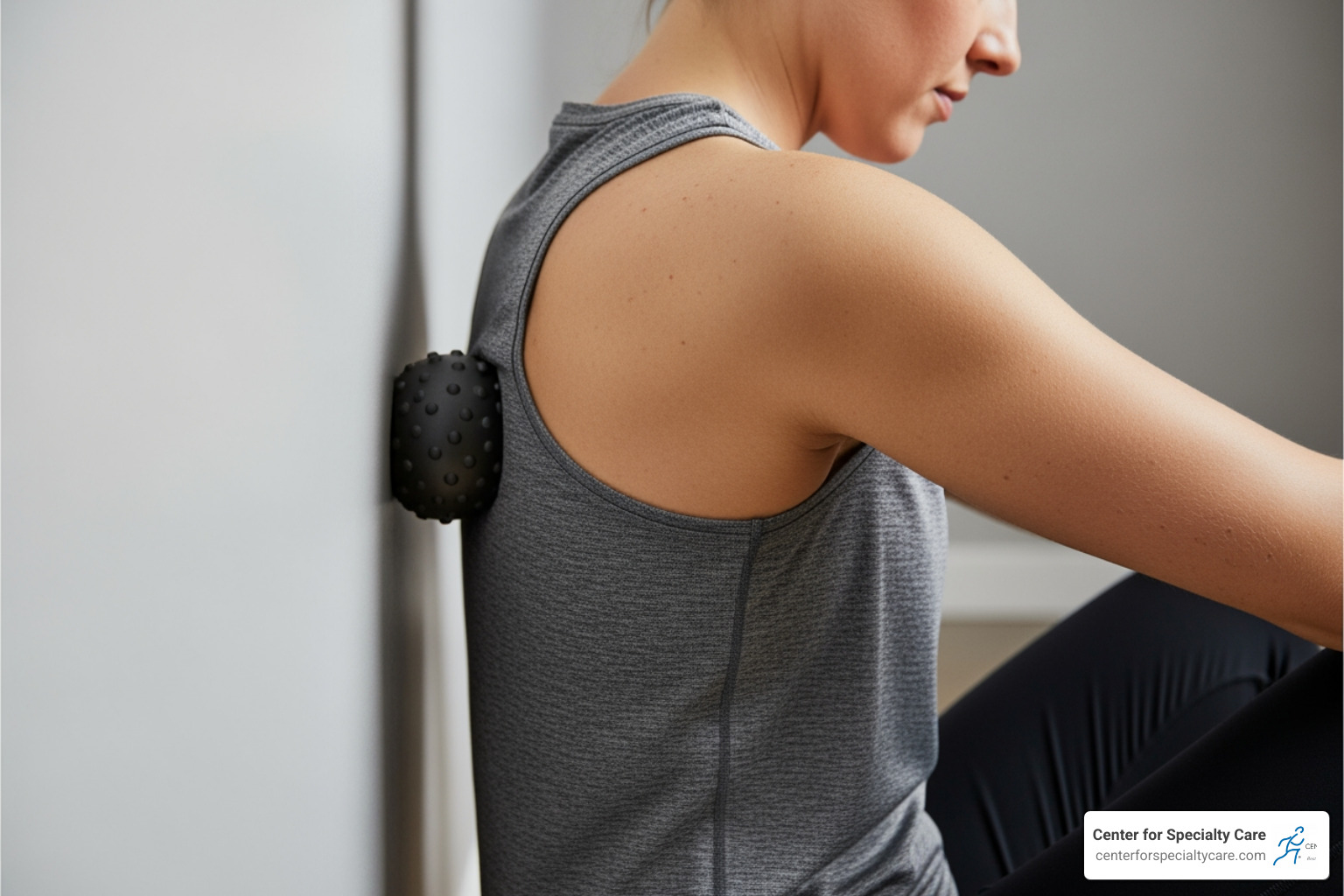
- Tennis/Lacrosse Ball: Place the ball between your shoulder blade and a wall. Lean into it with tolerable pressure (a “good hurt,” not sharp pain). Hold steady pressure for 30 seconds or make small circles for a minute.
- Foam Roller: Lie on your back with the roller under your shoulder blades. Cross your arms over your chest and gently roll up and down, pausing on tender spots.
Heat therapy increases blood flow, helping muscles relax and heal. Apply a heating pad or take a warm shower for 15-20 minutes. For chronic muscle tension, heat is generally more effective than ice, which is better for acute injuries with swelling.
If these methods don’t provide enough relief, it may be time for professional help. Our team specializes in personalized physical therapy to create a targeted treatment plan. You can learn about professional physical therapy and how it can accelerate your recovery.
Preventing Knots: Strengthening and Lifestyle Adjustments
Getting rid of a knot is satisfying, but preventing it from returning is the real victory. The best stretch for knot in shoulder blade is the one you don’t need. Combining stretching with strengthening is key. A 2022 study suggests strength training may be even more effective than stretching alone for preventing some shoulder injuries. Stronger back muscles improve posture and reduce strain. For athletes, prevention is crucial; Explore our Sports Medicine services to see how we help athletes stay injury-free.
Key Strengthening Exercises
These exercises build a stable foundation to resist knots. Aim for 8-12 reps of each.
- Scapular Squeezes: Sit or stand tall. Without shrugging, gently squeeze your shoulder blades together as if holding a pencil. Hold for 6 seconds, then release.
- Banded Rows: Anchor a resistance band at waist level. Hold the ends and pull back in a rowing motion, squeezing your shoulder blades together. Return slowly.
- Reverse Flys: Hold light dumbbells and hinge forward at your hips with a straight back. Let your arms hang down. Raise your arms out to the sides like wings, squeezing your shoulder blades at the top. Lower with control.
- Shoulder Blade Push-ups: In a plank position with straight elbows, sink your chest by squeezing your shoulder blades together. Then, push up by spreading them apart. The movement is small but effective.
Prevention Strategies for Daily Life
Your daily habits are just as important as your exercises.
- Ergonomic Workspace: Position your screen at eye level. Your feet should be flat on the floor with knees and elbows at 90-degree angles. Keep your head aligned over your shoulders.
- Regular Movement Breaks: Get up and move every hour. Walk, stretch, or just stand up to counteract a slumped posture.
- Stress Management: Chronic stress leads to tense shoulders. Practice daily relaxation like meditation, deep breathing, or a peaceful walk.
- Stay Hydrated: Dehydration makes muscles prone to tension. Drink water regularly throughout the day.
- Balanced Exercise: A routine with cardio, strength, and flexibility keeps your whole body resilient.
Frequently Asked Questions about Shoulder Blade Knots
Here are answers to common questions we hear from patients in our communities, from Fairmont to Estherville.
How long does it typically take to get rid of a shoulder blade knot?
The timeline depends on the knot’s severity, how long it’s been there, and your consistency with treatment. With a regular routine of stretching for knot in shoulder blade, self-massage, and posture correction, many people feel noticeable improvement within a few days to a week. Chronic knots that have been present for weeks or months may take longer to resolve, but they will respond to consistent effort. The sooner you address a knot, the faster you’ll find relief.
Can I treat a knot near the scapula myself?
Yes, most shoulder blade knots respond very well to self-treatment. A combination of targeted stretches for knot in shoulder blade, self-massage with a tennis ball, and heat therapy can be highly effective. The key is to listen to your body. A technique should feel like a comfortable stretch or pressure, not sharp pain. If something hurts, stop immediately. A comprehensive approach that includes stretching, massage, and posture awareness works best.
When should I see a doctor for a knot in my shoulder blade?
While self-care is powerful, professional evaluation is sometimes necessary. You should see a doctor if you experience any of the following:
- Pain that persists for more than a week despite consistent home treatment.
- Severe pain that disrupts your sleep, work, or daily activities.
- Neurological symptoms like numbness, tingling, or weakness radiating down your arm or into your hand.
- Pain that began suddenly after an injury or accident.
Sometimes, what feels like a knot could be related to a neck issue like a pinched nerve. If you have any concerns, trust your instincts and seek guidance. Our team in Minnesota and Iowa has extensive experience providing personalized care for muscle and joint pain. If you’re struggling, please Find a doctor for your shoulder problems for a professional diagnosis and treatment plan.
Conclusion: Your Path to a Pain-Free Shoulder
That persistent stretch for knot in shoulder blade discomfort doesn’t have to be a permanent part of your life. Relief comes from a consistent, comprehensive approach. By combining foundational stretches, self-massage, and strengthening exercises, you can address both the immediate pain and its underlying causes.
Remember to make small lifestyle adjustments, like improving your workspace ergonomics and taking regular movement breaks. Most people who commit to these daily practices see meaningful improvement within a week. The combination of stretching for flexibility, strengthening for stability, and self-care for prevention is a powerful formula for long-term shoulder health.
However, some situations require professional expertise. If your pain persists, is severe, or is accompanied by numbness or tingling, it’s time to seek help.
At Center for Specialty Care, we understand how shoulder blade knots can impact your life. Our team has helped patients across southern Minnesota and northern Iowa find lasting relief with personalized treatment plans. We are committed to your 100% satisfaction and getting you back to feeling your best.
You’ve taken the first step by learning about your condition. Now, take action. Take the next step and learn about our advanced shoulder treatments to see how our comprehensive approach can help you achieve the pain-free shoulder you deserve.