
Is It Just a Pop? Symptoms of a Partially Dislocated Shoulder
August 13, 2025
The Wobbly Shoulder: Why It Feels Out of Place But Isn’t Fully Dislocated
August 15, 2025
How to relieve a muscle knot in shoulder blade: #1 Ultimate
Understanding the Pain Behind Your Shoulder Blade
How to relieve a muscle knot in shoulder blade is a common question we hear from patients. That familiar tight, tender spot that just won’t go away is a muscle knot, also known as a myofascial trigger point.
Quick Relief Methods:
- Self-massage – Apply firm pressure for 30-60 seconds using fingers, a tennis ball, or a foam roller.
- Heat therapy – Use a heating pad or warm compress for 15-20 minutes.
- Gentle stretching – Hold a doorway chest stretch and cross-body arm stretch for 20-30 seconds.
- Take breaks – Move and stretch every 30-60 minutes during desk work.
Muscle knots are tight, contracted areas of muscle fibers that fail to relax. They hurt when pressed and can cause pain in other areas. The shoulder blade area is prone to knots because seventeen muscles attach to the shoulder blades. Poor posture, repetitive motions, stress, and awkward sleeping positions are common causes.
Most knots resolve in a few days to a week with proper care, though chronic knots may take longer. The good news is there are many effective ways to find relief at home.
As Dr. Corey Welchlin, a board-certified orthopedic surgeon, I’ve helped countless patients learn how to relieve a muscle knot in shoulder blade. My approach combines proven self-care techniques with professional medical guidance to ensure you get the most effective treatment for your specific situation.
Understanding Shoulder Blade Knots: Causes and Symptoms
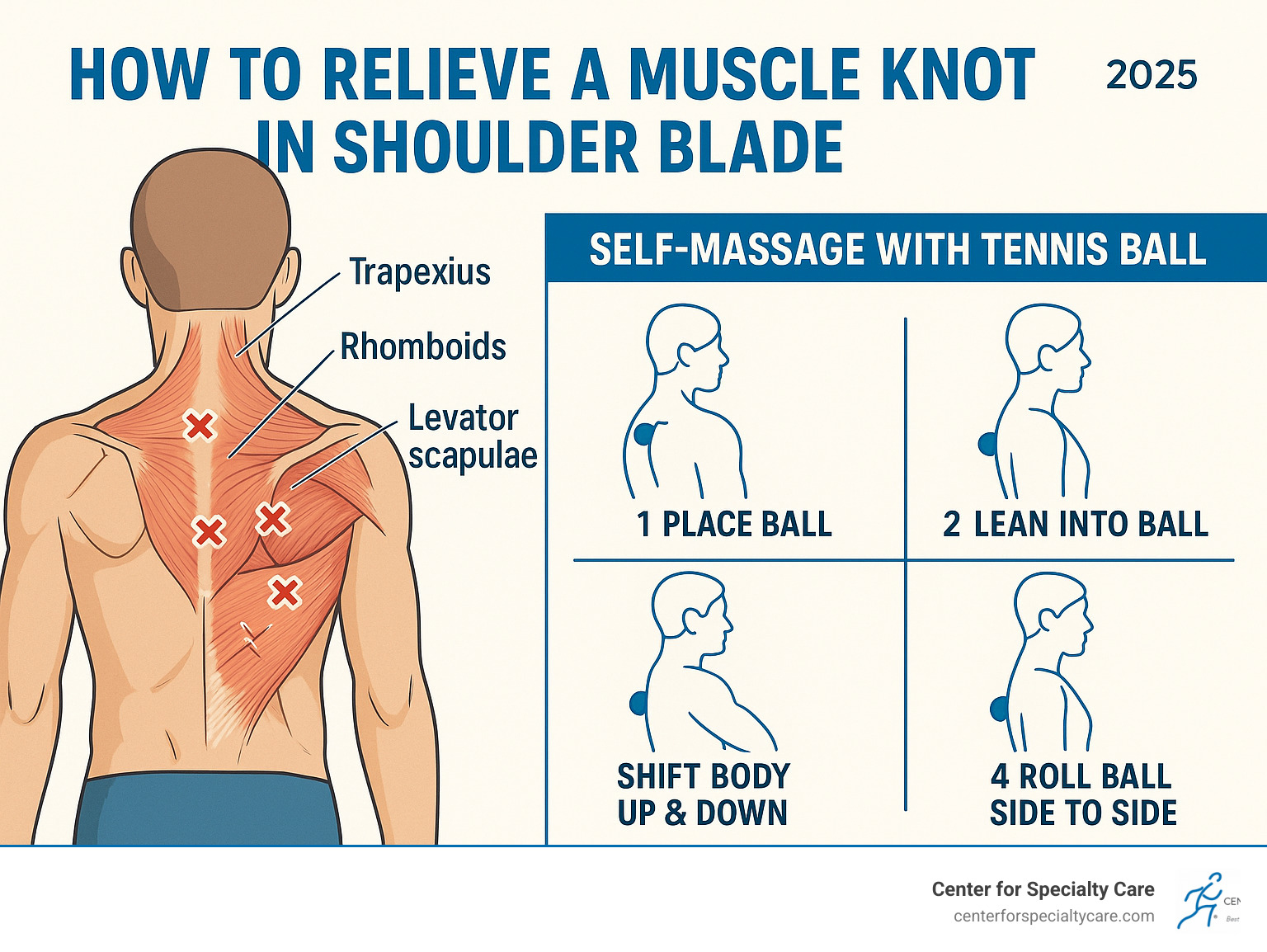
Your shoulder blade, or scapula, is a hub of activity, with seventeen different muscles attaching to it to allow for reaching, lifting, and throwing. With so much happening, it’s no wonder muscle knots can form.
Muscle knots occur when muscle fibers get stuck in a contracted state, cutting off their own blood supply and creating a painful cycle that keeps them tight.

What Causes Knots in the Shoulder Blade?
Shoulder blade knots are your body’s way of signaling that something is wrong. The most common causes include:
- Poor posture: Spending days hunched over a computer or phone forces your shoulders forward, straining the muscles around your shoulder blades (rhomboids, trapezius, and levator scapulae). These muscles are constantly working overtime to fight gravity and your forward head position.
- Repetitive motions: Lifting, playing sports like tennis, or intense upper-body workouts can fatigue your muscles and create tight spots.
- Sedentary lifestyle: Lack of regular movement decreases blood flow and flexibility, making muscles stiff.
- Stress and emotional tension: When you’re stressed, your body tenses up in a protective response called “muscle guarding.” This often settles in the shoulders and upper back.
- Dehydration and poor nutrition: Muscles need proper hydration and nutrients like calcium, potassium, and magnesium to function smoothly and avoid cramping.
- Previous injuries or muscle imbalances: An old injury can cause surrounding muscles to compensate and tighten. Similarly, tight chest muscles can pull the shoulders forward, forcing back muscles to constantly fight the pull.
Common Symptoms of a Shoulder Blade Knot
Knowing the symptoms makes it easier to understand how to relieve a muscle knot in shoulder blade.
- Localized pain and tenderness: A specific spot that feels like a dull ache but is sharp when you press on it. Many people feel a small, hard lump or tight band.
- Stiffness and reduced range of motion: You might find it uncomfortable to reach behind your back, lift your arm overhead, or turn your head fully.
- Referred pain: The knot can cause pain elsewhere, such as down your arm, into your neck, or even cause headaches. This phenomenon is well-documented in scientific research on trigger points.
Recognizing these symptoms is the first step. Most knots respond well to the right combination of self-care techniques, which we’ll cover next.
How to Relieve a Muscle Knot in Shoulder Blade: Effective At-Home Techniques
When a stubborn knot appears in your shoulder blade, several proven self-care strategies can provide relief. Combining different approaches is often more effective than relying on a single method.
Self-Massage and Trigger Point Release
Learning how to relieve a muscle knot in shoulder blade often starts with direct pressure, which helps muscle fibers release and improves blood flow.
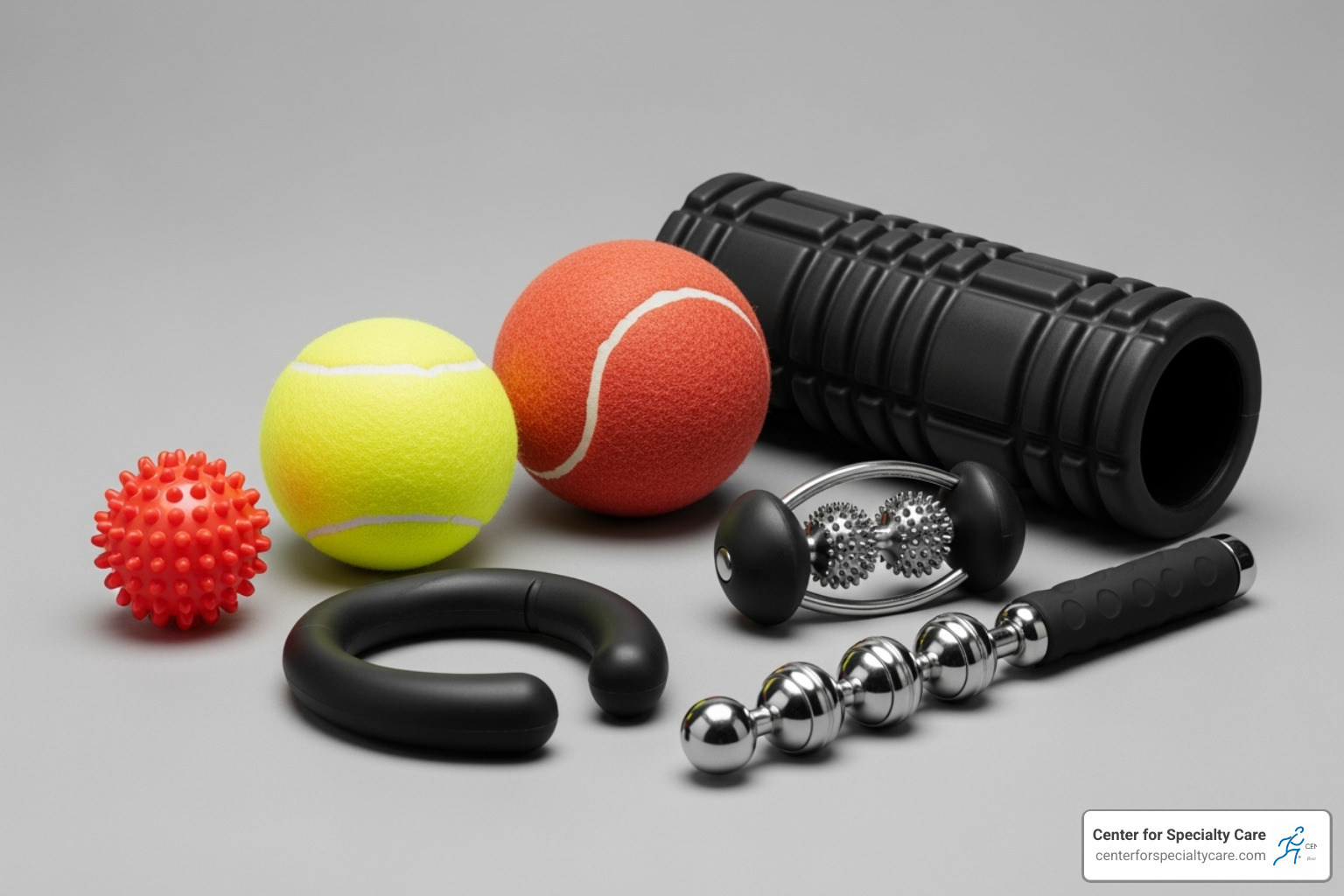
- Tennis Ball Technique: Lie on your back and place a tennis ball (or a lacrosse ball for deeper pressure) between your shoulder blade and the floor. Roll gently to find the tender spot and apply firm, comfortable pressure for 30-60 seconds. Aim for a “good hurt,” about a 5 out of 10 on the pain scale. Repeat 2-3 times a day.
- Foam Roller: For broader tension, position a foam roller just below your shoulder blades and roll slowly up and down. Let the roller do the work as you breathe deeply.
- Fingers or Massage Cane: If you can reach the knot, use your thumb or fingertips to apply steady pressure. A massage cane can help you reach difficult spots.
Remember to breathe deeply during self-massage and ease up if you feel sharp pain. Your muscles should feel better afterward, not worse.
Hot and Cold Therapy for Pain Relief
Temperature therapy can significantly improve your comfort. Experiment to see which works best for you.
- Heat Therapy: Heat helps muscles relax and improves blood flow. Apply a heating pad or warm compress for 15-20 minutes, especially before stretching. A warm shower can also help unwind the muscles in your upper back and shoulders.
- Cold Therapy: Cold reduces inflammation and numbs pain, which is helpful if the area is swollen or the knot is recent. Wrap an ice pack in a thin towel and apply it for 10 minutes at a time.
Some people find alternating between heat and cold effective. For more guidance, see our resources on heat and cold therapy.
Stretches and Mobility Exercises to Relieve a Muscle Knot in Shoulder Blade
Stretching provides long-term relief by improving flexibility and correcting muscle imbalances.
- Doorway Stretch: Stand in a doorway, place your forearms on the frame, and lean forward to feel a stretch across your chest. This counteracts the forward pull on your shoulders.
- Cat-Cow Stretch: On your hands and knees, alternate between arching your back (Cow) and rounding your spine (Cat) to mobilize your upper back.
- Child’s Pose: Kneel, sit back on your heels, and reach your arms forward, resting your forehead on the floor to release your upper back and shoulders.
- Cross-Body Arm Stretch: Pull one arm across your body with your other hand to target the muscles on the back of your shoulder.
- Shoulder Blade Squeezes: Sit or stand tall and squeeze your shoulder blades together for 6 seconds to strengthen posture muscles. Repeat 8-12 times.
Hold each stretch for 20-30 seconds and repeat 2-4 times. Move slowly and avoid pain. Consistency is key. Our physical therapy team can create a personalized program; learn more about our shoulder physical therapy services.
Preventing Future Knots: Lifestyle and Ergonomic Adjustments
The best way to learn how to relieve a muscle knot in shoulder blade is to prevent it from forming. This involves creating healthy habits that support your muscles throughout the day through small, consistent adjustments.

The Critical Role of Posture and Ergonomics
Your posture is foundational to muscle health. Good posture means your ears are aligned over your shoulders, your shoulders are relaxed, and your chest is open. When sitting, your feet should be flat on the floor with your knees at a 90-degree angle.
Poor posture, often from hunching over screens, forces muscles to tighten to support your body in an unnatural position.
- Create an ergonomic workspace: Position your computer screen at eye level, an arm’s length away. Keep your keyboard and mouse close so your elbows bend at roughly 90 degrees without reaching.
- Take frequent posture breaks: Set a reminder to stand up, roll your shoulders, and stretch every 30-60 minutes. Staying in one position for too long causes strain, even with a perfect setup.
- Counteract “tech neck”: Periodically tilt your head back and lift your chin toward the ceiling. This simple movement counteracts the constant downward gaze from using phones and computers.
How to Relieve a Muscle Knot in Shoulder Blade Through Stress Management and Activity
Emotional stress often manifests as physical tension in the shoulders and upper back. This creates a stress-tension cycle: stress causes muscle guarding, which forms knots, which cause pain, leading to more stress.
Breaking this cycle is key to prevention:
- Practice stress management: Simple techniques like deep breathing can activate your body’s relaxation response. Just five minutes of slow, deep breathing can release significant tension.
- Try yoga or meditation: These practices address both physical tightness and mental stress. Even 10-15 minutes of gentle stretching and mindful breathing can make a difference.
- Move regularly: Regular movement improves blood flow and prevents muscles from getting stiff. Walking and swimming are excellent low-impact options.
- Build strength: Strengthening the muscles around your shoulder blades with exercises like rows and wall slides makes them more resilient to strain.
- Stay hydrated and eat well: Proper hydration and a balanced diet support optimal muscle function and recovery.
For those with active lifestyles, our sports medicine approach can help prevent injuries. Learn more about sports medicine for active lifestyles.
When to Seek Professional Help for a Shoulder Blade Knot
While self-care is effective for most muscle knots, some situations require professional expertise. Knowing when how to relieve a muscle knot in shoulder blade requires a doctor can prevent a minor issue from becoming a major one.
Signs You Should See a Doctor
It’s time to schedule an appointment if you experience any of the following red flags:
- Persistent pain: The knot doesn’t improve after a week of consistent self-care.
- Severe or worsening pain: The pain is intense, getting worse, or doesn’t respond to over-the-counter pain relievers.
- Numbness or tingling: You feel numbness, pins-and-needles, or tingling in your arm or hand, which may indicate nerve irritation.
- Weakness: You notice weakness in your shoulder or arm, or a decrease in grip strength.
- Disruption to daily life: The pain is severe enough to disrupt your sleep, work, or other daily activities.
At Center for Specialty Care, our team specializes in diagnosing the root causes of your discomfort. We are committed to 100% patient satisfaction and offer quick appointments because we know that when you’re in pain, you can’t wait for relief. Explore our pain management options.
Benefits of Professional Treatments
When home remedies fail, professional treatments offer targeted relief.
- Physical Therapy: This is often the gold standard. A physical therapist assesses your posture, movement, and muscle imbalances to create a personalized program. They use manual therapy techniques to release stubborn trigger points and teach you exercises to prevent future knots.
- Massage Therapy: A skilled massage therapist can perform deep tissue and myofascial release techniques that are impossible to do on your own, breaking up even the most persistent knots.
- Chiropractic Care: A chiropractor can identify and correct spinal misalignments that may be contributing to muscle strain around the shoulder blades.
- Injections: For severe cases, trigger point injections deliver medication directly into the knot to provide rapid relief when other methods haven’t worked.
Our team at Center for Specialty Care offers comprehensive treatment options custom to your needs. Learn more about our physical therapy services and how we can restore your shoulder health.
Frequently Asked Questions about Shoulder Blade Knots
When it comes to how to relieve a muscle knot in shoulder blade, patients often have similar questions. Here are the most common ones I address in my practice.
How long does it take for a muscle knot in the shoulder blade to go away?
This depends. Most new knots resolve in a few days to a week with consistent self-care, including self-massage, stretching, and heat therapy.
However, chronic knots that have been present for weeks or months may take longer to resolve. These stubborn knots often require several weeks of consistent treatment, including professional care, to address the underlying cause, such as poor posture or muscle imbalances.
What is the difference between a muscle knot and a trigger point?
There is no difference. “Muscle knot” is the common term for what medical professionals call a “myofascial trigger point.”
Both terms describe the same thing: a small, hyperirritable spot within a taut band of skeletal muscle. It’s a tight, painful area of muscle tissue that is not relaxing properly.
Can you over-massage a knot?
Yes, it is possible to be too aggressive with self-massage. Applying too much pressure or massaging for too long can irritate the muscle and surrounding tissues, potentially making the pain worse.
The goal is firm but tolerable pressure for 30-60 seconds at a time. A total self-massage session should not exceed 15-20 minutes. Aim for a “good pain” that feels relieving, not damaging.
If you experience increased pain or bruising that lasts more than a day after self-massage, you have likely overdone it. Listen to your body and use a gentler approach. Consistent, gentle treatment is more effective than aggressive, infrequent sessions.
Your Path to a Pain-Free Shoulder
That nagging knot in your shoulder blade doesn’t have to be a constant problem. This guide has shown you how to relieve a muscle knot in shoulder blade, from understanding the causes to mastering effective self-care techniques.
Muscle knots are common and highly treatable. You now have a full range of strategies, from the tennis ball technique to the doorway stretch, to find relief.
Self-care is your first line of defense. Small, consistent actions like 30-second pressure point releases, 15-minute heating pad sessions, and daily stretches add up to significant relief and can prevent future problems.
Prevention is your best long-term strategy. By improving your workspace ergonomics, taking regular posture breaks, and managing stress, you can stop knots before they even start.
However, if self-care isn’t enough and you’re dealing with persistent pain, numbness, or pain that disrupts your life, it’s time to seek professional help.
At Center for Specialty Care, our dedicated specialists provide personalized care to diagnose and treat the root cause of your shoulder pain. We don’t use one-size-fits-all solutions. Whether you need physical therapy, manual treatments, or other advanced interventions, our team is here to help. Our commitment to 100% patient satisfaction and quick appointment availability means you can get the relief you need without a long wait.
Your journey to a pain-free shoulder starts now. Relief is within reach.