
Untangling the Mystery: A Guide to Muscle Knots
August 12, 2025
The Ultimate Guide to Relieving Shoulder Blade Knots
August 14, 2025
Partially Dislocated Shoulder Symptoms: Uncover Pain 2025
Recognizing the Warning Signs of Shoulder Subluxation
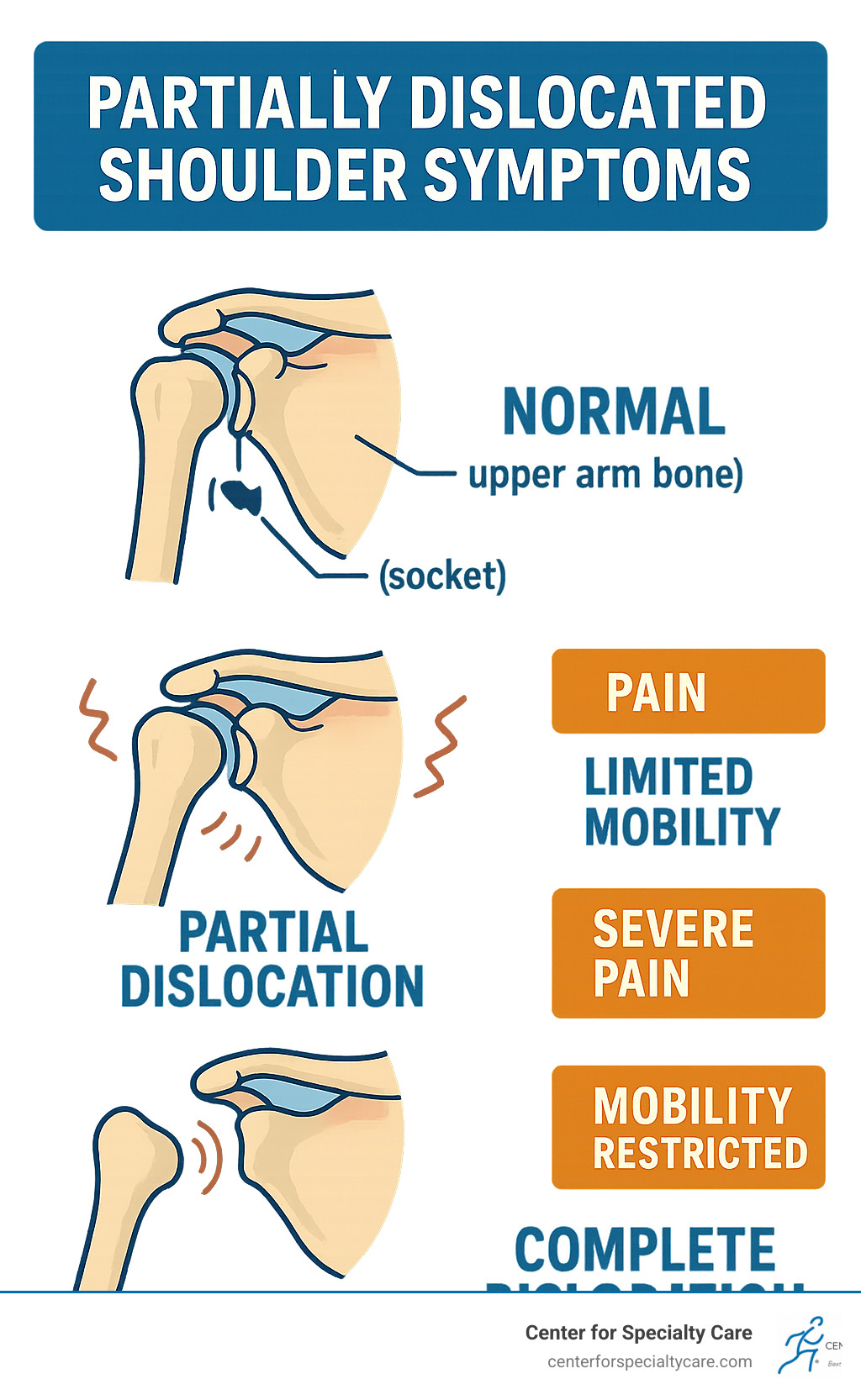
Partially dislocated shoulder symptoms can be subtle and confusing, often dismissed as just a jarring “pop” or a minor shoulder strain. You might be reaching for something or bracing for a fall, and suddenly feel a sickening slip in your shoulder, followed by a clunk as it slides back into place. This event is a partial dislocation, also known as a subluxation. Unlike a complete dislocation where the arm bone (humerus) fully separates from the shoulder socket (glenoid), a subluxation means the bone only slips partway out before spontaneously relocating. This fleeting nature makes it easy to downplay, but the underlying damage can be significant.
Recognizing the signs early is crucial for preventing long-term problems. Here are the key symptoms to watch for:
- Sharp or aching pain: The initial subluxation often causes a sudden, sharp pain that may quickly fade into a persistent, dull ache deep within the shoulder joint.
- Feeling of the shoulder “giving way”: This is a classic sign of instability. You may feel a disconcerting looseness or a sense that your shoulder is not secure, especially during certain movements like throwing or reaching overhead.
- Clicking, popping, or catching sounds: These noises (crepitus) during movement can indicate that the humeral head is not gliding smoothly within the socket, possibly due to damaged cartilage or ligaments.
- Arm weakness: You might find it suddenly difficult to lift objects that you could previously handle with ease. This weakness can stem from pain, nerve irritation, or damage to the stabilizing muscles.
- Numbness or tingling: A pins-and-needles sensation radiating down your arm or into your fingers suggests that the nerves around the shoulder (like the brachial plexus) were stretched or compressed during the event.
- Limited range of motion: Pain and instability often cause you to subconsciously guard your shoulder, making it difficult or impossible to lift your arm fully overhead or rotate it outwards.
- Swelling or visible deformity: While often less dramatic than a full dislocation, you may notice some localized swelling or a slight change in the contour of your shoulder compared to the uninjured side.
- Pain that worsens at night: Lying on the affected shoulder can increase pressure on the injured joint, leading to increased pain and disrupted sleep.
Shoulder instability is a widespread issue. For instance, research indicates that 80 percent of stroke patients develop shoulder subluxation due to muscle weakness (flaccidity) that can no longer support the joint. In the athletic population, the statistics are equally stark: more than 90% of young athletes who dislocate a shoulder will re-injure it again. This high recurrence rate highlights how the initial injury can stretch or tear the ligaments and capsule that provide stability. The shoulder joint’s incredible mobility—allowing movement in almost any direction—makes it the most commonly dislocated joint in the body, but also its most unstable.
What makes partial dislocations so tricky is that they can be much harder to detect than complete dislocations. The bones may slip back into place on their own, leaving you with lingering pain but a seemingly normal-looking shoulder. This is why many people ignore the warning signs, potentially leading to a cycle of repeated injuries and a condition known as chronic shoulder instability.
I’m Dr. Corey Welchlin, a board-certified orthopedic surgeon with over three decades of experience treating partially dislocated shoulder symptoms in the Fairmont, Minnesota region. Through my practice at the Center for Specialty Care, I’ve helped countless patients recognize and properly treat shoulder subluxations before they become chronic problems.
Understanding the Key Partially Dislocated Shoulder Symptoms
Your shoulder is a marvel of biological engineering. It’s the most mobile joint in your body, allowing you to throw a baseball, reach for something on a high shelf, or give someone a big hug. This incredible range of motion comes from its unique structure: the large, round head of your upper arm bone (the humerus) sits in a very shallow, cup-shaped socket on your shoulder blade called the glenoid. To visualize this, think of a golf ball sitting on a tee. This design grants amazing freedom of movement but at the cost of inherent instability.
To counteract this, a complex network of soft tissues—the ligaments, tendons, and muscles—works together like a skilled support crew to keep everything in place. The ligaments form the joint capsule, a watertight sac that encases the joint. The labrum, a ring of fibrocartilage, acts like a bumper around the glenoid, deepening the socket to better cradle the humeral head. The rotator cuff muscles and tendons provide dynamic stability, actively holding the ball centered on the tee during movement. When a force overwhelms this support system, a partial dislocation can occur. You might feel a deeply unsettling sensation of looseness or a clunk in your shoulder—the feeling of the ball briefly slipping partway off that tee before sliding back into place.

What Are the Most Common Partially Dislocated Shoulder Symptoms?
While a complete dislocation is an unmistakable, high-pain event, partially dislocated shoulder symptoms can be much trickier to recognize. They often masquerade as other shoulder problems like a simple strain or tendonitis, which is why many people unfortunately dismiss them.
The most telling sign is often sudden, sharp pain that strikes the moment the subluxation occurs. It’s an intense, immediate pain that makes you instinctively stop what you’re doing and grab your shoulder. This acute pain typically gives way to a persistent, deep aching that can linger for hours or even days. This dull ache often worsens at night, especially when you roll onto the affected side, disrupting sleep and hindering recovery.
Many of my patients at the Center for Specialty Care describe a distinctive feeling that their shoulder is “giving way” or is about to pop out. This sensation of instability, sometimes called apprehension, is most common during specific movements, particularly when reaching overhead and rotating the arm outward, as if to throw a ball. You might also notice clicking, popping, or grinding sounds (crepitus) as you move your shoulder. This occurs when the humeral head rubs abnormally against the glenoid rim or damaged soft tissues.
Swelling and bruising are your body’s natural inflammatory response to the trauma. They may not appear immediately. Swelling usually develops within a few hours as fluid accumulates in the joint, while bruising can emerge over the next day or two as blood from small, damaged vessels pools under the skin.
One of the more concerning symptoms is numbness or tingling that travels down your arm into your hand or fingers. This indicates that the partial dislocation has stretched or compressed the bundle of nerves, known as the brachial plexus, that runs through the shoulder area. Alongside this nerve irritation, you’ll likely experience significant arm weakness. This can make it difficult to lift a gallon of milk, carry groceries, or perform everyday tasks that require shoulder strength, like washing your hair.
Limited range of motion is another key indicator. You may find it particularly challenging and painful to raise your arm overhead or rotate it away from your body. This limitation is a combination of true mechanical blocking, pain, and your body’s protective muscle guarding to prevent further injury.
For more detailed information about various shoulder pain patterns, you can explore our comprehensive guide on shoulder clicking and pain causes.
Partial vs. Full Dislocation: What’s the Difference?
Understanding the distinction between a partial dislocation (subluxation) and a complete dislocation is vital for assessing your situation and communicating effectively with healthcare providers.
| Feature | Partial Dislocation (Subluxation) | Full Dislocation |
|---|---|---|
| Bone Position | Humerus slips partway out but returns to socket | Humerus completely separates from socket |
| Pain Severity | Sharp initially, then aching and moderate | Severe, constant, and intense |
| Arm Movement | Limited but some movement possible | Little to no movement possible |
| What Happens Next | Often reduces (goes back) spontaneously | Requires medical intervention to reduce |
| Visible Changes | May have subtle deformity or none at all | Clear visible deformity of shoulder contour |
| Recovery Time | Usually faster with proper treatment | Typically longer recovery period |
The key difference lies in the severity of separation and how your body responds. With a partial dislocation, the bone maintains some contact with the socket and often slips back into place on its own. This spontaneous reduction can be deceptive, making the injury seem less serious than it truly is. This often leads people to delay seeking treatment, which can result in stretched ligaments, a damaged labrum, and a progression toward chronic instability where the shoulder subluxates with increasing ease.
A complete dislocation, on the other hand, is an obvious medical emergency. The bone has completely lost contact with the socket, causing excruciating pain, an inability to move the arm, and a visible deformity. It requires immediate medical attention to relocate the joint properly. While more dramatic, the path to treatment is often more direct because the severity of the injury cannot be ignored.