
The Ultimate Guide to Relieving Shoulder Blade Knots
August 14, 2025
Knot in Neck? Here’s How to Fix It Fast
August 18, 2025
Shoulder feels out of place but not dislocated 2025 Guide
Understanding That ‘Out of Place’ Sensation in Your Shoulder
When your shoulder feels out of place but not dislocated, you’re likely experiencing shoulder instability—a condition where your shoulder joint moves too much or shifts partially out of its socket (subluxation). This unsettling sensation occurs when the structures that normally keep your shoulder stable become stretched, torn, or weakened.
Quick Answer: What’s happening when your shoulder feels out of place but not dislocated:
- Shoulder subluxation – Your shoulder partially slips out of the socket and slides back in.
- Ligament stretching – The tissues holding your shoulder together have become loose.
- Labral damage – The rim of cartilage around your shoulder socket is torn.
- Muscle weakness – Your rotator cuff can’t keep the joint properly centered.
- Previous injury – A past dislocation has left your shoulder chronically unstable.
This “wobbly” feeling is different from a complete dislocation. With instability, your shoulder may feel loose, weak, or like it’s about to “give way.” You might experience pain when reaching overhead or fear that your shoulder will pop out completely.
The shoulder is your body’s most mobile joint, which also makes it the least stable. It relies heavily on muscles, ligaments, and a cartilage rim called the labrum to stay in place.
I’m Dr. Corey Welchlin, and in my three decades as an orthopedic surgeon, I’ve helped countless patients with this frustrating condition. At the Center for Specialty Care, we use minimally invasive techniques and comprehensive care to restore stability and confidence to shoulders that once felt unreliable.
What is Shoulder Instability and What Causes It?
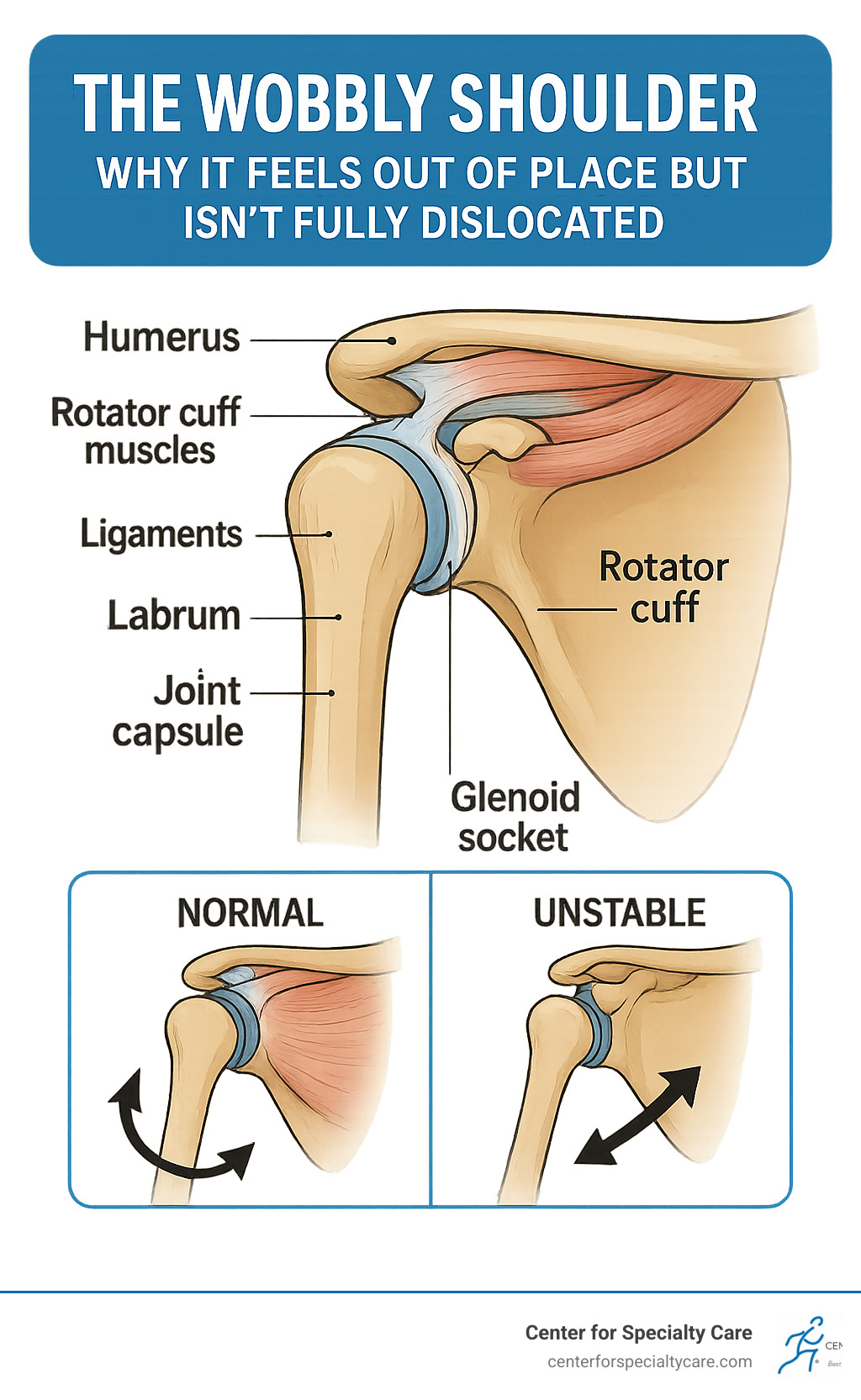
When your shoulder feels out of place but not dislocated, you’re experiencing shoulder instability. Your shoulder joint is like a golf ball on a tee—highly mobile but not inherently stable. In a stable shoulder, the ball of your upper arm bone (humerus) sits centered in the shallow socket (glenoid). With instability, that ball moves excessively, sometimes partially slipping out of place. This partial slip is called a shoulder subluxation.
Unlike a full dislocation, a subluxation is often sneakier. It might happen during a tennis serve or while reaching for something, causing an alarming slip before the joint slides back into place on its own. This can become a chronic issue once the stabilizing structures (ligaments, joint capsule, muscles) are compromised.
Common causes of shoulder instability include:
- Traumatic Injuries: A hard fall or collision can stretch or tear the tissues that stabilize your shoulder. A traumatic dislocation in someone under 35 has an 80% chance of leading to chronic instability.
- Repetitive Strain: Overhead motions in sports like swimming or baseball can gradually stretch the joint capsule and ligaments over time, leading to a loose, unstable feeling.
- Congenital Laxity: Some people are naturally “double-jointed” with more elastic ligaments, making their joints inherently less stable and more reliant on muscle strength.
At Center for Specialty Care, our comprehensive approach addresses not just the immediate problem but the underlying causes. More info about Sports Medicine
The Difference Between Shoulder Instability and a Full Dislocation
Understanding the difference between instability and a full dislocation is key to getting the right care. While both involve abnormal joint movement, they are distinct events.
| Feature | Shoulder Instability (Subluxation) | Full Shoulder Dislocation |
|---|---|---|
| Symptoms | – Quick feeling of slipping or pinching – Shoulder feels loose or wobbly – Sensation of joint slipping out, then returning – Pain with overhead movement |
– Intense, severe pain – Extreme pain with any movement – Numbness or tingling in the arm – Muscle spasms – “Dead arm” sensation |
| Appearance | – Typically no visible deformity | – Obvious deformity; shoulder appears “squared off” – Swelling and bruising are common |
| Immediate Action | – Rest and ice the area – Avoid provoking activities – Seek medical attention if symptoms persist |
– Do NOT try to put it back in yourself – Immobilize the arm – Seek immediate medical attention (ER) |
A true dislocation is a medical emergency with intense pain and visible deformity, while instability is characterized by a recurring sensation of looseness or brief slipping without the joint staying out of place.
The Role of the Labrum and Ligaments
Your shoulder’s stability depends on a team of structures. The labrum is a cartilage rim that deepens the shallow socket, acting like a bumper. A tear in the labrum can cause clicking, catching, and instability. Your ligaments and the surrounding joint capsule act like strong ropes, holding the joint together. When these are stretched or torn from injury or overuse, they can no longer do their job effectively, leading to that wobbly, unreliable feeling.
Understanding these structures helps us target treatment, whether it’s strengthening muscles to compensate for looseness or surgically repairing torn tissues. If you’re experiencing shoulder clicking with instability, these symptoms often go hand-in-hand. More info about Shoulder Clicking and Pain
Symptoms, Diagnosis, and When to See a Doctor
When your shoulder feels out of place but not dislocated, the sensation is often accompanied by other symptoms. Knowing these signs and when to see a doctor is crucial for preventing further issues.

Common Symptoms When Your Shoulder Feels Out of Place But Not Dislocated
Beyond the primary “wobbly” or loose sensation, you may experience:
- Pain with movement: A sharp, pinching pain, especially when raising your arm overhead or rotating it.
- Sensation of giving way: A sudden feeling of weakness, as if your shoulder is about to “give out.”
- Weakness in the arm: Difficulty with tasks like lifting or pushing, as your muscles struggle to keep the joint centered.
- Numbness or tingling: A sensation that travels down the arm, caused by nerves being stretched during a subluxation.
- Clicking or popping sounds: Noises during arm movement as the joint shifts abnormally.
- Apprehension: An unconscious avoidance of certain arm positions due to fear of triggering the unstable feeling.
If these symptoms sound familiar, especially if they are recurrent, it’s time to get them evaluated. More info about Muscle Kink in Shoulder Blade
Diagnosing Why Your Shoulder Feels Out of Place But Not Dislocated
At Center for Specialty Care, we use a thorough process to pinpoint the cause of your instability.
- Medical History and Physical Exam: We start by discussing your symptoms, past injuries, and how the instability affects your life. Our orthopedic specialists will then perform a hands-on examination, checking for tenderness and assessing your shoulder’s stability with specific tests, like the apprehension test, to safely check for instability.
- Range of Motion and Strength Tests: We evaluate how well you can move your arm and assess the strength of your shoulder and arm muscles to identify any weakness contributing to the problem.
- Imaging Studies: X-rays are used to check bone alignment and rule out fractures. An MRI scan provides detailed images of soft tissues like the labrum, ligaments, and tendons, helping us spot tears or stretching that X-rays can’t show.
Our precise diagnostic process ensures we create the most effective, personalized treatment plan to achieve our goal of 100% patient satisfaction. More info about finding a Doctor for Shoulder Problems
When to Seek Medical Attention
It’s tempting to ignore a minor “wobbly” feeling, but you should seek professional help if you experience:
- Persistent pain that doesn’t improve with rest and ice.
- Recurrent episodes of instability, as each event can cause more damage.
- Pain or instability that prevents you from performing daily activities, work, or sports.
- Significant weakness that affects your job or athletic performance.
- Nerve symptoms like numbness or tingling in your arm or hand.
While a full dislocation is an emergency, this more subtle instability still requires a proper evaluation. Our clinics in Minnesota and Iowa offer quick appointment availability so you can get answers without a long wait. More info about Urgent Care for Shoulder Pain
What to Do When Your Shoulder Feels Out of Place But Not Dislocated
When that unsettling feeling strikes, knowing the right steps to take can help manage the situation and prevent it from worsening. While a professional evaluation is always best, here are the immediate and long-term treatment options.

Non-Surgical Treatment Options
For most cases of shoulder instability, non-surgical treatments are the first line of defense. The goal is to reduce pain, restore function, and stabilize the joint.
- Rest and Activity Modification: Give your shoulder a break from aggravating activities, especially overhead motions or heavy lifting. Identifying and avoiding movements that trigger the instability is crucial.
- Ice: Apply an ice pack for 15-20 minutes at a time, several times a day, to reduce pain and swelling. Always use a cloth between the ice and your skin.
- Anti-inflammatory Medications (NSAIDs): Over-the-counter drugs like ibuprofen can help manage pain and inflammation. Follow dosage instructions and consult your doctor if you have other health conditions.
These conservative measures are most effective when combined with a structured rehabilitation program. More info about Pain Management
The Critical Role of Physical Therapy and Exercise
Physical therapy (PT) is the cornerstone of recovery when your shoulder feels out of place but not dislocated. PT aims to build a stronger, more stable shoulder through a personalized plan.

Key goals of physical therapy include:
- Strengthening Rotator Cuff Muscles: These muscles are essential for keeping the shoulder joint centered and stable during movement.
- Scapular Stabilization: Exercises to strengthen the muscles controlling your shoulder blade (scapula) provide a stable foundation for arm movement.
- Proprioception and Joint Control: Training to improve your body’s sense of joint position, helping your brain and muscles work together to prevent future slips.
Commitment to PT is often the most important factor in a successful recovery. More info about Shoulder Treatment with Physical Therapy
When is Surgery Necessary?
While we prioritize non-surgical care, surgery may be the best option if:
- Conservative treatment fails after several months of dedicated physical therapy.
- There is significant structural damage to the labrum or ligaments seen on an MRI.
- You are a high-level athlete in a contact or overhead sport where stability is critical.
- Recurrent subluxations or dislocations severely impact your quality of life.
The most common procedure is minimally invasive arthroscopic surgery to repair damaged structures. This may involve a Bankart repair (reattaching a torn labrum) or a capsular shift (tightening the stretched joint capsule). Surgery has a low recurrence rate (3-5%), and most patients report improved strength and stability. Recovery involves immobilization followed by extensive physical therapy over several months.
Our experienced surgeons are skilled in these procedures, ensuring personalized care for optimal outcomes. More info about Rotator Cuff Surgeons
Frequently Asked Questions about Shoulder Instability
It’s normal to have questions when your shoulder feels out of place but not dislocated. As an orthopedic surgeon with three decades of experience, I’ve addressed these common concerns for my patients at Center for Specialty Care.
Can shoulder instability heal on its own?
While the immediate sensation may pass, the underlying problem—stretched ligaments or a torn labrum—does not heal on its own. Without addressing the issue, the shoulder remains vulnerable. The inability of shoulder muscles to keep the arm bone in place is a key factor in chronic instability. Each time the shoulder subluxates, it can cause further damage. True healing requires a dedicated rehabilitation program to strengthen the supporting muscles and restore stability. It’s always best to get a professional opinion to guide your treatment.
How can I prevent my shoulder from feeling unstable?
While not all injuries are preventable, you can significantly reduce your risk of instability with these steps:
- Use Proper Exercise Form: Correct technique during workouts and daily activities protects your shoulder from unnecessary stress.
- Strengthen Your Rotator Cuff: These muscles provide dynamic stability, actively keeping your shoulder centered. Simple resistance band exercises are highly effective.
- Avoid Over-training: Give your shoulder adequate time to recover between intense workouts or activities.
- Build Core Stability: A strong core provides a stable platform for your upper body, preventing poor movement patterns that strain the shoulder.
- Listen to Your Body: Pain, clicking, or a loose feeling are warning signs. Don’t “push through” the discomfort. Addressing these early signs is much easier than treating advanced instability.
What are the long-term risks of an unstable shoulder?
Ignoring shoulder instability can lead to a cascade of problems over time. The primary long-term risks include:
- Chronic Pain: What starts as occasional discomfort can become persistent, aching pain that affects sleep and daily life.
- Early-Onset Arthritis: Repetitive slipping and abnormal movement accelerate the breakdown of cartilage, leading to degenerative arthritis at a younger age.
- Nerve Damage: Repeated stretching of nerves during subluxations can lead to persistent numbness, tingling, or weakness in the arm and hand.
- Decreased Function: The combination of pain, weakness, and joint damage can make simple tasks like reaching overhead or lifting objects difficult or impossible.
Addressing instability early is the best way to preserve your long-term shoulder health and prevent these complications. Chronic Shoulder Instability
Taking Control of Your Shoulder Health
When your shoulder feels out of place but not dislocated, it’s a clear signal from your body to seek attention. This sensation points to shoulder instability or subluxation, a condition caused by factors ranging from traumatic injuries to natural joint laxity.
Fortunately, the path from diagnosis to recovery is clear. Physical therapy is the cornerstone of treatment, strengthening the muscles that secure your joint. For more severe cases, surgical options like arthroscopic repair can restore the stability you need. The key is an accurate diagnosis to ensure your treatment plan is custom to you.
At Center for Specialty Care, we understand that an unreliable shoulder affects your confidence and quality of life. Our approach is built on personalized care that addresses your unique symptoms, lifestyle, and goals. With clinics in Fairmont, MN, Estherville, IA, Buffalo Center, IA, and St. James, MN, expert orthopedic care is always close to home.
Our commitment to 100% patient satisfaction and quick appointment availability means you don’t have to live with uncertainty. Your shoulder instability doesn’t have to define your limits. Take control by getting the right professional guidance to regain stability and confidence in your movements.