
Achey Breaky Shoulders: What’s Causing Your Pain?
August 29, 2025
Shoulder Blade Blues? A Guide to Understanding Your Scapula Pain
September 2, 2025
How to fix shoulder popping: 2025 Best Guide
Understanding the Pop: Why Your Shoulder Makes Noise
How to fix shoulder popping starts with understanding what’s actually happening inside your joint. If you’re hearing clicks, pops, or grinding sounds when you move your shoulder, you’re not alone – these noises are incredibly common and often completely harmless.
Quick Answer: How to Fix Shoulder Popping
- Improve your posture – Keep shoulders back and avoid slouching
- Perform gentle stretches – Doorway stretches and cross-body arm pulls
- Strengthen your rotator cuff – Use resistance bands for external rotation
- Try shoulder blade squeezes – Pull shoulder blades together 10-15 times daily
- Apply ice if there’s pain – 15-20 minutes at a time
- See a doctor if you have pain – Especially with weakness or limited motion
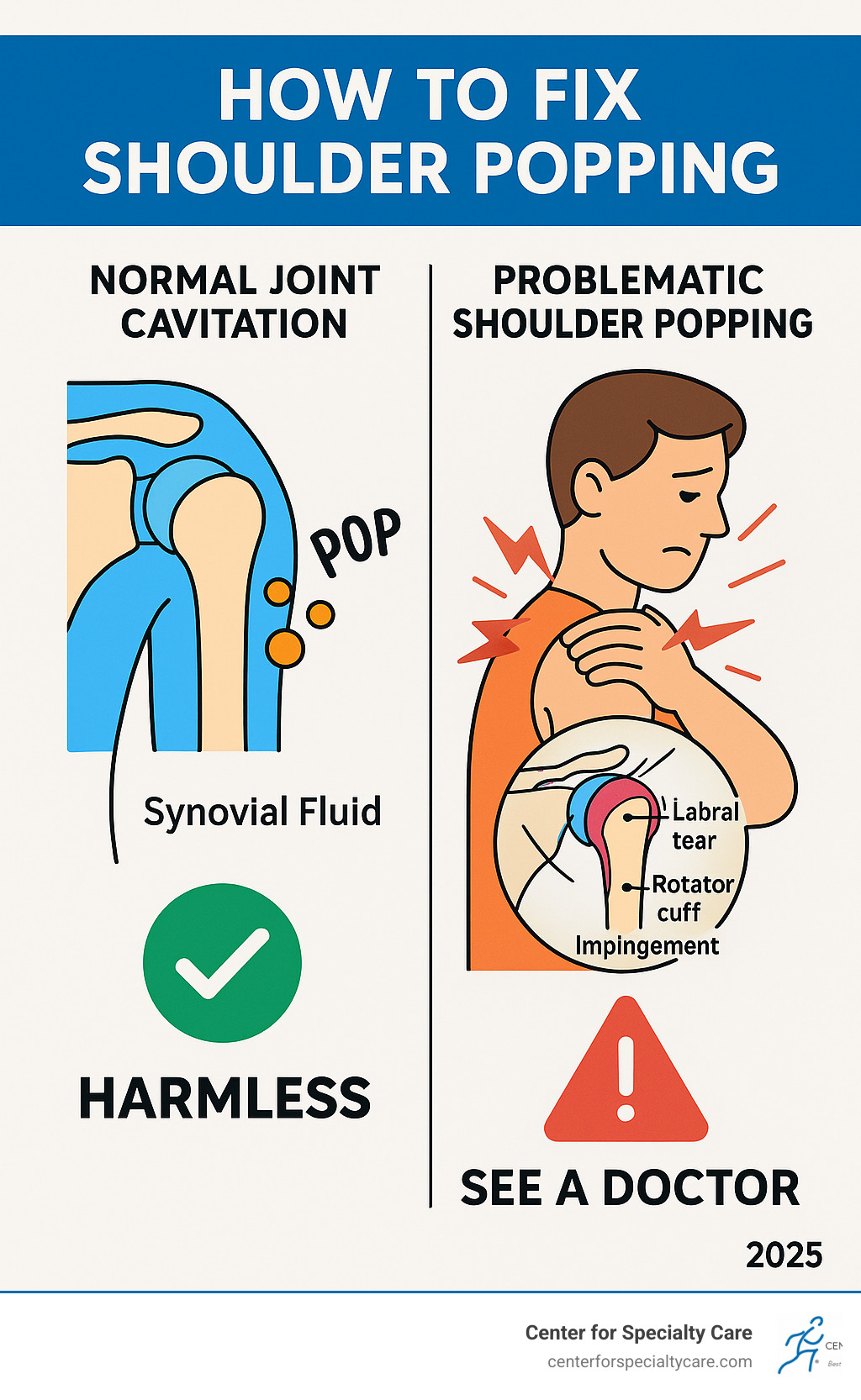
The good news? Most shoulder popping is just joint cavitation – tiny gas bubbles collapsing in your joint fluid, similar to cracking your knuckles. It’s when the popping comes with pain, weakness, or stiffness that you need to pay attention.
However, some shoulder sounds signal underlying issues like rotator cuff problems, labral tears, or shoulder impingement. The key is knowing the difference between normal joint sounds and those that require professional care.
As Dr. Corey Welchlin, I’ve spent over three decades helping patients in southern Minnesota and northern Iowa understand how to fix shoulder popping through both conservative treatments and surgical interventions when necessary. My experience as the region’s first permanent orthopedic surgeon has shown me that most shoulder popping responds well to simple exercises and posture improvements.
Why Your Shoulder Clicks and Pops: Uncovering the Causes
Fixing how to fix shoulder popping starts with understanding your shoulder’s complex anatomy. It’s the most mobile joint in your body, yet it must also be stable enough to lift heavy objects or throw a baseball.
Your shoulder achieves this balancing act through several key players. The glenohumeral joint is where your upper arm bone meets your shoulder blade—like a golf ball on a tee rather than a true ball-and-socket joint like your hip. This shallow design gives you an incredible range of motion but makes stability a constant challenge.
That’s where your rotator cuff comes in—four muscles and their tendons that wrap around your shoulder like a dynamic sleeve, keeping everything centered. The labrum acts like a bumper around the socket’s edge, deepening it and providing anchor points for ligaments. Finally, small fluid-filled cushions called bursae help everything glide smoothly.
When all these parts work harmoniously, your shoulder moves quietly. But sometimes, things get noisy, and understanding the difference between normal and concerning sounds becomes crucial. For more detailed information about clicking specifically when raising your arm, check out our guide on Shoulder Clicking When Raising Arm.
Harmless Shoulder Noises
Most shoulder popping is completely normal. If your shoulder makes sounds but doesn’t hurt, you’re likely experiencing one of two harmless phenomena.
The most common culprit is joint cavitation—essentially, your shoulder cracking its knuckles. Your joints contain synovial fluid (nature’s WD-40) with dissolved gases. When you stretch or move quickly, pressure changes cause these gases to form tiny bubbles that then pop. It sounds dramatic, but it’s harmless.
The other common cause of pain-free popping is tendons or ligaments briefly snapping over bone. Picture a rubber band sliding over a table’s edge—that’s what happens when a tendon moves around a bony prominence. It creates a distinct click, but as long as there’s no pain, it’s just your unique anatomy at work.
These harmless sounds are so common that many people have them daily. The key indicator that everything’s fine? No pain, no weakness, and no limited movement.
When Popping Signals a Problem
While innocent shoulder sounds are common, pay attention when popping comes with pain, weakness, or a feeling that something’s not right. These symptoms can indicate conditions that benefit from professional evaluation.
Labral tears can create a painful clicking or catching sensation, especially in people who do repetitive overhead activities. When this cartilage bumper tears, it can disrupt smooth joint movement and create noticeable instability.
Rotator cuff injuries—from wear and tear or trauma—can cause painful popping because the stabilizing muscles aren’t working properly. Without that control, your arm bone doesn’t stay centered, leading to abnormal movement and uncomfortable sounds.
Shoulder impingement happens when soft tissues get pinched between bones, often when you lift your arm. This creates painful clicking as inflamed tissues rub against bone. Poor posture and repetitive overhead motions are common contributors to this condition.
Bursitis involves inflammation of the fluid-filled bursae. When swollen, they can cause painful snapping as tendons move over them. This condition, sometimes called “snapping scapula syndrome,” often results from overuse.
Shoulder osteoarthritis creates a distinctive gritty, grinding sound—often described as “Rice Krispies” in the joint. This occurs when cartilage wears down and bones start rubbing together. You can learn more about this condition in our detailed explanation of shoulder osteoarthritis.
Instability can cause dramatic pops or clunks when your shoulder partially or completely slips out of place, resulting from injury, repetitive stress, or naturally loose joints.
An often overlooked cause of painful shoulder popping is biceps instability. Your biceps tendon normally sits in a groove in your upper arm bone. When the system holding it there is damaged, the tendon can snap in and out of its groove during shoulder movement, causing pain with rotation or reaching.
The bottom line? If your shoulder popping hurts or limits you, it’s worth getting checked out. For comprehensive information about painful shoulder popping, visit our detailed guide on Shoulder Joint Pain and Popping.
A Practical Guide on How to Fix Shoulder Popping at Home
If your shoulder makes noise but doesn’t hurt, or if you’re dealing with mild, occasional discomfort, you have plenty of options to improve things right from your living room. The secret to how to fix shoulder popping lies in understanding that your shoulder is like a complex orchestra – when all the parts work together harmoniously, the music flows smoothly and quietly.
Think of this as your personal shoulder rehabilitation program. We’re going to focus on improving joint mechanics, strengthening the muscles that support your shoulder, and creating better overall stability. Here’s the thing though – consistency trumps intensity every single time. You can’t expect to see real changes from doing these exercises once or twice. I tell my patients to think marathon, not sprint.
One important reality check: you can’t honestly say “exercises don’t help” unless you’ve committed to a quality program for at least six months. Your shoulder didn’t develop its issues overnight, and it won’t fix itself that quickly either.

The Critical Role of Posture
Before we jump into specific exercises, let’s talk about something that affects your shoulder health every single day: your posture. I know, I know – you’ve probably heard this lecture before. But here’s why it matters so much for shoulder popping.
When you slouch with rounded shoulders and forward head posture, you’re essentially changing the entire blueprint of how your shoulder joint works. Picture this: your shoulder blades slide away from your spine, your shoulders roll forward, and suddenly the space where your rotator cuff tendons need to glide becomes cramped and narrow.
It’s like trying to drive a car through a tunnel that’s too small – things are going to rub, scrape, and make noise. That shoulder blade alignment isn’t just about looking confident (though that’s a nice bonus). It’s about creating the right mechanical environment for smooth, quiet shoulder movement.
If you spend your days hunched over a computer, you’re not alone. Most of us do. But simple ergonomics at your desk can make a world of difference. Sit tall, imagine a string pulling the top of your head toward the ceiling, and gently draw your shoulder blades back and down. Your future self will thank you.

Simple exercises for how to fix shoulder popping
These exercises target the root causes of shoulder popping by strengthening stabilizing muscles, improving mechanics, and addressing the muscle imbalances that often contribute to noisy joints. Start gently, and remember – any sharp pain is your signal to stop.
Shoulder blade squeezes are your first line of defense against rounded shoulders. These target the muscles between your shoulder blades – your rhomboids and middle trapezius – which are often weak and overstretched in our modern world. Sit or stand tall, then gently squeeze your shoulder blades together like you’re trying to hold a pencil between them. Keep your shoulders down, away from your ears. Hold for 5-10 seconds, then relax. Aim for 10-15 repetitions, three times, and honestly, you can do these throughout your day whenever you think about it.
External rotation with a resistance band strengthens those crucial rotator cuff muscles that keep your arm bone centered in its socket. Stand with your elbow bent at 90 degrees and tucked against your side. Hold a light resistance band and slowly rotate your forearm away from your body, keeping that elbow glued to your side. Control the movement back to start. Ten repetitions, three sets per arm. This directly addresses the instability that often causes problematic popping.
Wall angels might look simple, but they’re incredibly effective for improving your upper back mobility and shoulder blade control. Stand with your back against a wall, feet a few inches away. Press your head, upper back, and buttocks against the wall. Bring your arms up like goalposts – elbows bent at 90 degrees, backs of your hands and elbows touching the wall. Slowly slide your arms up the wall, keeping contact, then slide back down. This exercise fights against that forward head posture and opens up your shoulder movement.
The doorway stretch releases the tightness in your chest and front shoulders that pulls you into that rounded position. Stand in a doorway, place your forearms on the frame with elbows at shoulder height, then gently step forward and lean into the stretch. You should feel a gentle pull across your chest and the front of your shoulders. Hold for 10-15 seconds, repeat 3-5 times.
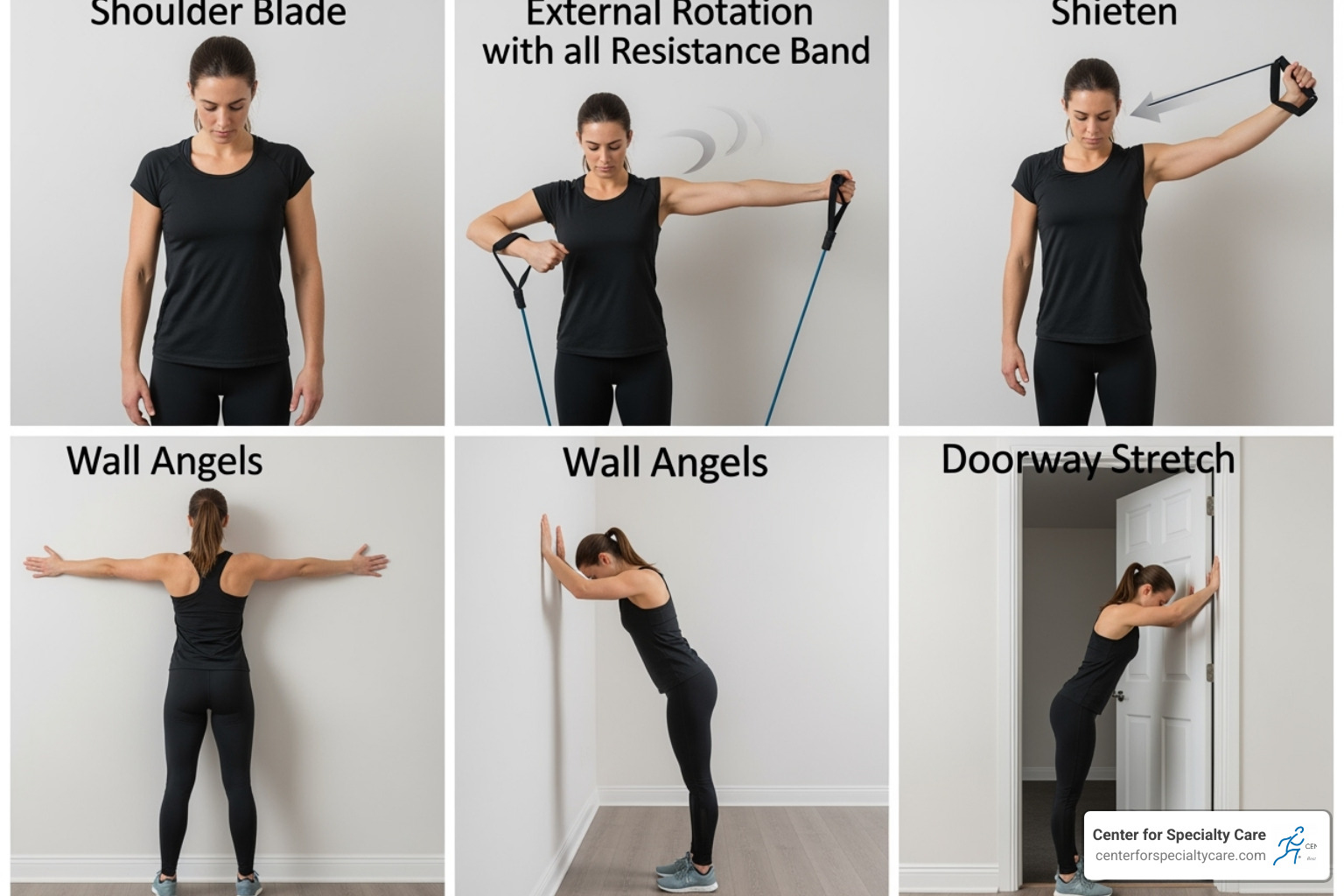
These exercises work by addressing the mechanical issues that often cause shoulder popping. They’re not magic – they require patience and consistency. But when done regularly, they can significantly improve how your shoulder feels and functions, often quieting those concerning noises in the process.
When to See a Doctor for Shoulder Popping
Let’s be honest – nobody likes to hear that they might need to see a doctor. But when it comes to shoulder popping, knowing when to seek professional help can save you from months of unnecessary discomfort and prevent minor issues from becoming major problems.
Ignoring persistent shoulder symptoms isn’t just uncomfortable – it can lead to serious long-term consequences. What starts as occasional clicking can progress into chronic pain, worsening tears, or even “frozen shoulder” (adhesive capsulitis), where your shoulder joint becomes so stiff and painful that simple tasks like reaching for your coffee mug become nearly impossible.
The good news? Early intervention can prevent these complications entirely. That’s why we encourage patients to seek evaluation sooner rather than later when certain warning signs appear.
For guidance on finding the right specialist for your needs, check out our comprehensive guide: Finding the Best Shoulder Doctor Near Me.
Red Flags: Don’t Ignore These Symptoms
Think of your body as your car’s dashboard – certain warning lights shouldn’t be ignored. When it comes to how to fix shoulder popping, some symptoms are clear signals that it’s time for professional evaluation.
Pain accompanying the pop is the biggest red flag. If your shoulder popping comes with sharp pain, aching, or any discomfort, something isn’t right. Pain-free popping might be normal, but painful popping almost always indicates an underlying issue that needs attention.
Weakness or instability in your shoulder suggests that the muscles and ligaments aren’t doing their job properly. If your arm feels weak during normal activities, or if your shoulder feels like it might “give out” or slip out of place, these are signs of potential rotator cuff problems or joint instability.
Loss of range of motion is another serious concern. When you can’t lift your arm overhead, reach behind your back, or move your shoulder through its normal range, this often points to impingement, tears, or inflammatory conditions that respond well to early treatment.
Watch for swelling, warmth, or redness around your shoulder joint. These classic signs of inflammation might indicate bursitis, tendinitis, or other conditions that can be effectively treated when caught early.
A “catching” or “locking” sensation suggests something is physically getting stuck in your joint – perhaps a torn labrum or loose piece of cartilage. This mechanical problem typically won’t resolve on its own and often requires professional intervention.
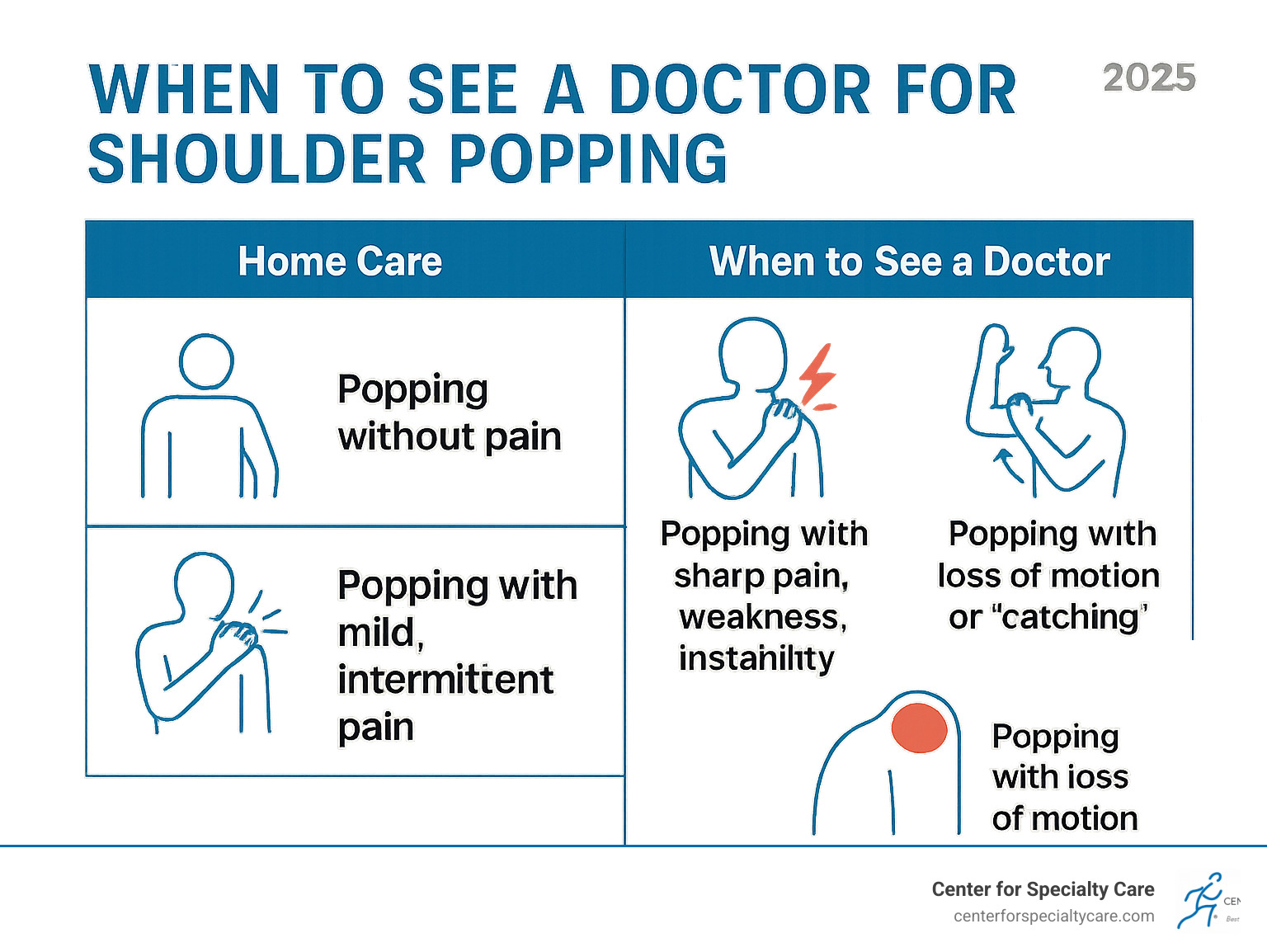
Here’s a simple way to think about it: popping without pain can often be managed with the home exercises we discussed earlier. But popping with any of these red flag symptoms warrants professional evaluation. When in doubt, it’s always better to have a quick consultation than to risk long-term complications.
Understanding professional treatments for how to fix shoulder popping
When you visit our specialists at Center for Specialty Care, we don’t just treat symptoms – we get to the root of what’s causing your shoulder to pop in the first place. Our approach starts with a thorough physical therapy evaluation where we assess your shoulder mechanics, identify muscle imbalances, and pinpoint exactly what’s going wrong.
Personalized exercise programs form the backbone of most successful treatments. Unlike generic exercises you might find online, our physical therapists design programs specifically for your shoulder’s unique needs. These programs focus on strengthening your rotator cuff, improving your posture, and restoring normal movement patterns.
Manual therapy techniques can work wonders for shoulder popping. Our therapists use hands-on approaches like joint mobilization and soft tissue massage to reduce tightness, improve alignment, and restore smooth joint movement. Many patients are amazed at how much better their shoulder feels after just a few sessions.
For shoulders that are popping due to inflammation, corticosteroid injections can provide significant relief. While these injections don’t fix mechanical problems, they can reduce swelling and pain enough to make physical therapy more effective. For specific conditions like biceps instability, ultrasound-guided injections can transform a painful clicking shoulder into a pain-free one for several months.
You can learn more about our comprehensive approach in our detailed guide: Shoulder Treatment with Physical Therapy.
Surgical options are available for severe cases, but we always prioritize conservative treatments first. When surgery is necessary – such as for complete rotator cuff tears or persistent instability – we use minimally invasive techniques whenever possible. For example, arthroscopic biceps tenodesis can effectively stabilize an unstable biceps tendon, with most patients able to use their arm out of a sling within just three days.
Our philosophy at Center for Specialty Care is simple: we want you back to doing what you love as quickly and safely as possible. Whether that’s through targeted exercises, hands-on therapy, or advanced treatments, we’ll work with you to find the best solution for your specific situation.
Frequently Asked Questions about Shoulder Popping
Over my three decades of practice, I’ve noticed that patients often have similar concerns about their shoulder noises. Let me address the most common questions I hear in my office.
Is it bad to crack my shoulder on purpose?
While the occasional natural joint cavitation might feel good, intentionally forcing your shoulder to crack is not recommended.
Here’s why: when you deliberately manipulate your shoulder to pop, you’re potentially stretching the ligaments holding your joint together. Like rubber bands, if stretched too often, they lose their snap. This ligament laxity can make your shoulder feel loose and unstable over time.
The bigger issue is that forced popping doesn’t address the underlying tension or stiffness you’re trying to relieve. It’s like turning up the radio to ignore a noisy car engine—you might not hear the problem, but it’s still there.
Instead of seeking temporary relief through self-manipulation, it’s better to focus on the underlying cause. The gentle exercises we discussed earlier, along with good posture, will give you lasting results without the potential for injury from forced popping.
Can ignoring shoulder clicking lead to long-term damage?
This is an excellent question, and the answer depends on whether your clicking comes with pain or other symptoms.
If your shoulder clicking is completely pain-free with a full range of motion, you can generally ignore it without worry. These harmless pops are just part of how your joint moves and won’t cause damage.
However, if you’re experiencing clicking with pain, weakness, or stiffness, ignoring these symptoms can lead to long-term damage. I’ve seen patients who thought a “minor” shoulder issue would go away, only to develop more serious problems.
Untreated injuries like rotator cuff or labral tears tend to worsen over time. A small tear can become a progressive injury that’s harder to treat. The surrounding tissues can develop chronic inflammation, and you might see early arthritis as your joint compensates for the damage.
One of the most serious consequences is adhesive capsulitis, or frozen shoulder. This condition can develop when shoulder pain and stiffness go untreated. The joint capsule becomes thick and tight, severely limiting movement and causing significant pain that can last for months or years.
The good news? Early intervention can prevent most of these complications. That’s why I always tell my patients: when in doubt, get it checked out.
How long does it take for exercises to help with shoulder popping?
Patience is the most important ingredient when using exercises for how to fix shoulder popping. The timeline for improvement varies from person to person.
For simple issues like poor posture or minor muscle imbalances, many patients feel improvements within a few weeks of consistent exercise. You might notice less tightness or that movements become smoother and less noisy.
For more established problems or injury recovery, the timeline is longer. I always tell my patients that consistency over intensity is what matters most. It’s better to do your exercises correctly for 10 minutes daily than an intense workout once a week.
Here’s something important I’ve learned: you can’t fairly judge if exercises are helping unless you’ve stuck with a quality program for at least six months. Rebuilding shoulder strength and stability is a gradual process.
Many of my patients report being able to raise their arms almost fully within 4-6 weeks of starting a proper strengthening program. The progressive strengthening phase typically continues for 3 months or more. We’re not just trying to quiet the popping—we’re working to create lasting stability and function in your shoulder joint.
Adherence to your program is crucial. I’ve seen patients make remarkable progress when they stick with their exercises and others struggle because they give up too early. Your shoulder took time to develop these issues, and it will take time to fix them properly.
Take the Next Step for a Healthier Shoulder
Understanding how to fix shoulder popping doesn’t have to be complicated. The most reassuring news is that painless popping is often completely normal – it’s simply your joint doing what it naturally does.
However, when that popping comes with pain, weakness, or a feeling that your shoulder might give out, your body is sending an important message. These symptoms deserve attention because ignoring them can lead to bigger problems, including chronic pain or frozen shoulder.
Being proactive is key to shoulder health. Simple changes like improving your posture and dedicating a few minutes to gentle strengthening exercises can make a remarkable difference. Consistency is more important than intensity; your shoulder responds better to regular, gentle care than to sporadic intense efforts.
Many of our patients are surprised by how much their daily habits affect their shoulder health. Adjusting your workspace ergonomics or being mindful of how you carry a bag can reduce strain and minimize unwanted clicking.
If you’re dealing with painful popping or any concerning symptoms, don’t let uncertainty keep you from seeking help. At Center for Specialty Care, we believe in making healthcare accessible and comfortable. Our commitment to 100% patient satisfaction means we listen to your concerns, explain what’s happening with your shoulder, and work with you to create a treatment plan that fits your lifestyle.
We understand that shoulder problems are frustrating and affect everything from reaching for high items to getting a good night’s sleep. That’s why we offer quick appointment availability and personalized care custom to your needs and goals.
Whether you need conservative treatment like physical therapy or have a more complex issue requiring surgery, our team serves communities across Minnesota and Iowa, including Fairmont MN, Estherville IA, Buffalo Center IA, and St James MN. We’re here to help you get back to the activities you love, pain-free and with confidence in your shoulder’s strength.
Your journey to a healthier, quieter shoulder starts with that first step. Find expert shoulder care and let us help you move forward with confidence.