
Step Pain-Free Again: The Best Foot Tendonitis Relief Options
July 30, 2026
Rhomboid Muscle Pain: Common Causes and How to Find Relief
August 1, 2026
Protecting Your Practice: A Guide to Foot Tendon Malpractice Insurance
Why Foot Tendon Malpractice Coverage Is One of the Most Important Decisions You’ll Make
Foot tendon malpractice coverage is specialized professional liability insurance that protects podiatrists and orthopedic surgeons against lawsuits arising from tendon-related procedures — including Achilles repairs, tendon transfers, bunionectomies, and tendon releases.
Here is a quick breakdown of what you need to know:
| Key Factor | What to Know |
|---|---|
| Who needs it | Podiatrists and orthopedic surgeons performing foot and ankle tendon procedures |
| Standard policy limits | $1M per claim / $3M aggregate |
| Average Achilles tendon claim payout | $431,405 |
| Most common allegations | Delayed diagnosis, surgical error, inadequate informed consent |
| Policy types | Claims-made (most common) or occurrence |
| Critical add-ons | Tail coverage, cyber liability, regulatory defense |
| Premium range | $6,000–$12,000+ annually for surgical podiatrists; $25,000–$100,000+ for orthopedic surgeons depending on venue and procedure mix |
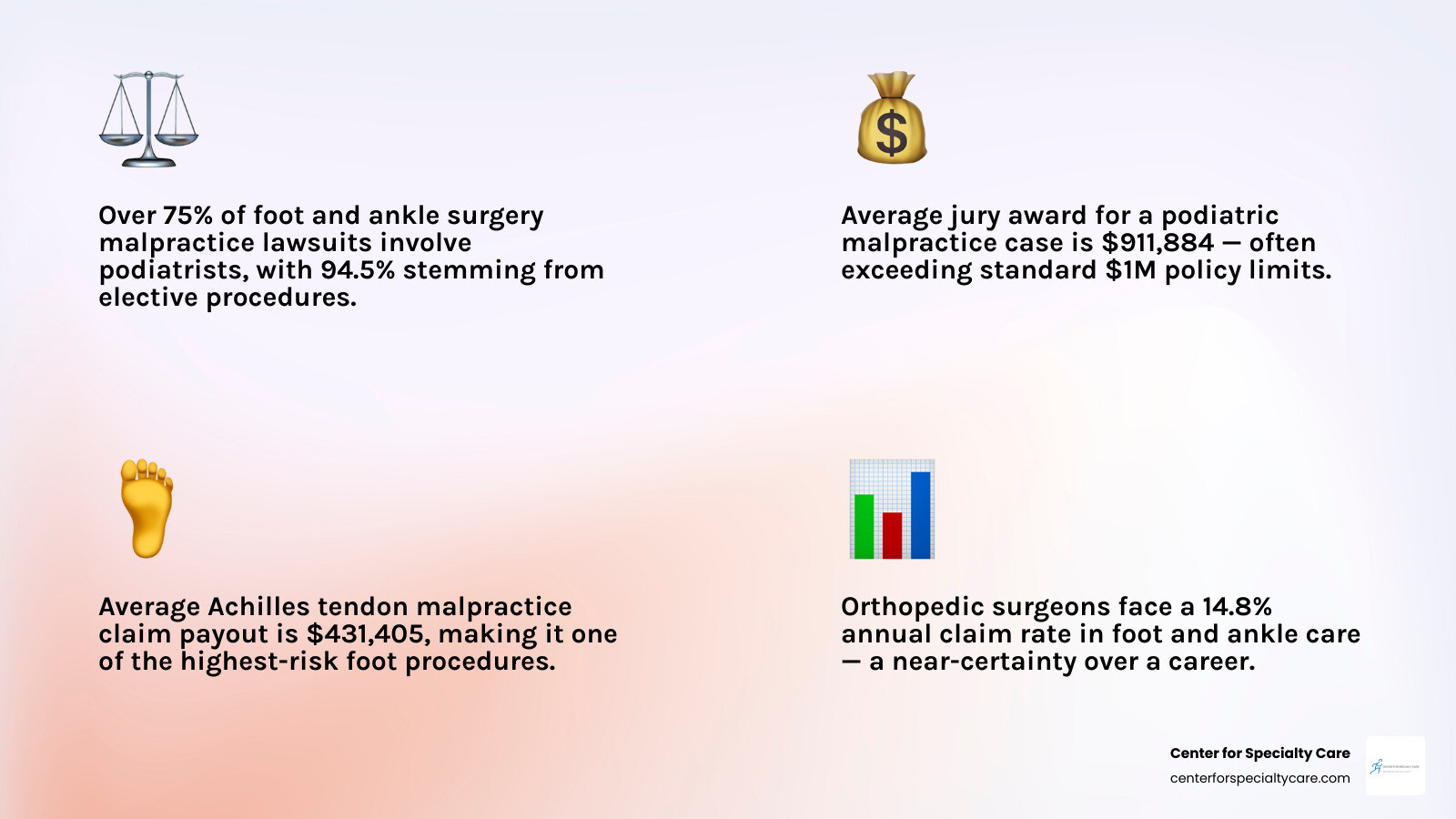
Foot tendon procedures carry serious legal exposure. Over 75% of foot and ankle surgery malpractice lawsuits involve podiatrists, and 94.5% of those claims stem from elective procedures — the exact surgeries patients choose voluntarily, then dispute when the outcome falls short of their expectations.
The financial stakes are just as high. When a podiatric malpractice case goes to court and the plaintiff wins, the average jury award reaches $911,884 — well above the standard $1M policy limit when legal defense costs are factored in. And with orthopedics carrying one of medicine’s highest annual claim rates at 14.8%, the risk is not hypothetical. It is a near-certainty over the course of a career.
Understanding your coverage — before a claim is filed — is what separates a manageable situation from a practice-ending one.
I’m Dr. Corey Welchlin, a board-certified orthopedic surgeon with over 30 years of experience performing foot and ankle procedures at the Center for Specialty Care in Fairmont, Minnesota, where navigating foot tendon malpractice coverage has been a real and recurring consideration throughout my career. In the sections below, I’ll walk you through everything you need to evaluate, compare, and strengthen your coverage.
Basic foot tendon malpractice coverage terms:
High-Risk Foot Tendon Procedures and Common Malpractice Allegations
In our clinical experience across southern Minnesota and northern Iowa, we know that the foot is an incredibly complex anatomical structure. It contains dozens of tendons working in perfect harmony to keep us balanced, walking, and running. When a surgeon operates on these delicate pathways, the margin for error is razor-thin.
Several specific procedures carry disproportionately high risk:
- Achilles Tendon Repairs: As the largest tendon in the body, the Achilles is highly vulnerable. Whether treating an acute rupture or a chronic tear, surgical repairs are heavily scrutinized.
- Tendon Transfers: Re-routing a healthy tendon to replace a non-functioning one (often performed for foot drop or posterior tibial tendon dysfunction) is highly complex. A slight miscalculation in tension can lead to a failed transfer, permanent weakness, or structural deformity.
- Tendon Releases and Lengthening: Procedures like a gastrocnemius recession or Achilles lengthening are designed to relieve tightness. However, an over-aggressive release can cause structural instability, while an under-correction fails to resolve the patient’s symptoms.
- Bunionectomies with Osteotomy: While bunion surgery primarily targets bone, it inherently involves muscle and tendon rebalancing. If the flexor or extensor tendons are accidentally lacerated or improperly balanced, a severe overcorrection can occur. This can result in a hallux varus deformity (where the big toe points inward), causing balance issues, toe contraction, and frequent falls.
Understanding the mechanics of these procedures helps explain why they lead to litigation. To dive deeper into the clinical details of these structures, you can read our guide on Everything You Need to Know About Foot Tendons.
According to a Retrospective Analysis of Malpractice Claims Following Achilles Tendon Rupture – PMC, the legal allegations following these surgeries are rarely simple. The most common drivers of litigation include:
- Delayed or Missed Diagnosis (24%): Up to 25% of Achilles tendon ruptures are initially misdiagnosed as simple ankle sprains by first-line or emergency room providers. By the time the patient is referred to a specialist, the tendon may have retracted significantly, turning a simple primary repair into a complex reconstruction requiring a graft.
- Inadequate Informed Consent (18%): Patients often expect a “perfect” foot after surgery. If they are not explicitly warned about potential risks—such as permanent stiffness, persistent pain, or altered gait—they are far more likely to sue when those complications occur.
- Surgical Errors: This includes direct nerve damage (such as lacerating the sural nerve during an Achilles repair), improper suture tensioning, or accidental tendon lacerations during bunion surgery.
- Postoperative Complications and VTE Risks: Shockingly, patient death occurred in 14% of the Achilles tendon rupture malpractice claims analyzed in the PMC study. These tragic outcomes were entirely due to venous thromboembolism (VTE), such as deep vein thrombosis (DVT) or pulmonary embolism (PE), occurring in the immediate postoperative period. Failing to implement or document a clear VTE prophylaxis protocol is a major liability trigger.
Comparing Malpractice Insurance for Podiatrists vs. Orthopedic Surgeons
While podiatrists (DPMs) and orthopedic surgeons (MDs/DOs) both perform intricate foot tendon surgeries, the insurance market treats them very differently. This is primarily due to differences in training, historical claims data, and the overall scope of their medical practices.
| Metric / Feature | Podiatrists (DPMs) | Orthopedic Surgeons (MDs/DOs) |
|---|---|---|
| Annual Claim Rate | Lower overall, but highly concentrated in elective foot surgeries | Approximately 14.8% (one of the highest in medicine) |
| Surgical Scope | Restricted to the foot and ankle (with state-by-state variations above the ankle) | Full-body musculoskeletal scope (unless strictly subspecialized) |
| Percentage of Foot/Ankle Lawsuits | Over 75% of foot/ankle surgery lawsuits name podiatrists | Named in roughly 44% of Achilles tendon rupture claims |
| Typical Premium Range | $6,000 to $12,000+ (for POD03 full surgical tier) | $25,000 to $100,000+ (highly dependent on spine/trauma mix) |
| Career Lawsuit Probability | Highly likely, especially for elective surgeries | 81% to 99% will be named in a lawsuit during their career |
For podiatrists, the risk is concentrated. Because over 75% of foot and ankle lawsuits target DPMs, underwriters categorize podiatrists into strict risk tiers. For instance, a podiatrist focusing strictly on routine, non-surgical foot care (Tier POD01) might pay only $2,000 to $4,000 annually. However, once they step into the operating room to perform reconstructive tendon surgeries (Tier POD03), their premiums jump to $12,000 or more.
If you are a podiatrist looking to evaluate your specific risk profile and secure a tailored policy, you can explore Podiatric Malpractice Insurance – Get a Quote.
Orthopedic surgeons, on the other hand, face premium structures driven by their broader surgical scope. Even if an orthopedic surgeon specializes in foot and ankle care, their premium is heavily influenced by whether they perform spine surgery, provide emergency department trauma call, or operate in high-litigation venues.
For clinics like ours that offer various Foot Surgery Options, understanding these professional distinctions is critical to structuring the right group or individual coverage.
Venue and State Tort Laws: The Minnesota and Iowa Landscape
Your geographic location plays a massive role in the cost and availability of foot tendon malpractice coverage. Fortunately, the Upper Midwest is generally considered a highly stable insurance market:
- Minnesota: MN tort laws and a stable judicial climate keep malpractice premiums relatively moderate compared to East or West Coast metro areas. However, because Minnesota does not have strict caps on non-economic damages, a catastrophic complication (like a fatal pulmonary embolism or permanent disability in a high-earning patient) can still result in a massive jury verdict.
- Iowa: Iowa has implemented tort reforms, including caps on non-economic damages in medical malpractice cases. This legal environment provides a highly predictable underwriting landscape, keeping premiums stable for surgeons practicing in our Estherville and Buffalo Center locations.
Policy Structures: Claims-Made vs. Occurrence and Essential Endorsements

When selecting or reviewing your foot tendon malpractice coverage, you must choose between two primary policy structures:
Claims-Made Policies
This is the most common policy type in modern medicine. A claims-made policy covers allegations only if both the treatment occurred after your retroactive date and the claim is filed while the policy is actively in force. Because the risk of a lawsuit increases the longer you practice, claims-made premiums start very low in your first year and “step up” over a 5-year period until they reach a mature rate.
The catch? If you cancel the policy (due to retirement, relocation, or switching carriers), you must purchase “tail coverage” to protect against any claims filed in the future for surgeries performed during the policy period.
Occurrence Policies
An occurrence policy covers any incident that happens during the policy period, regardless of when the claim is eventually filed. If you perform an Achilles repair in 2026 under an active occurrence policy, and the patient sues you in 2030, you are covered—even if you retired and canceled the policy in 2028. Because of this lifetime protection, occurrence policies are more expensive upfront but carry no tail-coverage liabilities.
To secure a policy that balances these options with robust risk-mitigation resources, many specialists look to carriers like Coverys. You can learn more about their specialized offerings at Medical Professional Liability Insurance for Podiatrists | Coverys.
Essential Policy Endorsements
A standard professional liability policy covers basic surgical negligence, but modern medical practices face a wide array of secondary risks. Ensure your policy includes these critical endorsements:
- Tail Coverage (Extended Reporting Period): Tail coverage can cost 1.5 to 2.5 times your expiring annual premium. Look for policies that offer free retirement tail coverage if you have been with the carrier for a certain number of years (typically 5 to 10 years) and have reached retirement age.
- Defense Costs Outside Limits: This is one of the most important clauses you can secure. If your policy has a $1M limit, and a complex trial costs $200,000 in legal defense, a policy with “defense inside limits” will leave only $800,000 to pay a settlement or judgment. “Defense outside limits” ensures your legal fees do not erode your actual protection.
- Pure Consent to Settle: Some policies contain a “hammer clause” that allows the insurer to settle a claim to save money, even if you did nothing wrong. A pure consent provision guarantees that the carrier cannot settle a lawsuit without your written approval, protecting your professional reputation.
- Cyber Liability: As healthcare systems rely heavily on EHRs, we are prime targets for ransomware and data breaches. Standard cyber endorsements provide $50,000 to $100,000 in coverage to handle patient notifications, forensic IT investigations, and regulatory fines.
- Regulatory and Board Defense: If a patient files a complaint with the Minnesota or Iowa Board of Medical Practice, standard malpractice insurance will not defend you. A regulatory endorsement provides dedicated funds (typically $25,000 to $50,000) to pay for legal representation during licensing board investigations.
Choosing the Right Foot Tendon Malpractice Coverage Limits
Historically, the standard liability limit for medical practitioners has been $1,000,000 per claim and $3,000,000 aggregate ($1M/$3M). However, in today’s legal climate, a standard limit may leave you personally exposed.
With the average jury award for successful podiatric court cases reaching $911,884, a single high-value verdict can easily wipe out a standard $1M policy limit, leaving your personal assets vulnerable. If a plaintiff attorney performs a wealth assessment and realizes a judgment exceeds your coverage, they can target your personal property, savings, or future practice earnings.
To prevent this, high-volume foot and ankle surgeons should consider:
- Increasing Primary Limits: Upgrading your primary coverage to $2M/$4M or $2M/$6M.
- Securing an Excess Liability (Umbrella) Policy: This adds an extra layer of protection (e.g., $5M or $10M) that sits on top of your primary malpractice policy, which is especially important if you operate on high-profile patients or professional athletes.
Setting realistic expectations with patients before they enter the operating room is the first line of defense against these high-value claims. For a patient-centered perspective on this, refer to The Patient’s Guide to Podiatric Surgery: Expectations and Outcomes.
Underwriting Drivers and Risk Management Strategies
Malpractice insurance carriers do not hand out flat rates; they price your policy based on your specific risk profile. Understanding what underwriters look for can help you position your practice to secure the lowest possible premiums.
Key Underwriting Drivers
- Claims History: A history of multiple settlements or open claims is a major red flag. It can result in premium surcharges of 20% to 50%, or force you out of the standard “admitted” market and into the more expensive “surplus lines” market.
- Procedure Mix: If you perform high-risk tendon transfers, reconstructive fusions, or total ankle replacements, you will be rated in the highest risk tier.
- Trauma Call and ER Volume: Taking emergency department call increases your exposure to high-stakes, unestablished patients, which underwriters view as a significant liability driver.
To mitigate these risks and lower your overhead, implementing structured risk management protocols is essential. Programs like those offered by Risk Placement Services can help practices design tailored safety nets; you can read about their approach at Podiatry Professional Liability Insurance | Risk Placement Services.
Actionable Risk Management Strategies
We recommend implementing these clinical best practices to protect your patients and secure premium discounts (often 5% to 10% for completing approved risk management CME courses):
- Meticulous Documentation: Your chart notes are your ultimate legal defense. Document not just what you did, but why you did it. If a patient is non-compliant—such as walking on a repaired Achilles tendon against your orders—document their non-compliance, missed appointments, and your specific warnings in detail.
- Longitudinal Informed Consent: Do not hand a patient a generic consent form on the morning of surgery. Instead, conduct informed consent discussions over multiple office visits. Verbally explain and document the specific risks of tendon retraction, permanent stiffness, nerve damage, and VTE.
- Strict Infection Control and Post-Op Protocols: Implement standardized checklists for surgical site preparation, suture removal timing, and postoperative wound care to catch complications like wound dehiscence before they escalate.
Key Factors Influencing Foot Tendon Malpractice Coverage Costs
To understand how these elements translate to your bottom line, let’s look at the primary financial variables. For a detailed guide on how DPMs are rated and evaluated, check out Podiatry Malpractice Insurance: What Every DPM Should Know.
- Your Practice Classification (Tiers):
- POD01 (Non-Surgical): Routine care, orthotics, minor wound care. Premium: $2,000 to $4,000.
- POD02 (Minor Surgical): In-office procedures, tenotomies, minor digital surgeries. Premium: $3,500 to $6,000.
- POD03 (Full Surgical): Major tendon repairs, osteotomies, reconstructive surgeries. Premium: $6,000 to $12,000+.
- Geographic Rating: Practicing in rural Minnesota or Iowa yields significantly lower premiums than practicing in highly litigious metropolitan areas.
- New-to-Practice Discounts: If you are fresh out of residency, carriers often offer massive premium discounts (sometimes 50% to 75% in your first year) that gradually scale down over four to five years.
Evaluating Your Foot Tendon Malpractice Coverage for Emerging Procedures
The field of foot and ankle surgery is constantly evolving. In 2026, we are seeing a massive shift toward minimally invasive tendon repairs (which utilize smaller incisions and specialized arthroscopic tools) and biologic injections (such as platelet-rich plasma [PRP], bone marrow aspirate concentrate, or stem cell therapies).
While these procedures offer faster recovery times and high patient satisfaction, they can create insurance gaps if your policy is not updated.
To ensure you are fully protected, take these steps:
- Verify Your Policy Definitions: Ensure your policy’s definition of “professional services” covers regenerative medicine, biologics, and minimally invasive techniques. Some older policies specifically exclude experimental or “off-label” treatments.
- Check Scope of Practice Laws: In states like Minnesota and Iowa, ensure any emerging procedure you perform falls strictly within your state-defined scope of practice. Performing a procedure outside your legal scope can instantly void your malpractice coverage.
- Update Your Carrier on Your Procedure Mix: If you transition from traditional open Achilles repairs to high-volume minimally invasive techniques, notify your underwriter to ensure your risk classification remains accurate.
For comprehensive resources on keeping your coverage aligned with your evolving clinical scope, you can consult Podiatry Malpractice Coverage – MedPro Group. Additionally, if you have questions about how these modern tendon therapies are coded and billed to avoid audit exposure, read our step-by-step guide on Navigating Foot Tendon Surgery Billing Questions.
Frequently Asked Questions About Foot Tendon Malpractice Insurance
What is the average payout for an Achilles tendon malpractice claim?
According to historical claims data, the average indemnity payment for a successful malpractice claim involving an Achilles tendon rupture is $431,405. However, when a case goes to a jury trial and results in a plaintiff verdict, the payouts can easily exceed $1,000,000, particularly if the patient suffers permanent mobility impairment or a life-threatening complication like a pulmonary embolism.
Why do podiatrists face higher foot surgery lawsuit rates than orthopedic surgeons?
Over 75% of foot and ankle surgery malpractice lawsuits involve podiatrists rather than orthopedic surgeons. This is primarily because 94.5% of podiatric lawsuits involve elective procedures (like bunionectomies or cosmetic tendon releases). In elective surgery, patients choose to undergo the procedure to improve their quality of life, meaning they have incredibly high—and sometimes unrealistic—expectations. If they experience persistent pain, stiffness, or cosmetic deformities, they are far more likely to sue than a trauma patient who is simply grateful to walk again.
How does tail coverage work when changing malpractice carriers?
When you transition from one claims-made malpractice carrier to another, you must address your “prior acts” (the surgeries you performed under your old policy). You can do this in two ways:
- Buy Tail Coverage: You pay a one-time fee (usually 150% to 250% of your annual premium) to your old carrier to cover any future claims arising from past surgeries.
- Secure “Nose” (Prior Acts) Coverage: Your new insurance carrier agrees to take on your retroactive date, meaning they will cover any claims filed in the future for surgeries performed under your old policy. This avoids the need to buy a tail, but your new carrier will evaluate your past claims history very carefully before agreeing to it.
Conclusion
At the Center for Specialty Care, we believe that the foundation of excellent orthopedic and pain management care is a combination of surgical expertise, personalized patient relationships, and rigorous professional standards. Whether we are treating patients at our main clinic in Fairmont, Minnesota, or serving our neighbors in Estherville, Iowa, Buffalo Center, Iowa, and St. James, Minnesota, our ultimate goal is 100% patient satisfaction.
Securing robust, comprehensive foot tendon malpractice coverage is not just about protecting our practice; it is about ensuring we have the resources and peace of mind to continue delivering the highest level of care to our communities. If you or a loved one are experiencing foot or ankle pain, we encourage you to take a proactive step toward recovery. To learn more about common foot conditions and our personalized treatment options, read our guide on A Walk Towards Healthy Feet: Common Foot Problems and Solutions or schedule an appointment with us today.