Rhomboid Muscle Pain: Common Causes and How to Find Relief
August 1, 2026
In Depth Guide to Fasciotomy Procedure and Recovery
August 5, 2026
The Ultimate Guide to Custom Orthotics for Flat Feet
Why Custom Orthotics for Flat Feet Are Worth Understanding Before You Buy
If you’re considering custom orthotics for flat feet, here’s a quick answer before we dive deeper:
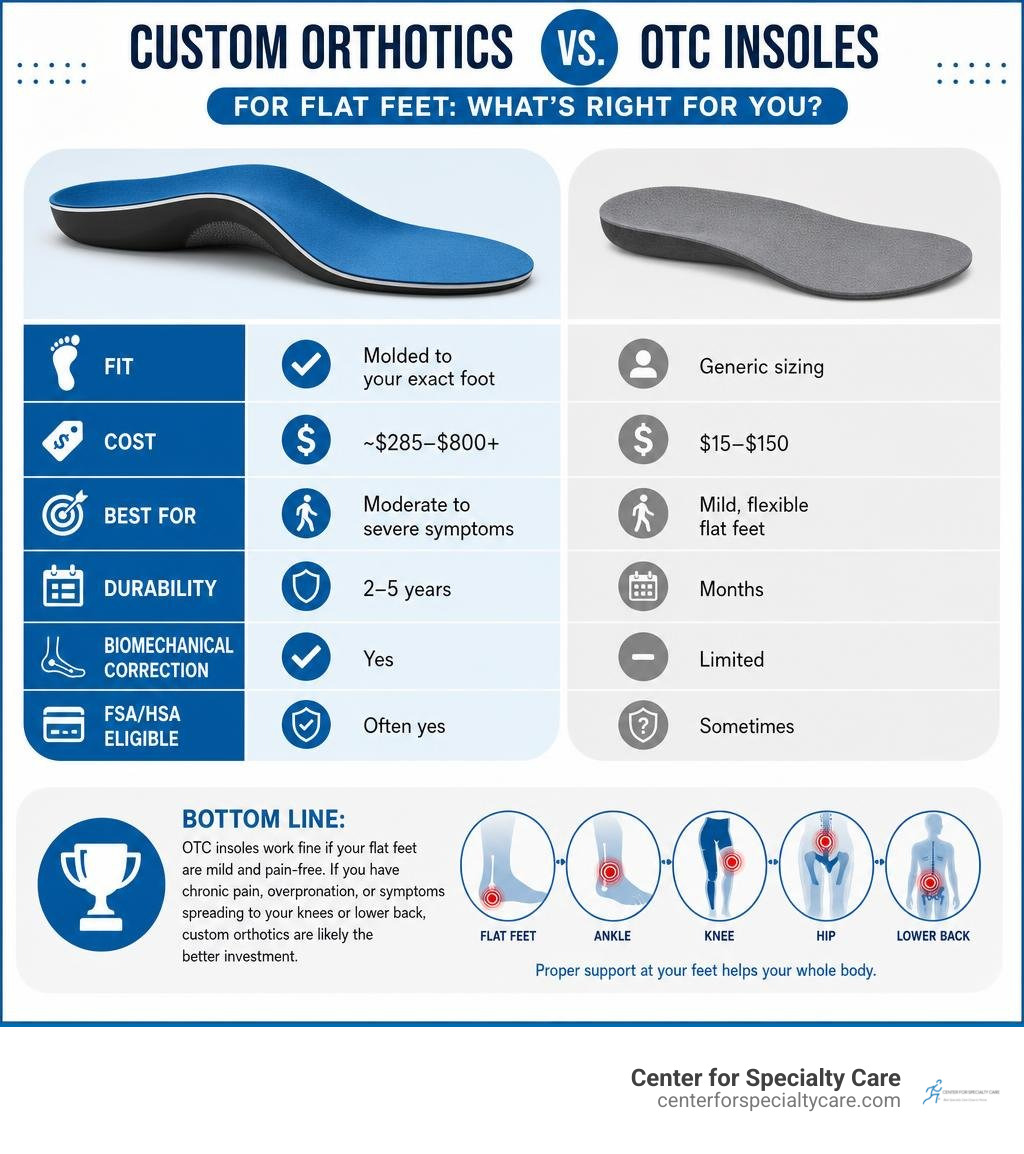
Custom orthotics vs. over-the-counter insoles — at a glance:
| Factor | Custom Orthotics | OTC Insoles |
|---|---|---|
| Fit | Molded to your exact foot | Generic sizing |
| Cost | ~$285–$800+ | $15–$150 |
| Best for | Moderate to severe symptoms | Mild, flexible flat feet |
| Durability | 2–5 years | Months |
| Biomechanical correction | Yes | Limited |
| FSA/HSA eligible | Often yes | Sometimes |
Bottom line: OTC insoles work fine if your flat feet are mild and pain-free. If you have chronic pain, overpronation, or symptoms spreading to your knees or lower back, custom orthotics are likely the better investment.
About 25% of adults have fallen arches — and many of them spend years cycling through drugstore insoles that feel good for a week, then go flat. The problem isn’t willpower or the wrong brand. It’s that a mass-produced insole simply cannot account for your foot’s specific shape, mechanics, or weight distribution.
Flat feet don’t just cause foot pain. They can trigger a chain reaction up through your ankles, knees, hips, and lower back — all because your arch isn’t absorbing ground impact the way it should. Understanding the difference between a quick cushioning fix and a structurally corrective device is the first step toward lasting relief.
I’m Dr. Corey Welchlin, a board-certified orthopedic surgeon with over 30 years of experience treating musculoskeletal conditions — including patients whose knee and back pain traced directly back to unaddressed flat feet managed with inadequate support. In this guide, I’ll walk you through everything you need to know about custom orthotics for flat feet so you can make a confident, informed decision.
Similar topics to custom orthotics for flat feet:
Understanding Flat Feet and Arch Mechanics
When we talk about flat feet (medically known as pes planus or fallen arches), we are describing a physical condition where the inner arch of the foot is flattened, allowing the entire sole of the foot to touch—or nearly touch—the ground when standing.

Every time your foot strikes the ground, it acts as a primary shock absorber. In a foot with healthy alignment, the arch flattens slightly to absorb force and then flexes back up to push off efficiently. When you have flat feet, that natural spring mechanism is compromised. Instead of dispersing impact, force radiates directly through the foot bones and upward along the kinetic chain. This strain transfers to the ankles, rotates the lower leg internally, and alters how your knees, hips, and lower spine absorb shock.
Flexible vs. Rigid Flat Feet
Not all flat feet are identical. In our practice across Minnesota and Iowa, we generally categorize flat feet into two primary categories: flexible and rigid.
- Flexible Flat Feet: This is by far the most common type. If you sit on a chair and lift your foot off the floor, you might notice a visible, defined arch. However, the moment you stand up and bear weight, that arch collapses under your body weight. Flexible flat feet often develop during childhood or early adulthood and may remain relatively painless for years until cumulative strain catches up with you.
- Rigid Flat Feet: A rigid flat foot lacks an arch regardless of whether you are standing, sitting, or resting unweighted. The foot structure remains completely flat under all circumstances due to underlying bone fusion, structural alignment issues, or progressive wear on supporting tendons.
A crucial factor in progressive flat feet is the health of the posterior tibial tendon. This key tendon runs down the inside of the ankle and acts as the primary structure holding up your arch. When it becomes inflamed or stretched out—a condition known as posterior tibial tendon dysfunction (PTTD)—the foot gradually loses mobility and structural arch height. For more details on maintaining proper foot structure, read The Complete Guide to Flat Foot Arch Support.
How Custom Orthotics for Flat Feet Address Biomechanics
To understand how custom orthotics for flat feet help, imagine your foot as the foundation of a house. If the foundation tilts inward, every door frame and wall above it starts to lean.
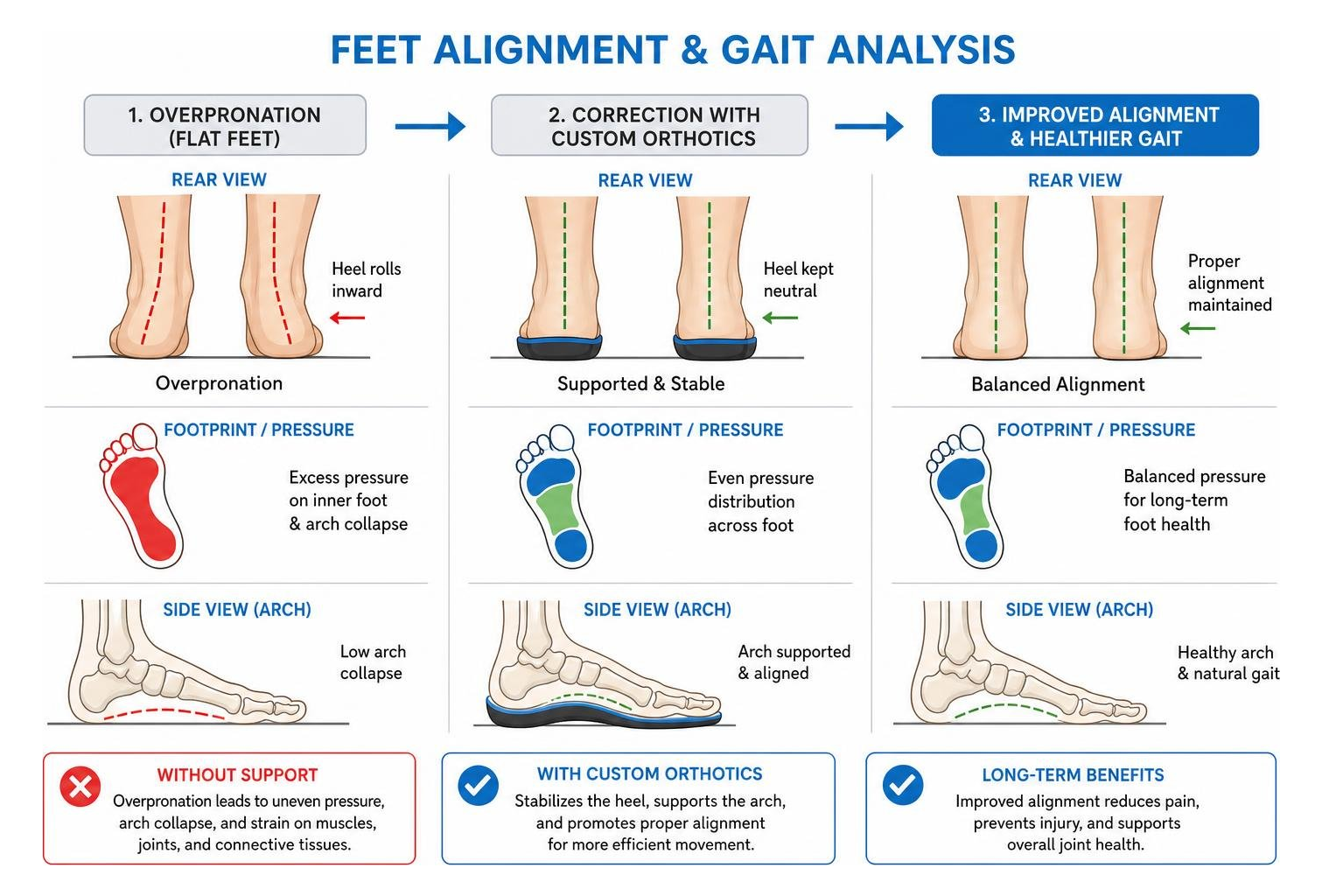
When you walk with flat feet, your subtalar joint (located just below the ankle) rolls inward excessively. This movement is called overpronation. Overpronation forces the tibia (shinbone) to rotate inward, which pulls on the knee joint, displaces pelvic alignment, and strains lower back muscles.
Custom medical orthotics don’t just shove a soft pad under your arch. Instead, they are precisely engineered devices designed to control subtalar joint motion, halt excessive internal tibia rotation, and restore proper shock absorption during everyday walking or high-impact activities. Discover how personalized care plays a pivotal role in overall alignment with our guide on Flat Feet Treatment.
Custom Orthotics for Flat Feet vs. Over-the-Counter Insoles
Walk into any local drugstore or department store, and you’ll find shelves stocked with brightly colored insoles promising instant relief. While over-the-counter (OTC) options have their place, understanding their limitations is vital before spending your hard-earned money.
OTC insoles are mass-produced based on shoe size averages. They assume every shoe size 10 has the same arch length, heel width, and pronation pattern. Custom orthotics, by contrast, are constructed using precise 3D digital scanning or detailed physical foam impressions taken of your unique feet.
| Feature | Custom Orthotics | Over-the-Counter (OTC) Insoles |
|---|---|---|
| Manufacturing Process | 3D foot scan or physical foam impression | Mass-produced factory molds |
| Biomechanical Control | Tailored medial posting & heel stabilization | Generic cushioning or flex support |
| Material Quality | Semi-rigid medical polymers & high-rebound foam | Soft gel, thin memory foam, or soft plastic |
| Durability | 2 to 5 years (shells often last longer) | 3 to 6 months before collapsing |
| Target Conditions | Severe overpronation, PTTD, chronic joint pain | Mild foot fatigue, general daily cushioning |
| Cost | Higher upfront investment ($285–$800+) | Low upfront cost ($15–$150) |
When to Choose Custom Orthotics Over OTC Options
If you have mild, flexible flat feet and only experience brief foot fatigue after standing for eight hours on concrete, a structured OTC insert might give you enough temporary comfort.
However, we strongly recommend choosing custom orthotics when:
- You experience chronic foot, ankle, knee, or lower back pain during daily activities.
- You have structural alignment deformities or rigid flat feet.
- You demonstrate severe overpronation that causes uneven shoe wear patterns.
- Generic insoles collapse within a few weeks due to lack of structural rebound support.
- You are managing complex conditions like plantar fasciitis, bunions, or posterior tibial tendonitis.
If you are exploring off-the-shelf options first to gauge your needs, take a look at our complete Over-the-Counter Insoles Guide.
Cost Breakdown and Long-Term Value
The upfront cost of custom orthotics often makes patients hesitate. Nationally, prescription custom orthotics range from $400 to $800+ when obtained through clinical evaluations, though direct-to-consumer digital scanning or impression methods can range between $245 and $495.
While $15 to $50 drugstore insoles sound tempting, consider the math: if you buy three or four pairs of generic insoles a year because the soft foam collapses under body weight, you can easily spend hundreds of dollars over a three-year period without ever addressing the root cause of your pain. A high-quality pair of custom orthotics lasts between 2 and 5 years, providing continuous, targeted support.
Furthermore, medical-grade custom orthotics are typically eligible for Flexible Spending Account (FSA) and Health Savings Account (HSA) coverage, allowing you to use pre-tax dollars. Learn more about budgeting for foot care in our detailed breakdown of Custom Orthotics Cost.
Key Features of Effective Custom Orthotics
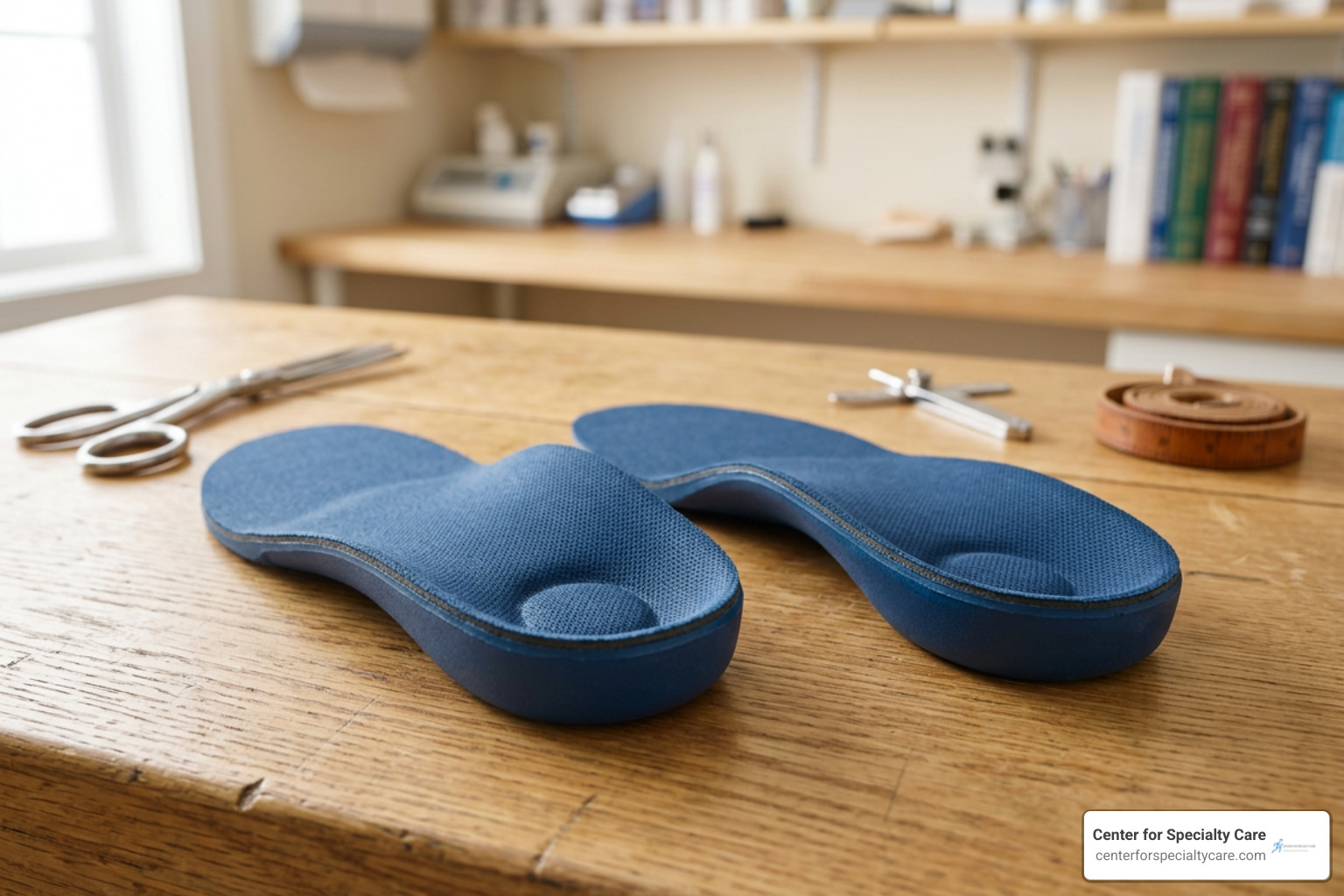
A prescription orthotic isn’t just a molded piece of plastic. It is a carefully built orthopedic tool with specific anatomical features working together to stabilize your gait.
Deep Heel Cups and Arch Support Alignment
For flat feet, two design elements are absolutely essential:
- Deep Heel Cup (typically 12mm or deeper): The heel cup cradles the fat pad under your calcaneus (heel bone), maintaining natural cushioning directly beneath the joint. More importantly, it holds the rearfoot stable, preventing the heel from rolling inward during initial heel strike.
- Medial Posting and Arch Alignment: Rather than pushing aggressively upward into the arch—which can cause sharp pressure pain—a properly designed custom orthotic features a semi-rigid arch structure combined with medial posting. This posted heel angle corrects the tilt of the rearfoot, distributing body weight evenly across the midfoot and forefoot.
Explore how proper arch mechanics protect your joints in our Arch Support Alignment Guide.
The Role of Rigidity and Material Selection
One of the biggest mistakes people make when choosing orthotics for flat feet is selecting overly soft materials. Soft gel or soft memory foam insoles feel wonderful for the first five minutes in the shoe store. However, under the force of your full body weight, soft gel simply squishes out of the way, providing zero structural support for a collapsing arch.
Effective custom orthotics for flat feet utilize semi-rigid shells made from durable thermoplastic polymers (like TPU) or carbon fiber composite bases, topped with shock-absorbing EVA foam or specialized cushioning layers. The semi-rigid shell gives the foot structural resistance to stop overpronation, while the top foam layer cushions sensitive pressure points.
Debunking Common Myths and Managing Related Conditions
Flat feet rarely exist in isolation. Because your feet are the base of your kinetic chain, fallen arches frequently create secondary symptoms throughout the body.
Relief for Plantar Fasciitis, Overpronation, and Knee Pain
When your arch flattens uncontrollably, the long band of tissue running along the bottom of your foot—the plantar fascia—is stretched beyond its normal limit. Over time, this repetitive stretching causes micro-tears and painful inflammation near the heel, leading to plantar fasciitis.
By stabilizing overpronation and limiting excessive arch collapse, custom orthotics relieve tension on the plantar fascia, prevent shin splints, reduce internal rotation forces on the knee joint, and alleviate secondary strain on lower back muscles. If you are experiencing persistent lower limb pain, explore our resources on Foot and Ankle Pain.
Common Myths About Custom Orthotics for Flat Feet
Let’s clear up some widespread misconceptions:
- Myth 1: “Orthotics will permanently cure my flat feet.” Fact: Orthotics provide functional alignment while you wear them, holding your arch in a healthy posture to relieve strain. They do not permanently change adult bone structure once you take your shoes off.
- Myth 2: “Soft gel insoles are best for flat foot pain.” Fact: Soft materials collapse under body weight and offer no mechanical control over fallen arches.
- Myth 3: “High arch support should push hard into the middle of your foot.” Fact: Aggressive, overly high arch humps create severe pressure points and intense discomfort. Good orthotics support the arch by stabilizing the rearfoot and heel angle.
- Myth 4: “One orthotic fits every type of shoe.” Fact: Volume matters. An orthotic built for a roomy running shoe will not fit properly into sleek dress footwear.
Read more about dispelling flat foot misbeliefs in our Flat Feet Solutions Guide.
Frequently Asked Questions about Custom Orthotics for Flat Feet
Can custom orthotics permanently fix flat feet?
No. In adults, bone and joint structures are fully developed, meaning orthotics cannot permanently reshape your foot structure or permanently rebuild a non-existent arch. What custom orthotics do provide is complete functional correction while you are wearing them. They hold the foot in proper alignment, stop progressive arch degeneration, and protect your joints from unnecessary wear and tear.
How long do custom orthotics typically last?
A well-crafted pair of custom orthotics generally lasts between 2 and 5 years. The rigid or semi-rigid structural base shell often lasts even longer. Depending on your body weight, daily step count, and activity level, top cushioning covers (like EVA foam) may show normal wear over time and can often be refurbished or recovered by an orthotist without replacing the custom-molded base.
What is the typical adjustment period for new custom orthotics?
Because custom orthotics alter how your feet, ankles, and legs align, your muscles and tendons need time to adapt. We recommend a gradual break-in period over 2 to 4 weeks:
- Days 1–3: Wear your new orthotics for 1 to 2 hours per day during light activity.
- Days 4–7: Increase wear time to 3 to 4 hours per day.
- Week 2: Wear them for half-day increments (4 to 6 hours).
- Weeks 3–4: Transition to full-day continuous wear.
If you feel mild muscle awareness—similar to starting a new workout routine—that is completely normal. However, if you experience sharp or persistent pain, contact your provider for a quick adjustment.
Conclusion
Living with flat feet doesn’t mean accepting persistent foot fatigue, aching knees, or lower back pain as part of daily life. While drugstore insoles might offer temporary relief, true long-term stability comes from understanding your foot mechanics and choosing structural support built specifically for your body.
At Center for Specialty Care, our team provides comprehensive orthopedic and pain management services across our convenient clinic locations in Fairmont, MN, Estherville, IA, Buffalo Center, IA, and St. James, MN. We pride ourselves on quick appointment availability, personalized patient care, and a 100% commitment to helping you live active, pain-free lives through both surgical and conservative non-surgical solutions.
Ready to take the next step toward comfortable walking and standing? Contact us today to schedule your personalized foot evaluation through our dedicated Podiatry Services.