Sore Achilles? Here’s How to Choose Between Ice and Heat for Relief
March 17, 2026
Finding the Best Pain Management in Minnesota Without the Stress
March 19, 2026
Support Your Sole with These Top Arch Inserts
Why Proper Foot Arch Support Matters for Your Overall Health
Foot arch support is essential for maintaining proper body alignment, reducing pain, and preventing injuries throughout your lower body. The arches of your feet act as natural shock absorbers, distributing your body weight evenly and saving up to 17% of your mechanical effort while running. Without adequate support, you may experience:
Common Problems from Poor Arch Support:
- Plantar fasciitis and chronic heel pain
- Knee, hip, and lower back discomfort
- Overpronation or supination issues
- Accelerated foot fatigue during daily activities
- Shin splints and Achilles tendinitis
Who Needs Arch Support:
- People with flat feet (pes planus) who overpronate
- Individuals with high arches (pes cavus) who supinate
- Those spending long hours standing or walking
- Athletes and runners seeking injury prevention
- Anyone experiencing unexplained joint or back pain
Your foot arches develop around age 5 to 6 and continue supporting you throughout life. The stance phase of walking accounts for approximately 60% of your gait cycle, requiring 10° of ankle dorsiflexion and 15° of plantarflexion for normal movement. When your arches lack proper support, this natural biomechanical process breaks down, leading to compensatory problems up the kinetic chain.
Roughly two million patients seek treatment for plantar fasciitis each year—one of the most common conditions linked to inadequate arch support. The plantar fascia, a ligament connecting your heel to your toes, develops small tears from repetitive stress when your arches collapse excessively during weight-bearing activities.
I’m Dr. Corey Welchlin, a board-certified orthopedic surgeon with over three decades of experience treating musculoskeletal conditions in southern Minnesota and northern Iowa. Throughout my career at the Center for Specialty Care, I’ve helped countless patients find relief through proper foot arch support solutions, from conservative orthotic interventions to comprehensive surgical care when needed.
Important foot arch support terms:
The Anatomy and Function of Foot Arches
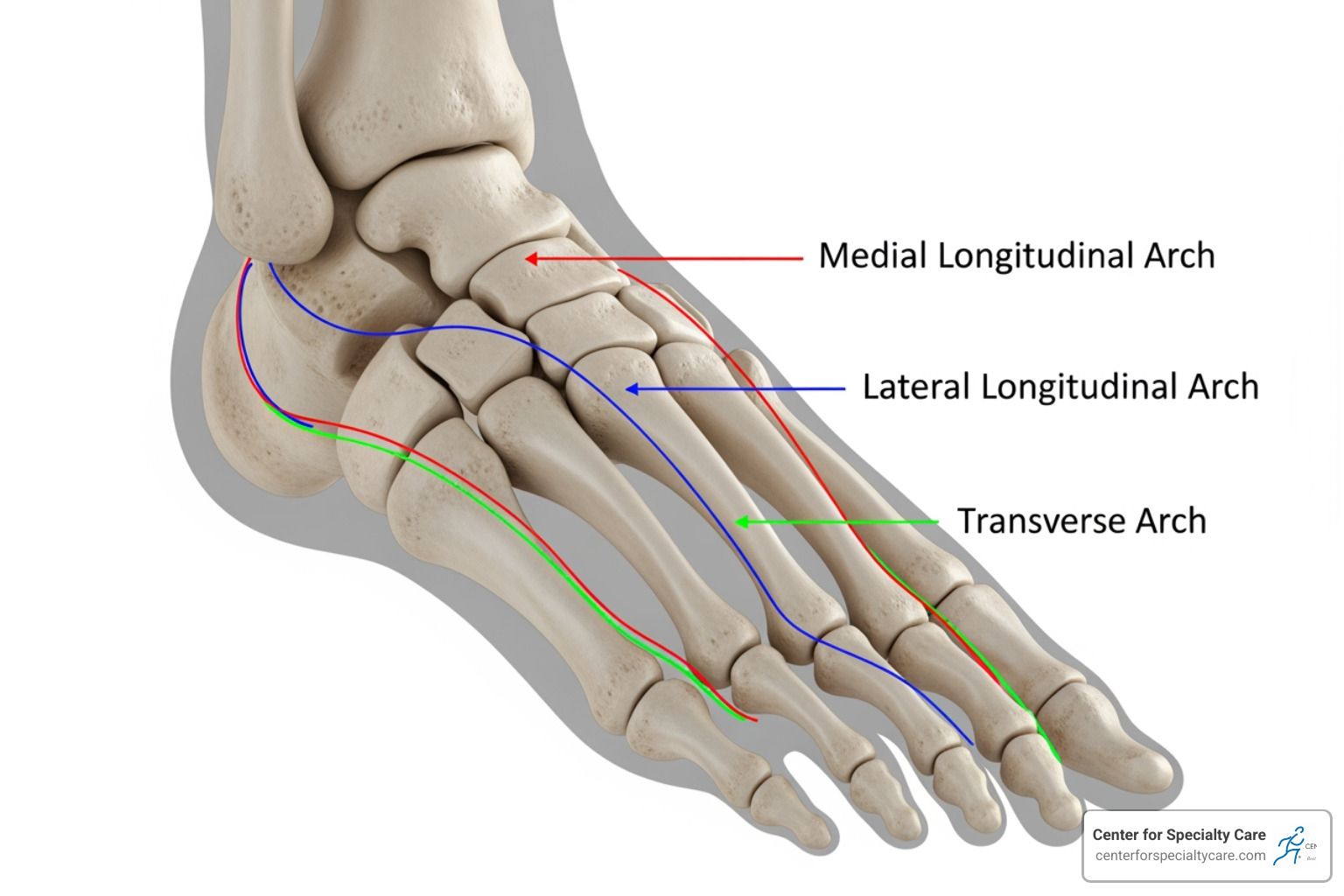
To understand why we need inserts, we first have to look at the incredible engineering of the human foot. Often called a “masterpiece of evolution,” the foot contains 26 bones, 33 joints, and over 100 muscles, tendons, and ligaments. At the heart of this structure are the three primary arches that work together to keep us moving.
The Three Pillars of Your Foot
- Medial Longitudinal Arch: This is the most prominent arch, running along the inside of your foot from the heel to the ball. It is the primary shock absorber and is responsible for that “spring” in your step. You can learn more about the Anatomy of the Medial Longitudinal Arch to see how its bony structure provides a firm foundation.
- Lateral Longitudinal Arch: Running along the outer edge of the foot, this arch is lower and flatter than the medial arch. Its primary job is to provide stability and support weight when you stand.
- Transverse Arch: This arch runs across the midfoot from inside to outside. It provides additional support and helps maintain the foot’s shape under heavy loads.
The Windlass Mechanism and Biometrics
One of the most fascinating aspects of foot function is the windlass mechanism. When you push off the ground, your big toe pulls the plantar fascia tight, which shortens the distance between your heel and the ball of your foot. This action automatically raises the arch, turning your foot into a rigid lever for efficient propulsion.
This mechanism is so efficient that it saves humans about 17% of the mechanical effort required for running. During a normal gait, the stance phase—the time your foot is in contact with the ground—accounts for roughly 60% of the cycle. To walk normally without pain, your body requires about 10° of ankle dorsiflexion (pulling the toes up). If your arches are collapsed or too rigid, your ankle biomechanics can suffer, leading to strain on the fibula and surrounding ligaments.
Identifying Your Arch Type for the Right foot arch support
Before you go shopping for inserts, you need to know what you’re working with. While a professional evaluation at our Fairmont clinic is the most accurate method, you can perform a simple “Wet Test” at home to get a general idea of your foot shape.
The Wet Footprint Test
- Pour a thin layer of water into a shallow pan.
- Wet the sole of your foot thoroughly.
- Step onto a piece of heavy paper or cardboard.
- Step away and look at the impression left behind.
Decoding Your Results:
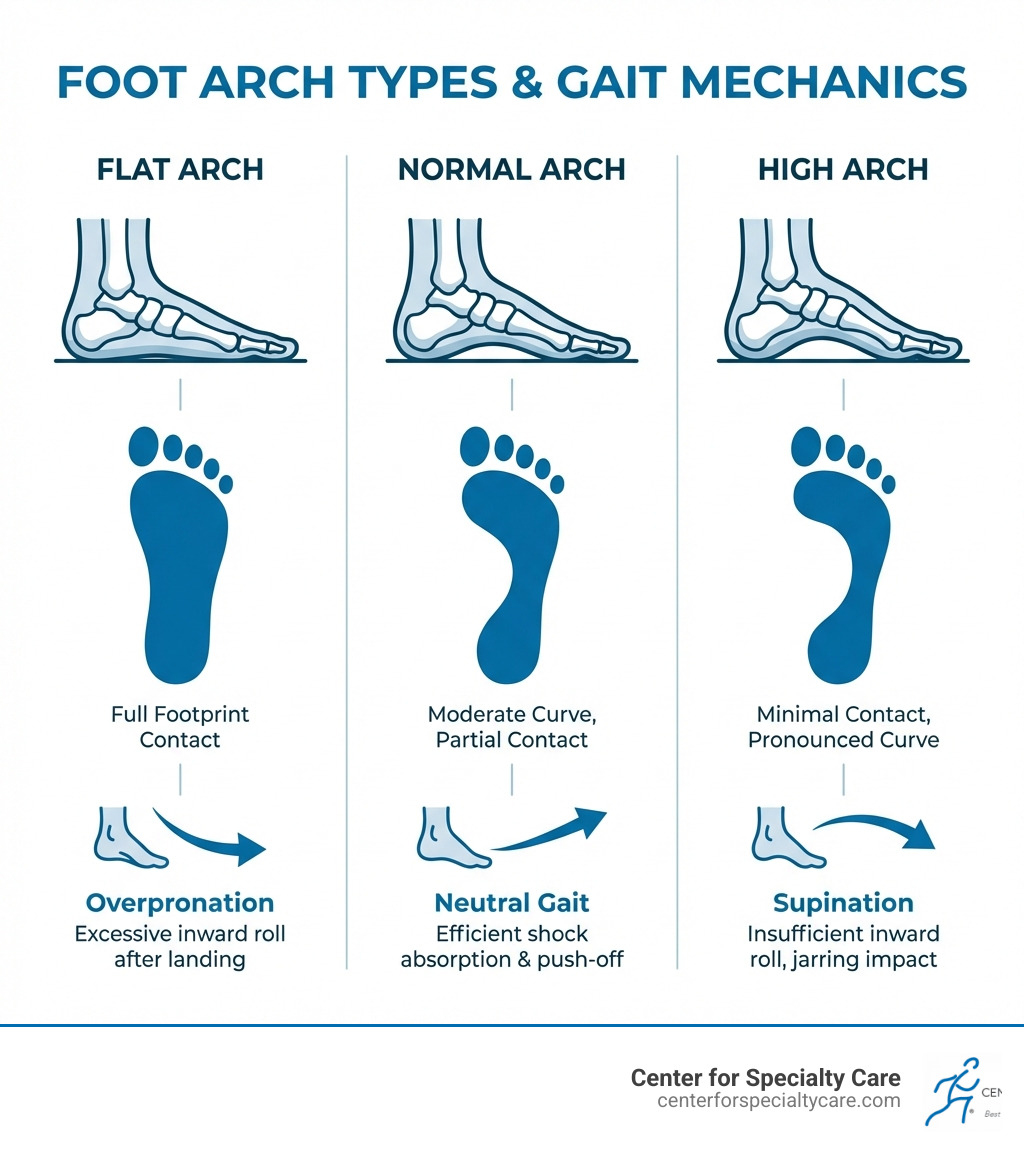
- Flat Arch (Low): If the footprint looks like a complete foot with very little curve on the inside, you likely have flat feet. This often leads to overpronation, where the feet roll excessively inward.
- Normal Arch (Medium): If you see about half of your arch region filled in with a distinct curve, you have a neutral arch.
- High Arch: If you see only the heel and the ball of the foot with a very thin line connecting them (or no line at all), you have high arches. This often leads to supination, where weight is pushed to the outer edges of the feet.
For more detailed help on interpreting these results, you can check out this Guide to Choosing Arch Support Inserts.
Benefits of foot arch support for Flat Feet
For those with pes planus or “fallen arches,” the foot lacks a natural curve to absorb impact. This causes the foot to collapse inward upon contact with the ground, straining the muscles and ligaments.
Proper foot arch support for flat feet provides the structural stability needed to prevent this inward roll. By using motion-control inserts with a firm midsole, we can help realign the foot and reduce the risk of flexible flatfoot complications, such as bunions or shin splints.
Support for High Arches and Neutral Feet
Conversely, pes cavus (high arches) means the foot is too rigid. Instead of rolling inward, the foot stays on the outer edge, which fails to absorb shock properly. This puts immense pressure on the heel and the ball of the foot.
For high arches, the goal of an insert is cushioning and pressure relief. These inserts fill the gap between the floor and the arch, redistributing weight across a larger surface area and providing the impact protection that the natural arch cannot.
Choosing the Best Inserts: Orthotics vs. Cushioning
Not all inserts are created equal. Depending on your activity level and pain points, you might need something rigid or something soft.
| Feature | Rigid Orthotics | Arch Cushions | Cushion Insoles | Sports Insoles |
|---|---|---|---|---|
| Primary Goal | Structural Correction | Targeted Arch Support | Overall Comfort | Impact Absorption |
| Material | Hard Plastic/Carbon Fiber | Soft Foam/Gel | Memory Foam/PU | High-Density Foam |
| Best For | Severe Overpronation | Mild Arch Pain | Long Hours Standing | Running/High Impact |
| Flexibility | Low | High | Very High | Moderate |
When choosing an insert, look for features like moisture-wicking covers to prevent odor and deep heel cups to maximize natural shock absorption. Proper heel stabilization is especially important for managing heel spurs, as it keeps the fatty pad of the heel centered under the bone.
When to Upgrade Your foot arch support
Inserts don’t last forever. Even the highest-quality over-the-counter (OTC) options lose their structural integrity over time. A good rule of thumb is the 350-500 mile rule: just like running shoes, most insoles should be replaced every 6 months if used daily.
Signs you need a replacement include:
- Visible compression or cracking in the material.
- Uneven wear patterns on the bottom of the insert.
- A return of chronic foot fatigue or morning heel pain.
- New aches in the top of the foot, which could indicate extensor tendonitis.
Strengthening Your Arches and Preventing Injury
While inserts provide an external “crutch,” strengthening the internal muscles of your foot is the best long-term strategy for foot health. We call these the “intrinsic muscles,” and they are vital for maintaining the arch’s height and resilience.
Top Exercises for Arch Health
- Towel Scrunches: Sit with your feet flat on the floor and a towel spread out in front of you. Use only your toes to scrunch the towel toward you.
- Pencil Pickups: Try to pick up a pencil from the floor using only your toes and drop it into a container. This improves toe dexterity and arch strength.
- Heel Raises: Stand with your feet hip-width apart and slowly rise onto the balls of your feet, then lower back down. This strengthens the calf muscles and the posterior tibialis tendon, which supports the medial arch.
- Arch Lifts (Foot Doming): Keep your toes and heel on the ground, then try to lift the arch of your foot by pulling the ball of your foot toward your heel.
By incorporating these into your routine, you are taking a proactive walk towards healthy feet and reducing your reliance on heavy corrective gear over time.
Frequently Asked Questions about Arch Health
How do I know if my arch support fits correctly?
A proper fit should feel like a “firm hug” under your arch. It should not feel like there is a golf ball in your shoe, nor should it feel like nothing is there. If your toes feel cramped or you develop blisters, the insert may be too thick or the wrong size for your shoe. Always remove the original factory insole before placing a new arch support insert to avoid crowding the foot.
Can inadequate arch support cause back or knee pain?
Absolutely. Your feet are the foundation of your entire body. When the arches collapse (overpronation), it causes the lower leg to rotate internally. This rotation puts stress on the knee joint, which then affects the alignment of the hip and the tilt of the pelvis. Many patients find that their chronic lower back pain disappears once they address their foot arch support issues.
How long does it take to break in new orthotics?
Most people require a transition period. Start by wearing your new inserts for only 1-2 hours on the first day, and gradually increase the time by one hour each day. It typically takes two to three weeks for your muscles and tendons to adapt to the new alignment. If you still experience sharp pain after three weeks, you should consult a professional.
Conclusion
Your feet carry you through every mile of your life, yet they are often the most neglected part of the body until pain sets in. Whether you are dealing with flat feet in Fairmont or high arches in Estherville, finding the right foot arch support is a critical step toward a pain-free life.
At the Center for Specialty Care, we pride ourselves on 100% patient satisfaction and personalized care. We offer quick appointment availability at our locations in Fairmont, MN, and throughout northern Iowa to help you diagnose your arch type and find the perfect solution—whether that’s a high-quality OTC insert or a custom-molded medical orthotic.
Don’t let foot pain hold you back from the activities you love. Schedule a consultation for professional podiatry support today and let us help you support your sole.