
Rhomboid Pain Relief Exercises That Actually Work
June 3, 2026
Say Goodbye to the Ache with These Simple Scapula Exercises
June 5, 2026
Best Ways to Treat a Painful Achilles Tendon
Why the Right Achilles Tendinitis Treatments Matter for Your Recovery
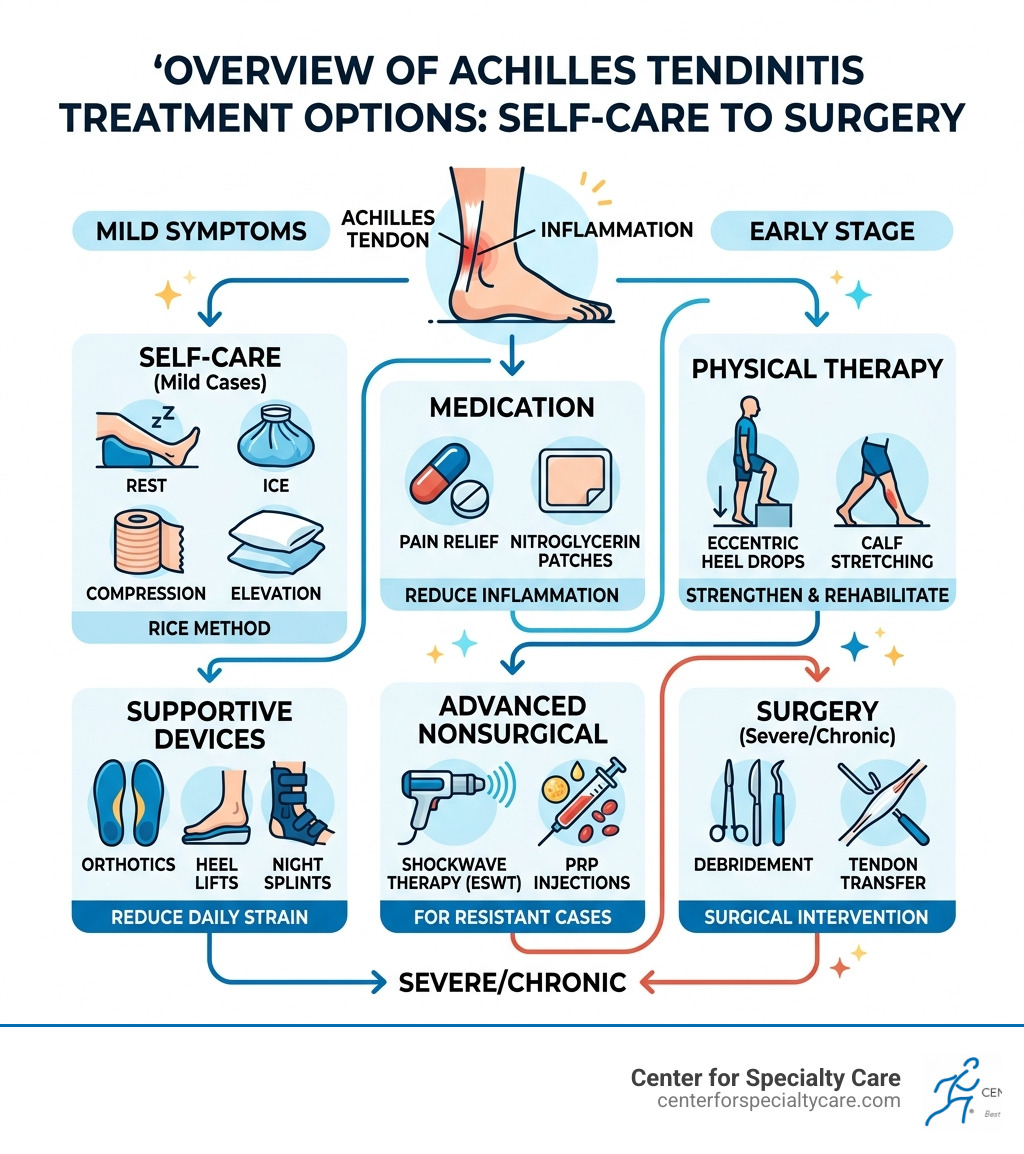
Achilles tendinitis treatments range from simple at-home remedies to advanced medical procedures, depending on how severe your symptoms are. Here is a quick overview of your main options:
| Treatment Type | Examples | Best For |
|---|---|---|
| Self-care | Rest, ice, compression, elevation (RICE) | Mild, early-stage pain |
| Medication | Ibuprofen, naproxen, nitroglycerin patches | Reducing pain and inflammation |
| Physical therapy | Eccentric heel drops, calf stretching | Strengthening and rehabilitation |
| Supportive devices | Orthotics, heel lifts, night splints | Reducing tendon strain daily |
| Advanced nonsurgical | Shockwave therapy (ESWT), PRP injections | Cases that don’t respond to basics |
| Surgery | Debridement, tendon transfer | Severe or chronic cases only |
About 1 in 4 athletes will experience an Achilles tendon injury in their lifetime. The pain — usually felt in the back of the heel or lower leg — can sideline you from the activities you love. The good news? Most cases improve without surgery when treated early and correctly.
The Achilles tendon is the largest tendon in your body. It connects your calf muscles to your heel bone and absorbs tremendous force every time you walk, run, or jump. When it becomes overloaded or inflamed, even everyday movement can become difficult.
I’m Dr. Corey Welchlin, a board-certified orthopedic surgeon with over 30 years of experience treating musculoskeletal conditions — including the full spectrum of achilles tendinitis treatments — at the Center for Specialty Care in Fairmont, Minnesota. In this guide, I’ll walk you through every proven option so you can make an informed decision about your care.
Achilles tendinitis treatments terms to learn:
Understanding Achilles Tendinitis Types and Symptoms
Before we dive into the “how” of treatment, we need to understand the “what.” Achilles tendinitis isn’t a one-size-fits-all diagnosis. It generally falls into two categories based on where the tendon is damaged.
Noninsertional Achilles Tendinitis
This type involves the middle portion of the tendon. The fibers in the center of the tendon begin to break down, thicken, and swell. This version is more common in younger, active individuals and runners. You’ll often feel the pain a few inches above your heel bone. Interestingly, this area (about 2 to 6 cm above the insertion) is known as a “watershed zone” because it has a lower blood supply, making it more prone to injury and slower to heal.
Insertional Achilles Tendinitis
This type affects the lower portion of the tendon, right where it attaches (inserts) to your heel bone. Unlike the noninsertional type, this can happen to anyone, even people who aren’t particularly active. Over time, the body may respond to the stress by creating extra bone, known as bone spurs or Haglund’s deformity.
Common Symptoms to Watch For
If you’re wondering if that “twinge” in your heel is something more serious, look for these classic signs:
- Morning Stiffness: That “walking on glass” feeling when you take your first steps out of bed.
- Heel Pain: A dull ache in the back of the leg or above the heel after running or other exercise.
- Severe Pain: Episodes of more severe pain after prolonged running, stair climbing, or sprinting.
- Swelling: A “bump” or thickening on the tendon that stays there all day and may get worse with activity.
- Reduced Range of Motion: Difficulty flexing your foot upward.
For a deeper dive into the clinical mechanics, you can review this Clinical overview of Achilles Tendinopathy.
First-Line Achilles Tendinitis Treatments: Self-Care and Medication
When pain first strikes, your body is screaming for a timeout. Most cases of Achilles tendinitis respond well to conservative care if you start immediately.
The RICE Method: Your First Line of Defense
We always recommend starting with the basics. RICE stands for:
- Rest: This is the hardest part for our athletes in Fairmont and Estherville. You don’t necessarily need to sit on the couch all day, but you must stop the activity that caused the pain. Switch to low-impact exercises like swimming or cycling while you heal.
- Ice: Apply ice to the most painful area for 15 to 20 minutes several times a day. Pro tip: Freeze a foam cup full of water and peel back the edges to create a convenient ice massager.
- Compression: Use an elastic bandage or athletic wrap to help minimize swelling and support the tendon.
- Elevation: Keep your foot raised above the level of your heart, especially at night, to help gravity pull fluid away from the inflamed area.
Medication and Pain Management
Over-the-counter nonsteroidal anti-inflammatory drugs (NSAIDs) like ibuprofen (Advil, Motrin) or naproxen (Aleve) can significantly reduce pain and swelling. However, we caution patients not to rely on these for more than a month without medical supervision, as they can have side effects on the stomach and kidneys.
One of the more unique achilles tendinitis treatments involves nitroglycerin patches. While usually used for heart conditions, clinical studies show that applying these patches daily for 2 to 3 months can improve blood flow to the tendon, significantly reducing pain and aiding the healing of chronic tendon damage.
For more on these initial steps, see the Self-care guidelines from Mayo Clinic.
Physical Therapy and Supportive Devices for Recovery
If the pain persists after a week of RICE, it’s time to get a little more proactive. Physical therapy is often the “magic bullet” for tendon injuries because it addresses the underlying cause: weakness and lack of flexibility.
Supportive Devices
We often use various “tools of the trade” to take the load off your Achilles while you go about your day.
| Device | How it Helps | Best For |
|---|---|---|
| Heel Lifts | Small silicone inserts that raise the heel slightly. | Reducing tension on the tendon during walking. |
| Night Splints | A brace worn during sleep to keep the foot flexed. | Preventing morning stiffness and stretching the calf. |
| Orthotics | Custom or over-the-counter shoe inserts. | Correcting flat feet or high arches that strain the tendon. |
| Walking Boots | Removable boots that immobilize the ankle. | Severe pain or early-stage healing of a partial tear. |
Effective Physical Therapy and Achilles Tendinitis Treatments
The gold standard for physical therapy is eccentric strengthening. Unlike standard calf raises where you focus on pushing up, eccentric exercises focus on the “lowering” phase.
The Alfredson Protocol (Heel Drops):
- Stand on the edge of a step with your heels hanging off.
- Use your “good” leg to lift your weight up onto your toes.
- Shift your weight to the “injured” leg and slowly lower your heel below the level of the step.
- Repeat this 15 times, three times a day.
Studies show that consistent eccentric stretching can achieve a 40% reduction in pain for those with chronic tendinopathy. We also utilize “Heavy Slow Resistance” training, which involves slower, weighted movements to help the tendon fibers realign and strengthen.
For a professional diagnosis and a tailored plan, check out Achilles Tendinitis Diagnosis and Treatment.
Advanced Nonsurgical Achilles Tendinitis Treatments
What happens when rest and PT aren’t enough? At the Center for Specialty Care, we offer several advanced, minimally invasive achilles tendinitis treatments that bridge the gap between physical therapy and surgery.
Extracorporeal Shockwave Therapy (ESWT)
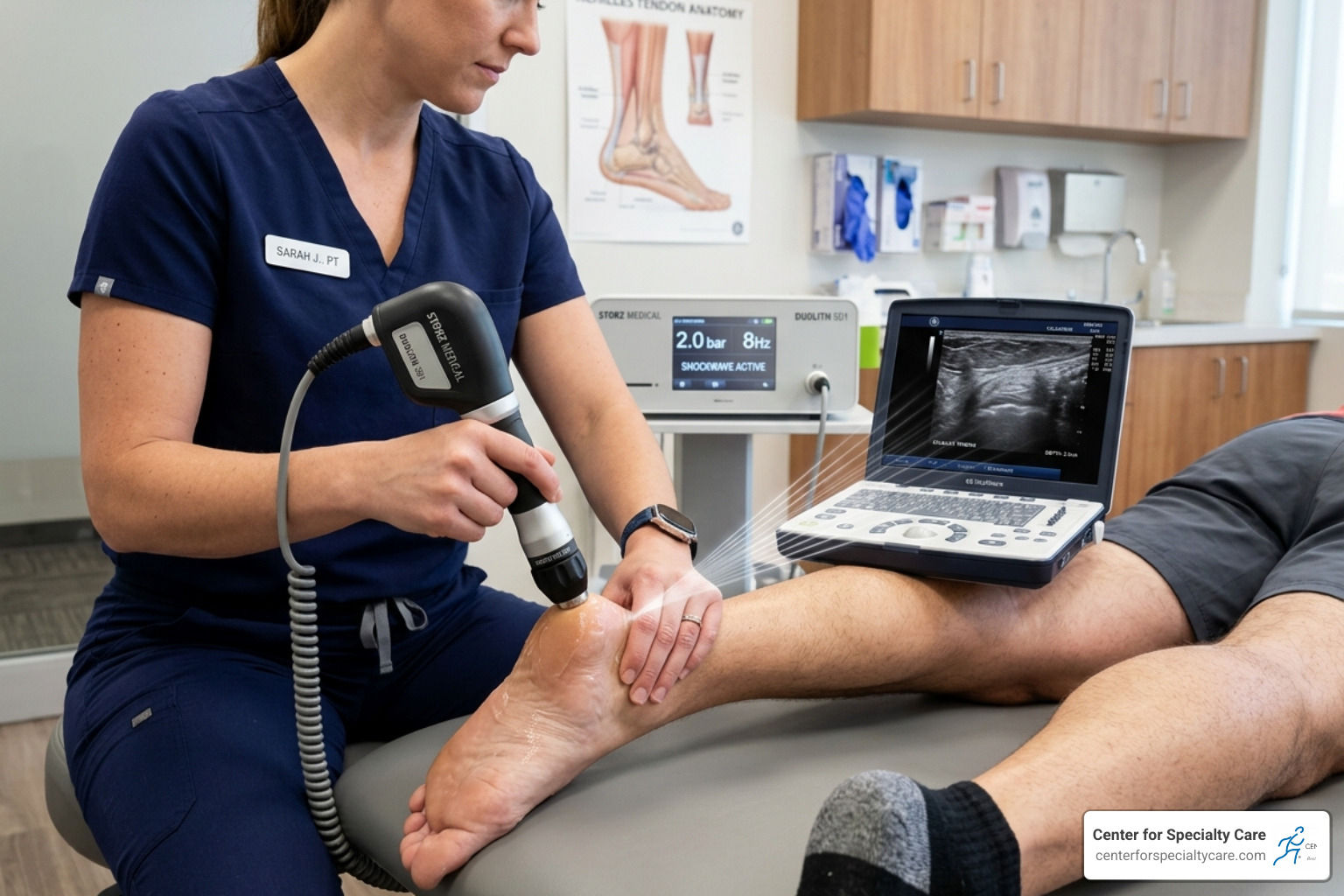
ESWT uses high-energy sound waves to stimulate healing in the tendon tissue. It’s non-invasive and usually performed in our office. Statistics show that ESWT reduces pain by 60% and achieves an 80% patient satisfaction rate. It’s an excellent option for those who have struggled with pain for more than six months.
The TenJet Procedure and Tendon Scraping
For chronic cases where scar tissue has built up, we may use ultrasound-guided tenotomy (often called TenJet). This procedure uses a high-pressure stream of saline to precisely remove damaged tendon tissue without harming the healthy parts.
Similarly, tendon scraping involves using a small needle or instrument under ultrasound guidance to disconnect abnormal nerves and blood vessels that have grown into the damaged tendon. This can provide rapid pain relief, often allowing patients to return to light activity within a week.
Innovative Nonsurgical Achilles Tendinitis Treatments
We are also leaders in regenerative medicine in the Minnesota and Iowa regions. This includes:
- Platelet-Rich Plasma (PRP) Injections: We draw a small amount of your own blood, spin it in a centrifuge to concentrate the healing platelets, and inject it directly into the tendon.
- Stem Cell Therapy: Using adult stem cells (often from bone marrow, known as BMAC), we can help “jumpstart” the body’s natural repair mechanisms. 92% of patients with certain Achilles injuries augmented with BMAC returned to sports in about 6 months.
When is Surgery Necessary for Achilles Tendon Pain?
We generally only consider surgery if you have tried conservative achilles tendinitis treatments for at least six months without success. Surgery is necessary for about 10% to 30% of patients who fail conservative therapy.
Common Surgical Options
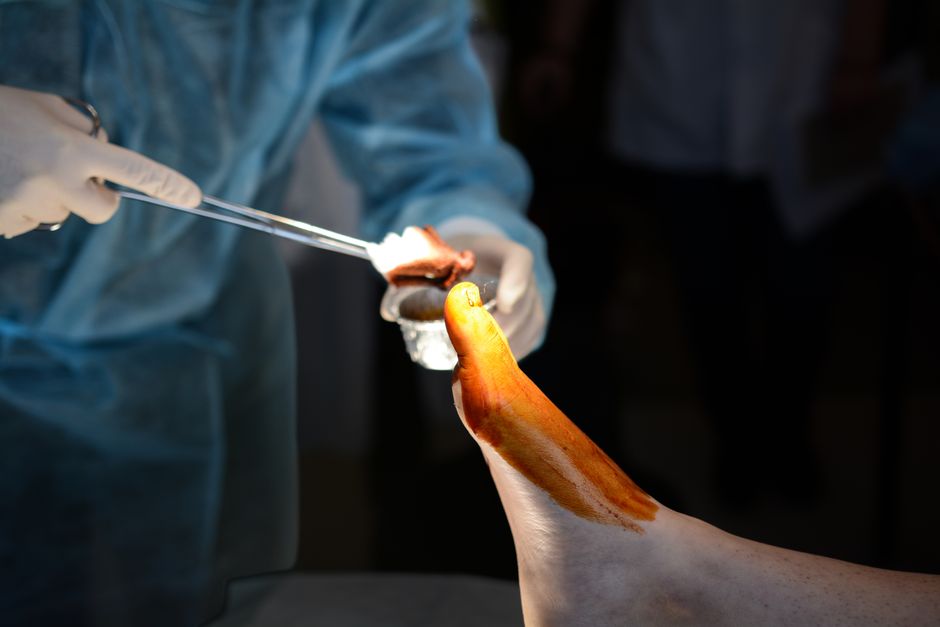
- Debridement: This is the most common procedure. We remove the damaged part of the tendon and any bone spurs. If more than 50% of the tendon is removed, we may perform a tendon transfer.
- Tendon Transfer: To strengthen the damaged Achilles, we move the tendon that helps the big toe point down to the heel bone. Don’t worry—your big toe will still move!
- Gastrocnemius Recession: If your calf muscles are chronically tight, we can surgically lengthen them. This reduces the “pull” on the Achilles tendon and is often very successful for insertional tendinitis.
- Minimally Invasive Surgery: We use smaller incisions to reduce recovery time and the risk of infection.
Surgical success rates for insertional Achilles tendinopathy exceed 80%, and combining debridement with bone resection can push success rates over 95%.
You can learn more about these Surgical options at Cleveland Clinic.
Frequently Asked Questions about Achilles Tendinitis
How long does it take for Achilles tendinitis to heal?
Tendon tissue has a notoriously poor blood supply, which means it heals slowly.
- Mild cases: 2 to 3 weeks with RICE and activity modification.
- Chronic cases: 3 to 6 months of dedicated physical therapy.
- Post-Surgery: Full recovery can take 9 to 12 months.
Can I walk with Achilles tendinitis?
Yes, but you shouldn’t “push through” sharp pain. If walking causes a limp or significant pain, you may need a walking boot or heel lifts for a few weeks. We recommend low-impact walking on flat surfaces—avoid hills or uneven terrain in our local parks until you are further along in your recovery.
What happens if Achilles tendinitis is left untreated?
Ignoring the pain is a recipe for disaster. Untreated tendinitis can lead to tendinosis, where the tendon becomes permanently thickened and weak. Even worse, the weakened fibers can eventually snap, resulting in a total Achilles tendon rupture, which almost always requires immediate surgery and a very long recovery.
Conclusion
At the Center for Specialty Care, we know that every step matters. Whether you’re a high school athlete in Fairmont or a “weekend warrior” in Estherville, our goal is to provide personalized care that gets you back on your feet quickly. We take pride in our quick appointment availability and our commitment to 100% patient satisfaction.
If you’re struggling with heel pain, don’t wait for it to become a rupture. From custom orthotics and physical therapy to the latest in regenerative medicine and minimally invasive surgery, we offer the most comprehensive achilles tendinitis treatments in Southern Minnesota and Northern Iowa.
Ready to take the first step toward pain-free movement? Request an appointment today and let’s get you back in the game.