
Untying the Knot: Relieving Neck Pain from Your Shoulder Blade
August 22, 2025
Decoding Neck Lumps: Why You Might Have a Knot on the Back of Your Neck
August 26, 2025
Shoulder Popping No Pain: Harmless 2025 Guide
Understanding Your Shoulder’s Sound Effects
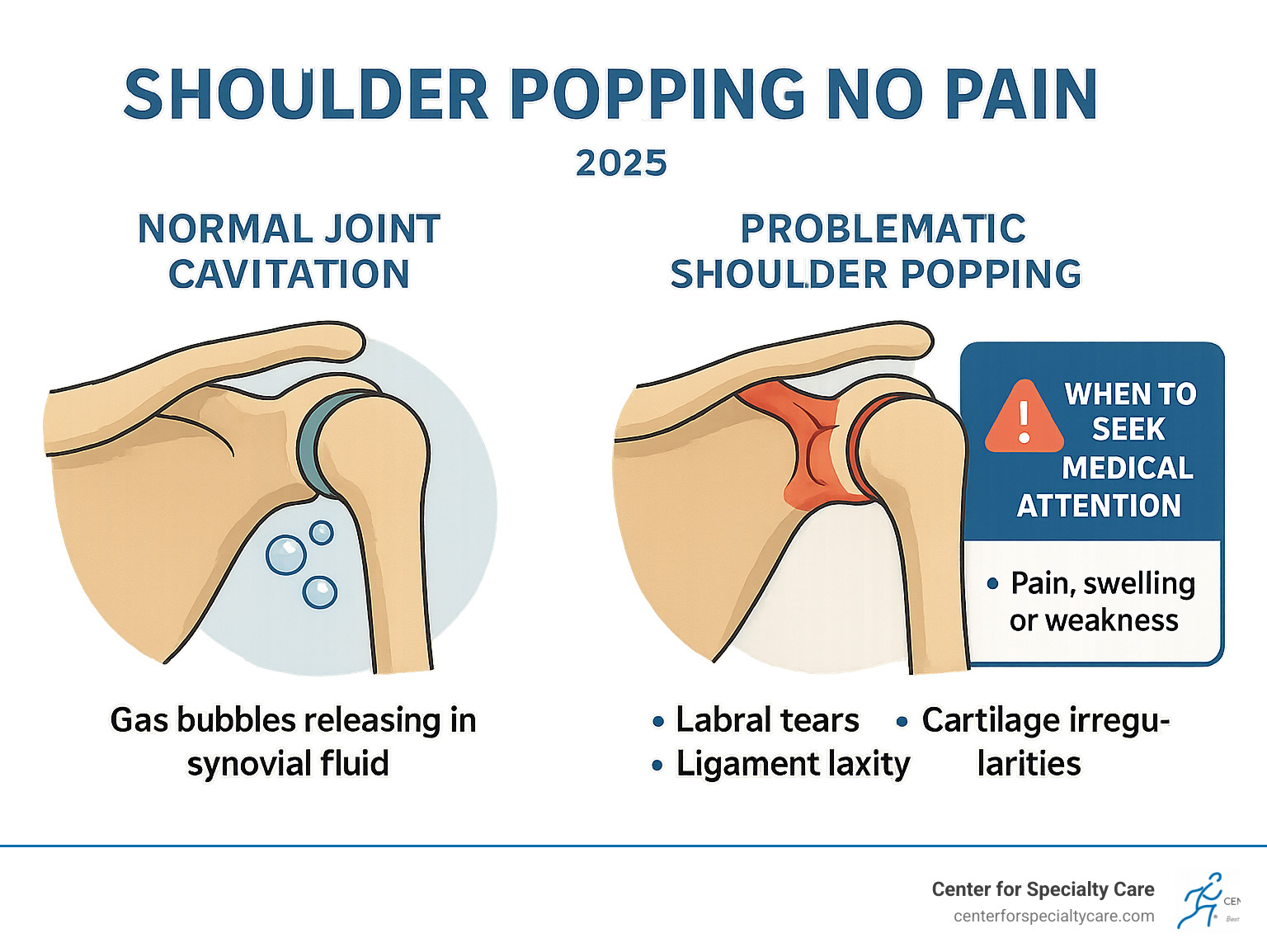
Shoulder popping no pain is one of the most common joint sounds people experience, and the good news is that it’s usually completely harmless. Most painless shoulder popping comes from normal joint processes like gas bubbles releasing in your synovial fluid or tendons moving over bone structures.
Quick Assessment for Painless Shoulder Sounds:
- Normal and harmless: Joint cavitation (gas bubbles), tendon movement, aging-related changes
- Monitor closely: Persistent new sounds, feeling of instability, reduced range of motion
- See a doctor if: Popping becomes painful, swelling develops, or weakness occurs
- Immediate attention: Sudden onset after injury, visible deformity, or severe pain
From time to time, hearing a cracking or popping sound in your joints is perfectly normal. However, if you notice these sensations on a regular basis, it’s worth investigating the cause. The shoulder joint is incredibly complex, with multiple moving parts that can create various sounds during normal movement.
While shoulder popping no pain is often harmless, it can sometimes indicate underlying joint changes that could contribute to future concerns like arthritis. Understanding when these sounds are normal versus when they might signal a problem can help you make informed decisions about your shoulder health.
I’m Dr. Corey Welchlin, a board-certified orthopedic surgeon with over three decades of experience treating shoulder conditions, including evaluating patients with shoulder popping no pain to determine when intervention is needed. Through my practice at the Center for Specialty Care, I’ve helped countless patients understand their shoulder sounds and develop appropriate treatment plans when necessary.
Understanding the Causes of Shoulder Popping No Pain
Your shoulder is a complex joint that allows for smooth movement. Sometimes, it produces pops, clicks, and snaps. Most of the time, these sounds are harmless and simply a sign that your shoulder is hard at work.
The shoulder joint, technically called the glenohumeral joint, is where your upper arm bone (humerus) meets your shoulder blade in a ball-and-socket design. It’s surrounded by muscles, tendons, ligaments, and bathed in a special lubricating fluid called synovial fluid. This incredible engineering allows you to throw a baseball, give hugs, and reach for that top shelf item you probably should have asked for help getting.
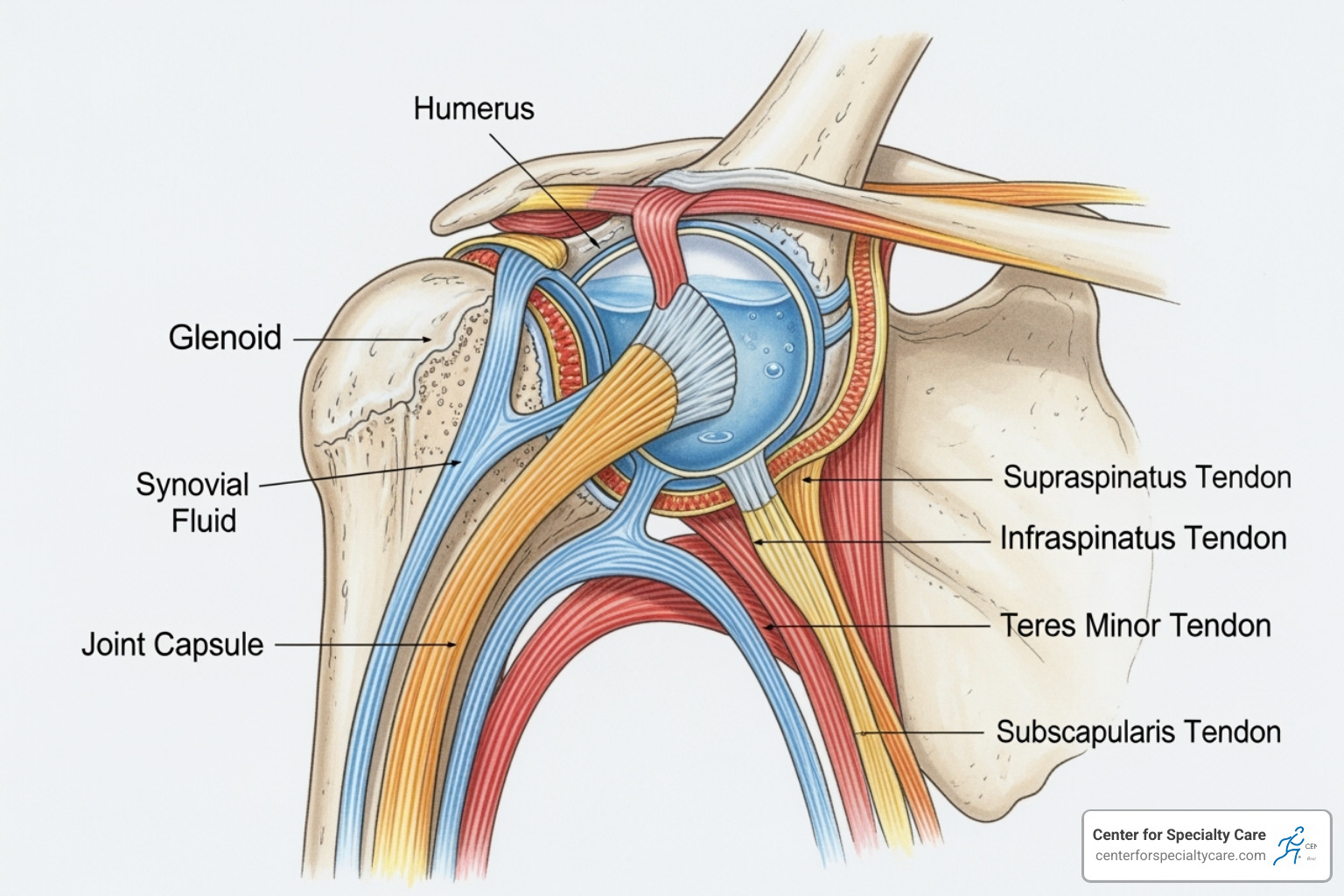
When you hear shoulder popping no pain, it’s usually just the natural result of all these moving parts doing their job. The synovial fluid keeps everything gliding smoothly, while tendons and ligaments guide your movements with precision. To better understand this complex system, you can explore the detailed anatomy of the shoulder joint.
Common Harmless Reasons for Shoulder Popping No Pain
Most painless shoulder sounds fall into a few common categories that are not very concerning.
Joint cavitation is a primary cause of shoulder popping no pain. Your synovial fluid contains dissolved gases like nitrogen, oxygen, and carbon dioxide. When you move your shoulder, these gases can form tiny bubbles that quickly pop. The result is a crack or pop that sounds dramatic but is completely harmless. It’s the same process that occurs when you crack your knuckles.
Tendon and ligament movement creates another common type of painless popping. As your tendons and ligaments glide over bony surfaces during movement, they can briefly catch and then release, causing a pop or click. This is just your body’s soft tissues navigating the complex shoulder joint.
Aging brings its own set of joint sounds. As we get older, our cartilage and synovial fluid naturally change. These age-related changes can make joint sounds more frequent, but they don’t automatically mean something is wrong.
Past injuries or periods of immobility can also contribute to occasional popping sounds. A minor injury that healed years ago might leave subtle changes in how your joint moves. Similarly, if you’ve had your arm in a sling or been inactive, your shoulder might make adjustment sounds as it gets back into its groove. For more detailed information about joint sounds, you can learn about what is crepitus?
Potential Underlying Conditions to Be Aware Of
While most shoulder popping no pain is innocent, sometimes these sounds can be early whispers of changes in your joint. Consider them subtle hints—not necessarily red flags, but gentle nudges to pay attention.
Labral tears or irregularities might sound scary, but small ones can exist without causing immediate problems. The labrum is a rubber-like gasket that helps deepen your shoulder socket for stability. Minor wear and tear can create clicking sounds as your joint moves, even without pain. These changes often develop gradually and may not require immediate treatment.
Shoulder instability or ligament laxity occurs when the ligaments holding your shoulder together become looser than ideal. This can create slightly more movement than usual within the joint, leading to popping sensations as things shift around, even without pain.
Scapulothoracic bursitis involves the small, fluid-filled cushions (bursae) that help your shoulder blade glide smoothly against your rib cage. When these become mildly irritated, they might create popping or grinding sensations during movement, often without significant pain.
Early osteoarthritis might announce itself with joint sounds before pain develops. As cartilage changes texture over time, the surfaces might create grinding or popping sounds when they move against each other. This doesn’t mean you’re headed for immediate problems, but it’s worth keeping on your radar.
Minor tendon issues can also contribute to painless popping. Sometimes tendons develop slight irregularities or mild inflammation that causes them to catch as they move. While significant tendon problems usually cause pain, minor changes might only create sounds.
Having any of these conditions doesn’t mean you’re in trouble or need immediate treatment. Many people live perfectly normal, active lives with these subtle changes. However, understanding them helps you make informed decisions about your shoulder health. For more comprehensive information about shoulder concerns, including those that do involve pain, check out our guide on shoulder joint pain, popping: causes and effective relief. You can also find more on osteochondromas, which are benign bone growths that occasionally contribute to joint sounds.
When to See a Doctor for Your Shoulder
While we’ve established that shoulder popping no pain is often harmless, there are definitely times when these sounds deserve a professional evaluation. Think of it this way: your shoulder is like a trusted friend who’s been quietly working for you all these years. When it starts making new sounds, it might just be saying “hello” – or it could be asking for a little help.

At the Center for Specialty Care, we believe in listening to what your body is telling you. Sometimes that means reassuring you that everything is perfectly normal, and sometimes it means catching small issues before they become bigger problems. Our approach is simple: better safe than sorry, especially when it comes to keeping you active and comfortable.
The truth is, many patients come to see us worried about their shoulder sounds, only to leave with peace of mind and a clear understanding of what’s happening. That consultation alone can be incredibly valuable – there’s nothing quite like having an expert take a look and tell you, “You’re doing just fine.”
If you’re wondering whether you need to see someone about your shoulder, we’re here to help you figure that out. Consider finding the best orthopedic shoulder specialist near me to get the expert evaluation you deserve.
When Shoulder Popping No Pain Warrants a Doctor’s Visit
So when should you pick up the phone and give us a call? Here are the situations where shoulder popping no pain deserves professional attention:
Persistent popping that happens with almost every movement is worth investigating. While the occasional pop is perfectly normal, constant popping might indicate that something mechanical is going on inside your joint. It’s like having a squeaky door hinge – it still works, but it’s telling you something has changed.
New or changing sounds are particularly important to pay attention to. If you suddenly start hearing a different type of sound, or if your usual soft click becomes a louder pop or grinding noise, your shoulder is communicating a change. We always encourage patients to trust their instincts about what feels different.
A feeling of instability is something we never want you to ignore, even without pain. If your shoulder feels like it’s “giving way,” slipping, or just generally loose, that’s your joint’s way of saying it needs some attention. This sensation often comes and goes, but it’s an important warning sign.
Weakness or reduced range of motion can sneak up on you gradually. You might notice you can’t reach as high overhead as you used to, or that your arm feels weaker when lifting things. These changes, even without pain, tell us a lot about what’s happening in your shoulder.
Locking or catching sensations are particularly telling. If your shoulder occasionally gets “stuck” during movement, even if you can work it free easily, this suggests that something inside the joint isn’t moving as smoothly as it should. Think of it like a zipper that catches – it still works, but something is interfering with the smooth motion.
If you have a history of dislocation or any previous shoulder injuries, any new popping sounds deserve extra attention. Previous injuries can sometimes leave behind subtle changes that make your shoulder more prone to problems down the road.
Symptoms That Require Immediate Attention
While we’re focusing on shoulder popping no pain, it’s crucial to recognize when popping comes with more serious warning signs. These situations need immediate medical attention:
Sudden onset after injury is always a red flag. If your shoulder starts popping right after a fall, car accident, or sports injury, don’t wait to see if it gets better on its own. Even if the initial pain fades, the underlying damage might still need attention.
Popping accompanied by pain changes everything. Pain is your body’s alarm system, and when it teams up with new popping sounds, it’s time to listen. Don’t try to tough it out – we’re here to help you feel better.
Swelling, warmth, or redness around your shoulder are signs that your body is fighting something, whether it’s inflammation or infection. These symptoms need prompt evaluation to prevent complications.
Visible deformity is always an emergency. If your shoulder looks different, has an unusual bump, or appears out of place, don’t wait – get help immediately.
The good news is that most shoulder issues, when caught early, respond well to treatment. If you’re dealing with shoulder problems related to an accident, our guide on shoulder pain after car accident: causes and recovery tips can provide helpful insights while you’re seeking care.
We’d rather see you for something that turns out to be harmless than have you wait too long with something that could have been easily treated early on. Your shoulder health is worth that peace of mind.
Treatment and Prevention for a Quiet, Healthy Shoulder
The good news about shoulder popping no pain is that most cases respond well to conservative treatment. At the Center for Specialty Care, we start with the gentlest, most effective methods first, as sometimes only a few careful adjustments are needed.

Prevention is always our favorite treatment. Simple lifestyle changes like good posture and regular movement can make a world of difference in keeping your shoulders quiet and comfortable. Addressing shoulder popping no pain early can save you from bigger problems down the road, as it’s much easier to handle when caught early. Our comprehensive approach at the Center for Specialty Care focuses on creating a personalized plan that fits your lifestyle.
The Role of Physical Therapy and Exercise
Physical therapy is often our go-to recommendation for shoulder popping no pain, especially when shoulder mechanics could use fine-tuning. Our physical therapists can spot issues that might not be obvious to the untrained eye.
Strengthening exercises form the foundation of most shoulder treatment plans. When your rotator cuff and surrounding muscles are strong and balanced, they keep your shoulder joint stable and moving smoothly. This stability helps prevent unnecessary shifting or popping.
Rotator cuff stability is particularly crucial because these four small muscles work together to keep your upper arm bone centered in its socket. When they’re weak or uncoordinated, your shoulder might develop compensatory movement patterns that lead to clicking or popping sounds.
Stretching and flexibility work can address tightness that might be pulling your shoulder out of its ideal alignment. Sometimes a tight chest muscle or stiff upper back can create tension that affects how your shoulder moves. Gentle stretching helps everything glide more smoothly.
Posture correction is huge, especially in our screen-heavy world. A forward head and rounded shoulder posture can dramatically change how your shoulder joint functions. Our physical therapists can help you identify and correct these habits.
Manual therapy techniques allow our therapists to use their hands to improve joint movement and reduce muscle tension, helping everything align and function better.
The beauty of physical therapy is that it empowers you with knowledge and tools to maintain your shoulder health long-term. For more detailed information about how this approach can help you, check out our guide on shoulder treatment with physical therapy: recovery and pain relief. You can also explore our comprehensive best therapy for shoulder pain: expert solutions and relief page.
Advanced and Surgical Options
While most cases of shoulder popping no pain respond well to conservative treatment, sometimes we need to consider more advanced options. This doesn’t mean jumping straight to surgery, as we have several effective intermediate steps.
When we might consider advanced treatment:
- Conservative treatments haven’t provided enough improvement after 3-6 months
- Imaging shows significant structural issues like large labral tears or advanced arthritis
- The popping becomes consistently painful or causes instability that affects your daily activities
- You’re experiencing recurrent dislocations or significant shoulder instability
Injection therapies can be incredibly helpful for inflammation-related popping. Corticosteroid injections can calm down irritated tissues, while newer treatments like Platelet-Rich Plasma (PRP) can help stimulate healing. These minimally invasive options often provide significant relief without surgery. Learn more about types of injections for shoulder pain relief: treatment options.
Arthroscopic surgery is the gold standard for minimally invasive shoulder procedures. Using tiny incisions and a small camera, we can see inside your joint and make precise repairs. Labral repair can address tears in the cartilage ring that stabilizes your shoulder, while stabilization procedures can tighten loose ligaments causing instability.
Surgery is truly a last resort for shoulder popping no pain. Our commitment to 100% patient satisfaction means we explore every conservative option first. We only recommend surgery when there’s clear structural damage significantly impacting your life and when all other treatments have been thoroughly tried.
Most shoulder popping without pain never requires surgical intervention. Our goal is always to help you maintain an active, comfortable lifestyle using the least invasive methods possible.
Frequently Asked Questions about Painless Shoulder Popping
We’ve been treating shoulder conditions for over three decades here at the Center for Specialty Care, and we hear the same thoughtful questions from patients. Let’s explore the most common concerns about shoulder popping no pain.
Can I fix shoulder popping on my own?
Sometimes, yes. Many cases of shoulder popping no pain respond well to gentle self-care measures. Your shoulder may just need a little maintenance to run smoothly again.
Gentle exercises are often your best starting point. Simple shoulder rolls, wall slides, and doorway stretches can work wonders for maintaining joint mobility and muscle balance. The key is to be gentle and not force anything.
Posture awareness is one of the most powerful tools you have. When you catch yourself slouching, gently correct your position. Your shoulders will thank you for it.
However, there’s an important caveat: when to stop. If any self-care efforts lead to pain, increased popping, or a feeling of instability, it’s time to pause and seek professional guidance.
The importance of getting a proper diagnosis cannot be overstated. While you can try gentle self-management, a specialist’s evaluation provides the roadmap you need. We can tell you whether your popping is harmless or needs more structured attention. If you’re dealing with exercise-related concerns, our guide on how to get rid of shoulder pain from lifting weights: tips and exercises offers targeted strategies.
Is it bad to crack my shoulder on purpose?
Many people feel the urge to crack a joint when it feels “stuck.” When it comes to your shoulder, however, intentionally forcing a pop is generally not recommended.
While the sound of habitual cracking (the gas bubble release) isn’t harmful, repeatedly forcing your joint through extreme positions can put unnecessary stress on your ligaments and joint capsule. This can cause potential ligament strain over time.
There’s a real difference between natural joint cavitation and forced popping. Spontaneous pops during normal movement are usually fine. The pops you create by forcing your arm into an awkward position are the concern.
Listening to your body is crucial. If your shoulder constantly feels like it needs to “pop,” that sensation might indicate underlying muscle tightness or joint stiffness that would benefit more from proper stretching and strengthening than from forced manipulation.
How does posture affect shoulder popping?
Your posture has a bigger impact on shoulder popping no pain than most people realize. In our screen-heavy world, poor posture is common, and our shoulders often suffer the consequences.
Slouching and forward head posture create a domino effect. When your head drifts forward and your shoulders round, it changes how your shoulder blade sits and how your arm bone moves in the socket.
Shoulder blade alignment (scapular mechanics) is critical for smooth shoulder function. Your shoulder blade needs to glide effortlessly over your rib cage. When poor posture interferes, that smooth gliding can turn into catching, grinding, or popping sounds.
Poor posture also creates muscle imbalances. Your chest muscles get tight while the muscles between your shoulder blades become weak. This tug-of-war can cause structures to rub against each other improperly.
Desk ergonomics play a huge role. Simple adjustments like raising your monitor to eye level and keeping your keyboard at elbow height can make a surprising difference in how your shoulders feel and sound.
The good news is that addressing posture-related shoulder popping no pain often responds beautifully to targeted intervention. This is the kind of comprehensive approach our physical therapy team excels at.
Your Next Steps for a Healthy Shoulder
We’ve covered a lot of ground together in understanding shoulder popping no pain, and I hope you’re feeling more confident about those mysterious sounds your shoulder makes. The truth is, while these pops and clicks are often completely harmless, they’re also your body’s way of communicating with you. Sometimes it’s just saying “hello,” and other times it might be gently nudging you to pay attention.
The key takeaway here is that persistent shoulder popping shouldn’t be ignored, even when it doesn’t hurt. Think of it like a check engine light in your car – it might not mean you’re about to break down on the highway, but it’s worth having someone take a look under the hood. Early evaluation can often prevent minor issues from becoming bigger problems down the road, and that’s exactly the kind of proactive care we believe in.
At the Center for Specialty Care, we understand that your shoulder health is deeply personal. Whether you’re a weekend warrior trying to stay active, a busy parent constantly lifting and carrying, or someone who simply wants to sleep comfortably without strange clicking sounds, we’re here to listen to both you and your shoulder.
Our approach is refreshingly straightforward. We’ll provide you with an accurate diagnosis and work alongside you to create a personalized care plan that makes sense for your lifestyle. We always prioritize conservative, non-surgical approaches when appropriate because we believe in letting your body heal naturally whenever possible. Surgery is rarely the first conversation we have about shoulder popping no pain.
What sets us apart is our commitment to 100% patient satisfaction, personalized care, and quick appointment availability. With our convenient locations in Fairmont, MN, Estherville, IA, Buffalo Center, IA, and St. James, MN, we bring world-class orthopedic expertise right to your neighborhood. No need to travel hours for quality care or wait weeks for answers.
Whether your shoulder is simply having a casual conversation with you through occasional pops, or it’s trying to tell you something more important, our team of specialists is ready to listen. We’ll help you understand exactly what those sounds mean and guide you toward the quietest, healthiest shoulder possible.
Don’t let unanswered questions about your shoulder keep you from living your best life. Ready to get some clarity and peace of mind? Explore our specialized shoulder care options and schedule your appointment with us today. We’re here to help you achieve a quiet, healthy shoulder and get back to confident, pain-free movement.