
Finding the Best Pain Management in Minnesota Without the Stress
March 19, 2026
The Rotator Cuff Revealed: Anatomy, Injuries, and What a Tear Really Means
March 23, 2026
The Stubborn Shoulder Knot: More Than Just a Trigger Point
That Stubborn Knot Between Your Shoulder Blades Isn’t Going Anywhere — Here’s Why
If a knot in shoulder blade won t go away no matter what you try, here are the most common reasons and what actually helps:
Why it won’t go away:
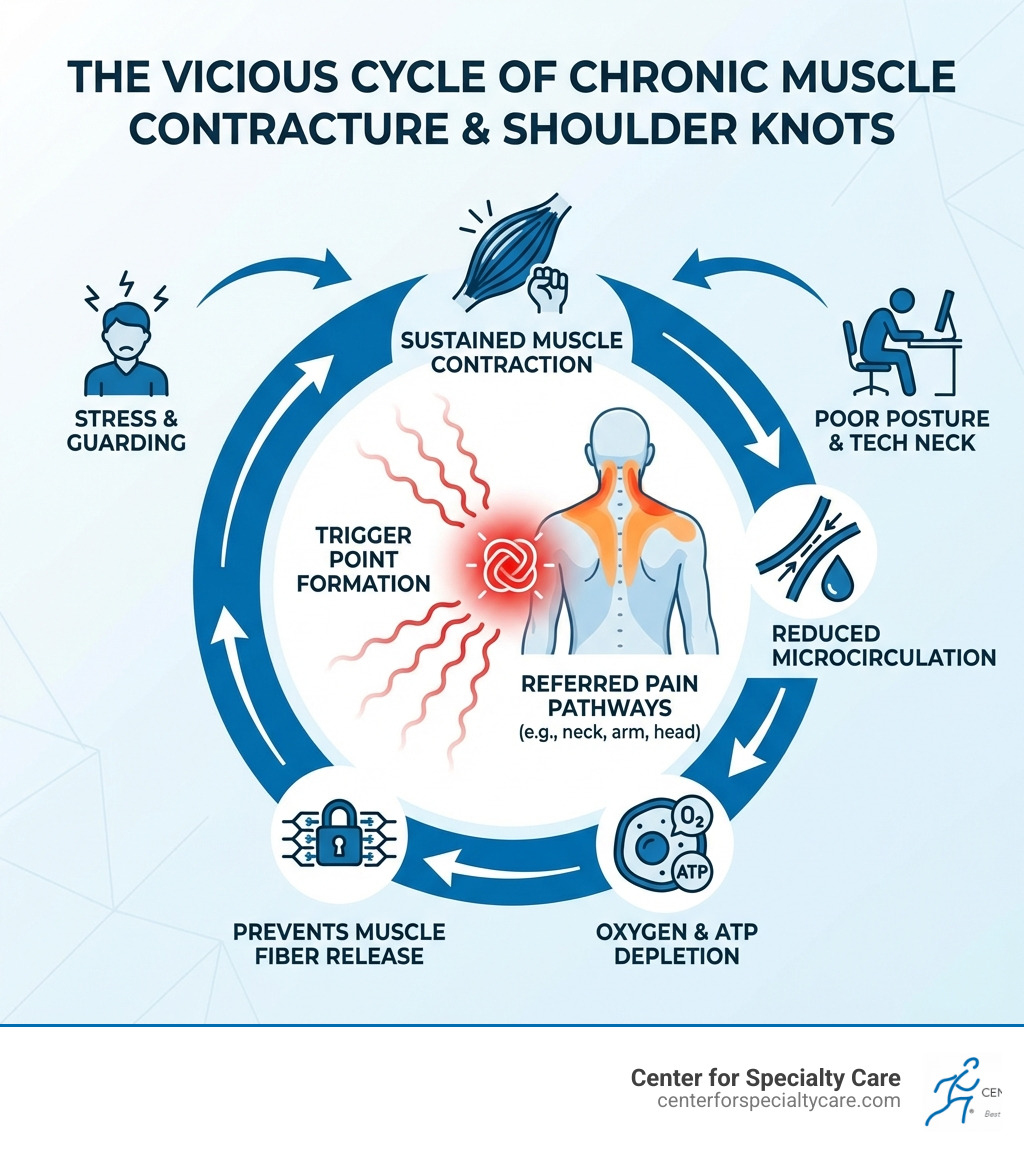
- The muscle fibers are stuck in a contraction cycle and can’t get enough oxygen to release
- Poor posture or “tech neck” keeps re-triggering the same muscles
- Stress keeps your nervous system in a guarding state
- It may not be a muscle knot at all — it could be a pinched nerve in your neck
What actually helps:
- Apply firm pressure to the spot for 30-90 seconds, 2-3 times a day
- Use heat for 15-20 minutes before stretching
- Take posture breaks every 30-60 minutes
- See a physical therapist or specialist if it lasts more than 1-2 weeks
That tight, burning spot between your shoulder blades is one of the most common complaints we see — and one of the most misunderstood. More than 8 in 10 people will develop a muscle knot at some point, yet most people try the same fixes over and over without getting lasting relief.
The reason? The knot itself is often just a symptom. The real cause might be hiding in your posture, your nervous system, or even your neck.
This guide breaks down exactly why these knots persist — and what it takes to finally get rid of them.
I’m Dr. Corey Welchlin, a board-certified orthopedic surgeon with over 30 years of experience treating musculoskeletal pain, including the stubborn knot in shoulder blade won t go away cases that have failed weeks of self-treatment. As the founder of the Center for Specialty Care in Fairmont, Minnesota, I’ve built a multidisciplinary team specifically to find and fix the root cause — not just the symptom.
Knot in shoulder blade won t go away terms at a glance:
Why a Knot in Your Shoulder Blade Won’t Go Away
To understand why that knot in shoulder blade won t go away, we first have to look at the sheer complexity of the area. Your shoulder blade, or scapula, is a triangular bone that serves as a massive junction for your upper body.
According to the Anatomy of the Scapula and Scapular Muscles, there are seventeen different muscles that attach to this single bone. These muscles connect your neck, shoulders, and lower back. With so much “traffic” converging in one spot, it is no wonder this area is a hotspot for tension.
Physiologically, a “knot” is actually a myofascial trigger point. Inside the muscle, tiny units called sarcomeres contain actin and myosin filaments. Normally, these filaments slide past each other to contract and relax. However, in a knot, these filaments become stuck in a state of sustained contracture.
This creates a “vicious cycle.” The constant contraction squeezes local blood vessels, leading to poor microcirculation. Without fresh blood flow, the muscle runs out of Adenosine Triphosphate (ATP)—the very energy molecule required to tell the myosin filaments to let go. This energy depletion means the muscle cannot relax on its own, even when you are sleeping. This state of “muscle guarding” is a primary reason why you might feel a Muscle Kink in Shoulder Blade: Causes & Effective Relief is necessary to break the cycle.
The Role of Posture and “Tech Neck”
In our Fairmont and Estherville clinics, we often see patients who spend eight hours a day hunched over a laptop or looking down at a smartphone. This is the classic “forward head posture.”
Think of your head as a heavy bowling ball. When your ears are aligned over your shoulders, the weight is distributed evenly. But for every inch your head juts forward, the effective weight on your neck and upper back muscles doubles. This puts an incredible strain on the levator scapulae and rhomboids.
These muscles are essentially acting like taut rubber bands trying to keep your head from falling forward. Over time, they become overstretched and weak, yet permanently tight. If you wake up feeling like your upper back is made of concrete, you might also need to learn How to Relieve a Stiff Neck After Waking Up to address the full postural chain.
Stress and the Persistent Knot in Shoulder Blade
We cannot talk about chronic knots without talking about the mind-body connection. When you are under emotional or psychological stress, your body enters a “fight-or-flight” response. This spikes your cortisol levels and causes your nervous system to instinctively “guard” your vital areas.
For most humans, this manifests as shrugging the shoulders toward the ears. The upper trapezius and levator scapulae stay “on” for hours or days at a time. This Research on Muscle Tension and Anxiety highlights how generalized anxiety can lead to physical muscle bundles that feel like hard marbles under the skin. If your stress levels remain high, your nervous system will keep re-triggering these knots even after a massage, making it feel like the knot in shoulder blade won t go away.
Beyond the Muscle: Underlying Causes of Chronic Pain
Sometimes, the “knot” you feel isn’t actually a muscle problem at all. It is referred pain from another structure.
A common culprit is cervical radiculopathy—a fancy term for a pinched nerve in the neck. When a nerve root between the C5 and C7 vertebrae is compressed by a bulging disc or arthritis, it sends pain signals down a specific pathway. This often feels like a deep, boring ache or a sharp “knot” right under the shoulder blade.
According to Cervical Radiculopathy Incidence Rates, this condition affects roughly 107 men and 64 women per 100,000 annually. If you have numbness or tingling in your fingers along with your shoulder pain, it’s a sign that you likely need Shoulder Treatment with Physical Therapy to address the spine rather than just the muscle.
When a Knot in Shoulder Blade Won’t Go Away Due to TMJ
It might sound strange, but your jaw could be the reason your shoulder hurts. Temporomandibular Joint (TMJ) disorders can cause referred pain that travels down the neck and into the scapular region.
Specialists like Dr. Nojan Bakhtiari, a diplomate of the American Board of Orofacial Pain, have noted that the muscles used for chewing and jaw stability are neurologically linked to the postural muscles of the neck and shoulders. When the jaw is misaligned or you grind your teeth at night, it can create a chain reaction of tension. In these cases, Orofacial Pain and TMJ Specialist Information suggests that oral appliance therapy or specific jaw exercises may be the “missing link” to finally releasing that shoulder knot.
Myofascial Pain Syndrome and Chronic Inflammation
If you have multiple knots that have persisted for more than six months, you may be dealing with Myofascial Pain Syndrome (MPS). This is a chronic inflammatory condition where trigger points are “active” (causing pain even at rest) or “latent” (hurting only when pressed).
MPS is often influenced by systemic factors. Dehydration, magnesium or vitamin B12 deficiencies, and poor sleep quality can all make your fascia—the connective tissue surrounding your muscles—more prone to “sticking.” At Center for Specialty Care, we look at these systemic issues as part of our Pain Management Solutions, ensuring we aren’t just treating the spot that hurts, but the environment that allowed the knot to form. You can read more in the Diagnosis and Management of Trigger Points to see how healthcare providers categorize these chronic spots.
Effective Strategies for Releasing Stubborn Knots
If you are currently struggling with a knot in shoulder blade won t go away, you can start a targeted relief protocol at home.
The most effective home method is self-myofascial release. Use a lacrosse ball or a tennis ball:
- Place the ball between the knot and a wall.
- Lean your body weight into the ball until you feel “good pain” (a deep, relieving pressure).
- Hold for 30-90 seconds. Do not roll back and forth rapidly; sustained pressure is what signals the sarcomeres to detach.
- Repeat 2-3 times a day.
For those whose knots are related to exercise, check out How to Get Rid of Shoulder Pain from Lifting Weights for specific modifications.
| Feature | Heat Therapy | Cold Therapy |
|---|---|---|
| Best For | Chronic stiffness, preparing for stretches | Acute injury, sudden “kinks,” inflammation |
| Action | Increases blood flow, relaxes tight fibers | Numbs pain, reduces swelling |
| Duration | 15-20 minutes | 10-15 minutes |
| When to use | Before exercise or stretching | After a flare-up or heavy activity |
Targeted Stretches and Exercises
Once you have “softened” the knot with pressure or heat, you must stretch the area to regain range of motion. We recommend the following:
- Doorway Chest Stretch: Stand in a doorway with arms at 90 degrees. Step forward to stretch the chest. This opens the front of the body, allowing the shoulder blades to sit back naturally.
- Cat-Cow Pose: On all fours, alternate between arching and rounding your back. This mobilizes the entire thoracic spine.
- Scapular Retractions: Squeeze your shoulder blades together as if trying to hold a pencil between them. Hold for 5 seconds, repeat 10 times.
- Chin Tucks: Gently pull your chin straight back (creating a “double chin”). This strengthens the deep neck flexors and counters “tech neck.”
Our Physical Therapy Services can provide a personalized routine if these basic moves aren’t enough.
Ergonomic Adjustments and Prevention
Prevention is the only way to ensure the knot doesn’t return.
- Monitor Height: Your screen should be at eye level so you aren’t looking down.
- Lumbar Support: A supportive chair keeps your pelvis tilted correctly, which prevents the upper back from slouching.
- Movement Breaks: Set a timer for every 30-60 minutes to stand up and do three “look ups” toward the ceiling.
- Hydration: Muscles are roughly 75% water. Dehydrated muscles are “sticky” muscles.
If you’ve tried these and still feel stuck, it might be time to start Finding the Best Shoulder Doctor Near Me to get a professional assessment.
Professional Treatments for Chronic Myofascial Pain
When home care fails, professional intervention can “reset” the muscle neurologically.
One of the most effective treatments for a knot in shoulder blade won t go away is dry needling. Unlike acupuncture, which follows traditional meridians, dry needling involves inserting a fine needle directly into the trigger point to cause a “local twitch response.” This twitch physically breaks the contraction cycle. A Scientific Study on Dry vs. Wet Needling suggests that “wet needling” (using an anesthetic) may offer even better long-term results for some patients.
Other professional options include:
- Manual Trigger Point Therapy: A therapist uses specialized hand techniques to release deep tissue.
- Spinal Manipulation: If the knot is caused by a “stuck” rib or vertebrae, a chiropractic or osteopathic adjustment can provide instant relief.
- Therapeutic Injections: For extreme cases, Types of Injections for Shoulder Pain Relief like sarapin or lidocaine can quiet the inflamed nerve endings.
To find the right path for your specific pain, explore the Best Therapy for Shoulder Pain options available at our Fairmont clinic.
Frequently Asked Questions about Persistent Shoulder Knots
How can I tell if it’s a muscle knot or a pinched nerve?
A muscle knot usually feels like a localized, tender lump. The pain is often a dull ache that stays in the shoulder area. A pinched nerve, however, often causes “radicular” symptoms: sharp, electric-shock sensations, numbness, or tingling that travels down the arm or into the hand. If you have muscle weakness (like trouble opening a jar), it’s likely a nerve issue. Consult a Doctor for Shoulder Problems: Your Guide to Specialized Care for a definitive diagnosis.
Can you over-massage a knot in the shoulder blade?
Yes! More pressure is not always better. If you massage a spot for too long or too hard, you can cause bruising and increase inflammation, which actually makes the muscle guard more. Limit self-massage to 15 minutes per session and use firm but tolerable pressure. If the skin becomes warm to the touch or discolored, you’ve gone too far.
How long does it take for a chronic knot to resolve?
An acute “kink” usually resolves in 1-2 weeks with rest and stretching. However, if the knot is part of a Myofascial Pain Syndrome Duration cycle, it can last for 6 months or longer. Consistency is key; you are trying to “un-train” a muscle that has been stuck for a long time.
Conclusion
At the Center for Specialty Care, we understand that a knot in shoulder blade won t go away is more than just an annoyance—it can affect your sleep, your work, and your mood. Our Fairmont orthopedic clinic offers a unique blend of surgical expertise and conservative pain management to ensure we find the right solution for you.
We pride ourselves on our 100% patient satisfaction, personalized care plans, and quick appointment availability in Fairmont, MN, and our satellite locations in Estherville, Buffalo Center, and St. James. You don’t have to live with that burning ache between your blades.
Ready to find lasting relief? Explore our Comprehensive Shoulder Care and schedule your consultation today. Let’s get you back to living pain-free.