In-Depth Guide to Extensor Tendonitis
August 8, 2026
Getting Your Shoulder Back in the Game with Expert Rotator Cuff Care
August 11, 2026
Why You Should Finally Book That Deep Tissue Massage
Why Deep Tissue Massage Deserves a Spot in Your Pain Relief Plan
Deep tissue massage is a therapeutic technique that uses slow, firm pressure to reach the deeper layers of muscle and connective tissue — helping break up knots, reduce chronic pain, and restore movement.
Here’s a quick look at what it offers:
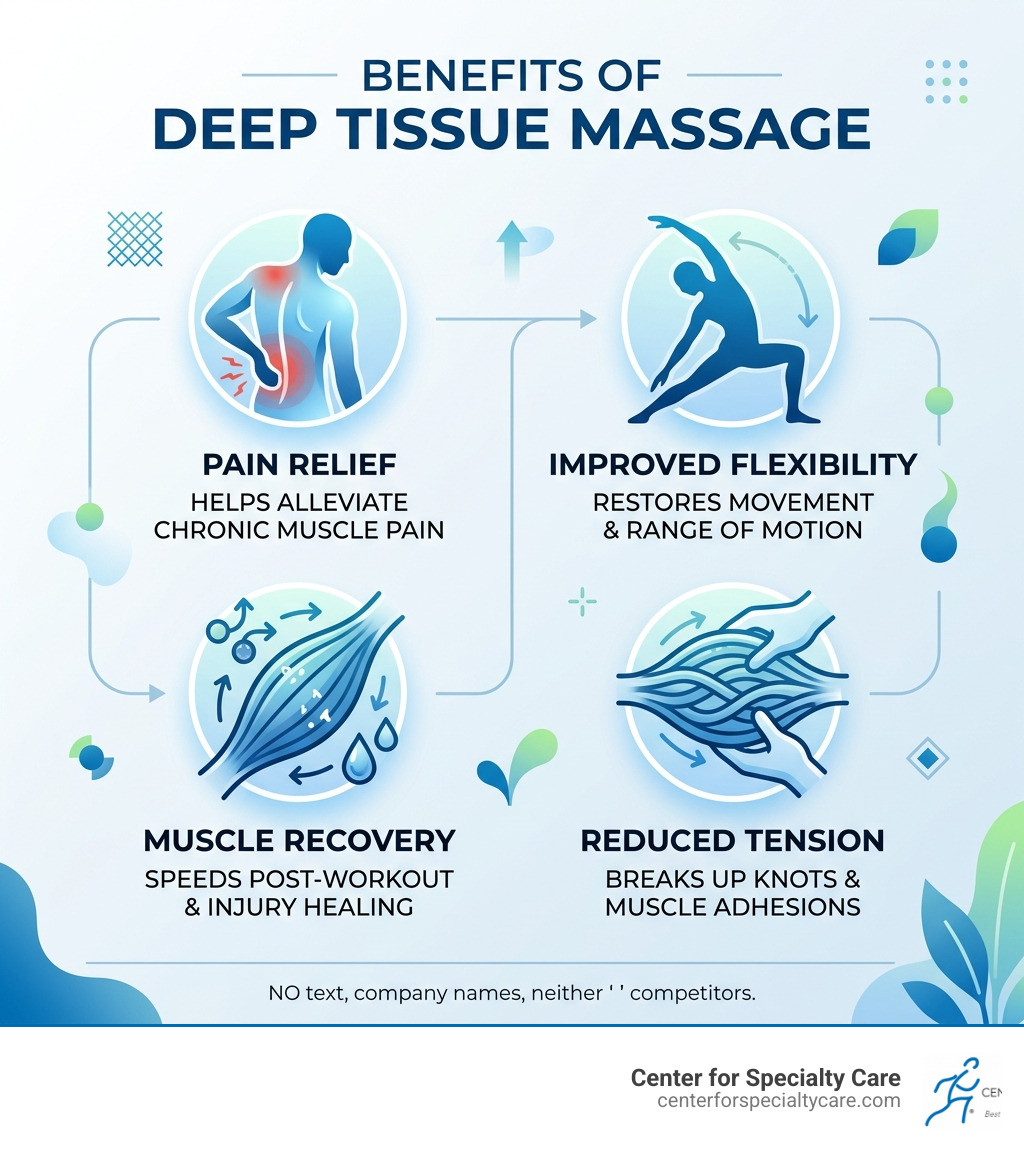
- Pain relief — comparable to NSAIDs for chronic low back pain, according to a 2014 study
- Muscle recovery — flushes out metabolic waste like lactic acid and improves circulation
- Better flexibility — especially with longer or more frequent sessions
- Reduced tension — targets adhesions (tight, rigid bands of tissue) that restrict movement
- Stress relief — both physical and psychological benefits in one session
It’s not a luxury spa treatment. It’s a clinical tool — one that 94% of people believe can help with pain, and that more than 30% have already turned to for relief.
If you’ve been dealing with chronic muscle tension, a nagging injury, or stiffness that just won’t quit, deep tissue massage may be exactly what your body needs.
I’m Dr. Corey Welchlin, a board-certified orthopedic surgeon and sports medicine physician with over 30 years of experience treating musculoskeletal pain — from conservative therapies like deep tissue massage to complex surgical interventions. Understanding how hands-on therapies complement orthopedic care is central to the multidisciplinary approach we use at the Center for Specialty Care.
Deep tissue massage terms to remember:
What is Deep Tissue Massage and How Does it Work?
When we talk about deep tissue massage, we aren’t just talking about someone pushing harder on your back. It is a specific, focused therapy designed to reach the “deep” layers of your anatomy. Think of your muscles like an onion; while a standard massage works the outer skin, this technique dives into the core layers.
At its heart, deep tissue massage targets chronic tension stored in muscles that lie far below the body’s surface. According to the National University of Health Sciences, the goal is to physically break down adhesions. Adhesions are bands of painful, rigid tissue—commonly called “knots”—that can form in muscles, tendons, and ligaments.
These adhesions are more than just uncomfortable; they are biological roadblocks. They block circulation, trap metabolic waste, and cause inflammation, which leads to a limited range of motion and persistent pain. By using slow strokes and direct pressure across the grain of the muscle, a therapist can “unstick” these fibers, allowing blood to flow freely again and helping the muscle return to its natural, relaxed state.

Deep Tissue Massage vs. Swedish Massage
A common question we hear at our Fairmont and Estherville clinics is: “Is this just a really intense Swedish massage?” The answer is no. While they share some DNA, their purposes are worlds apart.
The American Massage Therapy Association (AMTA) notes that while Swedish massage is the “gold standard” for relaxation, deep tissue massage is a clinical intervention. If Swedish massage is a casual swim in a pool, deep tissue is scuba diving—it goes much deeper and requires more specialized “equipment” (in this case, the therapist’s elbows, knuckles, and forearms).
| Feature | Swedish Massage | Deep Tissue Massage |
|---|---|---|
| Primary Goal | Relaxation and stress relief | Treating musculoskeletal issues and chronic pain |
| Pressure Level | Light to medium | Firm to intense |
| Stroke Speed | Faster, rhythmic, gliding | Very slow and deliberate |
| Target Area | Superficial (top) muscle layers | Deep muscle layers and fascia |
| Post-Session | Feeling energized or sleepy | Potential for mild soreness (DOMS) |
Common Techniques Used in Deep Tissue Massage
To reach those stubborn inner layers, therapists use a “tool kit” of advanced moves. It’s not just about brute force; it’s about mechanical precision.
- Cross-Fiber Friction: This involves applying pressure across the grain of the muscle fibers. It’s particularly effective for breaking up scar tissue and realigning muscle fibers that have become “tangled” due to injury.
- Trigger Point Therapy: Have you ever felt a spot in your shoulder that, when pressed, sends a zing of pain up to your neck? That’s a trigger point. Therapists apply sustained pressure to these hyper-irritable spots to force the muscle to “reset” and release the spasm.
- Myofascial Release: This focuses on the fascia—the tough connective tissue that wraps around your muscles like Saran wrap. When fascia gets tight, it can pull your whole body out of alignment. This technique uses slow, stretching strokes to “melt” the fascia.
- Active Release: This is a hybrid move where the therapist applies pressure while you move the affected limb. It’s excellent for “stripping” away adhesions that are stuck between different muscle groups.
The Science-Backed Benefits for Pain and Recovery
As medical professionals at the Center for Specialty Care, we don’t just recommend treatments because they “feel good.” We look at the data. The science behind deep tissue massage is robust, particularly regarding its ability to modulate the body’s inflammatory response and nervous system.
Research published via PMC highlights that deep tissue work stimulates mechanoreceptors in the body. This stimulation triggers the release of “feel-good” chemicals like serotonin and dopamine, while simultaneously reducing cortisol (the stress hormone). Physically, the increased blood flow helps flush out metabolic waste products like lactic acid, which is vital for anyone dealing with radiating pain.

Managing Chronic Pain with Deep Tissue Massage
One of the most impressive statistics in massage research comes from a 2014 study involving 59 participants. It found that deep tissue massage helped reduce pain in people with chronic low back pain so effectively that the results were comparable to taking nonsteroidal anti-inflammatory drugs (NSAIDs) like ibuprofen.
For our patients in Minnesota and Iowa recovering from trauma, such as shoulder pain after a car accident, this therapy is invaluable. It helps manage the “secondary” pain—the stiffness that occurs when your body tenses up to protect an injury. It is also a fantastic tool for those seeking solutions for common foot problems, as it can break up the thick adhesions found in the plantar fascia and calves.
Performance Gains for Athletes
If you’re a regular at local sports events in Fairmont or St. James, you know that performance is about more than just strength; it’s about recovery. A randomized controlled trial showed that team and strength athletes (think football, basketball, or weightlifting) showed the greatest performance improvements from deep tissue massage.
- Range of Motion (ROM): By releasing tight connective tissue, athletes can achieve deeper squats, higher jumps, and more fluid throwing motions.
- Flexibility: Statistical data (χ² = 19.77, p < 0.001) confirms that longer massage sessions lead to significant gains in joint flexibility.
- Injury Prevention: Regular sessions can identify “pre-injuries”—tight spots that haven’t started hurting yet but are likely to tear or strain under load.
What to Expect During Your Session
If you’ve never had a deep tissue massage, your first session might feel a bit more clinical than a spa visit. Here is the typical roadmap:
- The Consultation: Your therapist will ask about your medical history and specific “trouble spots.” This is the time to mention that old sports injury or the nagging pain in your lower back.
- The Environment: You’ll be in a private room, usually under a sheet. You should undress to your level of comfort. Many people leave their undergarments on, and that is perfectly fine.
- The Warm-Up: A skilled therapist won’t just jam their elbow into your back immediately. They will start with lighter, “effleurage” strokes to warm up the superficial tissue and increase blood flow.
- The Deep Work: Once the muscles are pliable, the therapist will begin using deeper kneading and friction. You might feel some discomfort—often described as “good pain”—as they work through a knot.
- Communication: This is vital. If the pressure is too much, speak up! You should be able to breathe through the pressure. If you are tensing up or holding your breath, the massage is actually becoming less effective.
Most sessions last between 60 and 90 minutes. WebMD suggests that 90 minutes is often better for full-body work, while 60 minutes is perfect for focusing on one or two specific areas, like the neck and shoulders.
Safety First: Who Should Avoid Deep Pressure?
While we are big fans of deep tissue massage, it isn’t for everyone. Because this technique moves a lot of fluid and applies significant pressure to the vascular system, there are several “contraindications” to keep in mind.
You should consult a doctor or avoid deep pressure if you have:
- Blood Clots or Deep Vein Thrombosis (DVT): Deep pressure could potentially dislodge a clot.
- Blood Thinners or Bleeding Disorders: You may bruise severely or experience internal bleeding.
- Osteoporosis: Fragile bones can be fractured by intense manual pressure.
- Cancer Treatments: Especially if you have had lymph nodes removed or are undergoing active radiation.
- Pregnancy: While prenatal massage is great, traditional “deep tissue” on the legs or lower back can be risky for expectant mothers.
- Open Wounds or Skin Infections: To avoid spreading bacteria or aggravating the wound.
If you are dealing with other systemic issues, it may also be worth checking in with a hormone therapy specialist to see how your overall metabolic health might be affecting your muscle recovery and inflammation levels.
Maximizing Your Results: Frequency and Aftercare
Getting a deep tissue massage is like a workout for your muscles—they need time to recover afterward.
Frequency: For chronic pain or heavy athletic training, bi-weekly sessions (every two weeks) have shown the best recovery outcomes (χ² = 9.41, p = 0.0243). For general maintenance and wellness, once a month is a standard recommendation.
The “Hangover”: It is very common to experience Delayed Onset Muscle Soreness (DOMS) for 24 to 48 hours after a session. This is because the massage has caused micro-trauma to the tissue to stimulate healing.
Aftercare Tips:
- Hydrate: Drink plenty of water to help your kidneys process the metabolic waste flushed out of your muscles.
- Heat Therapy: A warm bath with Epsom salts can soothe sore muscles and improve the “melting” effect of the massage.
- Rest: Avoid a heavy gym session for at least 24 hours. Give your body a chance to integrate the changes.
- Ice: If a specific area feels particularly inflamed, 10 minutes of icing can help calm the nerves.
Frequently Asked Questions about Therapeutic Massage
How much does a session typically cost?
In our region, you can expect to pay anywhere from $50 to $150 per hour. The price usually depends on the therapist’s level of experience and the length of the session. While it might seem like an investment, many patients find it much more cost-effective than long-term reliance on pain medications or missing work due to injury.
Is it normal to feel sore the next day?
Yes! Think of it as “productive soreness.” When a therapist breaks up adhesions, they are essentially creating a controlled inflammatory response to jumpstart healing. If the soreness lasts more than three days, or if you see significant bruising, let your therapist know so they can adjust the pressure for your next visit.
How often should I book a session for chronic issues?
If you are trying to “fix” a specific problem—like a frozen shoulder or chronic low back tightness—we often recommend a “loading phase” of one session per week for three to four weeks. Once the tissue becomes more pliable and your pain levels drop, you can move to a maintenance schedule of once every four to six weeks.
Conclusion
At the Center for Specialty Care, we believe that the best path to health is a comprehensive one. Whether you are visiting our Fairmont, MN office for orthopedic surgery or seeking non-invasive ways to manage your daily aches, deep tissue massage is a powerful ally. It bridges the gap between relaxation and medical treatment, offering a way to physically “reset” your body’s structural integrity.
By breaking down adhesions, improving circulation, and calming the nervous system, this therapy can significantly improve your quality of life. If you’re ready to move past the “knots” and get back to the activities you love, it might finally be time to book that session.
If your pain persists or if you need a more detailed diagnostic look at a joint issue, we are here to help. Schedule a consultation for shoulder or orthopedic relief today and let’s get you back on the road to recovery.