
When Scapula Pain Goes South: Radiating Shoulder Blade Pain Explained
August 7, 2026
Why You Should Finally Book That Deep Tissue Massage
August 10, 2026
In-Depth Guide to Extensor Tendonitis
What Is Extensor Tendonitis — and Why Does It Matter?
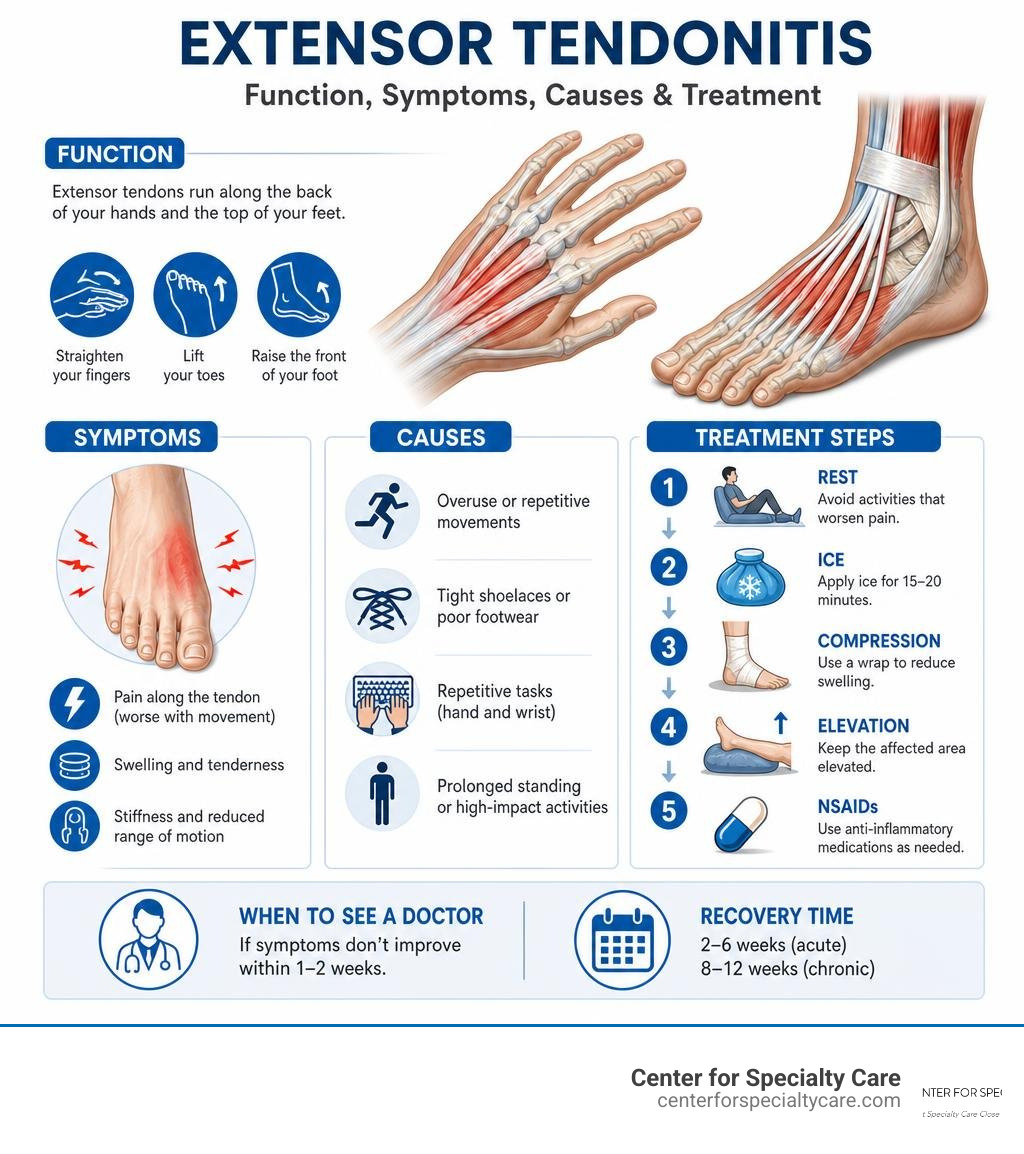
Extensor tendonitis is inflammation of the tendons that run along the back of your hands and the top of your feet. These tendons help you straighten your fingers, lift your toes, and raise the front of your foot when you walk.
Quick answer:
| Question | Answer |
|---|---|
| What is it? | Inflammation of extensor tendons on the top of the foot or back of the hand |
| Main symptoms | Pain, swelling, and stiffness along the tendon — worse with movement |
| Common causes | Overuse, tight shoelaces, repetitive motion, poor footwear |
| First-line treatment | Rest, ice, compression, elevation (RICE), and NSAIDs |
| Recovery time | 2–6 weeks (acute); 8–12 weeks (chronic) |
| When to see a doctor | If symptoms don’t improve within 1–2 weeks |
Anyone who spends time on their feet — or uses their hands for repetitive tasks — can develop this condition. Runners, cyclists, typists, and people who stand all day are especially at risk. The pain often shows up right where your shoelaces cross the top of your foot, or along the back of your wrist.
The good news? Most cases heal fully with the right approach. But pushing through the pain — or ignoring it — can turn a short-term injury into a chronic problem.
I’m Dr. Corey Welchlin, a board-certified orthopedic surgeon and sports medicine physician with over 30 years of experience diagnosing and treating musculoskeletal conditions like extensor tendonitis at the Center for Specialty Care in Fairmont, Minnesota. In this guide, I’ll walk you through everything you need to know — from anatomy and causes to diagnosis, treatment, and recovery.
What is Extensor Tendonitis? Anatomy of Hand and Foot Tendons
To understand why extensor tendonitis hurts so much, we have to look at the anatomy of your movement. Tendons are the thick, fibrous cords of tissue that anchor your muscles to your bones. When your muscles contract, they pull on these tendons to move your joints.
The extensor tendons are specifically designed to extend, pull up, or straighten your limbs and digits. Because they sit very close to the surface of the skin, they have very little padding to protect them from external pressure. This makes them highly vulnerable to compression, friction, and repetitive strain.
In the human body, the extensor system is divided into two primary regions: the hand/wrist and the foot/ankle.
- Extensor Hallucis Longus (EHL): This tendon runs down the front of your ankle and attaches to your big toe. Its main job is to pull your big toe upward.
- Extensor Digitorum Longus (EDL): This tendon branches out across the top of your foot to pull your four smaller toes upward.
- Tibialis Anterior: While technically a muscle of the shin, its tendon crosses the front of the ankle and plays a crucial role in dorsiflexion (lifting your entire foot toward your shin).
- Wrist and Finger Extensors: These muscles originate near the elbow and travel down the forearm to control your wrist and finger movements. You can learn more about this intricate network in the clinical guide on Anatomy, Shoulder and Upper Limb, Wrist Extensor Muscles – StatPearls.
Extensor Tendonitis in the Hand and Wrist
Our hands are marvels of biomechanical engineering. The back of the hand and wrist house the tendons responsible for opening your hand, lifting your fingers, and bending your wrist backward.
The primary tendons involved in hand extension include:
- Extensor Carpi Radialis (Longus and Brevis): These run along the thumb side of your wrist and help extend and stabilize your hand.
- Extensor Digitorum Communis (EDC): The main tendon bundle that splits to extend your fingers.
- Sagittal Bands: These are specialized fibrous bands at the knuckles that keep your extensor tendons centered when you make a fist.
Medical professionals divide the hand and wrist into nine distinct anatomical zones to classify injuries. Because the extensor tendons over the back of the hand are incredibly flat and thin, even a tiny millimeter of stretching or scarring can cause a noticeable “extensor lag” (the inability to fully straighten a finger).
If you want to dive deeper into the surgical and structural complexities of these hand zones, check out this comprehensive Clinical review of hand extensor injuries.
Extensor Tendonitis in the Foot and Ankle
In the lower body, the extensor tendons run right across the top of your foot. Every time you take a step, these tendons contract to lift your toes and foot so you don’t trip over the ground.
- Extensor Hallucis Brevis (EHB): A shorter tendon that assists in lifting the big toe.
- Dorsiflexion: The action of raising the foot upward toward the shin.
When you develop extensor tendonitis in the foot, the pain is typically localized directly on the top of the foot, often right over the midfoot bones. This area is highly susceptible to friction because the tendons lie directly between the hard bones of your foot and the stiff material of your shoes.
If your pain has migrated lower or wraps around the joint, you might be dealing with a related ankle issue, which requires a slightly different diagnostic approach.
Causes, Risk Factors, and Prevention of Tendon Strain
Why do these tendons get so irritated? In most cases, it boils down to a mismatch between the load you are placing on the tendon and its capacity to handle that load.
When a tendon is forced to work too hard, too fast, or under constant pressure, micro-tears develop in the tissue. If the body doesn’t get enough rest to repair these micro-tears, inflammation sets in.
According to the Cleveland Clinic, several factors can trigger this strain. You can read their complete medical breakdown here: Extensor Tendonitis: What It Is, Causes & Treatment.
The most common culprits include:
- Tight Shoelaces: This is the single most common cause of top-of-foot tendonitis. Tying your laces too tight compresses the extensor tendons directly against the underlying bones.
- Sudden Activity Increases: Doubling your running mileage over a weekend or suddenly taking up a high-intensity sport can overload the tendons before they have time to adapt.
- High Arches (Pes Cavus): People with high arches naturally have a more prominent bony ridge on the top of their foot, which increases pressure and friction against footwear.
- Repetitive Motion: Typing all day on a non-ergonomic keyboard or performing repetitive manual labor strains the wrist extensors.
Common Triggers for Athletes and Professionals
We frequently see extensor tendonitis flare up in specific populations due to the unique demands of their sports or professions:
- Cyclists: Rigid cycling shoes combined with the repetitive pulling motion of the pedal stroke can irritate the top of the foot.
- Dancers & Figure Skaters: Extreme ankle movements and tight, stiff footwear put massive eccentric loads on the extensor tendons.
- Keyboard Users & Musicians: Repetitive finger lifting without adequate wrist support causes chronic strain in the forearm and wrist extensors.
- Age and Lifestyle Factors: People older than 40 naturally have tighter, less elastic tendons. Additionally, smoking or using tobacco products impairs blood flow, which significantly slows down tendon healing.
- Medical Triggers: Certain systemic conditions like diabetes and rheumatoid arthritis increase your risk. Furthermore, medications like oral corticosteroids and fluoroquinolone antibiotics are known to weaken tendon structures.
Prevention Strategies for Repetitive Strain
Preventing extensor tendonitis is far easier than curing it. By making a few simple adjustments to your daily routine, you can protect your tendons from unnecessary wear and tear:
- Assess Your Footwear: Choose shoes with a wider, higher toe box to reduce compression on the top of your foot.
- Modify Your Lacing: Learn to tie your shoes with a tension-free pattern (more on this below!).
- Optimize Your Ergonomics: If you type for hours, use a split keyboard and adjust your chair so your wrists remain in a neutral, relaxed position.
- Warm-Up Diligently: Always perform dynamic stretches for your wrists or ankles before starting a workout or a long shift of manual labor.
- Gradual Progression: Follow the “10% rule” — never increase your workout volume, intensity, or distance by more than 10% per week.
Clinical Diagnosis, Symptoms, and Differential Diagnosis
Identifying extensor tendonitis early can save you months of frustration. The symptoms usually start as a mild, vague ache that gradually sharpens over time.
Typical symptoms include:
- Pain with Movement: Sharp or aching pain when you pull your fingers back or lift your toes upward.
- Swelling and Redness: Visible swelling or a pinkish discoloration directly over the affected tendon.
- Crepitus: A faint grating or crackling sensation when you move the tendon.
- Stiffness: Difficulty fully flexing your fingers or pointing your toes downward, especially first thing in the morning.
For an extensive list of symptoms and self-assessment tips, you can refer to the guide on Extensor Tendonitis Symptoms and Treatment.
During a clinical physical exam, we will palpate (press on) the tendons to locate the exact source of your pain. We may also perform specialized tests like the Elson Test — a highly sensitive exam used to evaluate the integrity of the central slip tendon in the finger. If we suspect a structural tear or bone involvement, we may order diagnostic imaging such as X-rays, high-resolution ultrasound, or an MRI.
Acute vs. Chronic Tendon Pathology
It is important to understand where your injury lies on the timeline of tendon damage.
- Tendonitis: This is an acute inflammatory response to sudden overload or friction. It usually responds quickly to rest and anti-inflammatory treatments.
- Tendinosis/Tendinopathy: If you ignore the early warning signs and continue to stress the tendon, the condition becomes chronic. The active inflammation fades, and the tendon’s collagen fibers begin to break down and disorganize.
Treating chronic degeneration requires a focus on cellular rebuilding rather than just cooling down inflammation. You can read more about this transition on the University of Iowa’s resource page on Tendinopathy.
Differential Diagnosis: Extensor Tendonitis vs. Stress Fractures
Because the top of the foot has many overlapping structures, it is easy to mistake other injuries for extensor tendonitis. The most critical distinction we must make is between tendonitis and a metatarsal stress fracture (a hairline crack in the foot bone).
| Feature | Extensor Tendonitis | Metatarsal Stress Fracture | Flexor Tendon Injury |
|---|---|---|---|
| Pain Location | Diffuse along the top tendon lines | Highly localized “point tenderness” on the bone | Bottom of the foot or toes |
| Lace Pressure Test | Pain worsens significantly with tight laces | Pain is largely unaffected by lace pressure | No change in pain |
| Pain with Resistance | Hurting when lifting toes up against resistance | Pain when walking or bearing weight | Pain when curling toes downward |
| X-ray Findings | Normal | May show a crack or healing bone callus after 2-4 weeks | Normal |
Other conditions we rule out during your exam include a Lisfranc injury (a midfoot ligament tear), gout, or nerve entrapment. For a detailed podiatric overview of these top-of-foot conditions, see the Extensor Tendonitis: Symptoms, Causes, Treatment and Prevention video guide.
Evidence-Based Treatment Options and Recovery Timeline
If you are diagnosed with extensor tendonitis, take a deep breath. This is a highly treatable, temporary condition.

At our clinic, we advocate for a progressive treatment approach. We start with conservative care and home remedies, moving to advanced therapies only if the tendon proves stubborn.
Conservative Care and Home Remedies
For the first few days of a flare-up, we recommend transitioning from the traditional RICE method to the modern POLICE protocol:
- Protect: Use a splint, brace, or supportive footwear to protect the tendon from further friction.
- Optimal Loading: Instead of complete bed rest, engage in gentle, pain-free movement to promote blood flow and tissue healing.
- Ice: Apply ice wrapped in a damp towel for 10–20 minutes, 2 to 3 times a day, to calm acute inflammation.
- Compression: Apply a light elastic bandage (but never wear compression sleeves to bed).
- Elevation: Prop your hand or foot above heart level when resting.
If you are past the initial acute phase (usually 48 to 72 hours), you can explore Tendonitis Heat Therapy to relax tight muscles and bring healing nutrients to the area.
Additionally, over-the-counter nonsteroidal anti-inflammatory drugs (NSAIDs) like ibuprofen or naproxen can help manage pain. However, you should not use these for more than 10 consecutive days without consulting a doctor. Gentle calf stretches can also relieve the tight muscles that force your foot extensors to work overtime.
For structured, professional guidance, working with a physical therapist is highly beneficial. If you are in the southern Minnesota region, you can access excellent care at Physical Therapy in St. James, Minn. – Mayo Clinic Health System.
Advanced Medical Treatments and Surgical Indications
If conservative measures don’t bring relief within 6 to 12 weeks, we may consider advanced medical interventions:
- Corticosteroid Injections: A targeted injection can quickly knock down severe, localized inflammation. However, we use these sparingly, as repeated steroid injections can weaken the tendon tissue over time.
- Platelet-Rich Plasma (PRP) Therapy: This cutting-edge regenerative therapy uses a concentrated sample of your own blood platelets to stimulate natural healing in chronic, degenerated tendons.
- Surgery: Surgical intervention is incredibly rare for extensor tendonitis. It is typically reserved for cases where the tendon has partially torn, ruptured, or pulled away from the bone.
To understand the specific surgical procedures used to repair damaged tendons, you can review the Extensor Tendon Injury – Clinical Tree.
Expected Recovery Timeline and Prognosis
How long will you be on the sidelines? Your recovery timeline depends heavily on how quickly you address the problem:
- Acute Cases: If you catch it early and modify your activity, most acute cases resolve beautifully within 2 to 6 weeks.
- Chronic Cases: If the tendon has progressed to tendinosis, recovery can take 8 to 12 weeks, and sometimes up to several months of dedicated physical therapy.
When returning to your favorite sports, we recommend using the “4/10 pain rule.” Keep your pain levels below a 4 out of 10 during the activity, and ensure that any mild soreness returns to your baseline within 24 hours.
If you are trying to gauge how your recovery compares to other lower-extremity tendon issues, you can read our comparative guide on Achilles Tendon Pain.
Frequently Asked Questions about Extensor Tendonitis
To help you navigate your recovery, here are some of the most common questions we hear from our patients at the Center for Specialty Care.

Can I run or exercise with extensor tendonitis?
Yes, in most cases, you do not need to stop exercising entirely! Complete rest can actually cause the tendon to stiffen and weaken.
The key is relative rest. You can continue to run or walk as long as you keep your pain levels below a 4/10. If you feel a sharp pinch or if your pain lingers into the next day, you need to scale back your distance or intensity. Switching to low-impact cross-training like swimming or water aerobics is a great way to maintain your cardiovascular fitness while letting your tendons rest.
How do I know if my top of foot pain is a stress fracture or tendonitis?
The easiest way to tell the difference at home is the point tenderness test.
Press firmly along the top of your foot. If the pain is spread out along the soft, fleshy lines of your tendons, it is likely extensor tendonitis. If you can press on one exact, highly localized spot on the bone and feel a sharp, deep pain, it is more likely a metatarsal stress fracture.
Additionally, stress fractures will hurt with every single step you take, regardless of whether your shoes are tied tight or loose. If you are in doubt, always get an professional evaluation and imaging.
What is the window lacing technique for foot extensor tendonitis?
The window lacing technique (also known as box lacing) is a simple, highly effective way to relieve pressure on the top of your foot.
Here is how you do it:
- Unlace your shoe down to the eyelets just below the painful, swollen area.
- Instead of crossing the laces over the painful spot, thread them straight up to the next eyelet on the same side. This creates an open “window” directly over your irritated tendon.
- Cross the laces back over and finish tying your shoe normally at the top.
This simple trick removes direct compression from the laces, allowing the tendon to glide freely without friction while you walk or run.
Conclusion: Get Back on Your Feet with the Center for Specialty Care
Dealing with pain on the top of your foot or the back of your hand can turn simple daily tasks into a frustrating challenge. But remember: extensor tendonitis is a temporary hurdle. With the right combination of rest, proper lacing, and targeted rehabilitation, you can expect a full recovery.
At the Center for Specialty Care in Fairmont, Minnesota, we are dedicated to helping you move without pain. We also proudly serve our neighbors in Estherville, IA, Buffalo Center, IA, and St. James, MN.
Our ultimate goal is 100% patient satisfaction. We achieve this by providing highly personalized orthopedic care tailored to your unique lifestyle, hobbies, and goals. Best of all, we offer quick appointment availability, so you don’t have to wait weeks in pain to see a specialist.
Ready to take the first step toward pain-free movement? Let us help you navigate recovery and maintain foot health today. Contact us to schedule your personalized consultation!