
Dry Spell? How to Find the Best IV for Dehydration Near Me
August 12, 2026
The Great Debate on Whether Heat or Ice is Better for Tendon Pain
August 14, 2026
Left-Sided Scapula Pain Explained and When It’s Not Just a Muscle Strain
What Pain Under the Left Scapula Could Mean — and When to Take It Seriously
Pain under the left scapula is one of the most common upper back complaints — and one of the most misunderstood.
Most people assume it’s just a pulled muscle. Sometimes it is. But this area of the back is also where pain from your heart, lungs, stomach, and spine can all show up at the same time.
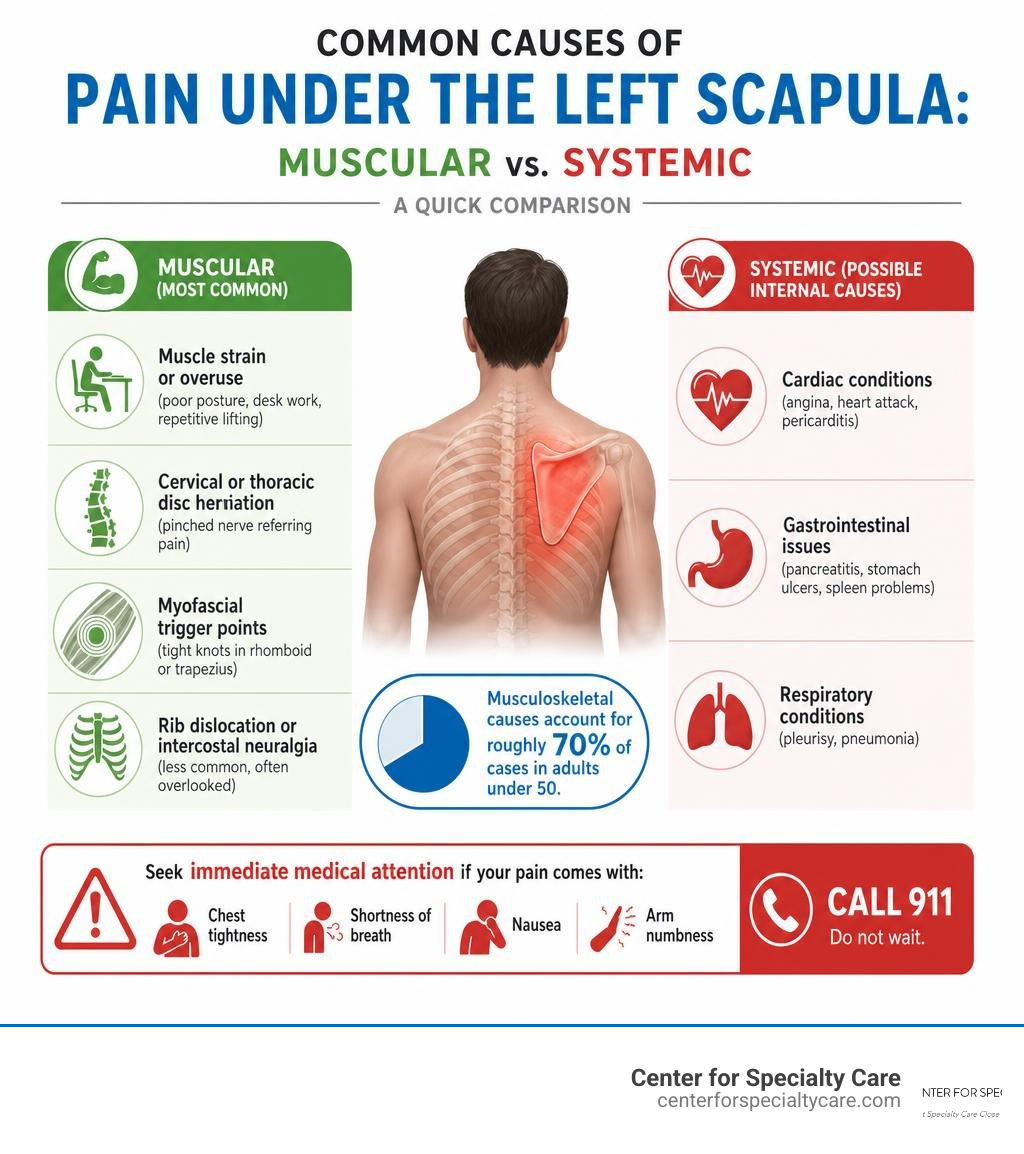
Here are the most common causes at a glance:
- Muscle strain or overuse — the most frequent cause, especially from desk work, repetitive lifting, or poor posture
- Cervical or thoracic disc herniation — a pinched nerve that refers pain to the scapular region
- Myofascial trigger points — tight knots in the rhomboid or trapezius muscles
- Cardiac conditions — angina, heart attack, or pericarditis can all cause referred pain to the left shoulder blade
- Gastrointestinal issues — pancreatitis, stomach ulcers, or spleen problems
- Respiratory conditions — pleurisy or pneumonia
- Rib dislocation or intercostal neuralgia — less common but often overlooked
Important: If your pain comes with chest tightness, shortness of breath, nausea, or arm numbness — call 911. Do not wait.
Musculoskeletal causes account for roughly 70% of cases in adults under 50. But up to 15% of people with left-sided scapular pain have an underlying cardiac condition. That gap matters.
This guide will walk you through every major cause, how to tell them apart, and what to do next.
I’m Dr. Corey Welchlin, a board-certified orthopedic surgeon and founder of the Center for Specialty Care in Fairmont, Minnesota — where I’ve been diagnosing and treating pain under the left scapula and related musculoskeletal conditions for over 30 years. Whether the source turns out to be a strained rhomboid or something that needs urgent evaluation, getting an accurate diagnosis is always the right first step.
Simple guide to pain under left scapula:
Common Musculoskeletal Causes of Pain Under Left Scapula
When you feel a nagging ache or a sharp bite right under your left shoulder blade, the most likely culprit is hiding in your muscles, tendons, or ligaments. The scapula is a flat, triangular bone that serves as a major anchoring station for some of the hardest-working muscles in your upper body, including the rhomboids, trapezius, and levator scapulae.

Musculoskeletal issues are incredibly common, representing 6% to 26% of all musculoskeletal complaints in primary care clinics. When a muscle in this region is overworked, stretched too far, or structurally misaligned, it quickly protests.
Common musculoskeletal triggers include:
- Muscle Strains: Occur when muscle fibers are stretched or torn, often from sudden lifting or twisting.
- Myofascial Trigger Points: Highly sensitive “knots” in the muscle fibers that can send deep, aching pain radiating under the shoulder blade.
- Scapular Dyskinesis: An alteration in the normal position or motion of the scapula during shoulder movements, which places uneven mechanical stress on the surrounding tissues.
If your upper back feels tight, tender to the touch, or aches when you move your arm, targeted physical therapy is often the most effective route to long-term relief. For a deeper look at how structured exercises can restore balance, read our More info about physical therapy for shoulder pain.
Postural Strain and Overuse Injuries
In our modern, screen-heavy world, poor posture is one of the primary drivers of chronic upper back pain. Many of us spend hours hunched over laptops, slouched in office chairs, or tilting our heads down to look at smartphones. Over time, this constant forward-leaning posture can lead to a muscle imbalance known as Upper Cross Syndrome.
In Upper Cross Syndrome, the chest muscles (pectorals) and upper neck muscles become excessively tight, while the muscles of the upper back—especially the rhomboids and lower trapezius—become overstretched, weakened, and strained.
Common postural and overuse triggers include:
- Slouching at a desk: Rounding your shoulders while typing forces the scapular muscles to work overtime just to keep your shoulders from collapsing forward.
- Repetitive overhead lifting: Activities like painting a ceiling, stacking shelves, or playing sports like tennis can overwork the scapular stabilizers.
- Carrying heavy bags: Slinging a heavy purse or backpack over just one shoulder forces your muscles to contract unevenly, leading to one-sided strain.
- Awkward sleeping positions: Sleeping on your side with your lower arm extended too far forward can push the scapula outward, leading to morning stiffness and pain.
When these muscles remain chronically tight and overworked, they often develop painful, palpable knots. If you are struggling with persistent tension that radiates up into your neck, you can find More info about neck knots to help identify and release these stubborn trigger points.
Rotator Cuff and Shoulder Joint Dysfunction
Because the scapula forms the socket part of your shoulder’s “ball-and-socket” joint (the glenohumeral joint), any issue within the shoulder itself can easily manifest as pain under left scapula. The rotator cuff is a group of four muscles and tendons that stabilize the shoulder joint. If one of these tendons is irritated, inflamed, or torn, the mechanics of the entire shoulder complex break down.
When shoulder joint mechanics are compromised, the muscles surrounding the shoulder blade have to contract forcefully to compensate. This secondary muscle spasm is often what causes the deep, aching pain felt directly beneath the scapula.
If you suspect your back discomfort might actually be rooted in a shoulder injury, you can read More info about rotator cuff tears to learn about symptoms and recovery.
Furthermore, shoulder injuries are notorious for keeping people awake. If your discomfort spikes the moment your head hits the pillow, check out More info about nighttime shoulder pain for practical tips on finding a comfortable sleeping position. You can also explore How To Survive The Night With A Torn Rotator Cuff and read about whether conservative care is right for you in Will A Torn Rotator Cuff Heal On Its Own Key Recovery Facts.
Spinal and Nerve-Related Issues Affecting the Upper Back
Sometimes, the true source of your shoulder blade pain isn’t located in the back or shoulder muscles at all. Instead, it originates in the spine. The cervical (neck) and thoracic (mid-back) spine house the complex network of nerves that control sensation and movement throughout your upper body.
Conditions like osteoarthritis of the facet joints (the small joints connecting your vertebrae) can restrict spinal movement and refer sharp or aching pain outward toward the scapula. Systemic inflammatory conditions can also play a role; you can read more about inflammatory joint issues in our Understanding Rheumatoid Arthritis A Comprehensive Overview.
When spinal arthritis or disc degeneration severely narrows the spinal canal, decompressive procedures may be discussed. For those exploring advanced surgical options, you can find More info about laminectomy procedures.
Cervical Herniated Discs and Pinched Nerves
A herniated or bulging disc in the lower neck (specifically at the C5, C6, or C7 vertebral levels) is a classic cause of referred scapular pain. When a disc herniates, its soft inner gel presses against adjacent nerve roots. This nerve irritation, known as cervical radiculopathy, sends pain signals traveling along the nerve’s path.
One specific nerve prone to compression is the dorsal scapular nerve. When compressed, it can cause a deep, constant, burning ache right along the inner edge of your left shoulder blade. This pain is often accompanied by:
- A “pins and needles” tingling sensation down the left arm.
- Numbness in the hand or fingers.
- Weakness when attempting to lift the arm or grip objects.
For a detailed medical breakdown of how spinal pathologies refer pain to this specific region, refer to this Scientific analysis of left scapular pain causes. Additionally, you can review this guide on Pain under the left scapula: causes and possible disease. How to overcome aching and stitching pain under the shoulder blades to understand how degenerative spinal conditions are diagnosed.
Rib Dislocation and Intercostal Neuralgia
Another structural issue that can cause sudden, sharp pain is a dislocated or subluxated rib. Your ribs attach to your thoracic spine in the back. A sudden twisting motion, a hard cough, or poor breathing mechanics can cause a rib to slip slightly out of its normal alignment at the joint.
This subluxation is especially common in individuals who exhibit “sympathetic chest breathing”—shallow breathing that relies heavily on the neck and chest muscles rather than the diaphragm. When a rib is misaligned, it irritates the surrounding intercostal nerves, leading to intercostal neuralgia.
This combination typically produces:
- A sharp, stabbing pain that feels like it is directly under or piercing through the shoulder blade.
- Pain that intensifies significantly when taking a deep breath, coughing, or sneezing.
- Tenderness when pressing directly on the rib near the spine.
To learn more about how rib and nerve-related issues present in clinical settings, read this overview of More info about managing pain under left scapula or explore Pain Under Shoulder Blade: Possible Causes and When to Get Help .
When Left-Sided Shoulder Blade Pain Signals a Medical Emergency
While the vast majority of upper back pain cases are musculoskeletal, pain under left scapula can occasionally be a warning sign of a serious, life-threatening medical emergency. Your internal organs do not have their own dedicated pain receptors; instead, they share nerve pathways with your skin and muscles. When an organ like the heart or lungs is in distress, the brain can misinterpret those signals as pain in the left shoulder blade or rib cage.

Musculoskeletal Pain vs. Systemic/Emergency Pain
To help you understand when to rest and when to head to the emergency room, consider this comparison:
| Characteristic | Musculoskeletal Pain | Systemic / Emergency Pain |
|---|---|---|
| Pain Quality | Dull, aching, sore, or localized tightness | Squeezing, crushing, heavy pressure, or deep burning |
| Movement Trigger | Worsens when moving your arm, twisting, or touching the area | Unchanged by movement; persists even at rest |
| Breathing Impact | May hurt slightly with deep movement, but localized | Sharp, stabbing pain specifically on deep inhalation |
| Accompanying Signs | Localized muscle stiffness or knots | Shortness of breath, sweating, dizziness, nausea, chest tightness |
Cardiac Conditions and Referred Pain Under Left Scapula
Because the heart is situated on the left side of the chest, cardiac issues frequently refer pain to the left shoulder, left arm, neck, and under the left shoulder blade. This is particularly true for women, who are far more likely than men to experience atypical heart attack symptoms—such as isolated upper back pain—instead of classic, crushing chest pain.
Serious cardiac conditions that can cause left scapular pain include:
- Myocardial Infarction (Heart Attack): A sudden blockage of blood flow to the heart muscle. The pain is typically described as a heavy, crushing pressure that may radiate to the left jaw, arm, and back.
- Angina Pectoris: Temporary chest pain or discomfort that occurs when the heart muscle doesn’t get enough blood, often triggered by physical exertion or stress.
- Pericarditis: Inflammation of the sac surrounding the heart (pericardium), often following a viral infection. This pain is typically sharp and worsens when lying flat, but improves when leaning forward.
- Aortic Dissection: A rare, life-threatening tear in the wall of the body’s main artery (the aorta). This causes a sudden, excruciating “tearing” or “ripping” sensation between the shoulder blades.
If you are experiencing left-sided discomfort and want to understand how pain can cross over from the chest to the ribs and back, read this Scientific insights on left rib and chest pain.
Respiratory and Gastrointestinal Triggers
Your lungs and gastrointestinal organs can also refer pain to the left upper back due to shared nerve pathways (especially the phrenic nerve, which innervates the diaphragm).
- Pleurisy: Inflammation of the lung linings (pleura). It causes a sharp, stabbing pain under the shoulder blade that gets significantly worse every time you take a breath or cough.
- Pneumonia: A lung infection that can cause localized back pain, accompanied by fever, chills, cough, and colored sputum.
- Acute Pancreatitis: Inflammation of the pancreas, located behind the stomach. This pain typically starts in the upper abdomen but frequently radiates straight through to the left shoulder blade.
- Stomach Ulcers: A perforated ulcer on the posterior wall of the stomach can cause sharp back pain, often occurring 20 to 50 minutes after eating.
- Spleen Pathology: Spleen injury, enlargement, or rupture (often from trauma) can cause blood to accumulate under the diaphragm, leading to referred left shoulder pain (known as Kehr’s sign).
For a detailed medical look at how these internal organs can trigger back discomfort, read this Scientific guide on back pain under the left shoulder blade.
Diagnostic Methods and Treatment Options
Because the potential causes of pain under left scapula range from a simple muscle knot to structural spinal issues, a thorough diagnostic evaluation is essential.
When you visit an orthopedic specialist, the diagnostic process typically includes:
- A Detailed Medical History: Discussing when the pain started, what makes it better or worse, and any accompanying symptoms.
- A Physical Examination: Assessing your posture, spinal alignment, shoulder range of motion, and pinpointing areas of localized tenderness.
- Imaging Studies:
- X-rays: To check for bone fractures, rib dislocations, or signs of spinal arthritis.
- MRI or CT Scans: To visualize soft tissues, such as herniated discs, pinched nerves, or muscle tears.
- ECG and Cardiac Screening: If there is any suspicion of a heart-related cause, an electrocardiogram (ECG) and blood tests for cardiac markers are performed immediately to ensure your safety.
Conservative and Home Remedies
If your pain is determined to be musculoskeletal, the good news is that roughly 90% of cases respond beautifully to conservative, non-surgical treatments.
To manage acute muscle strains or minor joint irritation at home, consider these strategies:
- The RICE Method: Rest the area for the first 48 hours, apply ice wrapped in a cloth for 10–15 minutes several times a day to reduce inflammation, and avoid heavy lifting or overhead reaching.
- Alternating Heat and Cold: Use ice for the first 48 hours to numb acute pain and control swelling. After the initial inflammation subsides, switch to heat therapy (like a warm shower or heating pad) to relax tight muscles and improve blood flow. If you are dealing with tendon irritation, read More info about heat for tendonitis and explore The Warm Truth Is Heat Your Tendonitis Best Friend.
- Over-the-Counter Medications: Non-steroidal anti-inflammatory drugs (NSAIDs) like ibuprofen can help reduce localized swelling and ease discomfort.
- Gentle Stretching: Performing simple stretches like the Cat-Cow, child’s pose, or doorway chest stretches can help open up the thoracic spine and release tension in the rhomboids.
Professional Medical and Interventional Treatments
When home remedies aren’t quite enough to resolve persistent pain, professional medical interventions can help accelerate your recovery:
- Customized Physical Therapy: A physical therapist can design a program to strengthen your scapular stabilizers, stretch tight chest muscles, and correct postural imbalances. For expert recovery tips, read More info about shoulder physical therapy tips.
- Chiropractic Adjustments: Gentle spinal or rib mobilization can help restore normal joint alignment and relieve nerve pressure.
- Advanced Pain Management: For chronic, severe back pain rooted in spinal disc degeneration, modern interventional treatments offer highly effective relief. To learn about innovative, minimally invasive options for chronic spinal pain, read about More info about the Intracept procedure.
Frequently Asked Questions About Upper Back Pain
Can stress cause pain under left scapula?
Yes, absolutely. When you experience psychological stress, your body releases stress hormones like cortisol and adrenaline, which trigger a natural “fight or flight” response. This response causes muscles throughout your neck, shoulders, and upper back to contract and tighten.
Over time, this chronic muscle tension can lead to painful myofascial trigger points in the trapezius and rhomboid muscles, resulting in a persistent, dull ache under your left shoulder blade.
How can I tell if my upper back pain is muscular or lung-related?
The easiest way to differentiate between the two is to pay attention to what triggers or changes the pain:
- Muscular pain is mechanical. It typically changes when you move your arm, twist your torso, or press directly on the sore spot.
- Lung-related pain (such as pleurisy) is respiratory. It typically remains unchanged when you move your arm, but it gets significantly sharper, stabbing, or worse specifically when you take a deep breath, cough, or sneeze.
When should I see a doctor for left shoulder blade pain?
You should schedule an medical evaluation if your pain:
- Persists for more than a week despite rest, ice, and gentle stretching.
- Progressively worsens over time.
- Is accompanied by numbness, tingling, or weakness in your left arm or hand.
- Began immediately following a traumatic injury, such as a car accident or a fall.
Reminder: If your pain is accompanied by chest tightness, shortness of breath, dizziness, or nausea, seek emergency medical care immediately.
Conclusion
Pain under the left scapula can certainly be a nuisance, but understanding its root cause is the key to finding lasting relief. Whether your pain stems from long hours at a desk, a pinched nerve in your neck, or a shoulder issue, you don’t have to live with the discomfort.
At the Center for Specialty Care, we are committed to helping you reclaim your mobility and live pain-free. Our orthopedic and pain management clinic in Fairmont offers comprehensive care for all types of musculoskeletal pain, providing both advanced surgical and non-surgical treatment options.
We take pride in our personalized care, 100% patient satisfaction, and quick appointment availability—ensuring you get the answers and relief you need without the wait. We are proud to serve patients across our convenient locations, including Fairmont, MN, St. James, MN, Estherville, IA, and Buffalo Center, IA.
If you are ready to stop guessing what is causing your upper back discomfort, Schedule a consultation for back pain relief with our team today.