

Say Goodbye to Foot Pain with Effective Plantar Fasciitis Treatments
February 5, 2026
Beyond the Trigger Point: Why Your Shoulder Blade Knots Won’t Go Away
February 7, 2026
Are pain management clinics legitimate? 2025 Expert Guide
Why Understanding Pain Clinic Legitimacy Matters
Are pain management clinics legitimate? Yes, legitimate pain management clinics are vital healthcare facilities staffed by board-certified specialists who use comprehensive, evidence-based approaches to diagnose and treat chronic pain—but illegitimate operations called “pill mills” also exist, making it crucial to know the difference.
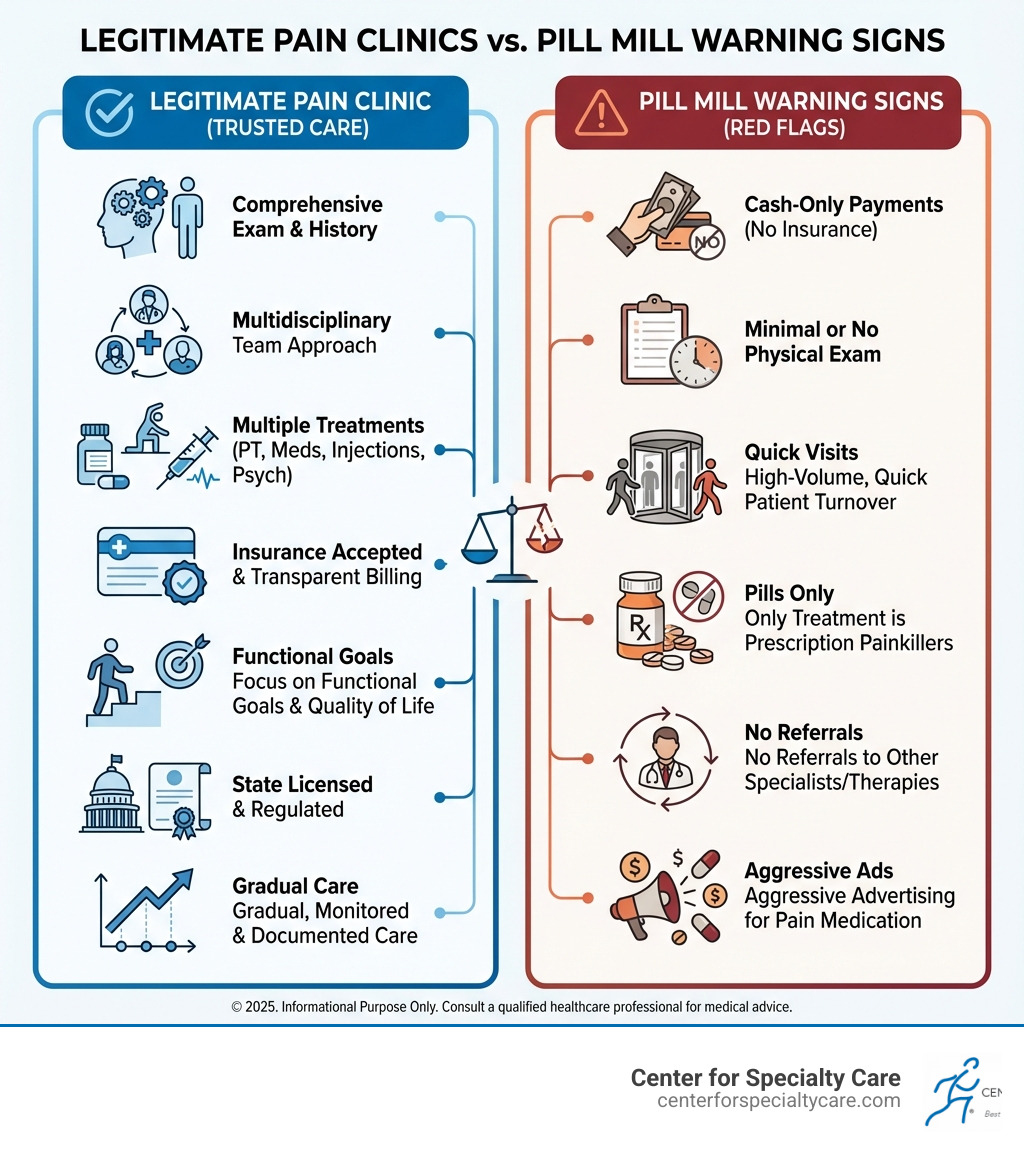
Quick Answer: What Makes a Pain Clinic Legitimate
- Comprehensive evaluation: Thorough physical exams, medical history review, and diagnostic testing
- Multidisciplinary team: Doctors, physical therapists, psychologists working together
- Multiple treatment options: Physical therapy, injections, medications, and psychological support—not just pills
- Insurance accepted: Transparent billing and accepts standard insurance plans
- Focus on function: Goals centered on improving daily activities and quality of life
- State registration: Licensed, inspected, and regulated by state health departments
- Gradual, monitored care: Regular follow-ups with documented treatment plans
Red Flags of Illegitimate “Pill Mills”:
- Cash-only payments with no insurance accepted
- Minimal or no physical examination
- High-volume, quick patient turnover (patients in and out rapidly)
- Only treatment offered is prescription painkillers
- No referrals to other specialists or therapies
- Aggressive advertising for pain medication
The distinction between legitimate pain management and dangerous “pill mills” became painfully clear during the opioid epidemic. In 2010 alone, nearly 19,000 Americans died from prescription opioid overdoses. Since then, states have enacted “pill mill” laws—and the results speak volumes. Florida’s 2011 regulations led to a 23% decrease in prescription drug overdose deaths and a 24% drop in oxycodone prescriptions.
Yet the challenge remains: chronic pain affects millions of Americans who genuinely need help. Up to 4.7 million people depend on prescription painkillers, and legitimate pain management clinics serve a critical role in their care. The key is knowing how to identify providers who prioritize your long-term health over quick profits.
As Dr. Corey Welchlin, a board-certified orthopedic surgeon and founder of the Center for Specialty Care in Fairmont, Minnesota, I’ve spent over three decades helping patients steer questions like are pain management clinics legitimate and guiding them toward comprehensive, ethical care that addresses the root causes of their pain. My team and I believe that legitimate pain management combines surgical expertise, physical therapy, and personalized treatment plans to restore function and improve quality of life—never just a prescription pad.
Are pain management clinics legitimate definitions:
What is a Legitimate Pain Management Clinic?

The primary purpose of a legitimate pain management clinic is to diagnose ongoing pain conditions and provide comprehensive, evidence-based care to alleviate suffering, restore function, and improve our patients’ overall quality of life. We understand that chronic pain is a complex beast, often requiring more than just a quick fix or a prescription pad. Our goal is to empower you with the tools and treatments necessary to manage your pain effectively, allowing you to get back to doing the things you love.
At our core, we aim to address the root causes of your pain, not merely mask the symptoms. This involves a thorough diagnostic process to understand precisely what’s going on in your body. Once we have a clear picture, we develop a personalized treatment plan that often draws from a wide array of options.
Generally, you’ll encounter two main types of pain clinics:
- Interdisciplinary Clinics: These are often considered the gold standard. They function as a “one-stop shop” where a team of diverse healthcare professionals collaborates to provide holistic care. This team can include physicians, physical therapists, occupational therapists, psychologists, nurses, and even dietitians. The focus here is on a comprehensive, coordinated approach to pain management, integrating various therapies simultaneously.
- Procedure-Focused Clinics (or “Block Clinics”): These clinics tend to specialize in interventional procedures like injections and nerve blocks, often performed by anesthesiologists or other specialists. While these procedures can be highly effective for specific pain conditions, a legitimate clinic will integrate them into a broader treatment plan, ensuring they aren’t the only solution offered.
At Center for Specialty Care, our approach leans heavily towards the interdisciplinary model, ensuring you receive well-rounded care that considers all aspects of your well-being. We offer comprehensive Pain Management services that encompass both advanced medical interventions and supportive therapies. Our Services are designed to help you regain control over your life, addressing everything from debilitating back pain to chronic arthritis.
The Team of Specialists You Should See
A truly legitimate pain management clinic, like ours, relies on a diverse team of specialists working in concert. We believe that tackling chronic pain requires multiple perspectives and areas of expertise. Here’s a glimpse of the professionals you might encounter:
- Pain Management Doctors: These are physicians, often with backgrounds in anesthesiology, physical medicine and rehabilitation (physiatry), or neurology, who have completed fellowships in pain medicine. They lead your care, diagnose conditions, and prescribe medications or procedures.
- Anesthesiologists: Many pain specialists are anesthesiologists by training, particularly those who perform interventional procedures like nerve blocks and injections. Their expertise in pain pathways and medication is invaluable.
- Physiatrists (Physical Medicine and Rehabilitation Physicians): These doctors specialize in restoring function to people with injuries or disabilities. They focus on non-surgical treatments and rehabilitation.
- Orthopedic Surgeons: While often associated with surgery, specialists like those at Center for Specialty Care also play a crucial role in diagnosing musculoskeletal pain and determining when surgical intervention is appropriate or when non-surgical pain management is the best path forward. If you’re looking for an expert in bones and joints, our Orthopedic Surgeon Near Me: How to Find Expert Care for Your Bones and Joints guide can shed more light.
- Sports Medicine Physicians: These specialists focus on injuries and conditions related to physical activity, often providing comprehensive non-surgical care for musculoskeletal pain. Our team includes experts who can help you understand what a Sports Medicine Physician Near Me can offer.
- Rheumatologists: For pain related to autoimmune and inflammatory conditions like arthritis, a rheumatologist is key to diagnosis and long-term management.
- Physical Therapists: They are essential for improving strength, flexibility, mobility, and posture, helping to correct underlying biomechanical issues that contribute to pain.
- Psychologists/Counselors: Chronic pain significantly impacts mental health. Psychologists help patients develop coping strategies, manage stress, anxiety, and depression, and address the emotional aspects of living with pain.
By bringing together this multidisciplinary expertise, we can create a truly personalized and effective treatment plan, ensuring all facets of your pain experience are addressed.
Spotting the Difference: Legitimate Clinics vs. ‘Pill Mills’
Understanding the distinction between a legitimate pain management clinic and a “pill mill” is perhaps the most critical takeaway for anyone seeking help for chronic pain. While we strive to provide ethical, patient-centered care, we acknowledge that the opioid crisis unfortunately highlighted operations that exploited patients and healthcare systems.
“Pill mills” are essentially fraudulent operations disguised as medical clinics. Their primary objective isn’t patient well-being but rather profit, achieved through the indiscriminate and often illegal dispensing of controlled substances, particularly opioids. The U.S. Drug Enforcement Agency (DEA) has led numerous sting operations to shut down these dangerous practices. For example, a major operation in South Florida in 2012 resulted in the arrest of 22 individuals and the seizure of millions in assets from over 40 “pill mills,” illustrating the scale and severity of this problem. These clinics not only fuel addiction but also prey on vulnerable individuals genuinely seeking relief from debilitating pain. In some cases, as reported in a Tennessee investigation, clinics have even been found to pressure staff to meet quotas for profitable but medically questionable procedures, blurring the line between care and commerce.
Here’s a more detailed breakdown of how to spot the difference:
| Characteristic | Legitimate Pain Clinic | “Pill Mill” (Red Flags) |
|---|---|---|
| Evaluation & Diagnosis | Conducts a thorough physical exam, reviews your complete medical history, and may order diagnostic tests like MRIs, X-rays, or nerve conduction studies to accurately identify the source of your pain. | Performs a minimal, cursory, or even no physical examination. The “diagnosis” is often based on a brief conversation, with the primary goal being to justify a prescription. |
| Treatment Approach | Employs a multidisciplinary, evidence-based approach. This includes a combination of treatments such as physical therapy, targeted injections, non-opioid medications, psychological support, and lifestyle counseling. The plan is customized to you. | Primarily offers one solution: prescription painkillers, especially opioids. There is little to no discussion of alternative therapies, physical therapy, or addressing the root cause of the pain. |
| Billing & Insurance | Accepts most major insurance plans and has a transparent, professional billing process. They work within the established healthcare system. | Often operates on a “cash-only” basis. This is a major red flag, as it allows the clinic to avoid the oversight and scrutiny that comes with insurance company billing and regulations. |
| Patient Flow & Volume | Appointments are scheduled to allow for adequate, one-on-one time with the physician and other specialists. The focus is on quality, comprehensive care, not patient volume. | Characterized by long lines, crowded waiting rooms, and very short “in-and-out” appointments, sometimes lasting only a few minutes. The goal is to process as many patients as possible. |
| Regulatory Compliance | Is properly licensed by the state medical board, adheres to all federal and state regulations, and actively uses state Prescription Drug Monitoring Programs (PDMPs) to prevent drug diversion and abuse. | May have a history of disciplinary actions against its practitioners, operate out of unconventional locations like strip malls, and show a clear disregard for state and federal prescribing laws. |
| Focus of Care | Aims to improve the patient’s overall function, mobility, and quality of life. Success is measured by what you can do, not just by pain score. | The primary focus is on dispensing medication. Success is often implicitly tied to providing the patient with the drugs they request. |