
Flat Feet Fixes: Choosing the Right Arch Sole for Pain-Free Walking
June 30, 2026
Say Goodbye to Aches with Buffalo Center Pain Solutions
July 2, 2026
All About Knot on Back: Common Causes
What a Knot on Your Back Actually Is (And Why It Happens)
A knot on back muscles is one of the most common sources of nagging pain that people deal with every day. Here’s a quick summary before we dive deeper:
Quick Answer: What Is a Back Muscle Knot?
- A muscle knot is a tight, sensitive spot in your muscle that stays contracted even when you’re at rest
- It’s clinically called a myofascial trigger point
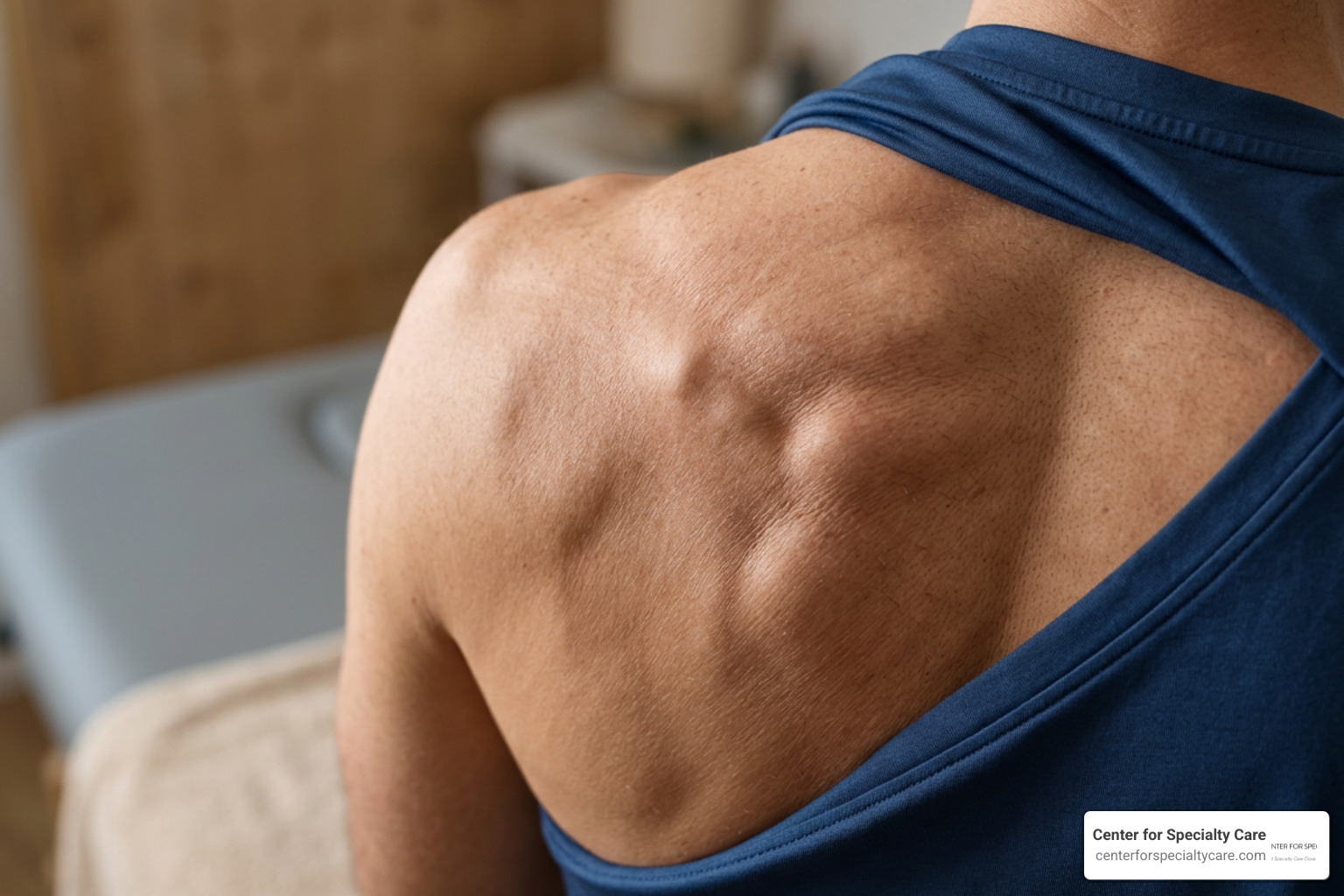
- It can feel like a small bump, a pea-sized lump, or a rope-like band under the skin
- It may cause pain right at the spot — or refer pain to other areas of your back
- Up to 85% of people will experience muscle knots at some point in their lives
These knots form when muscle fibers become overloaded and can’t fully relax. The result is a tight, irritated spot that restricts movement and causes real discomfort — sometimes even affecting sleep and daily activities.
The back is one of the most common places for knots to develop. The upper back, lower back, and the muscles around the shoulder blades are all frequent trouble spots. And while most knots aren’t dangerous, some persistent cases do need professional attention.
I’m Dr. Corey Welchlin, a board-certified orthopedic surgeon with over 30 years of experience treating musculoskeletal pain — including the kind caused by a stubborn knot on back muscles. In this guide, I’ll walk you through the causes, what to watch for, and when it’s time to seek care.
What is a Myofascial Knot on Back?
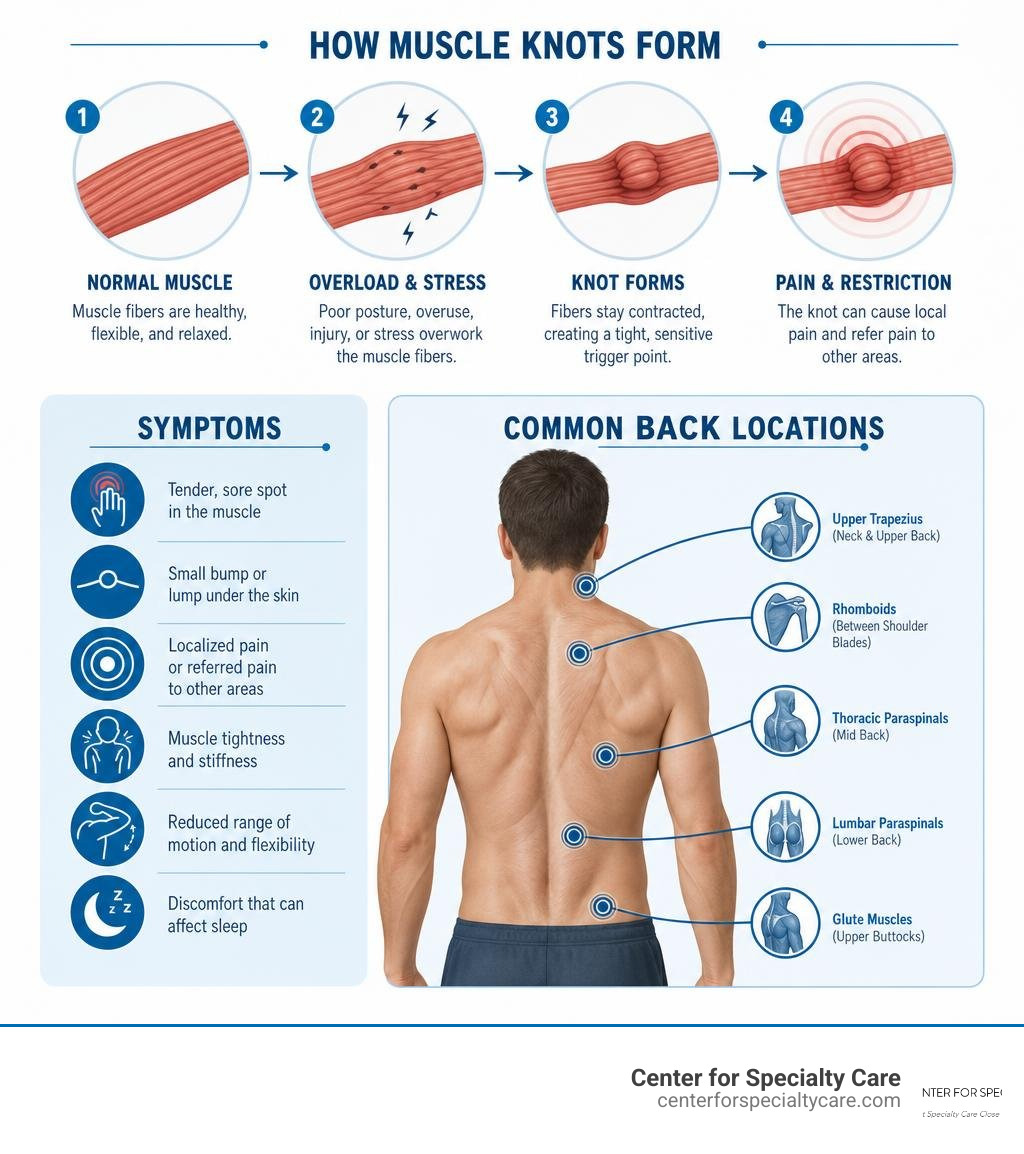
To understand what a knot on back muscles actually is, we have to look beneath the skin. When you run your fingers over a sore spot on your shoulder or lower back and feel a hard, pea-sized lump, you aren’t actually feeling a literal “knot” in the tissue. Your muscle fibers haven’t tied themselves in a bow. Instead, you are feeling a highly localized, hyperirritable spot within a band of skeletal muscle.
Clinically, these are known as myofascial trigger points. Under normal conditions, your muscle fibers are designed to contract and relax smoothly to facilitate movement. However, when a muscle is pushed beyond its capacity, injured, or subjected to prolonged immobility, sections of these fibers can get stuck in a state of constant, involuntary contraction.
To explain how these form, researchers often point to the Cinderella hypothesis. This theory suggests that during low-intensity, repetitive tasks (like typing at a desk or driving), the body repeatedly recruits the same small, low-threshold muscle fibers—the “Cinderella fibers”—to do all the work. Because these fibers never get a break, they become severely overworked, while the larger, stronger fibers remain underutilized.
When these fibers stay continuously contracted, the local blood flow is cut off. This lack of circulation means the muscle fibers do not receive the oxygen and nutrients they need to recover. At the same time, cellular waste products and toxins build up in the tissue, unable to be swept away by the bloodstream. This toxic, oxygen-deprived microenvironment irritates nearby nerve endings, sending pain signals to your brain and causing the surrounding muscle to tighten further in a defensive spasm.
Common Trigger Point Locations
While you can get a muscle knot almost anywhere you have skeletal muscle, they are incredibly common in the back. The most frequent locations include:
- The Upper Trapezius: Running from the base of your skull, across your neck, and down to your shoulders.
- The Rhomboids: Located in the mid-back, right between your shoulder blades and your spine.
- The Levator Scapulae: The muscles running along the side and back of your neck down to your shoulder blade.
- The Quadratus Lumborum (QL): A deep muscle in your lower back on either side of your lumbar spine.
- The Gluteal Complex: The gluteus medius and minimus, which often refer pain directly up into the lower back.
Common Causes of Back Knots by Region
Why do these painful trigger points develop in the first place? In our orthopedic and pain management clinics across Southern Minnesota and Northern Iowa, we find that muscle knots rarely happen in a vacuum. They are typically the body’s defensive reaction to underlying issues such as muscle imbalances, poor posture, repetitive strain, or a sedentary lifestyle.
When a muscle is weak or improperly aligned, other muscles have to overcompensate. This extra burden pushes those “helper” muscles past their limit, forcing them to lock up to prevent further injury. Let’s break down why this happens in different areas of the back.
Causes of an Upper Back Knot on Back
The upper back and shoulder region is perhaps the single most common area for a stubborn knot on back muscles to form. This is largely due to the demands of modern daily life.
Most of us spend hours each day hunched over computers, looking down at smartphones, or driving. This forward-head posture places an immense mechanical strain on the trapezius and levator scapulae muscles. For every inch your head juts forward, it adds roughly 10 pounds of extra weight that your upper back muscles must actively hold up against gravity.
To visualize how these structures connect, you can view our detailed Diagram Of A Shoulder. When the shoulders roll forward and the upper back rounds, the muscles between your shoulder blades (the rhomboids) are pulled into a chronically overstretched, weak state, while the chest muscles become tight and short. This muscle imbalance is a perfect recipe for chronic trigger points.
Furthermore, issues within the shoulder joint itself can cause the surrounding back muscles to tighten defensively. If you are experiencing joint irritation, you might notice clicking or snapping sounds, which we discuss in our guide on Shoulder Joint Pain Popping Causes Effective Relief. When the joint is unstable, the upper back muscles contract to stabilize the shoulder, creating painful knots.
Causes of a Lower Back Knot on Back
If you are dealing with a knot further down, you are certainly not alone. A knot on back muscles in the lumbar region often involves the quadratus lumborum (QL) or the erector spinae.
According to physical therapy experts, a Knot in Lower Back: Causes, Symptoms & How to Get Relief is frequently tied to core and glute weakness. The lower back serves as the central bridge transferring force between your upper and lower body. If your deep abdominal muscles and glutes are weak, they cannot support your pelvis and spine properly. The muscles of the lower back are forced to work overtime to keep you upright.
Other common causes of lower back knots include:
- Favoring One Side: Carrying a heavy bag consistently on one shoulder, standing with your weight shifted to one hip, or sitting on a thick wallet can unevenly distribute force, overloading the muscles on one side of your lower spine.
- Prolonged Sitting: Sitting for hours without movement starves the lower back muscles of fresh, oxygenated blood.
- Repetitive Twisting or Heavy Lifting: Overusing the lower back during yard work, lifting heavy boxes incorrectly, or sudden athletic movements can trigger a protective muscle spasm.
Differentiating a Simple Muscle Knot from Serious Conditions
While the vast majority of back lumps are harmless, tight muscle fibers, it is vital to know when a lump is actually a muscle knot and when it might point to a different medical issue.
| Feature | Simple Muscle Knot | “Back Mouse” (Episacral Lipoma) | Serious Mass / Infection |
|---|---|---|---|
| Feel / Texture | Firm, rope-like, or pea-sized; feels like it is deep within the muscle tissue. | Soft, rubbery, oval-shaped nodule that easily slips or rolls under your fingers. | Can be hard and fixed, or soft and fluctuant (fluid-filled). |
| Location | Commonly in the belly of the muscle (trapezius, QL, rhomboids). | Over the posterior iliac crest (upper outer pelvic brim/lower back). | Can appear anywhere, sometimes over the spine or deep tissue. |
| Pain Pattern | Hurts when pressed; may refer pain to a nearby area. | Can be highly tender if nerves are compressed, but often painless. | Persistent, deep, worsening pain; does not respond to massage or stretching. |
| Systemic Symptoms | None. | None. | May include fever, chills, night sweats, unexplained weight loss, or headaches. |
One benign condition that is frequently mistaken for a lower back muscle knot is a “back mouse.” As detailed in Back Mice: Definition and Treatment – Healthline, these are small, herniated pieces of fat that push through the fibrous connective tissue (fascia) just above the pelvis. They are rubbery, mobile, and can sometimes pinch nearby nerves, causing localized back pain that feels exactly like a stubborn muscle knot.
In rare cases, what looks like a simple muscle knot can turn out to be a sign of a systemic illness or infection. For example, a case study titled Not Your Average Back Knot presented the story of a young patient who complained of a migrating “knot” in his back that was initially treated as a simple muscle spasm. Further clinical examination revealed a fluctuant mass caused by a deep infection, accompanied by low-grade fevers and headaches.
Similarly, a painful lump at the very top of your neck or base of your skull requires careful assessment. While many are simple muscle spasms, a persistent lump in this region can sometimes be linked to cervical spine issues or swollen lymph nodes, as explored in Knot on Back of Skull: Causes and Relief Tips – Acibadem Health Point — JCI-Accredited Treatment in Türkiye.
When to See a Doctor
We always advise patients to listen to their bodies. You should schedule a professional medical evaluation if you experience any of the following “red flag” symptoms:
- The lump is rapidly growing, hard, and does not move when pressed.
- You experience numbness, tingling, or weakness radiating down your arms or legs.
- Your back pain is accompanied by systemic signs like fever, chills, night sweats, or unexpected weight loss.
- The pain is severe (interfering with sleep) and has not improved after two weeks of conservative home care.
- You have a history of cancer.
Effective Home Remedies and Self-Care Techniques
If you have ruled out any red flags and are dealing with a standard, run-of-the-mill knot on back muscles, the good news is that you can easily start treating it at home.

When addressing a trigger point, the primary goal is to restore normal blood flow to the area and encourage the tight muscle fibers to release. In our guide on 3 Ways to Get Rid of Muscle Knots in Back (Quickly & Naturally), we highlight the most effective natural approaches:
- Targeted Self-Massage: You don’t need a professional masseuse on speed dial to get relief. You can use a tennis ball, lacrosse ball, or a specialized cane-style massage tool. Place the ball between your back and a wall (or the floor) and gently roll until you find the tender spot. Apply comfortable, steady pressure for 10 to 30 seconds. Avoid crushing the tissue with extreme force; gentle, repetitive pressure is much more effective.
- Local Tip: If you live near Buffalo Center, Iowa, and need a quick, budget-friendly self-massage tool, you can easily pick up a pack of tennis balls or basic home care supplies at BC Hardware – Hardware store in Buffalo Center, Iowa – Do it Best.
- Strategic Heat and Cold Therapy: Differentiating between hot and cold is crucial. If your knot is brand new, highly inflamed, or occurred after a sudden strain, apply an ice pack wrapped in a thin towel for 10 minutes to reduce local swelling. For chronic, stubborn knots, use moist heat (like a warm bath or a damp heating pad) for 15 to 20 minutes. The heat dilates blood vessels, bringing fresh oxygen and nutrients to the starved muscle fibers.
- Hydration and Nutrition: Muscles are highly sensitive to dehydration and electrolyte imbalances. Drink plenty of water throughout the day. Ensure your diet includes foods rich in potassium, calcium, and magnesium (like leafy greens, bananas, and nuts) to support healthy muscle contraction and relaxation.
Stretches and Exercises for Relief
Movement is medicine. While your instinct might be to rest and immobilize a sore back, gentle movement is actually the fastest way to flush out waste products and encourage muscle fibers to relax.
- Cat-Cow Stretch: On your hands and knees, slowly arch your back toward the ceiling (like a cat), then dip your belly toward the floor while looking upward. Repeat this gentle flow 10 times to improve spinal mobility.
- Child’s Pose with Side Bend: Kneel on the floor, sit back on your heels, and fold forward, reaching your arms out in front of you. To target a knot on the side of your back, slowly walk both hands to the left side until you feel a deep stretch along your right flank. Hold for 30 seconds, then repeat on the other side.
- Foam Rolling: Lie on your back with a foam roller positioned horizontally beneath your shoulder blades. Support your head with your hands and gently roll up and down your mid-back. Avoid rolling directly over your lower back (lumbar spine) without professional guidance, as this can place excessive strain on the joints.
- Diaphragmatic Breathing: Stress is a major contributor to muscle tension. Practice taking deep, slow belly breaths. This activates your parasympathetic nervous system, lowering systemic muscle tension and helping stubborn knots release.
Professional Treatment Options for Stubborn Knots
Sometimes, despite your best efforts with tennis balls and heating pads, a knot on back muscles simply refuses to budge. If a trigger point is severely restricting your mobility or causing chronic pain, it may be time to seek professional care.
At Center for Specialty Care, we offer a range of advanced, personalized treatments designed to break the cycle of chronic muscle spasms. Some of the most effective professional interventions include:
- Physical Therapy: A physical therapist does much more than just massage the sore spot. They perform a comprehensive movement assessment to identify the root cause of your pain—such as weak core muscles or shoulder instability. They will design a customized strength and stretching program to correct these imbalances permanently. To learn more about how physical medicine approaches these issues, you can read about Treating Knots In Your Back | Twin Cities Spine Doctor.
- Dry Needling: This highly effective technique involves inserting a very thin, sterile needle directly into the active trigger point. This stimulates a local “twitch response” in the muscle, which essentially forces the contracted fibers to instantly release and allows normal blood flow to return. Many patients find that dry needling provides much faster and deeper relief than traditional massage.
- Chiropractic Care and Spinal Decompression: If your muscle knots are a protective reaction to a misaligned spine or compressed spinal discs, chiropractic adjustments can help restore proper joint mechanics. For patients dealing with lower back knots linked to sciatica or disc issues, we sometimes utilize advanced therapies like Spinal Decompression in Estherville – Hoyer Chiropractic to gently relieve pressure on the spinal nerves.
- Orthopedic Evaluation: If your back pain is closely linked to a shoulder issue—such as a rotator cuff tear or severe joint instability—our surgical and non-surgical specialists are here to help. You can read more about finding the right specialist in our article, Rotator Cuff Surgeon Near Me Find Trusted Specialists In Your Area.
Frequently Asked Questions about Back Knots
We hear many of the same questions from patients visiting our clinics in Fairmont, Estherville, and Buffalo Center. Here are the facts behind some of the most common myths.
Do muscle knots pop when massaged?
It is a very common sensation: you are massaging a tight spot in your back, and you feel or hear a distinct “pop” or “crunch.”
In most cases, this is not the muscle knot popping. Instead, it is typically the sound of a tendon or fascia slipping over a bony prominence with friction. In other cases, a true popping sound comes from a nearby joint moving, which is a form of joint manipulation. During a professional physical exam, a doctor or therapist will look for a physical “twitch response” when pressing on a trigger point, which can feel like a sudden snap under the fingers as the muscle releases.
Do muscle knots go away on their own?
Yes, minor muscle knots can and do go away on their own. If you develop a mild knot after a hard workout or a stressful day at work, your body’s natural self-repair mechanisms will usually resolve it within a few days—especially if you stay hydrated, do some light stretching, and avoid the repetitive movement that caused the strain in the first place. However, if the underlying cause (like poor posture or a muscle imbalance) isn’t addressed, the knot is highly likely to return.
How long do muscle knots last?
The lifespan of a knot on back muscles depends entirely on its cause and how you treat it:
- Acute Knots: Typically last 10 to 14 days and resolve with basic home care, rest, and light movement.
- Chronic Knots: Can last for weeks, months, or even years if they are tied to a persistent posture habit, joint instability, or chronic stress. These stubborn cases usually require professional intervention to break the pain-spasm cycle.
Conclusion
A knot on back muscles can be incredibly frustrating, but you do not have to live with chronic stiffness and pain. Whether your symptoms are caused by long hours at a desk, a sudden workout strain, or an underlying muscle imbalance, there are highly effective ways to find lasting relief.
At the Center for Specialty Care, our orthopedic and pain management clinic in Fairmont, Minnesota—along with our convenient locations in Estherville, Buffalo Center, and St. James—is dedicated to providing comprehensive, personalized care. We offer both surgical and non-surgical options tailored to your unique lifestyle, with a commitment to quick appointment availability and 100% patient satisfaction.
If you are tired of dealing with a stubborn back knot or shoulder pain, let our experienced team help you get back to doing what you love. Schedule a consultation for back and shoulder pain with us today!