
Extensor Tendonitis Joint Stiffness: Don’t Let Tight Tendons Ruin Your Walk
July 20, 2026
Detailed Guide to Radiating Pain Causes
July 22, 2026
Rubbing Your Back the Right Way to Release Deep Knots
Why Knots in Your Shoulder Blades Won’t Go Away on Their Own
Knots in shoulder blades massage is one of the most effective ways to find real, lasting relief from that deep, nagging tension that just won’t quit.
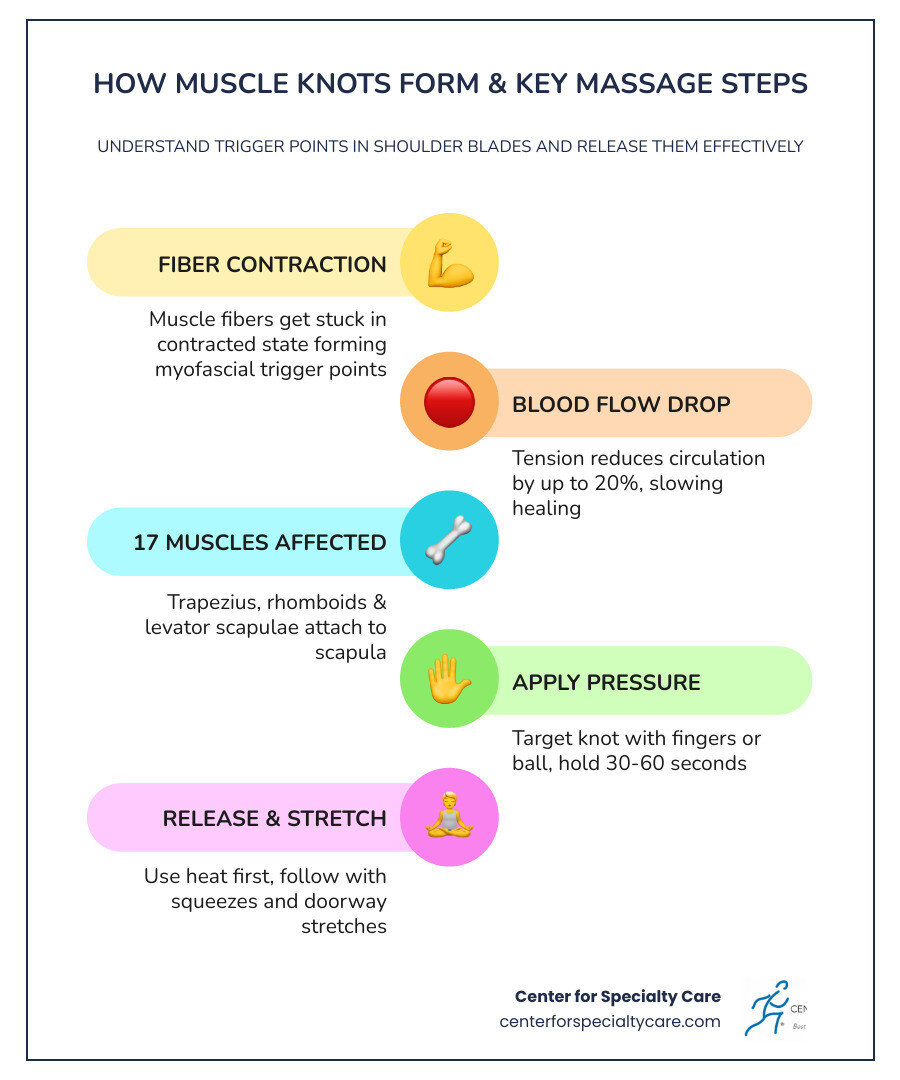
Here’s a quick overview of how to release shoulder blade knots with massage:
- Apply targeted pressure – Use your fingers, a tennis ball, or a massage tool directly on the tender spot
- Hold for 30-60 seconds – Sustained pressure helps the contracted muscle fibers release
- Use heat first – Apply a heating pad for 15-20 minutes before massaging to relax the tissue
- Work the front, not just the back – Tight chest muscles often drive the problem, so address both sides
- Follow up with stretching – Gentle shoulder blade squeezes and doorway stretches lock in the relief
- See a professional for stubborn knots – Deep or chronic knots often need expert hands
If you’ve ever felt a hard, tender lump between your shoulder blades that aches even when you’re sitting still, you’re not alone. Research suggests muscle knots may affect up to 85% of the population at some point in their lives.
These knots — clinically known as myofascial trigger points — form when muscle fibers get stuck in a contracted state and can’t fully release. The shoulder blade area is especially vulnerable. Seventeen muscles attach to the scapula alone, including the trapezius, rhomboids, and levator scapulae. That’s a lot of muscle tissue that can go wrong.
And when it does, the effects spread. Prolonged tension can reduce local blood flow by up to 20%, which slows healing and makes the knot worse over time — not better.
The good news? The right massage approach, combined with a few targeted habits, can break that cycle.
I’m Dr. Corey Welchlin, a board-certified orthopedic surgeon with over 30 years of experience treating musculoskeletal pain at the Center for Specialty Care in Fairmont, Minnesota. Throughout my career, I’ve worked with countless patients struggling with knots in shoulder blades, and massage — done correctly — is one of the most reliable first steps toward lasting relief.
Explore more about knots in shoulder blades massage:
Introduction & The Anatomy of a Knot
To understand why a knots in shoulder blades massage feels so necessary, we first have to look at the “traffic jam” happening under your skin. Your shoulder blade, or scapula, isn’t just a flat bone sitting on your back; it is a central hub for movement. As of April 2026, we are seeing more “posture-related” knots than ever before, largely due to our reliance on handheld devices and workstation setups.
Seventeen different muscles attach to your shoulder blade. These muscles originate from your neck, your mid-back, and even your lower back. When one of these muscles becomes overworked—perhaps from hunching over a laptop in Fairmont or lifting heavy equipment in Estherville—it can develop a myofascial trigger point.
A “knot” isn’t a literal knot in the muscle fiber. Instead, it is a hyper-irritable spot within a taut band of skeletal muscle. Think of it like a small patch of muscle that has forgotten how to relax. It stays “on” 24/7, which uses up energy, creates metabolic waste, and eventually restricts blood flow. This lack of circulation creates a painful feedback loop: the muscle hurts because it lacks oxygen, and the pain causes the muscle to tighten even further to “protect” itself.
The primary culprits in this area are:
- The Trapezius: The large, diamond-shaped muscle that runs from your neck down to your mid-back.
- The Rhomboids: These sit directly between your shoulder blades and the spine. They are the most common site for that “nagging” deep ache.
- The Levator Scapulae: This muscle connects your neck to your shoulder blade. If you have a knot here, you’ll likely feel it every time you turn your head.
Because so many people (up to 85% of us!) deal with this, understanding the anatomy is the first step toward Shoulder Blade Knots: Causes, Relief, and Prevention Techniques.
Professional Techniques for knots in shoulder blades massage
When you visit us for professional therapy, we don’t just “rub the sore spot.” Professional knots in shoulder blades massage involves a systematic approach to deactivate the trigger point and restore normal muscle function. This is a core part of our Sports Medicine philosophy—getting you back to peak performance by addressing the root of the tension.
The Role of Myofascial Release
One of the most effective professional tools is myofascial release. Your muscles are wrapped in a thin, strong layer of connective tissue called fascia. When you have chronic knots, this fascia can become “stuck” or develop adhesions. During a session, a therapist uses sustained, gentle pressure to stretch and soften the fascia. This isn’t about quick movements; it’s about waiting for the tissue to literally “melt” under the hands, which allows the underlying muscle to finally let go.
Clinical Trigger Point Therapy
In a clinical setting, we distinguish between active and latent trigger points.
- Active points cause pain even when you aren’t touching them.
- Latent points only hurt when pressed, but they still restrict your range of motion.
The gold standard for treating these is ischemic compression. By applying firm, direct pressure to the knot, we temporarily restrict blood flow. When the pressure is released, a fresh surge of oxygenated blood rushes into the area. This “flushes” out the metabolic waste that has been keeping the muscle in a state of spasm. It’s important to remember that prolonged tension can reduce circulation by up to 20%, so this “reboot” of blood flow is essential for healing.
If you are interested in the biological mechanics of this process, you can read more at How to Massage Knots Out of Your Shoulder – Biology Insights.
At-Home Relief: Tools and Methods for Deep Tension
We know you can’t always make it into our Fairmont or Buffalo Center clinics the moment a knot flares up. Fortunately, there are several highly effective ways to perform a knots in shoulder blades massage on yourself.
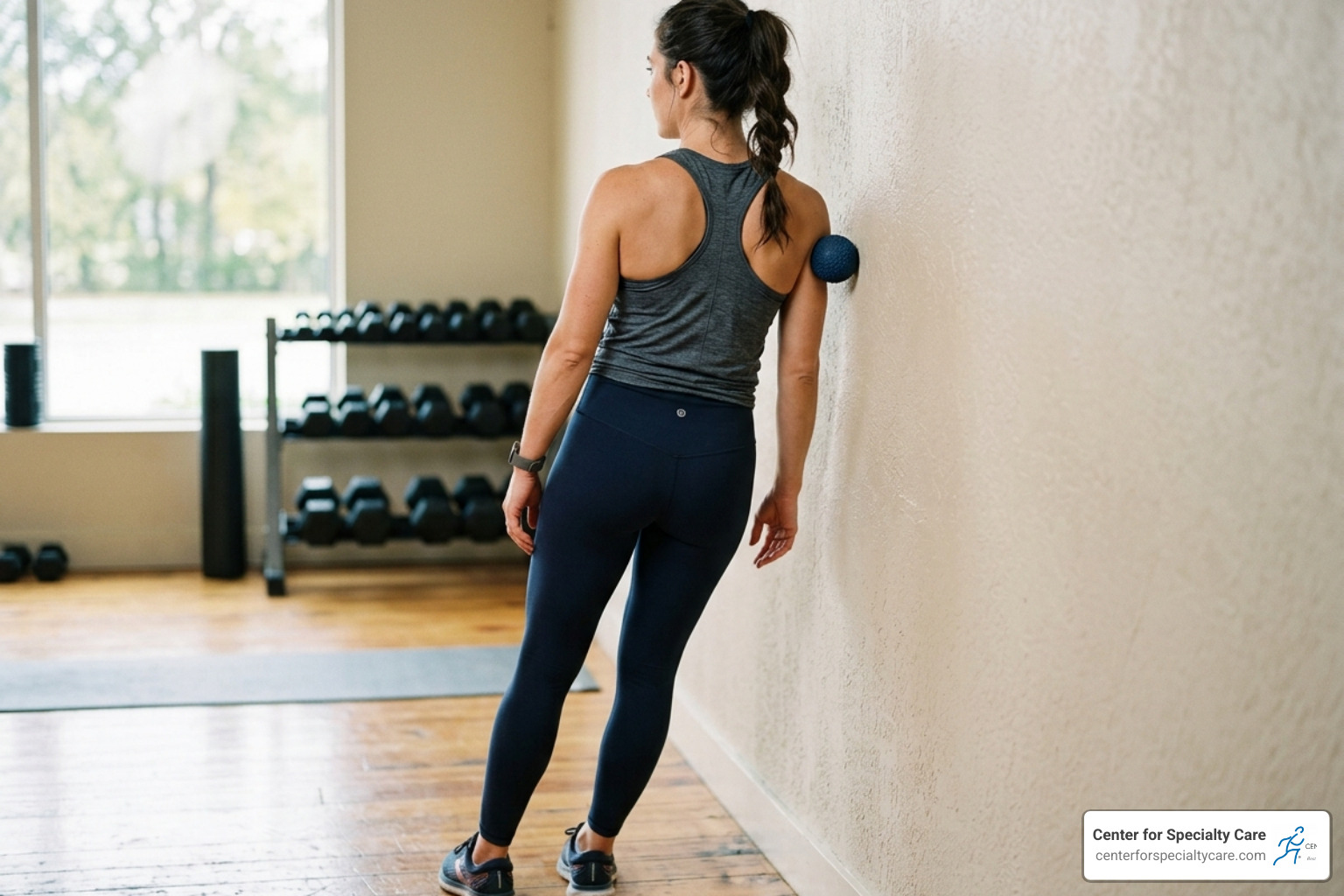
The “Peanut” and Tennis Ball Methods
The most famous at-home tool is a simple tennis ball. For a more intense version, some of our patients prefer a lacrosse ball because it is denser and doesn’t “give” as much.
- The Tennis Ball: Best for beginners or those with high sensitivity.
- The Lacrosse Ball: Best for deep, chronic knots that need significant pressure.
- The Peanut: You can make this by taping two tennis balls together. It’s perfect for rolling up and down the spine, as the gap between the balls protects your vertebrae while the balls massage the muscles on either side.
Heat Therapy: The Essential First Step
Never try to massage a “cold” knot. We recommend applying heat for 15-20 minutes before you start. This increases tissue elasticity and makes the massage much more effective. A warm shower or a heating pad works wonders.
Step-by-Step Guide to Self-knots in shoulder blades massage
To get the most out of your self-treatment, follow this clinical protocol:
- Locate the “Hot Spot”: Lean against a wall with a tennis ball placed between your shoulder blade and your spine. Move slowly until you find the point of maximum tenderness.
- Apply Ischemic Pressure: Lean your body weight into the ball. You want to reach a “good hurt”—about a 6 or 7 on a scale of 10. If you are gasping for air or tensing up, you are pressing too hard.
- Deep Breathing: This is the most overlooked step. As you hold the pressure, take deep, slow breaths. This signals your nervous system to relax. If you hold your breath, your brain thinks you’re in danger and will keep the muscle tight.
- Hold for 30-60 Seconds: You should feel the knot start to “soften” or the pain start to dull. This is the sign that the muscle fibers are releasing.
- Circular Friction: After the initial hold, move your body slightly to make small circles with the ball around the area to flush out the tissue.
Using Modern Massage Tools
In 2026, percussion massagers (massage guns) have become household staples. These are great for knots in shoulder blades massage because they provide rapid pulses that override pain signals to the brain. However, be careful! Never use a massage gun directly on the bone of the shoulder blade or the spine. Keep it on the fleshy muscle tissue and use a lower-intensity setting for the upper back.
Interestingly, tension in the upper back can sometimes be linked to repetitive strain in other areas, such as the Wrist. If you’re typing all day, your wrist position can actually affect how your shoulder muscles fire!
Corrective Stretches and Postural Exercises
Massage is excellent for immediate relief, but if you don’t change the underlying habits, the knots will return. Most shoulder blade knots are caused by “short” muscles in the front of the body pulling on “long, tired” muscles in the back.
The Doorway Stretch
If your chest is tight, your shoulder blades are constantly being pulled forward. This overstretches the rhomboids, leading to knots.
- Stand in a doorway.
- Place your forearms on the doorframe with elbows at 90 degrees.
- Step forward gently until you feel a stretch across your chest.
- Hold for 30 seconds.
Wall Angels and Scapular Squeezes
These exercises help “re-train” your muscles.
- Wall Angels: Stand with your back against a wall. Try to keep your head, shoulders, elbows, and wrists touching the wall as you slide your arms up and down like you’re making a snow angel.
- Scapular Squeezes: Imagine there is a pencil between your shoulder blades. Squeeze them together to “hold” the pencil for 5-10 seconds, then release.
| Feature | Stretching | Strengthening |
|---|---|---|
| Primary Goal | Increase muscle length | Support joint stability |
| Best For | Acute tightness/cramps | Preventing recurring knots |
| Frequency | Multiple times daily | 2-3 times per week |
| Effect on Knots | Provides immediate relief | Fixes the root cause |
Postural Awareness in 2026
We often talk about “Tech Neck.” Your head weighs about 10-12 pounds. For every inch you lean it forward, the effective weight on your neck and upper back doubles. By the time you’re hunched over a phone, your back muscles are trying to hold up a 60-pound weight!
Our 2026 Ergonomic Rules:
- The 90-Degree Rule: Elbows and knees should be at 90 degrees while sitting.
- Eye-Level Monitors: If you are looking down, you are creating knots.
- The 30-Minute Break: Every 30 minutes, stand up and do three scapular squeezes.
Frequently Asked Questions about knots in shoulder blades massage
When to Seek Professional knots in shoulder blades massage
While most knots are harmless, some symptoms are “red flags” that require a medical evaluation at our Fairmont clinic. Seek help if you experience:
- Numbness or tingling traveling down your arm.
- Sudden weakness in your grip or arm.
- Pain that prevents you from sleeping.
- A “knot” that feels like a hard, immovable lump that doesn’t change with massage.
How long does it take for a shoulder blade knot to go away?
For a new (acute) knot, you might find relief in just one or two sessions of knots in shoulder blades massage. However, for chronic knots that have been there for months, it typically takes 3 to 5 consistent sessions combined with at-home stretching to see a significant, lasting change.
Can stress cause knots between the shoulder blades?
Absolutely. Stress triggers a “fight or flight” response, which often leads to subconscious clenching of the jaw and shrugging of the shoulders. This is called “muscle guarding.” Over time, this constant tension creates trigger points. Managing your cortisol levels through deep breathing and movement is just as important as the massage itself.
Conclusion
Deep knots in your shoulder blades can feel like a permanent part of your life, but they don’t have to be. By combining professional knots in shoulder blades massage with dedicated at-home care and postural changes, you can reclaim your mobility and live pain-free.
At the Center for Specialty Care, we are committed to providing the residents of Fairmont, St. James, and our neighboring communities in Iowa with the highest level of orthopedic and pain management care. Whether you need a targeted massage therapy plan, physical therapy, or a consultation with an orthopedic surgeon, we are here to help. Our 100% patient satisfaction goal means we listen to your concerns and create a personalized plan that fits your lifestyle.
Don’t let a “knotty” back hold you back from the activities you love in Southern Minnesota and Northern Iowa.