
Sweet Dreams, No Pain: Your Guide to Sleeping with Frozen Shoulder
October 10, 2025
Your Guide to the Coolest Ice Packs on the Market
October 14, 2025
Rhomboid muscle pain: Ultimate 2025 Relief Guide
Why That Nagging Pain Between Your Shoulder Blades Demands Attention
Rhomboid muscle pain is a persistent ache between your shoulder blades that can make simple tasks like reaching or sitting at a desk uncomfortable. This common condition affects the diamond-shaped muscles connecting your shoulder blades to your spine, and while often overlooked, it can significantly impact your daily life.
Quick Answer: Rhomboid Muscle Pain Overview
- Location: Deep aching pain between shoulder blades and spine
- Common Causes: Poor posture, overuse from sports, prolonged sitting, heavy lifting
- Key Symptoms: Tenderness, muscle knots, pain with breathing, limited shoulder motion
- Treatment: Rest, ice/heat therapy, stretching, physical therapy
- Recovery Time: 3 weeks for mild strains, up to several months for severe cases
- Prevention: Good posture, regular stretching, proper lifting technique
Whether it’s a sudden strain from lifting or a chronic ache from poor posture, understanding your rhomboid muscles is the first step toward relief. These muscles are crucial for shoulder stability and posture, and their dysfunction affects your entire upper body.
The good news is that rhomboid muscle pain is highly treatable. Most cases respond well to conservative care, allowing you to return to pain-free movement and prevent future episodes.
As Dr. Corey Welchlin, a board-certified orthopedic surgeon with over 30 years of experience, I’ve helped countless patients at the Center for Specialty Care overcome rhomboid muscle pain. We use personalized treatment plans, combining conservative and surgical methods when necessary, to get you back to the activities you love.
Rhomboid muscle pain vocabulary:
Understanding Your Rhomboid Muscles and Their Pain
Your rhomboid muscles are the unsung heroes that keep your shoulders properly aligned. These diamond-shaped muscles are essential for good posture and everyday movements like reaching for a high shelf.
Anatomy and Function of the Rhomboids
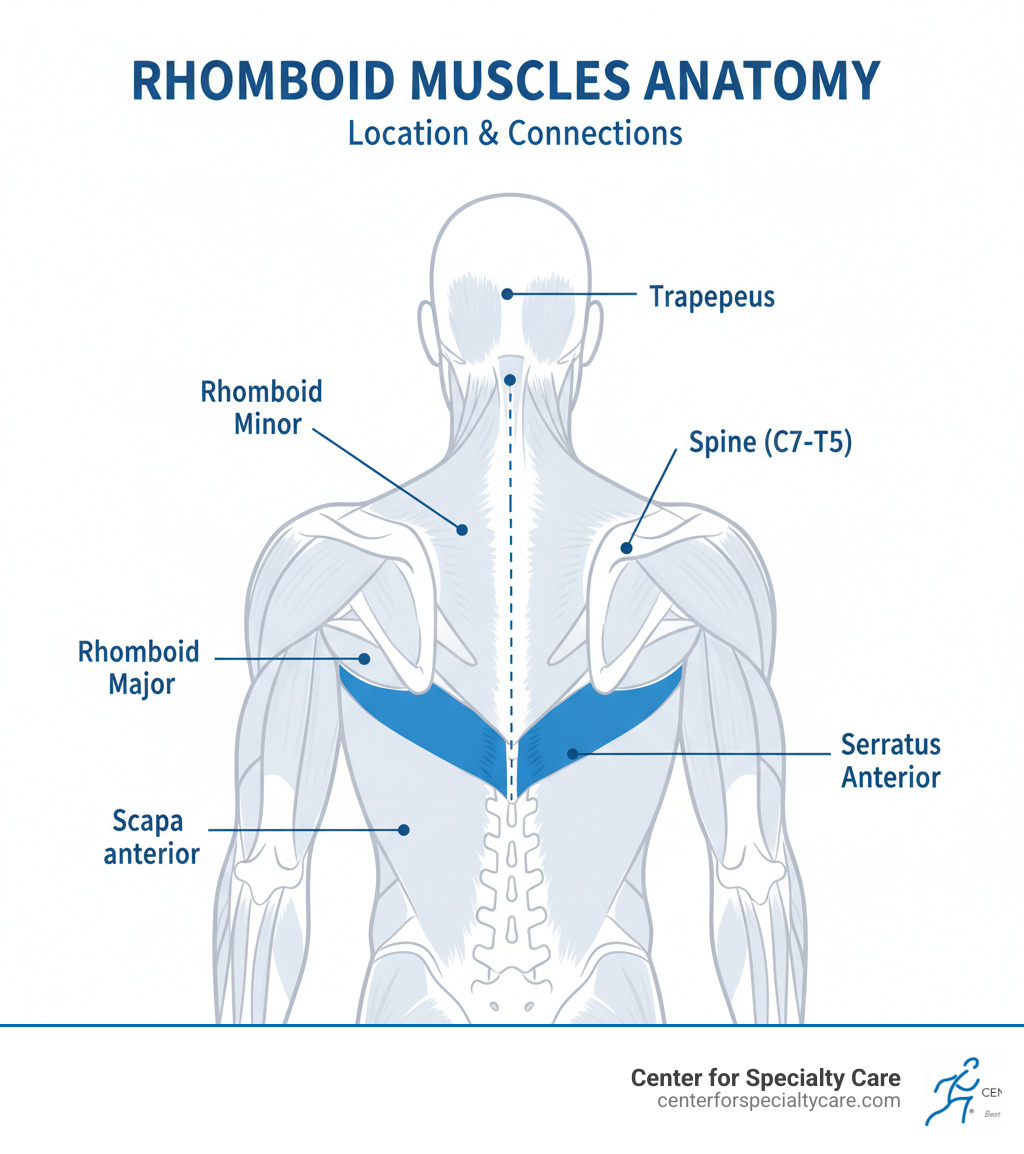
The rhomboids are a pair of muscles located beneath your larger trapezius muscle. The rhomboid major connects your mid-back vertebrae (T2 to T5) to the inner edge of your shoulder blade. Its smaller partner, the rhomboid minor, sits just above it, connecting your lower neck and upper back (C7 to T1) to the same area.
Together, these muscles perform scapular retraction—pulling your shoulder blades toward your spine. This action is key for maintaining good posture and preventing rounded shoulders. They also help squeeze and rotate the shoulder blades downward. As part of the shoulder girdle, they provide essential stability for the entire shoulder complex, enabling smooth, pain-free movement.
You can learn more about how these muscles fit into the bigger picture by exploring the detailed anatomy of the back muscles and their interconnected roles.
Common Symptoms of Rhomboid Muscle Pain
When your rhomboids are strained, they produce several distinct symptoms. The most common complaint is a deep, aching, or burning pain located between your shoulder blades.
Other key signs include:
- Tenderness to the touch in the area between the spine and shoulder blade.
- Muscle knots or spasms, which feel like tight, hard lumps in the muscle. If you have a muscle kink in shoulder blade, your rhomboids are often the cause.
- Pain that worsens with deep breaths, coughing, or sneezing because these muscles help support your ribcage.
- Popping or grinding sounds with shoulder movement. Our guide on shoulder clicking and pain explains what these sounds might mean.
- Limited shoulder motion, making it difficult or painful to reach overhead, across your body, or behind your back.
The pain can also radiate to your upper back, neck, or chest, and may be accompanied by arm fatigue. Symptoms often worsen with prolonged sitting or standing, making it especially troublesome for desk workers.
Common Causes and Diagnosis of Rhomboid Muscle Pain
Rhomboid muscle pain rarely appears without a reason. Understanding what triggers this discomfort is the first step toward effective treatment and prevention.
What Causes Rhomboid Muscle Pain and Spasms?
Rhomboid muscles support your posture and stabilize your shoulders, but they can develop painful spasms and trigger points when pushed beyond their limits. Common causes include:
- Sports and repetitive activities like rowing, tennis, golf, and swimming, especially without a proper warm-up.
- Poor posture, often called “tech neck,” from hours spent hunched over computers or smartphones. If you wake with neck stiffness, our guide on How to Relieve a Stiff Neck After Waking Up may help.
- Heavy lifting done improperly, or carrying heavy backpacks and bags over one shoulder.
- Acute trauma from a fall, a direct blow to the back, or a car accident. If you have Shoulder Pain After Car Accident: Causes & Recovery Tips, your rhomboids might be part of the problem.
- Sleeping in an awkward position, dehydration, or underlying conditions like arthritis.
How a Doctor Diagnoses the Issue
At Center for Specialty Care, we use a comprehensive approach to diagnose rhomboid muscle pain.
- Medical History: We start by discussing your symptoms, when the pain began, and what activities make it better or worse. This helps us understand the context of your injury.
- Physical Examination: We gently press on the area to check for tenderness, tightness, and muscle knots. We also assess your range of motion and observe how your shoulder blades move to pinpoint the source of pain.
- Posture and Strength Assessment: We evaluate your natural posture and test muscle strength to identify any imbalances contributing to your pain.
- Imaging Tests: While usually not necessary, we may recommend an X-ray, CT scan, or MRI if we suspect a more serious issue like a bone problem, nerve compression, or significant tissue damage.
For complex cases, our Orthopedics team uses advanced diagnostic tools. You can learn more about conditions affecting this area from resources on scapular disorders. Our goal is to treat your current pain and help you prevent it from returning.
Your Guide to Effective Treatment and Relief
Once you understand the cause of your rhomboid muscle pain, you can begin the path to recovery. Most people find significant relief with simple, conservative treatments.
At-Home and Self-Care Strategies
Recovery often starts at home with these proven strategies:
- RICE Method: For the first 2-3 days after an injury, follow the RICE protocol. Rest the muscle, apply Ice for 20-30 minutes every few hours to reduce inflammation, and use pillows for Elevation to support your shoulders.
- Heat Therapy: After the initial inflammatory phase, a heating pad or warm compress for 15-20 minutes can improve blood flow and relax tight muscles.
- Pain Relievers: Over-the-counter medications like ibuprofen or acetaminophen, along with topical pain creams, can help manage discomfort.
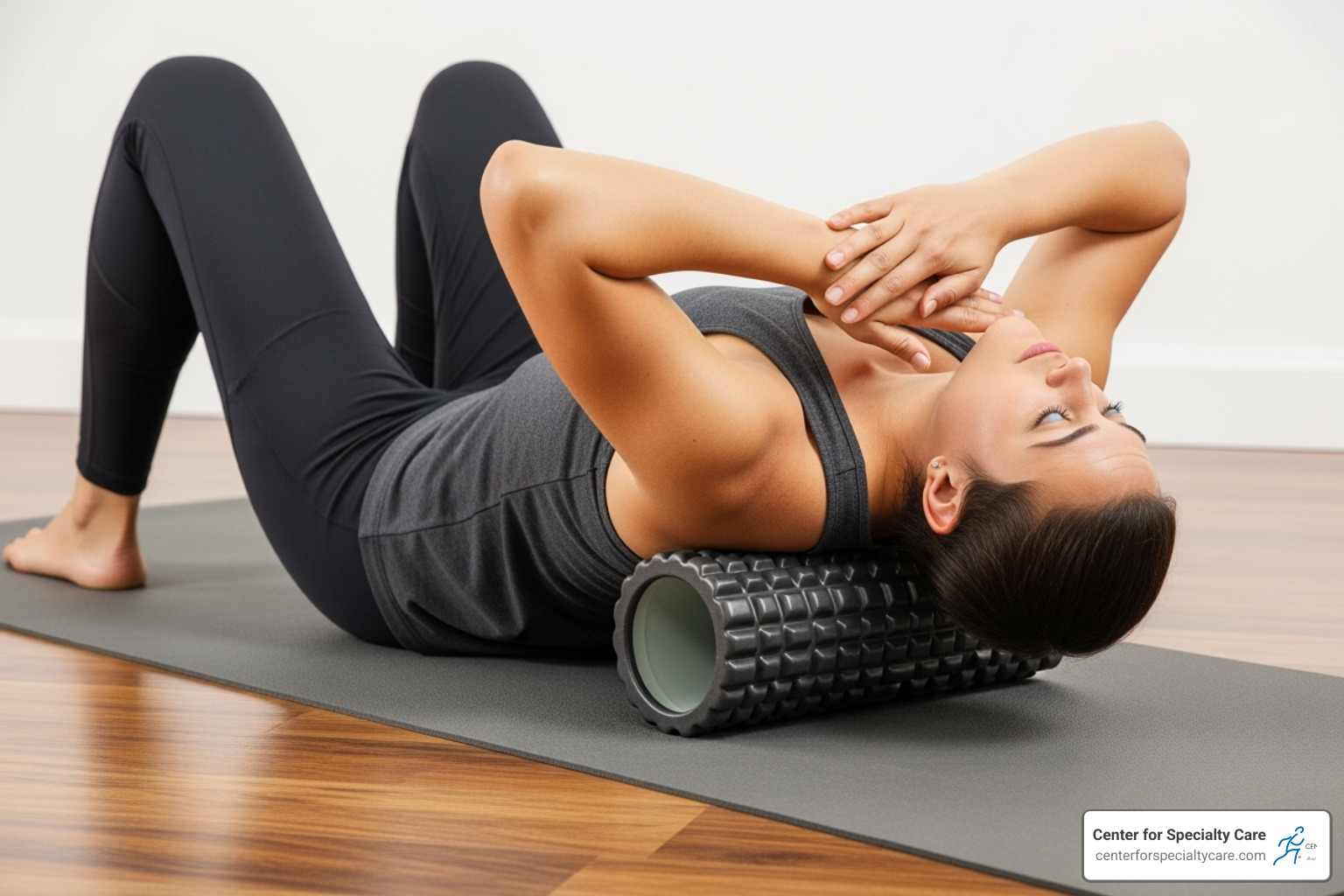
- Self-Massage: Use a tennis ball or foam roller to release stubborn knots. Lie on your back and position the ball between your shoulder blade and spine, then gently roll over it.
- Gentle Stretching: As the acute pain subsides, begin gentle stretches. Combined with good posture and regular movement breaks, this can prevent future episodes.
Professional Treatment Options
If home remedies aren’t enough, our team at Center for Specialty Care offers several effective treatments:
- Physical Therapy: Our Physical Therapy specialists create personalized exercise programs to strengthen your rhomboids, correct muscle imbalances, and improve posture. Hands-on manual therapy can provide immediate relief.
- Massage Therapy: Targeted massage can significantly reduce pain, improve blood flow, and release muscle knots, as confirmed by research in the Journal of Manipulative and Physiological Therapeutics.
- Injection Therapy: For persistent pain, trigger point injections deliver medication directly into muscle knots for targeted relief. Our Pain Management Dr Near Me: A Comprehensive Guide explains these options.
- Surgery: Surgery is extremely rare for rhomboid pain, reserved for cases with significant muscle tears or nerve damage that haven’t responded to conservative care.
When to Seek Medical Attention
While most cases resolve with self-care, seek professional help if you experience:
- Severe or worsening pain that persists for several weeks.
- Numbness, tingling, or weakness in your arm or hand.
- Limited arm movement, especially after a significant injury.
- Difficulty breathing or pain that worsens with breathing.
- Swelling, redness, or fever.
- Persistent grinding sounds with shoulder movement, which could signal underlying Common Spinal Conditions.
At Center for Specialty Care, we offer quick appointment availability across our locations in Fairmont MN, Estherville IA, Buffalo Center IA, and St James MN because early treatment often leads to faster recovery.
Exercises and Prevention for Long-Term Health
Once your rhomboid muscle pain begins to ease, focusing on strength and prevention is crucial to keep the pain from returning. Gentle, consistent movement is the key to keeping your rhomboids strong and flexible. Start slowly and stop if you feel any sharp pain.
Effective Exercises and Stretches
These exercises can help you regain strength and prevent future pain. Consistency is more important than intensity.
- Shoulder Blade Squeeze: Sit or stand tall and gently squeeze your shoulder blades together as if holding a pencil between them. Hold for 5-10 seconds. Repeat 10-15 times for 2-3 sets.
- Rhomboid Stretch: Interlace your fingers with palms facing away from you. Extend your arms forward, rounding your upper back and tucking your chin to feel a stretch between your shoulder blades. Hold for 30 seconds and repeat 2-3 times.
- Side Arm Stretch: Bring one arm across your body at shoulder height. Use your other hand to gently pull the elbow of the stretching arm closer to your body. Hold for 15-30 seconds and repeat 3-5 times per side.
- Doorway Stretch: This stretch helps counteract the forward pull on your shoulders from tight chest muscles. Stand in a doorway with your forearms on the frame and elbows bent at 90 degrees. Step forward with one foot until you feel a stretch across your chest. Hold for 15-30 seconds and repeat 3 times.

- Thoracic Rotations: To improve mid-back mobility, sit upright in a chair, place your right hand on your left knee, and gently twist your upper body to the left. Hold for 20-30 seconds and repeat 2-3 times per side.
- Banded Rows: Once you feel stronger, secure an elastic exercise band at waist level. Hold the ends, keep your elbows close to your sides, and pull back, squeezing your shoulder blades together. Do 2-3 sets of 8-12 reps.
These exercises are often part of the personalized plans in our Sports Medicine program.
How to Prevent Rhomboid Muscle Pain
Prevention is the best defense against rhomboid muscle pain. Small changes to your daily routine can make a big difference.
- Create an ergonomic workspace: Adjust your monitor to eye level, ensure your feet are flat on the floor, and use a chair with good lumbar support.
- Practice good posture: Regularly remind yourself to sit and stand tall with your shoulders back and down.
- Take frequent stretch breaks: Every 30-60 minutes, get up to walk around and stretch your neck, shoulders, and upper back.
- Use proper lifting techniques: Always lift with your legs, not your back. Keep objects close to your body and avoid lifting things that are too heavy.
- Strengthen your back and core: A balanced exercise routine provides a strong foundation for your back. The General back pain prevention tips from the NIH offer excellent guidance.
- Maintain a healthy weight to reduce strain on your back muscles.
- Sleep in a supportive position using pillows to maintain proper spinal alignment.
- Warm up and cool down before and after physical activity.
Frequently Asked Questions about Rhomboid Pain
Here are answers to some of the most common questions our patients have about rhomboid muscle pain.
How long does a rhomboid strain take to heal?
Healing time depends on the severity of the strain and how closely you follow a treatment plan. Here are general timelines:
- Mild strains: Typically heal in about three weeks with proper rest and self-care.
- Moderate strains: May require six weeks or longer to heal completely.
- Severe injuries: Can take several months of dedicated rehabilitation.
Recovery is fastest when you start treatment promptly and avoid returning to full activity until you can move without pain.
Can stress cause pain between the shoulder blades?
Yes, absolutely. When you’re stressed, your body’s natural response is to tense up, which often leads to sustained muscle contraction in the neck, shoulders, and upper back. This chronic tension creates painful trigger points and knots in the rhomboid muscles.
Managing stress through relaxation techniques, mindfulness, and gentle physical activity can be a powerful tool for relieving and preventing rhomboid muscle pain.
Is heat or ice better for rhomboid pain?
The choice between ice and heat depends on the timing of your pain.
- Use ice for the first 2-3 days after an acute injury or when you feel a sudden spasm. Apply an ice pack wrapped in a cloth for 20-30 minutes every few hours. Ice reduces inflammation, swelling, and pain.
- Use heat for chronic, nagging muscle tightness after the initial 48-72 hours. A heating pad or warm compress for 15-20 minutes helps relax muscles, reduce spasms, and improve blood flow.
Some people find that alternating between heat and cold therapy provides the most relief for persistent stiffness. Experiment to see what works best for you.
Take the Next Step Towards a Pain-Free Back
Living with rhomboid muscle pain doesn’t have to be your reality. You are now equipped with the knowledge to understand its causes, find effective treatment, and prevent it from returning.
You’ve learned that this nagging pain often stems from common triggers like poor posture, overuse in sports, or daily stress. Recognizing these causes is the first step toward making smarter choices for your back health.
Effective treatment ranges from simple home remedies like rest and stretching to professional care, including physical therapy and pain management, when you need more support. Most importantly, prevention is your best tool. Small habits like setting up an ergonomic workspace, taking regular stretch breaks, and strengthening your upper back are an investment in your long-term comfort.
At Center for Specialty Care, we provide personalized care for rhomboid muscle pain. Our orthopedic and pain management specialists in Fairmont MN, Estherville IA, Buffalo Center IA, and St James MN are committed to your recovery, creating a plan custom to your needs.
We know that when you’re in pain, you can’t wait weeks for an appointment. That’s why we prioritize quick appointment availability. Our commitment to 100% patient satisfaction means we’re focused on one thing: getting you back to doing what you love, pain-free.
Your journey to comfort starts now. Don’t let rhomboid muscle pain hold you back any longer.