
The Great Debate on Whether Heat or Ice is Better for Tendon Pain
August 14, 2026
Rhomboid Taping 101: Banishing the Pain Between Your Shoulder Blades
August 19, 2026
The Best Exercises to Release Knots Under Your Shoulder Blade
That Nagging Ache Under Your Shoulder Blade Has a Name — and a Fix
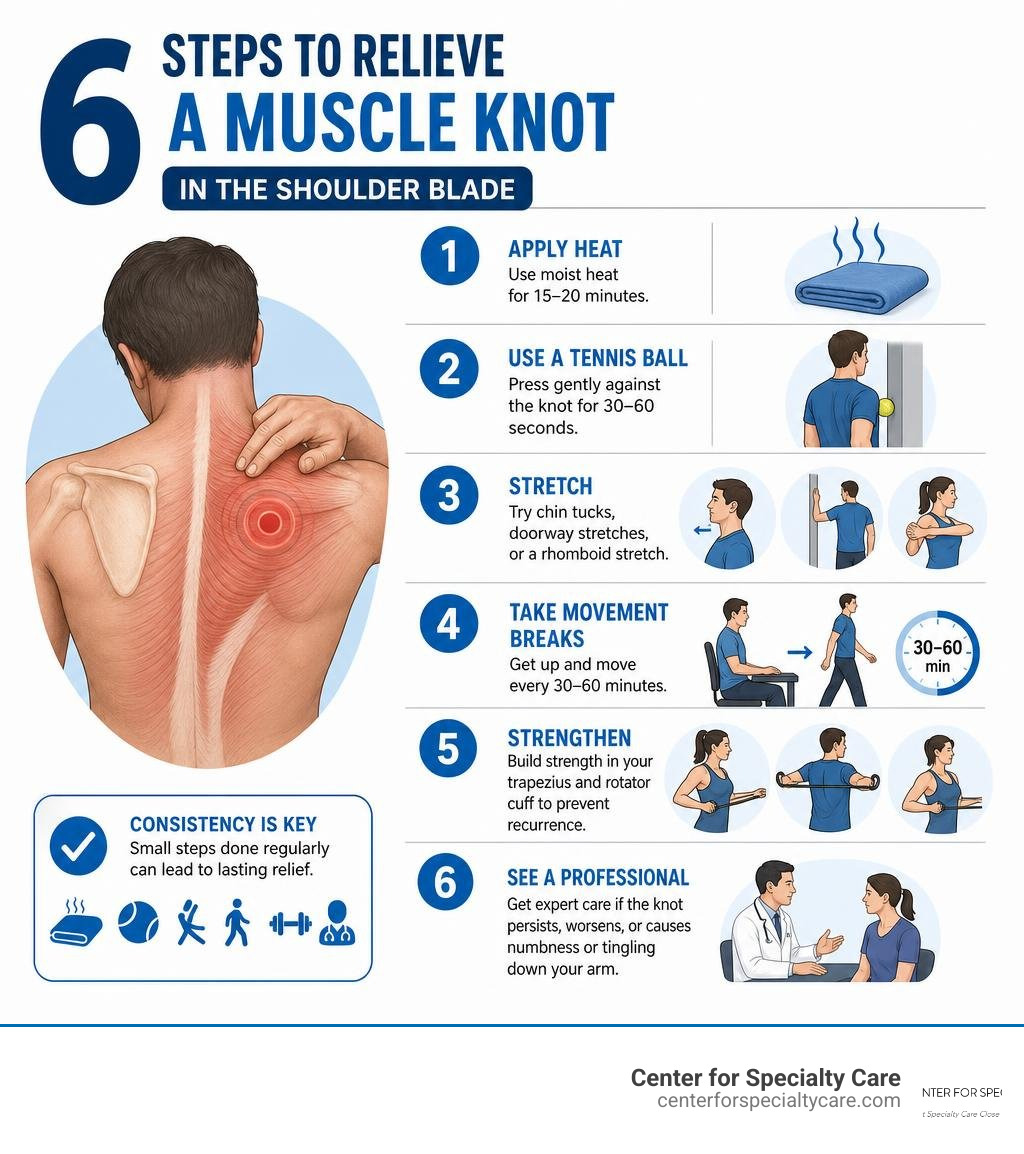
If you’re trying to figure out how to get rid of muscle knot in shoulder blade pain, here’s the short answer:
- Apply moist heat for 15-20 minutes to relax the muscle
- Use a tennis ball against a wall to apply gentle pressure to the knot for 30-60 seconds
- Stretch the area with chin tucks, doorway stretches, or a rhomboid stretch
- Take movement breaks every 30-60 minutes if you sit at a desk
- Strengthen the surrounding muscles (trapezius, rotator cuff) to prevent recurrence
- See a professional if the knot persists, worsens, or causes numbness or tingling down your arm
That tight, tender spot near your shoulder blade is one of the most common complaints we see. It can feel like a small lump, a dull ache, or even a sharp zing — and it can appear out of nowhere.
The shoulder blade area is especially vulnerable to this kind of tension. Why? Because seventeen different muscles attach directly to the scapula, connecting it to your neck, shoulders, and lower back. When any of those muscles get overworked, overstretched, or stuck in one position for too long, they can lock up into what’s clinically called a myofascial trigger point — or more simply, a muscle knot.
For most people, the culprit is something ordinary: sitting at a desk, staring at a screen, or repeating the same motion over and over. The pain can stay local, or it can radiate — sometimes causing headaches, stiffness, or soreness that seems unrelated to the shoulder at all.
The good news? Most shoulder blade knots respond well to targeted exercises, self-massage, and simple lifestyle changes.
I’m Dr. Corey Welchlin, a board-certified orthopedic surgeon with over 30 years of experience treating musculoskeletal pain — including the stubborn shoulder and upper back conditions that bring many patients to our clinic here in Fairmont, Minnesota. I’ve guided countless patients through exactly how to get rid of muscle knot in shoulder blade discomfort, from simple home strategies all the way to clinical intervention when needed. In this guide, we’ll walk through everything you need to know to find real, lasting relief.
How to get rid of muscle knot in shoulder blade helpful reading:
- what are knots in muscles
- muscle knots in shoulder blade symptoms
- stretch for knot in shoulder blade
How to Get Rid of Muscle Knot in Shoulder Blade: Understanding the Causes
To effectively release a muscle knot, we first have to understand why it formed in the first place. The scapula (shoulder blade) is a highly mobile bone that floats on the back of your rib cage. Because it relies entirely on muscles for its stability and movement, any postural dysfunction or repetitive strain quickly translates into muscular tension.
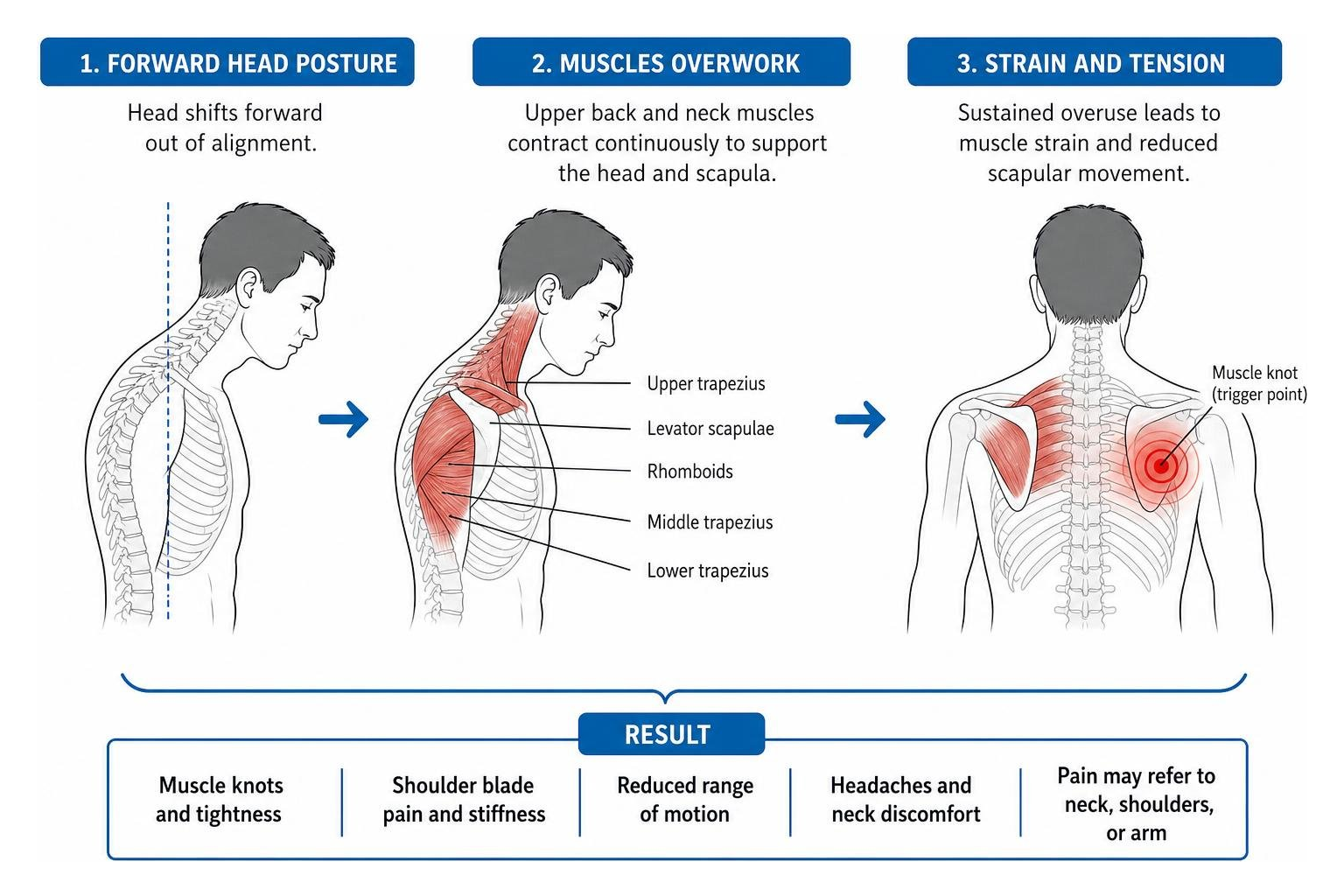
When we evaluate patients at our Fairmont clinic, we find that the vast majority of shoulder blade knots stem from a combination of:
- Prolonged Static Postures: Sitting at a computer, hunching over a steering wheel, or looking down at a smartphone for hours on end.
- The “Bowling Ball” Analogy: The average human head weighs about 10 to 12 pounds. When your posture is upright, that weight is easily balanced over your spine. However, for every inch your head tilts forward (a posture we affectionately call “shrimp mode”), the effective weight of your head increases dramatically. Your upper back and neck muscles must contract constantly just to keep your head from falling forward, leading directly to stubborn knots.
- Repetitive Overhead Movements: Activities like painting a ceiling, playing pickleball, throwing a ball, rowing, or even extensive gardening can overwork the scapular stabilizers.
- Emotional Stress: When we are stressed, we tend to unconsciously shrug our shoulders and hold tension in our upper backs, keeping these muscles in a state of constant low-grade contraction.
To learn more about the physiological breakdown of these tight tissue bands, read our in-depth guide on What Are Knots in Muscles?
The Anatomy of a Shoulder Blade Knot
Underneath your skin, your upper back is a complex web of overlapping muscle layers. The most common muscles to develop trigger points in this region include:
- The Rhomboids: These muscles sit directly between your spine and your shoulder blade, pulling your shoulder blades back toward each other.
- The Levator Scapulae: Running from the top of your shoulder blade up to your neck, this muscle is highly sensitive to forward head posture and stress.
- The Trapezius: This large, kite-shaped muscle covers your neck, shoulders, and upper back. Its middle and lower fibers are frequently overworked and under-strengthened.
When these muscles are subjected to chronic strain, the motor endplates (where nerves meet muscle fibers) release an excess of a chemical called acetylcholine. This flood of chemical signals, combined with local calcium accumulation, causes the microscopic muscle fibers to lock into a sustained contraction.
This localized contraction squeezes nearby blood vessels, cutting off the local oxygen supply (a state called ischemia). Without fresh, oxygenated blood, the muscle cannot easily release, and cellular waste products like lactic acid and bradykinin build up, irritating the local nerves and causing that familiar, throbbing ache. For a comprehensive look at how these muscle layers interact, you can explore detailed Shoulder Massage Techniques to help understand myofascial release.
Common Symptoms of a Shoulder Blade Knot
Identifying a shoulder blade knot is usually straightforward, but the symptoms can occasionally mimic other issues. Common signs include:
- A Palpable, Hard Lump: A distinct, tender nodule that feels like a tight band or a small “marble” under the skin.
- Localized Pain and Tenderness: Sharp pain when direct pressure is applied, transitioning to a dull, persistent ache when at rest.
- Stiffness and Reduced Range of Motion: Difficulty reaching behind your back, stretching your arm across your chest, or turning your head from side to side.
- Referred Pain and Tension Headaches: Active trigger points in the upper trapezius and levator scapulae frequently refer pain upward into the neck, behind the ear, and around the temples, triggering tension headaches.
Because these symptoms are often exacerbated by how you rest at night, choosing the right sleep posture is critical for recovery. If you struggle to sleep comfortably with upper back pain, check out The Ultimate Rhomboid Pain Sleeping Position Guide for practical tips to rest without aggravating your muscles.
The Best Exercises and Stretches for Shoulder Blade Relief
Movement is medicine when it comes to resolving myofascial pain. While it is tempting to rest a sore shoulder, keeping the joint static can actually cause the surrounding tissues to tighten further.
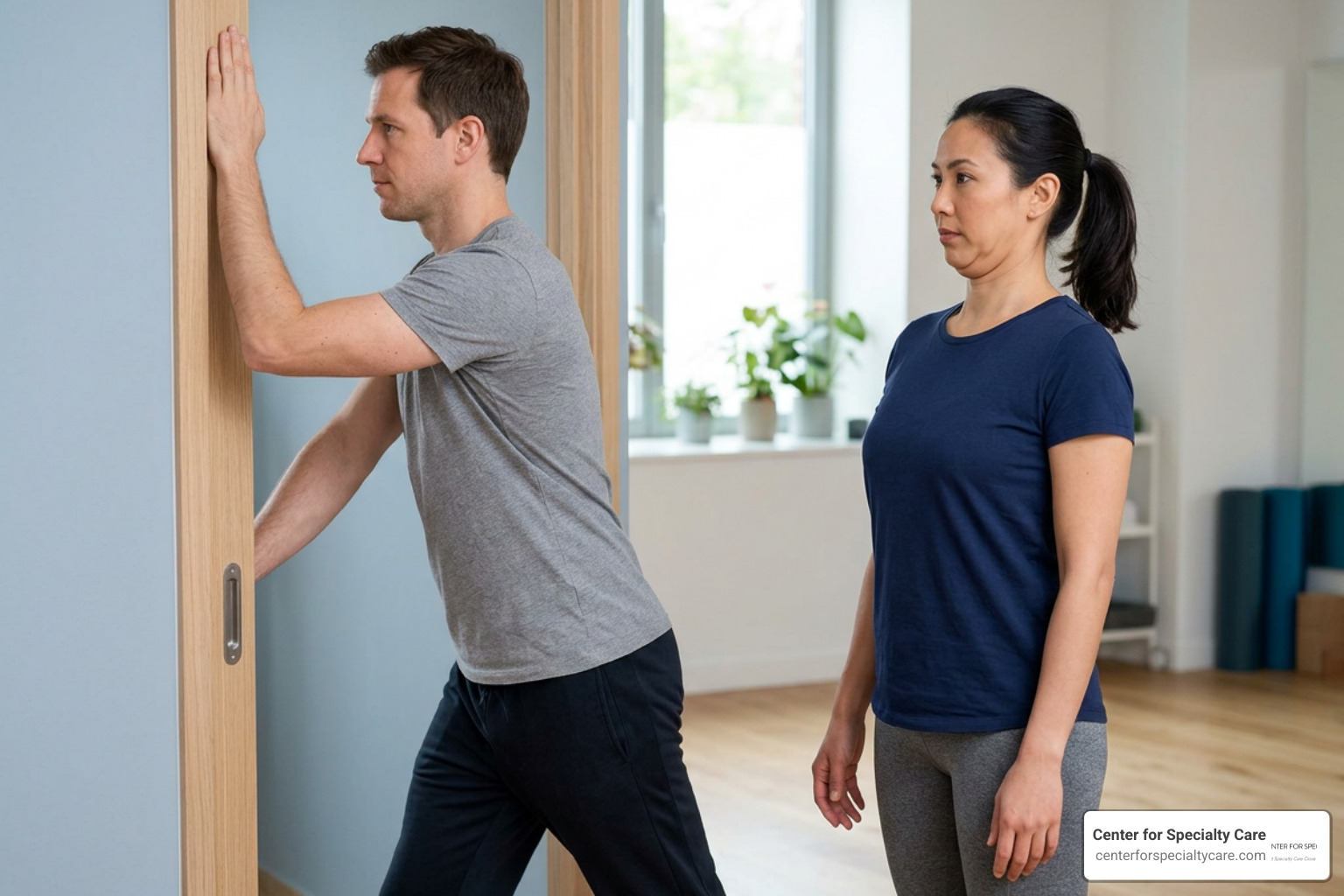
These physical therapy-approved exercises are designed to restore mobility, stretch tight tissues, and build the strength necessary to keep knots from returning. For a deeper dive into movement-based recovery, you can read more about How to Get Rid of a Knot in Your Shoulder Blade as recommended by physical therapists.
Active Stretches to Target Rhomboid and Trapezius Tension
- Chin Tucks (The “Double Chin” Stretch): Sit up straight. Look straight ahead and slowly pull your head straight back, as if you are trying to make a double chin (don’t tilt your head down; keep your eyes on the horizon). Hold for 5 seconds, then release. Repeat 10 times. This simple movement counteracts forward head posture and stretches the suboccipital and levator scapulae muscles.
- The Doorway Stretch: Stand in a doorway with your elbows bent at 90 degrees and your forearms resting against the doorframe. Slowly step one foot forward until you feel a gentle stretch across your chest. Hold for 15 to 30 seconds. Opening up the chest is crucial because tight chest muscles pull your shoulders forward, overstretching and straining the muscles in your upper back.
- Cat-Cow Stretch: On your hands and knees, slowly inhale and let your belly sink toward the floor as you look up (Cow). As you exhale, round your spine toward the ceiling, tucking your chin and pushing through your hands to spread your shoulder blades apart (Cat). Repeat for 10 slow breath cycles.
- Kneeling Lat Stretch: Kneel in front of a chair or couch. Place your elbows on the seat, bring your hands together behind your head, and gently lower your chest toward the floor until you feel a stretch along the sides of your back (lats) and under your armpits. Hold for 30 seconds.
- Median Nerve Glides: Extend one arm out to the side at shoulder height, palm facing up. Flex your wrist so your fingers point toward the floor, then gently tilt your head away from that arm. Slowly return your head and wrist to the starting position. Repeat 10 times to help release any nerve tension that may be contributing to your shoulder pain.
Strengthening Exercises to Prevent Future Knots
Once we have restored mobility, we must build strength in the stabilizing muscles to ensure the larger muscles don’t have to overcompensate.
- Serratus Anterior Activation (“Grandma’s Shawl”): Loop a light resistance band around your back and hold the ends in each hand. Extend your arms forward at chest level. Keeping your elbows straight, punch your hands forward by sliding your shoulder blades forward around your rib cage. Slowly pull your shoulder blades back together. Repeat for 2 sets of 10-12 repetitions.
- Middle Trapezius Squeezes: Sit tall with your chin tucked. Place your palms up with your elbows bent at 90 degrees by your sides. Slowly squeeze your shoulder blades down and together, imagining you are trying to hold a pencil between them. Hold for 6 seconds, then relax. Repeat 8 to 12 times.
- Rotator Cuff Strengthening: The rotator cuff acts as the primary stabilizer of the shoulder joint. If these small muscles are weak, the larger muscles of the upper back must work double-time to keep your arm in its socket, leading to chronic knots. To learn about rehabilitating these crucial stabilizers, read our guide on PT for Rotator Cuff Tears.
Self-Massage and Clinical Treatments for Stubborn Knots
If stretching alone isn’t providing the relief you need, incorporating direct tissue manipulation can help break up the stubborn adhesions.
How to Get Rid of Muscle Knot in Shoulder Blade Using a Tennis Ball
Using a tennis ball or lacrosse ball is one of the most effective, accessible ways to perform self-myofascial release at home. This technique utilizes ischemic compression—applying direct, sustained pressure to the knot to temporarily restrict blood flow. When you release the pressure, a rush of fresh, oxygenated blood floods the tissue, flushing out metabolic waste and helping the muscle fibers finally relax.
- Find a Wall or the Floor: Standing against a wall allows you to easily control the amount of pressure you apply. If you need deeper pressure, you can lie on the floor.
- Position the Ball: Place the tennis ball between your spine and your shoulder blade, directly over the tender knot. (Avoid placing the ball directly on your spine or the bone of your shoulder blade).
- Lean In: Gently lean your body weight into the ball until you feel a deep, satisfying pressure. On a pain scale of 1 to 10, aim for a 6 or 7—it should feel “comfortably uncomfortable,” but never cause sharp, stabbing pain or numbness.
- Hold and Breathe: Hold steady pressure on the spot for 30 to 60 seconds while taking slow, deep diaphragmatic breaths. Do not roll rapidly back and forth; sustained static pressure is much more effective for trigger point release.
- Add Gentle Movement: While maintaining pressure, slowly raise your arm on the affected side up and down to glide the muscle under the ball.
For more detailed instructions on self-massage techniques, you can read How to Massage a Knot Out of Your Shoulder.
How to Get Rid of Muscle Knot in Shoulder Blade When Conservative Methods Fail
Sometimes, a knot is so deeply entrenched or has been present for so long that home remedies aren’t enough. When conservative methods fail, it may indicate a condition called Myofascial Pain Syndrome, where trigger points become chronic and highly sensitive.
In these cases, professional clinical interventions can provide the breakthrough you need:
- Dry Needling: A physical therapist or trained clinician inserts thin, sterile acupuncture-style needles directly into the active trigger point. This elicits a localized “twitch response,” which instantly resets the muscle spindle and forces the contracted fibers to relax.
- Trigger Point Injections (TPI): Done in a clinical setting, TPI involves injecting a small amount of local anesthetic (like lidocaine) or saline directly into the knot. This numbs the irritated nerve endings, breaks the pain-spasm cycle, and allows the muscle to heal.
- Manual Therapy and Rib Mobilization: A physical therapist can manually mobilize the scapula and the surrounding joints to ensure proper biomechanics.
| Treatment Type | Best For | Recovery Time | Access |
|---|---|---|---|
| Self-Massage (Tennis Ball) | Acute, mild knots; daily maintenance | Immediate | At-home, anytime |
| Moist Heat / Cold Therapy | Relieving muscle spasms and reducing acute soreness | Immediate | At-home, anytime |
| Physical Therapy | Correcting postural imbalances and strengthening stabilizers | 4 – 12 weeks | Clinical prescription |
| Dry Needling | Stubborn, deep-seated knots that won’t release | 24 – 48 hours | Licensed PT / Clinician |
| Trigger Point Injections | Chronic, severe myofascial pain syndrome | Immediate to 24 hours | Pain Specialist / Orthopedist |
If you are experiencing persistent, non-resolving pain, our comprehensive Pain Management and Orthopedics teams at Center for Specialty Care are here to help you identify the root cause and find a permanent solution.
The Role of Heat and Cold Therapy
Using temperature therapy is an excellent, low-risk way to manage pain and prepare your muscles for stretching or massage.
- Moist Heat: Heat is a powerful vasodilator. It opens up blood vessels, stimulates blood flow, increases the elasticity of connective tissues, and helps stop painful muscle spasms. Applying a warm bath, a hot shower, or a moist heating pad to your upper back for 15 to 20 minutes before stretching or massaging will make the tissues much more pliable. To understand the science behind this, read about the Benefits of Heat Therapy.
- Cold Therapy: Cold acts as a vasoconstrictor, narrowing blood vessels to reduce swelling and numb sharp pain. If your shoulder blade pain is acute (less than 72 hours old) or accompanied by active swelling and inflammation, apply a cold compress or a bag of frozen peas wrapped in a thin towel for 10 minutes at a time. Learn more about balancing these two modalities in our guide on Heat Cold Therapy for Tendonitis.
Why Symmetrical Tools Prevent Rib Misalignment
A highly common clinical mistake people make when trying to treat a “knot” under the shoulder blade is aggressively digging into the area with a single lacrosse ball or a hard, hook-shaped massage cane.
Your ribs connect to your spine at joints that are held in place by tiny intercostal muscles. Sometimes, what feels like a muscle knot is actually a slightly misaligned rib that has been pulled out of place by a tight intercostal muscle.
If you place a single, hard ball directly into the gap next to a misaligned rib, you can inadvertently push the ribs further apart, worsening the structural misalignment and intensifying your pain.
To prevent this, we recommend using symmetrical tools that apply even pressure to both sides of your spine simultaneously:
- The “Peanut” Ball: Tape two tennis balls together or place them inside a clean sock, tying the end tight. Position the “valley” of the peanut over your spine so the balls rest evenly on the muscles on either side, then gently roll up and down.
- A Foam Roller: Laying vertically or horizontally on a foam roller distributes your body weight evenly across your upper back, opening up your chest and mobilizing your thoracic spine safely without putting uneven pressure on individual ribs.
Frequently Asked Questions About Shoulder Blade Knots
What is the difference between a muscle knot, a trigger point, and other shoulder pain?
A muscle knot and a myofascial trigger point are essentially the same thing: a localized, hyperirritable spot within a taut band of muscle fibers. Traditional muscle soreness (like the kind you feel after a hard workout) is typically widespread and resolves within a few days.
Structural shoulder pain, such as a rotator cuff tear, bursitis, or arthritis, originates inside the joint itself and is often accompanied by a clicking or popping sensation, sharp pain when lifting your arm overhead, or pain that wakes you up from sleep.
Why does a knot under my shoulder blade cause headaches or referred pain?
This occurs due to a phenomenon called “referred pain.” When the nerves traveling through your upper back and neck are compressed or irritated by chronically tight muscle fibers, the brain can misinterpret where the pain signals are coming from.
Active trigger points in the upper trapezius and levator scapulae muscles are notorious for sending pain signals upward into the skull, resulting in tension headaches, behind-the-eye pressure, or neck stiffness.
When should I see a doctor for a persistent shoulder blade knot?
While most muscle knots are harmless and resolve with conservative care, you should seek a professional medical evaluation if your shoulder blade pain:
- Does not improve after two weeks of consistent home care, stretching, and rest.
- Is accompanied by numbness, tingling, or a “pins and needles” sensation radiating down your arm or into your fingers (which can indicate a pinched nerve in your cervical spine).
- Causes progressive weakness in your arm or hand.
- Is accompanied by shortness of breath, dizziness, or chest tightness (which require immediate emergency medical attention).
Conclusion
Learning how to get rid of muscle knot in shoulder blade pain doesn’t have to be a guessing game. By combining targeted active stretches, safe self-massage using symmetrical tools, and proper posture habits like taking regular “movement snacks,” you can successfully release tension and reclaim your range of motion.
At the Center for Specialty Care, we are dedicated to helping our communities in Fairmont, MN, Estherville, IA, Buffalo Center, IA, and St. James, MN live pain-free. Our orthopedic and pain management specialists offer personalized, comprehensive care designed to get you back to doing what you love. Whether you need hands-on physical therapy, advanced non-surgical treatments, or a personalized evaluation of your shoulder biomechanics, we are here to help.
Don’t let a stubborn upper back knot keep you on the sidelines. Reach out to our friendly team today and Schedule a Consultation at our Fairmont clinic or one of our convenient satellite locations!