

Why Your Rotator Cuff Hurts at Night and What to Do About It
September 12, 2025
Scapula Secrets: Uncovering the Roots of Your Under-Blade Pain
September 16, 2025
Shoulder Instability Exercises: 3 Steps to Less Pop
Why Shoulder Instability Exercises Are Your Best Defense Against Recurring Dislocations
If your shoulder feels like it might “pop out” during certain movements, you’re not alone. This unsettling sensation is a hallmark of shoulder instability. The frustrating truth is that once you dislocate your shoulder, you have a high probability of it happening again—unless you take proactive steps.
Shoulder instability exercises are targeted movements designed to strengthen the muscles supporting the shoulder joint, improving its stability and reducing the risk of future dislocations. Research shows that a structured exercise program can dramatically reduce your risk of re-injury. For the best results, you must be consistent for at least six months.
Essential Shoulder Instability Exercise Types:
- Range of Motion Exercises: Pendulum swings, wall crawls, passive stretching
- Rotator Cuff Strengthening: External/internal rotation with bands, isometric holds
- Scapular Stabilization: Shoulder blade squeezes, rows, wall push-ups
- Closed-Chain Exercises: Planks with shoulder taps, wall ball stabilization
- Proprioception Training: Rhythmic stabilization, balance challenges
Not all shoulder instability is the same, and the right exercises depend on the cause. I’m Dr. Corey Welchlin, a board-certified orthopedic surgeon with over 30 years of experience. At the Center for Specialty Care, I’ve guided countless patients through recovery using evidence-based shoulder instability exercises that restore both strength and confidence.
Shoulder instability exercises glossary:
Understanding Shoulder Instability: Why Your Shoulder Pops and Clicks
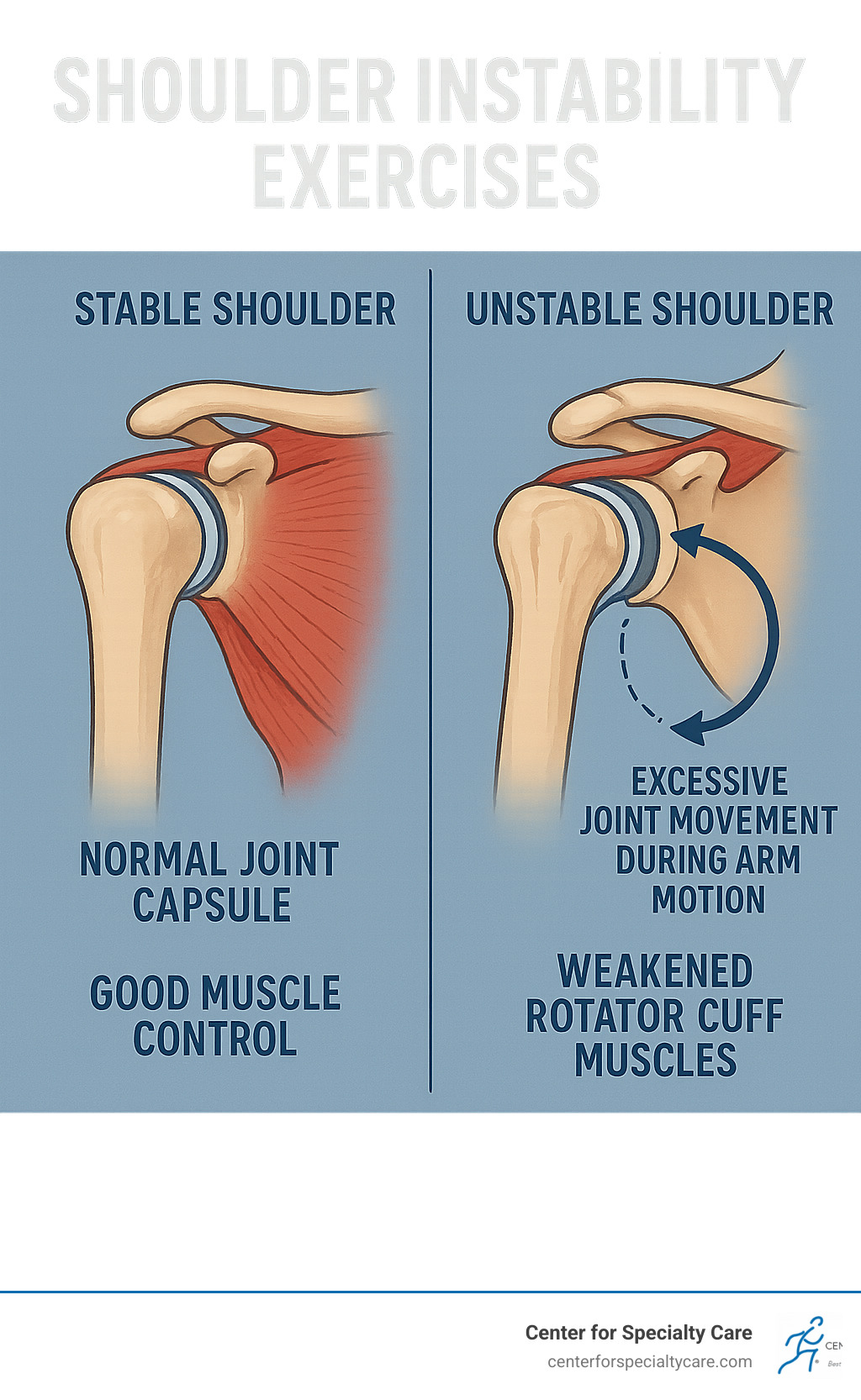
When your shoulder is working correctly, you barely notice it. But when it’s unstable, every pop and click can cause concern. The main shoulder joint (the glenohumeral joint) is a ball-and-socket design, similar to a golf ball on a tee. This provides incredible mobility but sacrifices inherent stability.
To keep the joint secure, your shoulder relies on a support system:
- The rotator cuff muscles act as a dynamic stabilizer, a group of four muscles that wrap around the joint to keep the ball centered in the socket.
- The labrum is a ring of cartilage that deepens the shallow socket, much like adding walls to the golf tee to make it more secure.
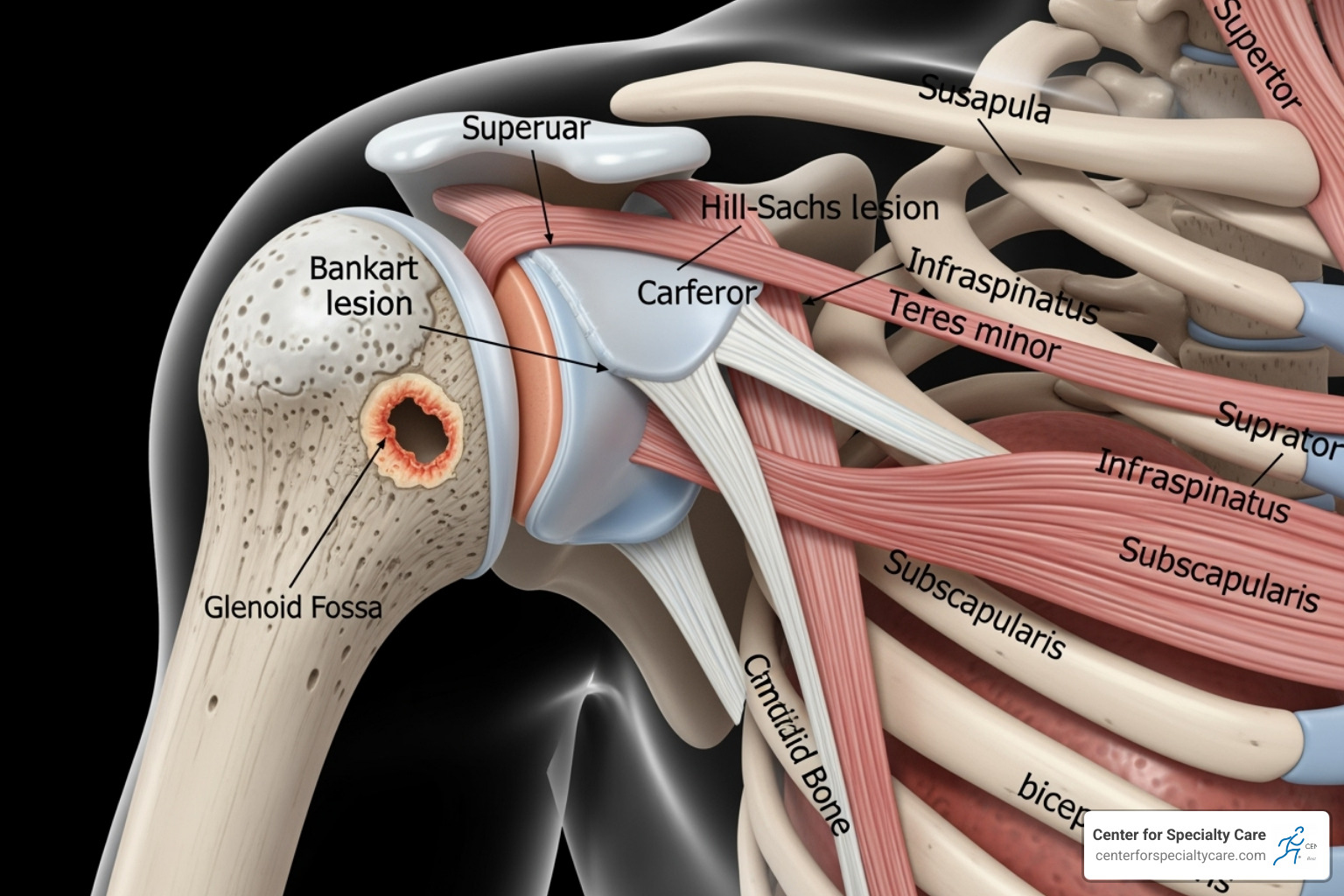
When these structures are damaged or stretched, shoulder instability occurs. The ball moves excessively, creating a feeling of looseness or the sensation that it might slip out. A dislocation is when the ball comes completely out of the socket. A subluxation is a partial dislocation where the ball slips out and then back in. Both can cause lasting damage, such as a Bankart lesion (a tear of the labrum) or a Hill-Sachs lesion (a dent in the ball of the humerus). You can learn more about shoulder joint pain, popping, and effective relief here.
Traumatic vs. Atraumatic Instability
Understanding the cause of your instability is crucial for treatment. There are two main types:
Traumatic Instability (TUBS): This results from a sudden, forceful event like a fall or sports injury. The acronym TUBS summarizes the condition: Traumatic origin, Unidirectional instability (usually forward), often with a Bankart lesion, and frequently requiring Surgery, especially in young athletes.
Atraumatic Instability (AMBRI): This develops gradually without a specific injury, often due to repetitive overhead motions (like in swimming) or naturally loose joints. The acronym is AMBRI: Atraumatic, Multidirectional, often Bilateral (affecting both shoulders), with Rehabilitation as the primary treatment. Surgery (Inferior capsular shift) is less common and may not be more effective than a dedicated exercise program.
Atraumatic instability often responds very well to shoulder instability exercises designed to retrain movement patterns. However, some cases can be a mix of both types, which is why a professional evaluation is essential for an effective treatment plan. For more information, see our guide on the various causes of shoulder problems.
The Foundation of Recovery: Key Principles for Shoulder Stability
Successful recovery from shoulder instability, regardless of its cause, is built on several key principles. These guidelines will help you steer your return to confident, pain-free movement.
-
Initial Management: After a dislocation, a brief period of immobilization in a sling (a couple of weeks for a first-time, non-surgical injury; up to 4 weeks post-surgery) is used for comfort and protection. However, prolonged stillness can cause stiffness, so the goal is to begin gentle, safe movement as soon as possible.
-
Pain as Your Guide: Your body has a built-in warning system. During shoulder instability exercises, you should feel the muscles working, but not sharp pain. If an exercise causes discomfort that lasts more than 10 seconds, stop and ease off.
-
The Importance of Consistency: Shoulder rehabilitation is a marathon, not a sprint. You cannot accurately judge if an exercise program is working unless you have been consistent for at least six months. Persistent effort is the key to long-term success.
-
Gradual Progression: Effective rehab starts with gentle movements in stable positions and slowly advances. As your shoulder strengthens, you will progress to a fuller range of motion, higher intensity, and more complex movements.
-
The Role of Physical Therapy: Professional guidance is invaluable. A physical therapist or surgeon can create a personalized program, ensure proper form, and tell you exactly when and how to progress safely. They are essential for monitoring your recovery. Learn more about the role of physical therapy in recovery.
Before starting any exercise program, consult with your physician. The exercises discussed here are effective but must be performed comfortably and progressed appropriately under professional guidance. Research on rehabilitation goals confirms that a structured, patient-centered approach yields the best outcomes.
A Phased Approach to Shoulder Instability Exercises
Recovering from shoulder instability is a gradual process. We use a phased approach to build strength and confidence, with each phase preparing you for the next. Professional guidance is essential to know when to begin each phase and which shoulder instability exercises are right for you. Always start slowly, listen to your body, and prioritize proper form over the number of repetitions.
Phase 1: Restoring Gentle Range of Motion
This phase focuses on gently reintroducing movement without pain or stress to healing tissues.
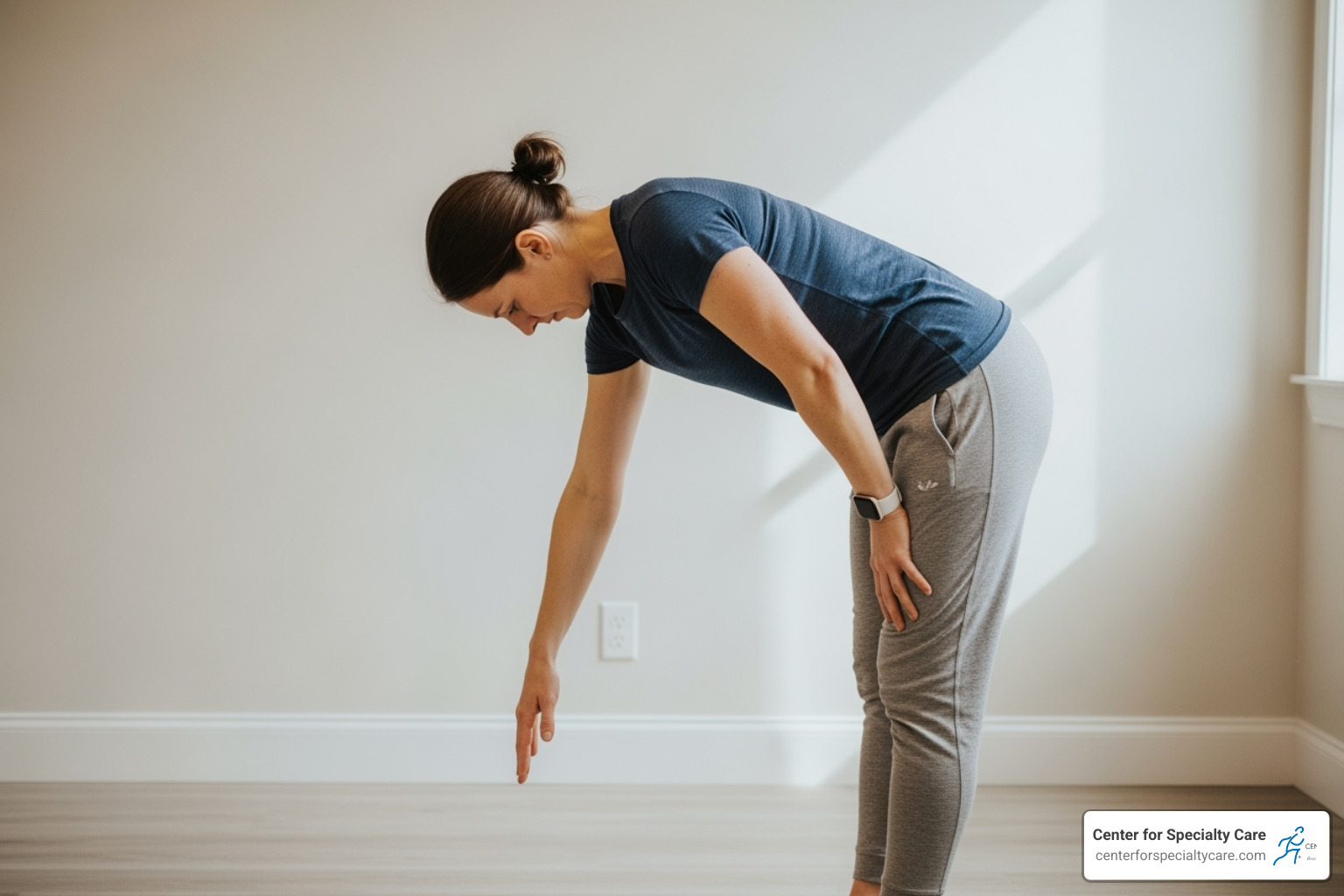
- Pendulum Swings: Lean forward, letting your affected arm hang down. Use gravity to gently swing the arm forward/backward, side-to-side, and in small circles. Do not use your muscles. Perform 2 sets of 10 reps per direction, 5-6 days a week.
-
Wand-Assisted Shoulder Flexion: Lie on your back holding a wand or broom handle with both hands. Keeping your elbows straight, use your good arm to slowly raise both arms overhead until you feel a gentle stretch. Hold for 15-30 seconds and repeat 2-4 times daily.
-
Wall Crawls: Stand facing a wall and place your fingertips on it. Slowly “crawl” your fingers up the wall, moving closer as your arm goes higher. Go only as high as is comfortable. Perform 8-12 repetitions daily.
-
Passive External Rotation with a Stick: Lie on your back holding a stick. Keep your affected arm’s elbow bent at 90 degrees and tucked at your side. Use your other hand to gently push the stick, rotating your affected forearm outward. Hold for 15-30 seconds and repeat 4 times, 5-6 days per week.
Phase 2: Building Foundational Strength with Rotator Cuff and Scapular Exercises
This phase strengthens the rotator cuff and scapular muscles, which provide a stable platform for arm movement.
-
Isometric Rotator Cuff Exercises: To strengthen without joint movement, press the back of your hand (for external rotation) or your palm (for internal rotation) against a wall. Keep your elbow bent at 90 degrees. Hold for 6 seconds and repeat 8-12 times, 2-3 times daily.
-
Scapular Squeezes: Sit or stand with arms at your sides. Gently squeeze your shoulder blades together as if holding a pencil between them. Keep shoulders relaxed. Hold for 6 seconds and repeat 8-12 times daily.
-
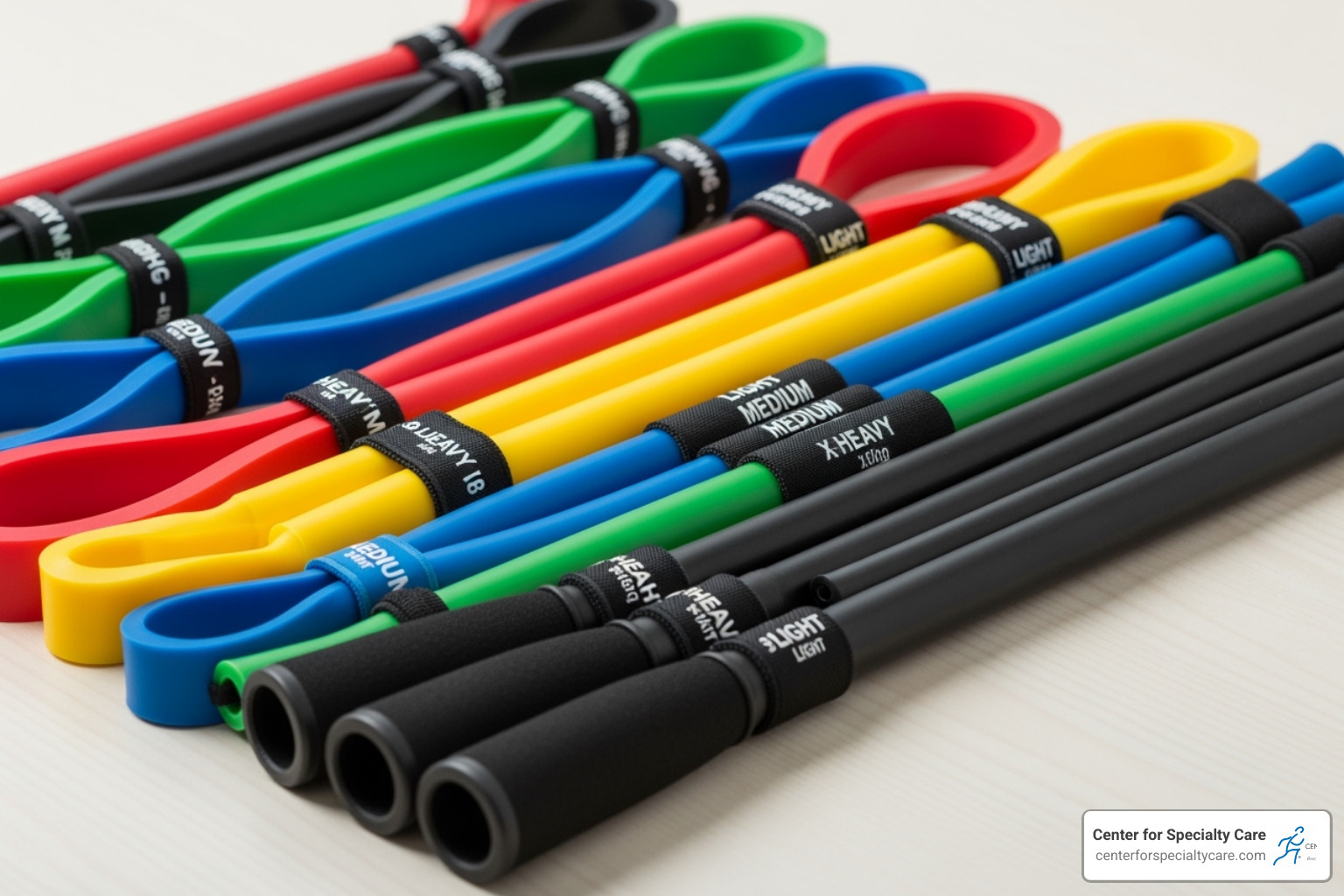
Resisted Rows: Secure a resistance band at waist level. Hold the ends, keep your elbows bent at 90 degrees, and pull back, squeezing your shoulder blades together. Repeat 8-12 times.
-
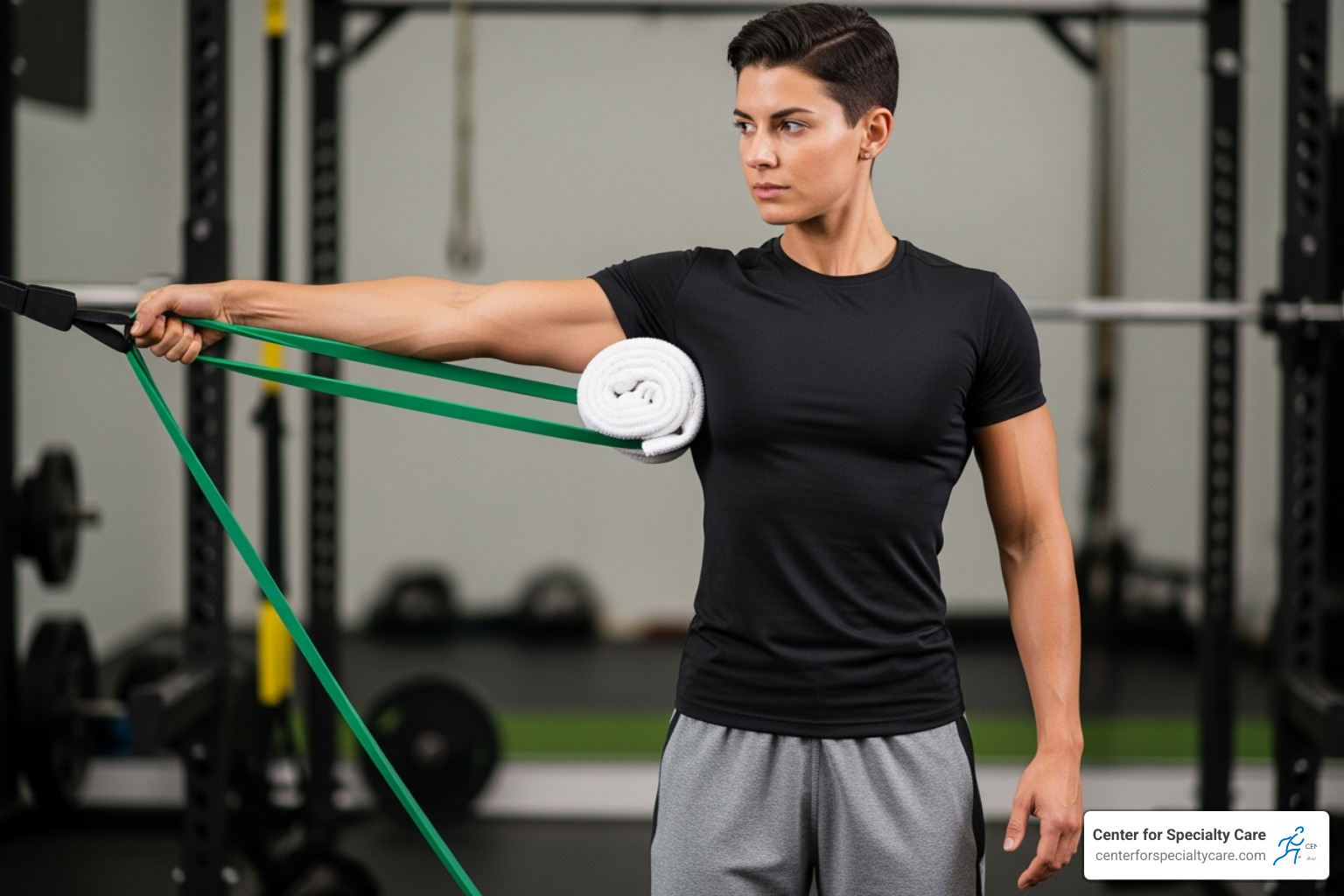
Banded External/Internal Rotation: Tie a band to a doorknob. For external rotation, stand with your elbow bent to 90 degrees (place a rolled towel under your elbow to ensure proper form) and rotate your forearm outward. For internal rotation, rotate your forearm toward your belly. Start with 10 reps and build to 20-25.
- Wall Push-ups: Stand arm’s length from a wall and place your hands on it. Lean in and push back out. This closed-chain exercise engages multiple shoulder muscles. Repeat 8-12 times.
For more information, explore our guide: Best Therapy for Shoulder Pain: Expert Solutions, Relief.
Phase 3: Advanced Shoulder Instability Exercises for Dynamic Control
These exercises prepare your shoulder for real-world demands by training it to react quickly and maintain stability.
-
Plank with Shoulder Taps: In a plank position (on hands and toes, or knees), lift one hand to tap the opposite shoulder while keeping your hips stable. This forces shoulder muscles to work together. Perform 3 sets of 8-12 taps per side, 2-3 times per week.
-
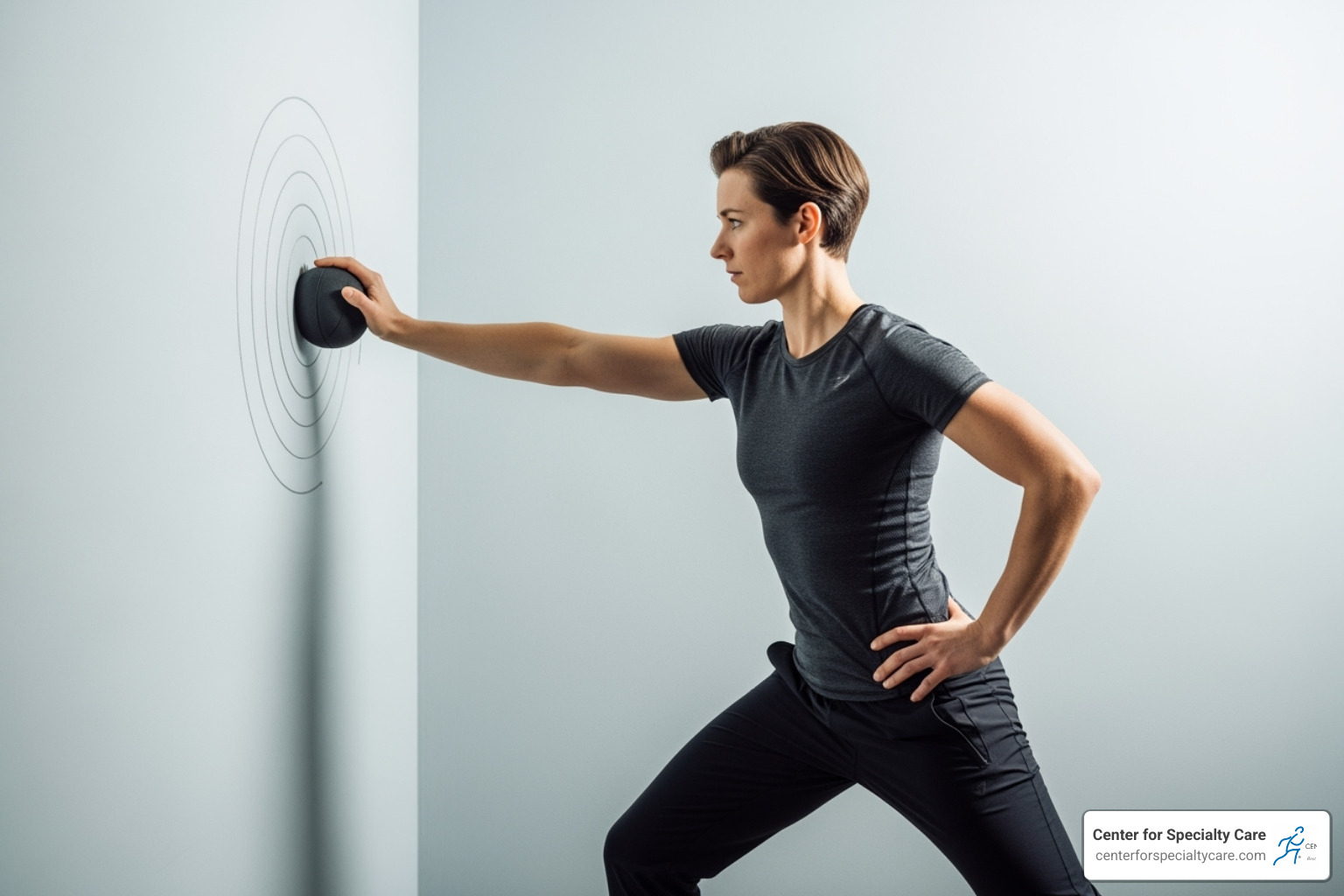
Wall Ball Stabilization: Press a small medicine ball against a wall with your affected hand. Maintain constant pressure while making small circles or figure-eights. This builds reactive stability. Perform for 30-60 seconds for 2-3 sets, 2-3 times per week.
-
Proprioception Drills: Restore your shoulder’s sense of position by performing simple arm movements (e.g., small circles with a light weight) while balancing on one leg or an unstable surface. Perform for 30-60 seconds for 2-3 sets, 2-3 times per week.
-
Rhythmic Stabilization: This advanced technique requires a partner. Lie down with your arm in a specific position. Your partner applies gentle, unpredictable pushes while you resist, keeping your arm still. This trains muscles to react to unexpected forces. Perform for 30-60 seconds per position for 2-3 sets, 2-3 times per week under the guidance of a physical therapist.
For athletes, this phase is crucial. Research shows that passing criteria-based return-to-sport testing, which includes dynamic exercises, significantly lowers the rate of recurrent instability.
Movements to Avoid: Protecting Your Shoulder During Recovery
While strengthening your shoulder, it’s equally important to avoid movements that could set back your recovery. These activities should be avoided or modified until your shoulder has rebuilt sufficient strength and stability.
Be cautious with the following:
- Extreme Overhead Lifting: Heavy, wide-grip overhead presses place significant stress on the front of the shoulder capsule, a vulnerable area after instability.
- Behind-the-Neck Press: This movement forces the shoulder into an extreme and unstable position, combining external rotation and abduction, which mimics the mechanism of dislocation.
- Wide-Grip Bench Pressing and Pec Flyes: An overly wide grip or excessive range of motion can strain the front of the shoulder. Use a narrower grip and limit the stretch until your shoulder is more stable.
- Throwing Motions: Throwing involves high-speed, extreme ranges of motion. A return to throwing sports must be gradual and professionally supervised.
- Certain Swimming Strokes: The butterfly and some freestyle techniques can place significant stress on the joint. Modify your stroke or stick to gentler styles during recovery.
Pay special attention to the “stop sign” position, where your arm is raised to shoulder level and rotated outward. This places the shoulder in a particularly vulnerable state and should be avoided.

Trust your body’s signals. If a movement causes pain or a feeling of instability, stop immediately. These restrictions are often temporary. As you get stronger through your shoulder instability exercises, you can gradually and safely return to more activities. For more tips, see our guide on managing shoulder pain from lifting weights.
Frequently Asked Questions about Shoulder Instability
Here are concise answers to common questions I hear from patients about shoulder instability exercises and rehabilitation.
How does rehabilitation differ for traumatic versus atraumatic instability?
The approach depends on the cause. For traumatic instability, rehab focuses on protecting the injured tissues (like the labrum) while restoring strength. Apprehension is common, and surgery may be considered earlier for young, high-level athletes to prevent recurrence. For atraumatic instability, the focus is heavily on neuromuscular control and endurance training to create a “muscular corset” around the naturally loose joint. Surgery is rarely the first option and has less predictable outcomes.
How long does it take to see results from these exercises?
Recovery is a gradual process. You may feel some pain relief and improved control within the first few weeks. However, significant gains in strength, stability, and confidence typically take three to six months of consistent work. Sticking with a quality program for at least six months is essential for success. For many, a maintenance program becomes a long-term part of their routine to prevent future issues.
When is surgery considered for shoulder instability?
Surgery is an option when a dedicated physical therapy program fails to provide the necessary stability. It is typically considered in these situations:
- Recurrent dislocations that continue despite proper rehabilitation.
- Significant structural damage (e.g., a large Bankart lesion on an MRI) after a traumatic injury, especially in young, high-demand athletes involved in contact or overhead sports.
- Failure to meet personal goals, where instability prevents a return to desired activities or sports.
For atraumatic instability, surgery is considered less often as comprehensive rehabilitation is typically more effective. The decision is always based on your specific injury, activity level, and goals. If you’re considering surgery, learn more about finding expert shoulder care.
Your Path to a Stable Shoulder: Long-Term Success and Expert Guidance
Committing to shoulder instability exercises is an investment in a lifetime of confident, pain-free movement. Sticking with your program provides significant long-term benefits, including a reduced risk of re-injury, improved joint function for daily tasks, and most importantly, increased confidence in movement.
This renewed stability and strength lead to an improved overall quality of life, allowing you to return to the activities you love without fear or hesitation. The journey doesn’t end when symptoms fade; a maintenance program is often recommended to keep your shoulder strong and stable for years to come.
At the Center for Specialty Care, we understand that every patient is unique. We create personalized care plans custom to your type of instability, lifestyle, and goals. Our commitment to 100% patient satisfaction and quick appointment availability across our locations in Fairmont MN, Estherville IA, Buffalo Center IA, and St James MN, ensures you get the expert care you need without delay.
Don’t let shoulder instability control your life. Let us help you regain a stable, functional shoulder you can trust. Learn more about our comprehensive shoulder care and start your journey back to confident movement.