

7 Ways to Relieve a Big Knot in Your Neck
June 25, 2026
Flat Feet Fixes: Choosing the Right Arch Sole for Pain-Free Walking
June 30, 2026
The best way to find a foam roller that actually works
Why Choosing the Right Foam Roller for Your Pain Actually Matters
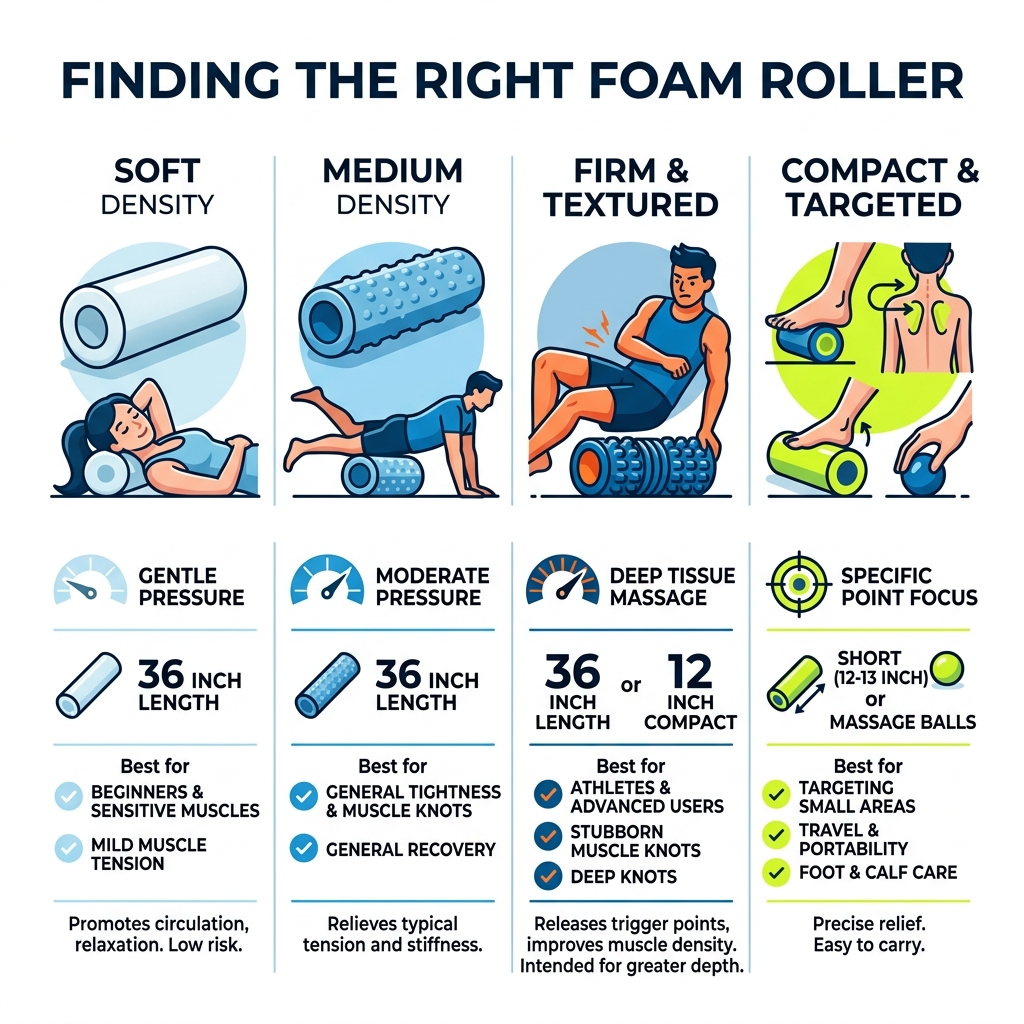
A foam roller for muscle recovery isn’t one-size-fits-all. The right choice depends on your experience level, pain areas, and muscle density. Here’s a quick guide:
| Your Situation | Best Foam Roller Type |
|---|---|
| Beginner or sensitive muscles | Soft to medium density, smooth surface |
| Desk worker with general tightness | Medium density, 36-inch length |
| Athlete or advanced user | Extra firm, textured surface |
| Targeting small or specific areas | Short or compact roller (12-13 inches) |
| Travel or portability needs | Compact half-round or short roller |
Walk into any gym and you’ll notice people rolling their calves, glutes, and backs on cylindrical foam tools. Most of them are guessing which roller to use. That guessing often leads to frustration — or worse, more pain.
The truth is, using the wrong density or size can reduce the benefits significantly. And for people already dealing with muscle soreness, joint pain, or recovery from injury, that gap really matters.
I’m Dr. Corey Welchlin, a board-certified orthopedic surgeon with over 30 years of experience helping patients recover from musculoskeletal injuries — and foam roller for self-care is a topic I regularly discuss with patients as part of a broader recovery plan. In the sections below, I’ll walk you through exactly how to find the right roller for your specific needs.
Foam roller for vocabulary:
Understanding How a Foam Roller Works
At its core, a foam roller is a tool for self-myofascial release (SMR). But what does that actually mean? Think of your muscles as being wrapped in a thin, tough sleeve of connective tissue called fascia. When you are active, or even when you sit still for too long at a desk in Fairmont, this fascia can become tight, developing “knots” or trigger points.
Using a foam roller for these tight spots works much like a rolling pin on dough. By pressing your body weight against the roller, you help “iron out” the tissues. This mechanical pressure helps to:
- Increase Blood Flow: Rolling aerates the tissue, encouraging fresh, oxygenated blood to reach the muscle fibers.
- Improve Elasticity: It helps restore the sliding nature of fascia, making you feel less “stiff.”
- Enhance Lymphatic Drainage: This helps the body process metabolic waste that accumulates after a hard workout.
- Boost Performance: Scientific research on foam rolling and performance indicates that using these tools can improve joint range of motion without the temporary loss of strength sometimes associated with static stretching.
Essentially, you are performing a DIY deep-tissue massage. While it might feel a bit like “good pain” in the moment, the goal is to signal the nervous system to allow the muscle to relax.
How to Choose the Best Foam Roller for Your Specific Needs
When you start shopping, you’ll see everything from soft pool-noodle-style rollers to aggressive, knobby cylinders that look like they belong in a construction zone. Choosing the right foam roller for your body requires looking at three main factors: density, texture, and size.
Material and Construction
- EVA Foam: This is the gold standard for most rollers. It is a durable, “rubbery” foam that is water and sweat-resistant. It holds its shape better than cheaper polyethylene rollers.
- EPP Construction: Expanded Polypropylene is a heat-molded foam that is very lightweight but incredibly firm. Brands like OPTP Black AXIS Foam Rollers use this to ensure the roller doesn’t “pancake” or lose its roundness after months of heavy use.
- Hollow Core: Some modern rollers, like the GRID 2.0 Foam Roller, use a hard plastic inner tube wrapped in foam. This design is often more durable than solid foam and can support up to 300-500 pounds.
The Best Foam Roller for Beginners
If you are new to this, do not start with the hardest roller available. If the pain is too intense, your muscles will tense up to protect themselves, which defeats the whole purpose.
For beginners, we recommend a medium-density roller. The CORE Foam Roller is an excellent starting point. It provides a solid-foam construction that is forgiving on sore muscles but still firm enough to get the job done. A 36-inch length is also ideal for beginners because it is stable and long enough to use for spinal alignment exercises where you lie vertically along the roller.

Selecting a Foam Roller for Athletes and Advanced Users
If you’ve been rolling for years and your muscles feel like “dense corduroy,” you likely need more intensity. Advanced users should look for:
- Extra Firm Density: Rollers like the GRID X Foam Roller are significantly firmer than standard models, designed specifically to penetrate deeper into thick muscle tissue.
- Textured Surfaces: Some rollers feature a “GRID” pattern that mimics a massage therapist’s hands—flat areas feel like palms, while ridges feel like fingers.
- Aggressive Bumps: The RumbleRoller Xtra Firm is 36% firmer than their original model and features flexible bumps that knead the muscle from multiple angles. This is highly effective for eroding stubborn trigger points but should be used with caution by those with sensitive skin or low pain tolerance.
| Feature | Beginner (CORE) | Intermediate (GRID 2.0) | Advanced (RumbleRoller) |
|---|---|---|---|
| Density | Medium/Soft | Firm | Extra Firm |
| Surface | Smooth/Light Texture | Patented GRID Pattern | Deep Bumps/Nodules |
| Primary Goal | General Wellness | Recovery & Mobility | Deep Knot Release |
Targeted Techniques for Common Pain Areas
Simply rolling back and forth isn’t always enough. To get the most out of your foam roller for pain relief, you need to target the right spots with the right technique.
Relieving Tension in the Upper Body
Many of our patients in Fairmont and Estherville come to us with “desk neck” or upper back stiffness.
- Thoracic Spine (Upper Back): Place the roller under your shoulder blades, support your head with your hands, and slowly roll from the middle of your back to the top of your shoulders. Avoid the lower back (lumbar spine) as it lacks the rib cage protection of the upper back.
- The “Wing” Muscles (Lats): Lie on your side with the roller under your armpit. This can be intense! If you find a muscle kink in shoulder blade, hold the position and take deep breaths.
- Neck Relief: If you are struggling with how to relieve a stiff neck after waking up, you can gently rest the base of your skull on a small roller or even a tennis ball, performing small “nodding” motions.
Addressing Lower Body Tightness
The legs contain some of the densest muscles in the body, making them perfect candidates for a foam roller for recovery.
- Quads and Hip Flexors: Get into a forearm plank position with the roller under your thighs. Use your arms to move your body back and forth. Research suggests that sitting for more than 7 hours a day can severely tighten hip flexors, so this is a must for office workers.
- The IT Band: This is the thick band of tissue on the outside of your thigh. This is notoriously painful to roll. Instead of rolling the whole length, try “sectioning” it—work the top third, then the middle, then the bottom.
- Calves: Sit on the floor with your legs extended and the roller under your lower legs. For extra pressure, cross one leg over the other. This is a favorite for runners looking for shoulder treatment and physical therapy tips to balance their overall body mechanics.
Safety Guidelines and Mistakes to Avoid
While a foam roller for home use is generally safe, there are ways to do it wrong. At Center for Specialty Care, we want to ensure your recovery doesn’t lead to a new injury.
- Don’t Roll Over Bone: Never roll directly over your kneecap, the point of your hip, or your spine’s bony protrusions. Stay on the “meaty” parts of the muscle.
- Avoid Active Injuries: If you have a suspected fracture, a severe muscle tear, or significant bruising, put the roller away. Use physical therapy for professional guidance in these cases.
- Brace Your Core: Don’t let your lower back sag while rolling your quads. Keep your abs engaged to protect your spine.
- Don’t Spend Too Much Time: 30 to 60 seconds per muscle group is usually plenty. More is not always better; over-rolling can actually irritate the tissue and cause bruising.
- Stop if You Feel Numbness: If you feel a “pins and needles” sensation, you might be compressing a nerve. Move the roller immediately.
Frequently Asked Questions about Foam Rolling
Is it okay to foam roll every day?
Yes, for most people, daily foam rolling is perfectly safe and can be a great way to “reset” your posture after a long day of work. Think of it like brushing your teeth for your muscles. However, if you are using an extra-firm roller like a RumbleRoller, you might want to give your tissues a day of rest between intense sessions.
Why are my muscles sore after foam rolling?
It’s common to feel a little tender the next day, similar to the feeling after a deep-tissue massage. This is often because you’ve successfully broken up some adhesions or used significant pressure on tight tissue. If the soreness persists for more than 48 hours, you likely used too much pressure or rolled for too long.
Can foam rolling replace professional massage?
While a foam roller for self-care is a fantastic maintenance tool, it cannot fully replace the diagnostic hands of a professional. A therapist can reach angles and use techniques that are impossible to replicate on a cylinder. At Center for Specialty Care, we often recommend SMR as a way to maintain the progress made during physical therapy sessions.
Conclusion
Finding the right foam roller for your needs is the first step toward a more mobile, pain-free life. Whether you are a beginner looking for the gentle pressure of a CORE roller or an athlete needing the intensity of a GRID X, consistency is the key to seeing results.
At Center for Specialty Care, we believe in a holistic approach to orthopedic health. Sometimes that means surgical intervention, but often it means empowering our patients in Fairmont, Estherville, and the surrounding areas with the right tools and knowledge for self-care.
If you’ve been rolling but your pain persists, it might be time for a professional evaluation. We offer quick appointment availability and personalized care to get you back to the activities you love. For more expert solutions for shoulder pain or other musculoskeletal issues, reach out to our team today.