
Is That a Knot at the Base of Your Spine or Something Else?
June 24, 2026
The best way to find a foam roller that actually works
June 26, 2026
7 Ways to Relieve a Big Knot in Your Neck
What a Big Knot in Your Neck Is Trying to Tell You
A big knot in neck muscles is one of the most common — and most uncomfortable — pain complaints people deal with every day. The good news: most neck knots can be relieved with the right approach.
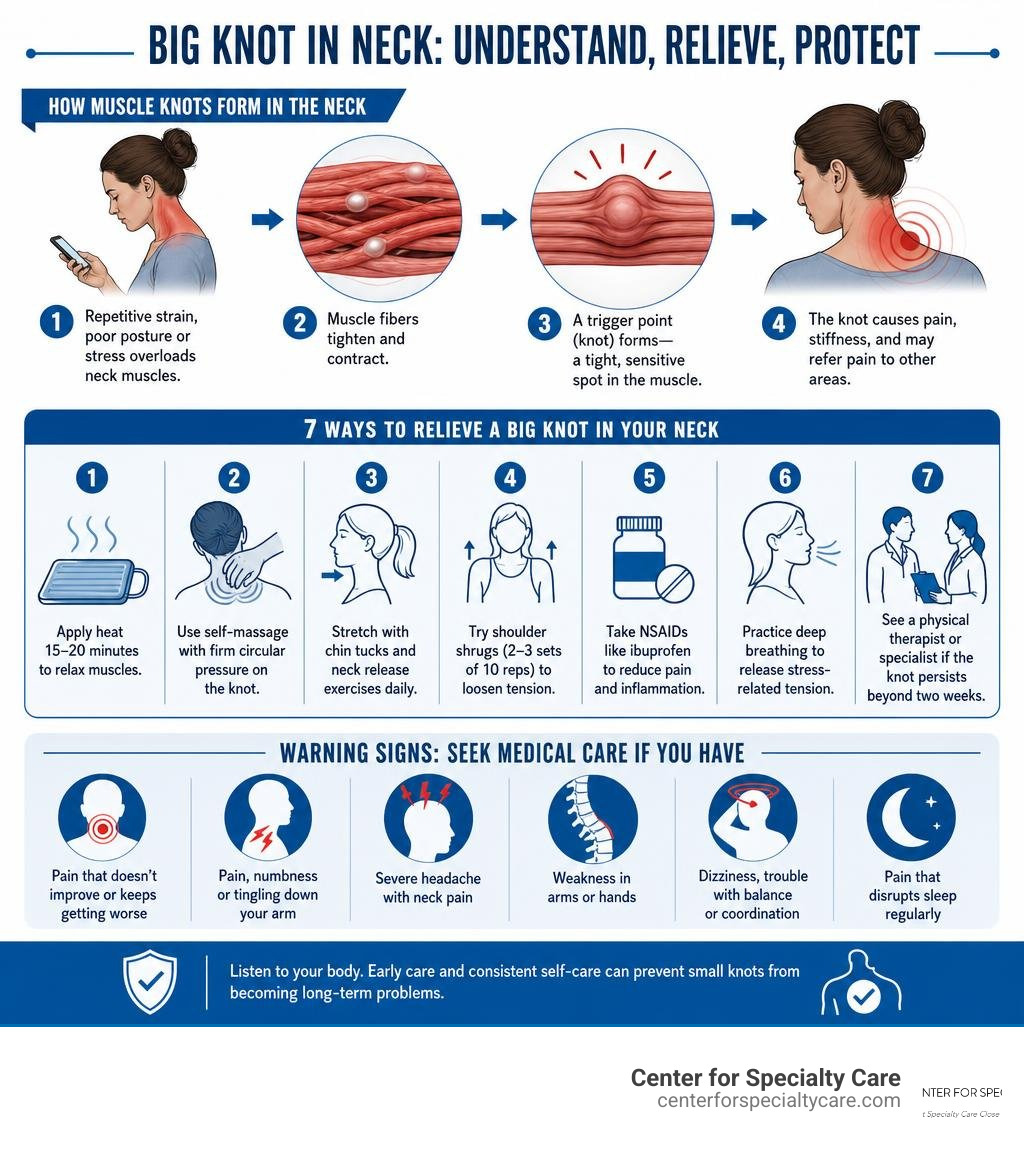
Quick answer — 7 ways to relieve a big neck knot:
- Apply heat for 15–20 minutes to relax tight muscle fibers
- Use self-massage with firm circular pressure on the knot
- Stretch with chin tucks and neck release exercises several times daily
- Try shoulder shrugs (2–3 sets of 10 reps) to loosen tension
- Take NSAIDs like ibuprofen to reduce pain and inflammation
- Practice deep breathing to release stress-related muscle tension
- See a physical therapist or specialist if the knot persists beyond two weeks
That tight, tender lump in your neck is technically called a myofascial trigger point — a small area of muscle fibers that have contracted and won’t let go. Research shows muscle knots affect up to 85% of the population, and 100% of people with neck pain have them. They can make it hard to turn your head, sleep, or get through a normal day.
You’re not alone, and you don’t have to just live with it.
I’m Dr. Corey Welchlin, a board-certified orthopedic surgeon with over 30 years of experience treating musculoskeletal pain — including patients dealing with a big knot in neck muscles that just won’t quit. As the founder of the Center for Specialty Care in Fairmont, Minnesota, I’ve helped countless patients in southern Minnesota and northern Iowa find lasting relief through both conservative and surgical approaches.
Understanding the Causes of a Big Knot in Neck
To effectively banish a big knot in neck muscles, we must first understand why it forms. Our neck and shoulder muscles work tirelessly to keep our heads balanced. When these muscles are subjected to repetitive strain, poor mechanics, or emotional stress, they begin to protest.
One of the leading explanations for how these stubborn trigger points develop is known as the Cinderella hypothesis. This physiological theory suggests that during low-intensity, prolonged activities — such as typing at a computer or driving — the body continuously recruits the exact same small, low-threshold muscle fibers (referred to as the “Cinderella fibers” because they work first and work the longest). Because these fibers never get a break, they eventually become metabolically overloaded, lose their blood supply, and lock up into a painful spasm.
When these fibers contract and fail to relax, they squeeze the local capillary beds. This cuts off oxygen and nutrient delivery while trapping metabolic waste products (like lactic acid) inside the muscle tissue. The result is a highly sensitive, hardened nodule that feels like a physical lump under your skin.

To prevent this metabolic overload, ergonomics play a vital role. While many of us were taught to sit perfectly upright at a 90-degree angle, physical therapy insights suggest that reclining your office chair to about 25 to 30 degrees with proper lumbar support can actually reduce static neck and upper back strain much more effectively.
What Exactly is a Big Knot in Neck?
At the microscopic level, your muscles are made of tiny contracting units called sarcomeres. When a muscle is healthy, these sarcomeres slide open and closed smoothly. However, during an involuntary muscle spasm, a cluster of sarcomeres becomes stuck in a fully contracted state.
This localized contraction can easily be felt through the skin, leading many patients to ask: Can a knot in your neck feel like a lump? The answer is a resounding yes. Because the contracted tissue is dense, swollen, and surrounded by protective muscle guarding, it feels remarkably like a hard, pea-sized or even grape-sized ball.
Additionally, these trigger points are notorious for causing referred pain. A knot located at the base of your skull or in your upper trapezius can send radiating aches up into your temples, behind your eyes, or down into your shoulder blades. If you are experiencing radiating tightness lower down, you might find our guide on Getting Knots Out of Your Shoulder: A Step-by-Step Stretching Guide highly beneficial for restoring full range of motion.
Common Triggers of Neck Muscle Knots
In our modern, screen-centric world, several daily habits serve as primary catalysts for neck muscle knots:
- Text Neck and Forward Head Posture: For every inch your head tilts forward past neutral alignment, its relative weight on your cervical spine increases by about 10 pounds. This places an immense eccentric load on your neck muscles.
- Physical Inactivity: Muscles are designed to move. Lack of movement causes muscle fibers to literally “stick” together, encouraging the development of myofascial adhesions.
- Dehydration and Poor Nutrition: Insufficient water intake prevents muscles from flushing out inflammatory byproducts. Deficiencies in essential minerals like potassium, magnesium, and calcium also make muscle fibers highly prone to cramping and hyper-irritability.
- Stress and Anxiety: When stressed, we unconsciously shrug our shoulders up toward our ears (mimicking a protective fetal posture). This sustained contraction quickly turns into a chronic big knot in neck tissue.
- Sleep Disturbances: Sleeping on an unsupportive pillow or in an awkward position can lock your neck in a strained state for hours at a time, leading to acute morning stiffness and severe Burning Shoulder Pain.
How to Tell the Difference: Muscle Knot vs. Lymph Node or Cyst
Because a large muscle knot feels like a distinct lump, it is incredibly common for patients to worry that they are dealing with something more serious, such as a swollen lymph node, a cyst, or even a tumor. While the vast majority of neck lumps are benign muscle issues, knowing how to differentiate them is crucial for your peace of mind and safety.
| Characteristic | Muscle Knot (Trigger Point) | Swollen Lymph Node | Benign Cyst (e.g., Sebaceous or TDC) |
|---|---|---|---|
| Texture | Firm, taut, band-like, or rubbery | Rubbery, firm, or soft | Soft, squishy, or fluid-filled |
| Mobility | Moves slightly with the muscle tissue when stretched | Moves freely under the skin when pressed | Can be rolled slightly, but fixed in its tissue layer |
| Pain/Tenderness | Highly tender to direct pressure; causes referred pain | Tender when actively fighting an infection; painless otherwise | Usually painless unless infected or highly compressed |
| Location | Within the belly of a muscle (trapezius, levator scapulae) | Clustered along the sides, back, or under the jawline | Often superficial (under skin) or midline (thyroglossal) |
| Duration | Can fluctuate in size; improves with stretching and massage | Swells quickly with illness; typically resolves in 2 to 4 weeks | Persists indefinitely and may grow slowly over time |
To understand these differences in a clinical context, we can look to medical literature. For instance, a classic case report titled An Adolescent Male With a “Knot” in His Neck highlights how persistent cervical lymphadenopathy (swollen lymph nodes) can sometimes present as a localized “knot” that requires careful diagnostic testing to rule out underlying infections.
Furthermore, while extremely rare, other structural masses can develop in the neck. A congenital anomaly can sometimes manifest later in life, as detailed in the study of a Giant Thyroglossal Duct Cyst in an Elderly Patient, which required a specialized surgical procedure (the Sistrunk technique) to resolve. Similarly, rare soft-tissue growths, such as those described in A giant desmoid neck tumor, can mimic muscle tightness but require advanced imaging like MRI to properly diagnose.
If your neck lump is hard, completely immovable, growing rapidly, or does not improve after two weeks of self-care, a professional evaluation is always recommended.
7 Ways to Relieve a Neck Knot at Home
If you have confirmed that your lump is indeed a stubborn myofascial trigger point, you can begin implementing these highly effective home remedies to find relief.

1. Targeted Trigger Point Self-Massage
To perform self-massage, locate the most tender spot on your neck using your fingers or a specialized tool like a massage cane. Apply firm, direct pressure to the center of the knot for 5 to 10 seconds, then slowly release. Repeat this process for 3 to 5 minutes, up to six times daily. Alternatively, make small, gentle circular motions over the area to encourage localized blood flow and break up tissue adhesions.
2. Strategic Heat and Cold Therapy
Choosing the right temperature is key to healing. For chronic, stiff muscle knots, warm moist heat is highly effective because it dilates blood vessels, bringing fresh oxygenated blood to the starved tissue. Apply a warm damp towel or heating pad for 15 to 20 minutes.
If your neck pain is acute or accompanied by sharp inflammation from a recent strain, cold therapy is your best starting point to numb the pain receptors and reduce swelling. For a deeper dive into choosing the right temperature protocol, read our guide on Is Heat or Cold Best for Tendonitis? and explore our recommendations on Heat & Cold Therapy for Tendonitis.
3. Gentle Stretching and Range of Motion Exercises
Stretching helps elongate the contracted sarcomeres. Hold each of these stretches for 15 to 30 seconds, breathing deeply to help your nervous system release the muscle guarding:
- The Head-to-Hand Neck Release: Sit up straight. Place your right hand over the top of your head and gently guide your right ear toward your right shoulder. To deepen the stretch, reach your left hand toward the floor. Repeat on the opposite side.
- Chin Tucks: Sit tall and look straight ahead. Slowly pull your chin straight back (as if making a “double chin”) to stretch the deep suboccipital muscles at the base of your skull.
4. Active Movement: Shoulder Shrugs and Rolls
Immobilizing a painful neck often makes the spasm worse. Instead, perform 2 to 3 sets of 10 slow, controlled shoulder shrugs and backward shoulder rolls. This active movement acts as a mechanical pump, pushing stagnant metabolic waste out of the trapezius muscle and drawing fresh blood in.
5. Over-the-Counter Relief (NSAIDs)
Nonsteroidal anti-inflammatory drugs (NSAIDs) like ibuprofen or naproxen can temporarily dull the sharp pain of a neck knot, making it easier to perform your therapeutic stretches. Always use these medications as directed and pair them with physical movement for the best long-term results.
6. Gentle Yoga Poses for “Tech Neck”
Incorporate gentle, spine-opening yoga poses into your daily routine. The Cat-Cow pose (performed on hands and knees for 1 minute) gently mobilizes the entire cervical and thoracic spine. The Cobra pose (lying on your stomach and gently lifting your chest while keeping your shoulders relaxed and down) helps strengthen the weak upper back muscles that contribute to a forward head posture.
7. Hydration and Mineral Support
Drink plenty of water throughout the day to keep your muscle tissues plump and lubricated. Consider incorporating foods rich in potassium, magnesium, and calcium into your diet to prevent spontaneous muscle cramping. If you frequently struggle with knots in the upper back region, our article Knot Today: Banishing Those Pesky Shoulder Blade Knots for Good offers additional lifestyle and self-care tips.
For a comprehensive overview of how these home remedies work together to alleviate myofascial pain, you can also consult the guide on Knot in Neck: Causes, Symptoms, and Tips to Relieve the Pain.
When to Seek Professional Treatment
Sometimes, a big knot in neck muscles is simply too deep or too stubborn to resolve with at-home care alone. If your symptoms persist beyond two weeks or frequently recur, seeking professional intervention can save you months of discomfort.
At the Center for Specialty Care, we believe in a comprehensive, multi-disciplinary approach to pain management. Our physical therapists can design a highly personalized program to restore your mobility, correct postural imbalances, and strengthen your deep neck stabilizers. Learn more about how we utilize physical therapy to relieve chronic neck and upper back pain through our Shoulder Treatment with Physical Therapy: Recovery & Pain Relief resources.
Our specialists utilize several advanced clinical modalities to target deep trigger points:
- Dry Needling: This highly effective technique involves inserting a thin, sterile monofilament needle directly into the active trigger point. This produces a “local twitch response,” which instantly resets the contracted muscle fibers and dramatically increases local blood flow. You can read more about the clinical efficacy of needling therapies in this peer-reviewed study on Checking your browser – reCAPTCHA.
- Therapeutic Ultrasound: This modality uses deep-penetrating sound waves to generate gentle heat within the deep muscle layers, accelerating tissue repair.
- Chiropractic Care and Manual Therapy: Gentle adjustments and joint mobilizations can correct underlying cervical spine misalignments that may be placing mechanical stress on your neck muscles.
To explore our full range of advanced therapies and expert solutions for upper body pain, visit our page on the Best Therapy for Shoulder Pain: Expert Solutions & Relief.
When to Seek Medical Care for a Big Knot in Neck
While most muscle knots are harmless, certain “red flag” symptoms indicate that your neck pain may be a sign of a more serious neurological or structural issue.
Schedule an immediate medical evaluation if your neck knot is accompanied by:
- Numbness, tingling, or a “pins and needles” sensation radiating down your arm or into your fingers
- Progressive weakness in your arm, hand, or grip strength
- Unexplained dizziness, blurry vision, or persistent, severe headaches
- Difficulty swallowing or trouble breathing
- A high fever accompanied by severe neck stiffness (inability to touch your chin to your chest)
In some cases, chronic neck and shoulder pain can be referred from degenerative issues in the cervical spine, such as osteoarthritis. If you suspect wear-and-tear is playing a role, consulting an Arthritis Specialist Near Me is a wise next step.
Additionally, for patients experiencing chronic, debilitating spinal pain, we offer cutting-edge, minimally invasive options. You can read about advanced spinal interventions and check if the Intracept Procedure Covered by Insurance is a match for your needs. (And if your pain extends to other joints, we can also guide you on How to Find the Best Elbow Doctors Near Me for complete upper extremity care).
Frequently Asked Questions about Neck Knots
Do muscle knots go away on their own?
Yes, minor muscle knots can resolve on their own within a few days if you remove the triggering stressor, stay well-hydrated, engage in active recovery, and perform gentle stretches. However, chronic knots that have developed significant myofascial adhesions usually require active intervention (such as self-massage, heat, or physical therapy) to fully release.
Can a neck knot cause tension headaches?
Absolutely. The muscles in your neck — particularly the suboccipital muscles at the base of your skull and the upper trapezius — share pathways with the nerves that wrap around your head. When these muscles develop active trigger points, they refer pain upward, resulting in a dull, tight, band-like tension headache. Relieving the big knot in neck muscles is often the key to stopping these headaches permanently. For visual demonstrations of how to release these specific headache-triggering spots, you can watch video guides like How To Fix Muscle Knots FOREVER! (Neck, Traps, and ….
How long do muscle knots last?
An acute muscle knot caused by a minor strain or a bad night’s sleep typically lasts anywhere from a few days to a week. However, if the underlying postural habits, stress, or ergonomic issues are not corrected, the knot can become chronic. In cases of Myofascial Pain Syndrome, trigger points can persist for six months or longer, requiring professional care to break the cycle of chronic pain.
Conclusion
A big knot in neck muscles can feel incredibly disruptive, but it is a highly treatable condition. By combining targeted at-home care — like moist heat, self-massage, and gentle stretching — with proper workplace ergonomics, you can successfully relieve tension and prevent future knots from forming.
When conservative home remedies aren’t quite enough, the team at the Center for Specialty Care is here to help. We proudly serve our communities across Southern Minnesota and Northern Iowa, including Fairmont, MN, St. James, MN, Estherville, IA, and Buffalo Center, IA. Our ultimate goal is 100% patient satisfaction, and we achieve this through highly personalized care, state-of-the-art non-surgical and surgical treatment options, and quick appointment availability so you don’t have to wait to start feeling better.
If you are ready to banish that stubborn neck pain and reclaim your mobility, we invite you to take the first step today. Schedule a consultation for neck and shoulder pain relief at our Fairmont clinic, and let us help you live pain-free.