
The Real Deal: Unmasking Legitimate Pain Management Clinics
February 6, 2026
Find Your Perfect Fit: Best Rotator Cuff Sleeping Braces for Pain Relief
February 9, 2026
Chronic muscle knots in shoulder blade: Banish Pain 2026
Why Shoulder Blade Knots Persist and What It Really Means
Chronic muscle knots in shoulder blade areas are more than just annoying—they’re often a sign that something deeper is going on in your body. These persistent, tender spots refuse to disappear no matter how much you stretch, massage, or rest. Unlike an acute knot that develops after a tough workout and fades within days, chronic knots stick around for weeks or months, creating a cycle of pain and stiffness that affects your daily life.
What you need to know about chronic shoulder blade knots:
- They’re called myofascial trigger points by medical professionals—tight bands of muscle fiber that won’t relax
- They differ from acute knots in that they persist beyond the normal healing timeframe and often have multiple contributing factors
- Common causes include poor posture, repetitive strain, stress, muscle imbalances, dehydration, and nutritional deficiencies
- Symptoms extend beyond the knot itself and can include referred pain to your neck, arm, or head, plus reduced range of motion
- They require consistent treatment addressing both the trigger point and underlying causes like posture or stress patterns
- Most chronic knots need several weeks of combined self-care and professional intervention to fully resolve
The reason these knots become chronic often lies in a vicious cycle: poor posture or repetitive movements create the initial tension, stress keeps your muscles guarded, and daily habits prevent proper healing. Seventeen different muscles attach to your shoulder blade, making this area particularly vulnerable to persistent tension and referred pain patterns.
I’m Dr. Corey Welchlin, a board-certified orthopedic surgeon and sports medicine physician with over three decades of experience treating musculoskeletal conditions, including chronic muscle knots in shoulder blade areas and related soft tissue pain. At the Center for Specialty Care, I work with patients to identify the root causes of persistent muscle tension and develop comprehensive treatment plans that combine hands-on therapy, lifestyle adjustments, and when necessary, advanced medical interventions.
Handy chronic muscle knots in shoulder blade terms:
The Vicious Cycle: Understanding Why Knots Become Chronic
That annoying, tight knot in your shoulder becomes a chronic muscle knot when it lingers for weeks or months. Understanding why these knots persist is the first step toward relief.

Persistent knots are fueled by a mix of factors: repetitive strain, muscle imbalances, a sedentary lifestyle, and stress. Over time, these issues create a chronic pain cycle that impacts your quality of life.
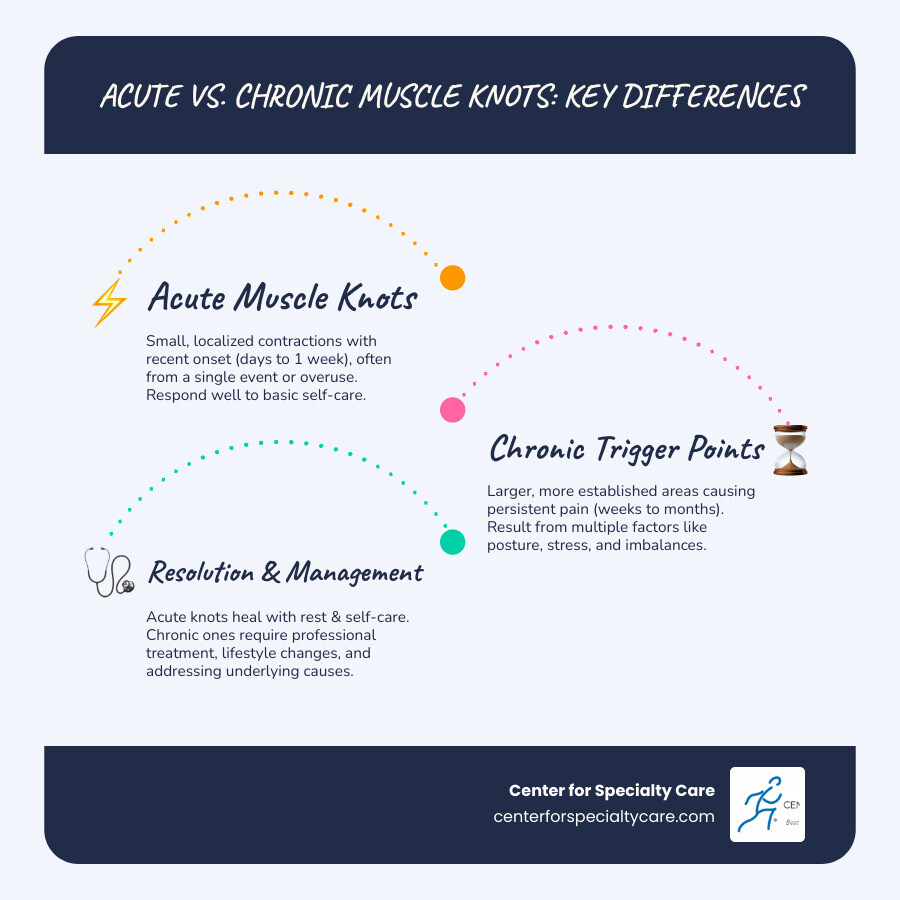
Acute vs. Chronic Knots: More Than Just Time
The difference between an acute and a chronic muscle knot in the shoulder blade is more than just time.
Acute knots result from a recent event, like a tough workout or lifting something heavy. They are temporary muscle spasms that usually resolve within a week with self-care like rest and stretching.
Chronic trigger points are different. They are persistent, irritable spots in a muscle that cause pain for weeks or months. They develop from repeated micro-trauma or sustained muscle contraction. When resistant to home remedies, they may be part of myofascial pain syndrome, a condition involving chronic pain in the muscle’s connective tissue (fascia). The medical term for a muscle knot is a myofascial trigger point. You can learn more by understanding what is a myofascial trigger point?.
The Deep-Seated Causes of Persistent Shoulder Blade Pain
When we dig into why chronic muscle knots in shoulder blade areas develop, we often find a combination of culprits.
- Poor Posture and “Tech Neck”: Hours spent hunched over screens strains neck and upper back muscles. This forward head posture, or “tech neck,” forces supporting muscles to work overtime, leading to chronic tension and knots.
- Muscle Overuse and Repetitive Strain: Repetitive movements from work, hobbies, or daily tasks can exhaust muscles and cause micro-trauma. Without rest, muscle fibers can get stuck in a contracted state, forming stubborn knots, especially around the shoulder blade.
- Dehydration and Nutritional Deficiencies: Muscles need water and nutrients to function. Dehydration or a lack of minerals like magnesium and potassium can make muscles stiff and prone to knots.
- Muscle Guarding and Emotional Stress: The mind-body connection is clear here. Emotional stress and anxiety cause physical tension. The body instinctively “guards” itself by tensing muscles, often in the shoulders and upper back. This constant contraction leads to painful knots, as confirmed by research on how stress contributes to knots.
- Sedentary Lifestyle: Too little movement is also harmful. Prolonged sitting weakens supporting muscles, limits circulation, and causes stiffness, all contributing to knots.
- TMJ Disorders: Surprisingly, temporomandibular joint (TMJ) issues can refer pain to the neck, shoulders, and upper back. This can trigger muscle tension and contribute to chronic knots, making it an often-overlooked factor.
Symptoms Beyond the Ache: Referred Pain and Other Signs
The main symptom of a chronic muscle knot in the shoulder blade is pain, but it often extends beyond the knot itself.
- Localized Tenderness and Pain: A specific spot in the muscle that feels tight, hard, and is painful to the touch, sometimes like a small nodule.
- Stiffness and Reduced Range of Motion: The affected muscle and surrounding area feel stiff, limiting your ability to move your arm, neck, or shoulder freely.
- Referred Pain Patterns: The pain can radiate to other areas. For shoulder blade knots, this can cause:
- Tension Headaches: Knots in the upper trapezius or neck muscles can refer pain up into the head.
- Neck Pain: Pain can travel up into the neck, contributing to stiffness.
- Arm Numbness or Tingling: Severe knots can put pressure on nerves, leading to tingling, numbness, or weakness down the arm.
- Pain in the Chest or Lower Back: Depending on the muscle, pain can radiate to other areas of the back or chest.
- Muscle Tightness or Spasms: The muscle may feel constantly tight or have visible spasms.
- Fatigue: Chronic pain and muscle tension can be exhausting.
Referred pain from trigger points is well-documented in scientific research on trigger points. This is why a headache might actually stem from a shoulder knot. If you have symptoms like shoulder clicking and pain with your knots, it’s important to have the underlying cause assessed.
At-Home Strategies for Immediate and Long-Term Relief
While chronic muscle knots in shoulder blade areas often require professional intervention, there’s a lot you can do at home to manage symptoms and prevent recurrence.

Our approach combines self-care for immediate comfort, ergonomic adjustments to minimize strain, and lifestyle changes for long-term muscle health.
Self-Massage and Myofascial Release Techniques
Applying direct pressure to a muscle knot, known as self-myofascial release, can help it relax.
- Tennis Ball or Lacrosse Ball: Lean against a wall or lie on the floor with the ball on the knot. Apply firm, steady pressure for 30-60 seconds, aiming for a “good hurt” (a 5 out of 10 on the pain scale) without sharp pain.
- Foam Roller: To address a broader area, lie with a foam roller beneath your shoulder blades. Roll slowly up and down, pausing on tender spots.
- Massage Cane/Hook: Use these tools to easily reach knots in your upper back and shoulders, applying pressure as you would with a tennis ball.
- Heat Therapy: To relax stiff muscles and increase blood flow, use a heating pad or warm compress for 15-20 minutes. A warm bath also helps. For effective options, consider using a heating pad for muscle pain.
- Cold Therapy: For inflammation or recent overexertion, apply an ice pack (wrapped in a towel) for 10-15 minutes to reduce swelling and numb pain. Wait at least 15 minutes between applications.
Consistency is key; a few minutes of self-care each day can make a big difference.
Essential Stretches and Exercises for Shoulder Blade Knots
Stretching and targeted exercises are crucial for releasing knots and preventing new ones by improving flexibility and correcting imbalances.
- Doorway Chest Stretch: Stand in a doorway with forearms on the frame, elbows at 90 degrees. Lean forward to feel a chest stretch. Hold for 20-30 seconds; repeat 2-4 times.
- Cat-Cow Pose: On your hands and knees, alternate between arching your back on an inhale (cow) and rounding your spine on an exhale (cat) to mobilize the spine.
- Cross-Body Arm Stretch: Pull one arm across your body with the other, holding for 20-30 seconds to stretch the shoulder and upper back.
- Scapular Squeezes: Sit or stand tall and squeeze your shoulder blades together for 5-10 seconds, keeping shoulders down. Repeat 8-12 times to strengthen key posture muscles.
- Wall Slides: Stand with your back against a wall. Start with your arms in a “W” shape against the wall and slide them up into a “Y,” keeping contact with the wall. This strengthens shoulder blade stabilizers.
- Rows (Resistance Band or Light Weights): Strengthen your upper back with rows to improve posture and reduce strain. Use a resistance band or light weights.
- Strengthening Opposing Muscles: Knots can form when weak muscles force others to overcompensate. Strengthen opposing muscle groups (like chest muscles) to create balance.
Focus on gentle stretching first, then build strength. For more ideas, explore exercises for shoulder pain relief.
Lifestyle and Ergonomic Adjustments for Prevention
Preventing chronic muscle knots in shoulder blade areas involves small, consistent changes to your daily routine.
- Posture Correction: Be mindful of your posture. Sit and stand tall, aligning your ears over your shoulders, with shoulders relaxed and back.
- Desk Setup and Ergonomics: An ergonomic desk setup is critical. Position your monitor at eye level, keep your keyboard and mouse close, and adjust your chair so your feet are flat on the floor. These tips from Mayo Clinic’s office ergonomics guide reduce strain.
- Taking Movement Breaks: Avoid prolonged sitting. Take short breaks every 30-60 minutes to stand, walk, and stretch.
- Hydration: Drink plenty of water. Hydrated muscles are less prone to stiffness and knots.
- Stress Management: Since stress causes muscle tension, practice stress-reduction techniques like deep breathing, meditation, or hobbies that help you unwind.
- Balanced Diet: Eat a diet rich in calcium, potassium, and magnesium for proper muscle function to help prevent knots.
Professional Treatment for Chronic Muscle Knots in Shoulder Blade
When home remedies aren’t enough, or if your chronic muscle knots in shoulder blade persist and significantly impact your life, it’s time to seek professional help. At the Center for Specialty Care in Fairmont, MN, Estherville, IA, St. James, MN, and Buffalo Center, IA, we offer comprehensive care designed to address the root causes of your pain.
Our approach involves accurate medical diagnosis, advanced therapies, and holistic pain management strategies to get you back to living comfortably.
When to See a Doctor: Red Flags and Warning Signs
While most muscle knots are benign, there are certain red flags that indicate you should seek medical attention promptly:
- Pain Persists for Weeks: If your knot has been bothering you for more than 1-2 weeks despite consistent self-care, it’s time for an evaluation.
- Severe or Worsening Pain: If the pain is intense, getting worse, or interfering with your daily activities and quality of life, don’t delay.
- Numbness or Weakness in Arm: If you experience tingling, numbness, or weakness radiating down your arm, it could indicate nerve involvement that requires professional assessment.
- Fever or Swelling: If the area around the knot is red, hot, significantly swollen, or if you have a fever, this could signal an infection or other serious condition.
- Pain Interferes with Sleep: Chronic pain that disrupts your sleep is a clear sign that you need professional help.
- Lump Appears Out of Nowhere and Grows: While most knots are just muscle, any new lump that grows steadily or changes in appearance should be evaluated to rule out other conditions.
- It’s Draining Blood, Pus, or Fluid: This is a definitive sign of a problem requiring immediate medical attention.
For more guidance on when to seek medical help, consult resources like when to seek medical help or consider should I go to urgent care for shoulder pain? if your symptoms are acute and severe.
Effective Therapies for managing chronic muscle knots in the shoulder blade
Once we understand the underlying causes of your chronic muscle knots in shoulder blade, we can tailor a treatment plan to your specific needs. Our comprehensive approach often includes:
- Physical Therapy Assessment and Treatment: Our physical therapists are experts in musculoskeletal function. They will conduct a thorough assessment to identify muscle imbalances, postural issues, and movement patterns contributing to your knots. Treatment may include:
- Manual Therapy: Hands-on techniques such as soft tissue mobilization and myofascial release therapy are highly effective. These involve applying sustained, gentle pressure to the trigger points to help them relax and release. Myofascial release therapy is a specific type of massage therapy that focuses on releasing tension in the fascia.
- Targeted Exercises: Your physical therapist will design a specific exercise regimen to strengthen weak muscles, stretch tight ones, and improve your overall posture and body mechanics.
- Ergonomics Evaluation: For those whose knots stem from their work environment, a physical therapist can provide recommendations for optimizing your workstation.
- Dry Needling: For knots that are deep inside muscle tissue or resistant to other types of therapy, dry needling can be a game-changer. This procedure involves inserting thin needles into the trigger points to stimulate a “twitch response,” which can help the muscle contract and then relax, promoting healing and reducing pain. It’s like a more targeted version of acupuncture focused on muscle release.
- Trigger Point Injections: If a knot is particularly stubborn and painful, your doctor might recommend trigger point injections. This involves injecting a local anesthetic, sometimes with a corticosteroid, directly into the trigger point. This helps to numb the area, relax the muscle, and break the pain cycle.
- Pain Management Consultations: For complex or severe chronic pain, our pain management specialists can explore various options, including advanced interventional procedures. We provide comprehensive pain management consultations to develop a personalized strategy.
- Chiropractic Adjustments: Misalignments in the spine, particularly in the neck and upper back, can contribute to muscle tension and knots. Chiropractic adjustments can help restore proper spinal alignment, reducing nerve irritation and muscle guarding.
- Addressing Underlying Conditions: If your knots are linked to conditions like TMJ disorders, we can coordinate with specialists to ensure a comprehensive treatment plan that addresses all contributing factors.
Finding the right professional is key. At the Center for Specialty Care, we pride ourselves on personalized care and quick appointment availability. We’re here to help you understand your pain and find effective solutions, so you can stop asking “Why won’t these knots go away?” and start asking “What can we do to make them disappear for good?” For expert guidance, consider finding the right shoulder specialist to assess your unique situation.
Frequently Asked Questions about Shoulder Blade Knots
We often hear similar questions from our patients struggling with chronic muscle knots in shoulder blade areas. Let’s tackle some of the most common ones.
How long does it take for a chronic shoulder blade knot to go away?
This is perhaps the most common question, and unfortunately, there’s no single answer. The duration varies significantly by individual and depends heavily on the underlying cause, the chronicity of the knot, and your adherence to the treatment plan.
While acute knots often resolve in a few days to a week with basic care, chronic knots are a different story. They typically require several weeks, sometimes even months, of consistent treatment. This might involve a combination of professional care (physical therapy, manual therapies, injections) and diligent self-care (stretching, ergonomic adjustments, stress management). The key is to address the root cause, not just the symptom. If the underlying issues like poor posture, muscle imbalances, or chronic stress aren’t managed, the knots will likely return. Adherence to your prescribed physical therapy plan is paramount for a successful and lasting resolution.
Can stress alone cause chronic muscle knots in the shoulder blade?
Absolutely! Stress is a powerful force, and it can manifest physically in many ways, including the development of chronic muscle knots in shoulder blade areas. When we experience chronic stress or emotional tension, our bodies often go into a state of “muscle guarding.” This is an involuntary protective response where muscles tense up, often in the shoulders, neck, and upper back.
Sustained muscle tension due to stress can lead to reduced blood flow, accumulation of waste products, and eventually, the formation of stubborn trigger points. While stress might not be the only factor, it can certainly be a primary contributing factor, making existing knots worse or preventing new ones from resolving. That’s why stress management techniques are an integral part of any comprehensive treatment plan for chronic knots.
Is it a muscle knot or could it be something more serious?
Most of the time, that tender spot you feel in your shoulder blade is indeed a muscle knot or myofascial trigger point. They are incredibly common. However, it’s always wise to be vigilant, especially if you experience any of the “red flag” symptoms we discussed earlier, such as severe pain, numbness, fever, or a rapidly growing lump.
Sometimes, what feels like a muscle knot could be something else entirely. For example, swollen lymph nodes can feel like knots, but they are usually accompanied by other signs of infection. Rarer conditions, including certain types of tumors or issues with the spine, can also cause pain that might be mistaken for a muscle knot.
If you have any doubts, if your pain is persistent, severe, or accompanied by concerning symptoms, it’s crucial to seek a medical diagnosis. A professional assessment can help rule out more serious conditions and ensure you receive the appropriate treatment. Consulting an orthopedic specialist at our clinics can provide the clarity and specialized care you need.
Conclusion: Taking the Next Step Towards a Pain-Free Shoulder
Chronic muscle knots in shoulder blade areas are a complex and often frustrating problem, but they are far from untreatable. We’ve seen that these persistent pains are not just simple aches but a signal from your body that something—or several things—need attention. From poor posture and repetitive strain to dehydration, nutritional deficiencies, and the pervasive impact of stress, the causes are often multi-faceted.
The journey to relief involves a comprehensive, multi-faceted approach. It requires a combination of diligent self-care, including targeted stretches, exercises, and ergonomic adjustments, alongside professional medical guidance. We believe in empowering our patients with the knowledge and tools they need to take control of their pain, but we’re also here to provide the expert intervention when home remedies aren’t enough.
At the Center for Specialty Care, we are dedicated to 100% patient satisfaction, offering personalized care and quick appointment availability for all our patients in Southern Minnesota and Northern Iowa, including Fairmont, MN, Estherville, IA, St. James, MN, and Buffalo Center, IA. Our team of orthopedic and pain management specialists is ready to help you identify the root cause of your chronic shoulder blade knots and develop a custom treatment plan that brings lasting relief.
Don’t let these stubborn knots dictate your life. Take the next step towards a pain-free shoulder and explore our comprehensive shoulder care options. We’re here to help you regain your comfort, mobility, and overall well-being.