
Heat Therapy for Tendonitis: Your Guide to Soothing Aches and Promoting Healing
April 10, 2026
How to Bounce Back with Physical Therapy for Your Torn Rotator Cuff
April 14, 2026
Shoulder Blade Knots: Why Your Back Is Acting Like a Pre-Tangled Slinky
That Nagging Knot Near Your Shoulder Blade — Here’s What’s Going On
A knot near shoulder blade is one of the most common sources of upper back pain, affecting up to 85% of people at some point in their lives. Here’s a quick summary of what you need to know:
- What it is: A tight, tender spot (called a myofascial trigger point) where muscle fibers get stuck in a contracted state
- Common symptoms: Dull aching, stiffness, a palpable lump, and referred pain that can spread to the neck, arm, or head
- Main causes: Poor posture, repetitive motion, emotional stress, muscle overuse, and dehydration
- Quick relief: Self-massage with a tennis ball, heat therapy, and targeted stretching
- When to see a doctor: If pain persists beyond two weeks, worsens, or comes with numbness, tingling, or arm weakness
That tight, nagging spot between your shoulder blade and spine can make turning your head or reaching overhead feel surprisingly difficult. It may feel like a small marble lodged under the skin — and no matter how many times you dig an elbow into it against a door frame, it keeps coming back.
That’s because most people treat the symptom, not the source.
The shoulder blade area is a surprisingly complex region. Seventeen muscles attach to the scapula alone, pulling from the neck, upper back, and even the lower back. When any of these muscles become overworked, overstretched, or chronically tense, they can lock up into painful trigger points that resist even the most determined self-massage attempts.
I’m Dr. Corey Welchlin, a board-certified orthopedic surgeon with over 30 years of experience treating musculoskeletal pain — including countless patients who came in frustrated by a persistent knot near shoulder blade that just wouldn’t quit. In this guide, I’ll walk you through exactly what’s happening in your muscle tissue, why it keeps recurring, and what actually works to fix it for good.
Knot near shoulder blade glossary:
Understanding the Knot Near the Shoulder Blade
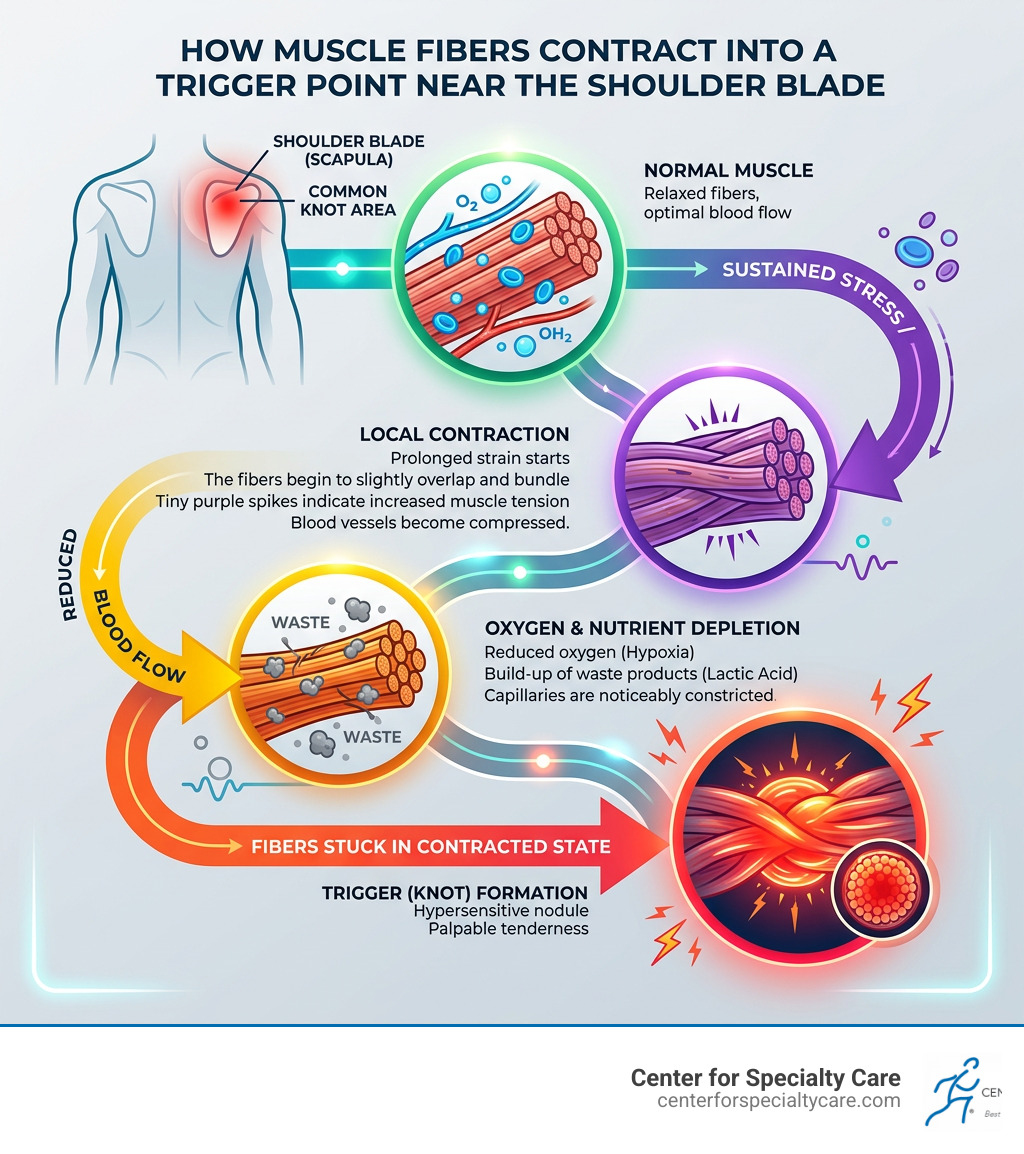
When we talk about a knot near shoulder blade, we are medically referring to a myofascial trigger point. These aren’t literal knots in your muscle fibers like a tangled fishing line. Instead, they are hyperirritable spots within a taut band of skeletal muscle.
To understand the “why” behind the pain, we have to look at the microscopic level. Muscles are made of tiny units called sarcomeres. These units contain filaments called actin and myosin that slide past each other to contract or relax the muscle. In a healthy state, these filaments detach easily. However, when a muscle is overstressed, these filaments can get “stuck.”
This creates a vicious cycle: the sustained contraction compresses nearby capillaries, leading to a lack of oxygen (hypoxia) and poor microcirculation. Because muscles actually require energy (ATP) to relax, the lack of blood flow prevents the muscle from getting the fuel it needs to let go. This creates a localized “energy crisis” that keeps the knot tight and tender. According to Scientific research on trigger point diagnosis, these points are often palpable as hard nodules that, when pressed, can cause pain to jump to entirely different parts of the body.
Anatomy of the Scapula
Your shoulder blade, or scapula, is a floating bone held in place by an intricate web of tissue. Seventeen different muscles attach to the shoulder blade, making it a high-traffic zone for tension.
Key players include:
- The Trapezius: A large diamond-shaped muscle that moves the shoulder blade and supports the neck.
- The Rhomboids: These connect the shoulder blade to the spine. When they get overstretched from slouching, they often develop deep, burning knots.
- Levator Scapulae: This muscle “elevates” the scapula. If you find yourself hiking your shoulders up to your ears when stressed, this is the culprit.
- Infraspinatus: Part of the rotator cuff, a knot here can actually refer pain all the way down your arm to your fingers.
Because the shoulder is a ball-and-socket joint with the greatest range of motion in the human body, any imbalance in these seventeen muscles can lead to a knot near shoulder blade as the body tries to stabilize the joint.
Why Your Back is Knotting Up: Common Causes
Most knots don’t appear out of thin air; they are the result of cumulative “micro-traumas” from our daily habits.
- Tech Neck and Forward Head Posture: Your head weighs about 10–12 pounds. For every inch your head juts forward to look at a phone or computer, the effective weight on your neck and upper back muscles doubles. This constant strain forces the muscles near your shoulder blade to work overtime just to keep your head upright.
- Repetitive Motion: Whether it’s a weekend of painting the ceiling, rowing, or even just carrying a heavy purse on the same shoulder every day, repetitive stress causes muscle fibers to fatigue and lock up.
- Emotional Stress: When we are stressed, our bodies enter a “fight-or-flight” mode, releasing cortisol and causing us to unconsciously clench our muscles. This chronic tension is a primary driver for trigger points.
- Muscle Imbalances: If your chest muscles (pectorals) are tight from sitting, they pull your shoulders forward. This leaves the muscles in your back perpetually overstretched and weak—a condition that makes them highly susceptible to knotting.
- Dehydration and Nutrition: Muscles are about 75% water. Without proper hydration or adequate magnesium and potassium, muscle fibers become irritable and prone to spasms.

The Role of Posture and Stress
Think of your head like a bowling ball. If you hold it directly over your shoulders, it’s easy. If you hold it out at arm’s length, your muscles will scream within minutes. This is exactly what happens during a long workday. We also see the “Cinderella Hypothesis” in action here: smaller muscle fibers (the “Cinderellas”) work continuously while larger fibers rest, leading to exhaustion and knots in those specific small areas.
Muscle Knot vs. Pinched Nerve: Knowing the Difference
One of the most frequent questions we hear at our Fairmont and St. James clinics is: “Is this just a knot, or is it a pinched nerve?”
While a knot near shoulder blade is a muscular issue, cervical radiculopathy (a pinched nerve in the neck) can feel remarkably similar because the nerves exiting your neck travel right past the shoulder blade. In fact, research on cervical radiculopathy incidence shows that 100% of people with neck-related nerve pain also have myofascial trigger points.
| Feature | Muscle Knot (Trigger Point) | Pinched Nerve (Radiculopathy) |
|---|---|---|
| Pain Type | Dull, aching, “gnawing” | Sharp, electric, “stabbing” |
| Sensation | Localized tenderness | Numbness, tingling, “pins and needles” |
| Physical Sign | Palpable hard lump or nodule | No lump; possible arm weakness |
| Movement | Worse with stretching the muscle | Worse with certain neck positions |
| Referred Pain | Deep ache in a specific zone | Radiates down the arm to the hand |
Identifying a Knot Near the Shoulder Blade vs. Pinched Nerves
If you can feel a distinct “marble” or “taut band” that is tender to the touch, you likely have a muscle knot. However, if your pain is accompanied by a loss of strength in your hand or a “zinging” sensation that travels down to your elbow, it’s time to investigate the neck. The dorsal scapular nerve, which starts in the neck, can often be the “circuit breaker” that causes pain near the shoulder blade even if your neck doesn’t feel stiff.
How to Relieve a Knot Near the Shoulder Blade at Home
If you’re dealing with an acute knot, you can often find relief using these self-care strategies.
- The Tennis Ball Technique: This is the gold standard for home care. Place a tennis ball (or a firmer lacrosse ball) between your shoulder blade and a wall. Lean back into the ball, applying gentle pressure to the knot. Hold for 30–90 seconds. You want “good pain”—a sensation of release—not sharp, stabbing pain.
- Heat vs. Cold Therapy: For a chronic, stiff knot near shoulder blade, heat is usually best. Use a heating pad for 15–20 minutes to increase blood flow and encourage the actin-myosin filaments to detach. If the area feels “angry” or swollen after an injury, use ice for the first 48 hours to reduce inflammation.
- Foam Rolling: Lie on your back with a foam roller positioned horizontally across your shoulder blades. Support your head with your hands and slowly roll up and down to massage the large muscle groups.
- Hydration: Drink plenty of water. Staying hydrated helps flush out the metabolic waste that builds up inside a contracted muscle knot.
Targeted Stretches for a Knot Near the Shoulder Blade
Stretching helps reset the muscle’s resting length. Try these daily:
- Cat-Cow Pose: On all fours, alternate between arching your back like a cat and dropping your belly toward the floor. This mobilizes the entire spine and scapula.
- Doorway Chest Stretch: Stand in a doorway with your arms at 90 degrees against the frame. Step forward to stretch your chest. This stops the “pull” that creates back knots.
- Scapular Squeezes: Imagine trying to hold a pencil between your shoulder blades. Squeeze for 5 seconds and release. Repeat 10 times to wake up the rhomboids.
- Chin Tucks: Gently pull your chin straight back (creating a “double chin”). This aligns the “bowling ball” head over your shoulders and relieves the levator scapulae.
Professional Treatments and When to See a Specialist
Sometimes, a knot near shoulder blade is too deep or too chronic for a tennis ball to reach. At Center for Specialty Care, we offer several advanced options:
- Physical Therapy: Our therapists focus on correcting the muscle imbalances and postural habits that caused the knot in the first place.
- Manual Trigger Point Therapy: A hands-on technique where the provider applies specific, sustained pressure to “reset” the muscle tone.
- Dry Needling: This involves inserting a very thin needle directly into the trigger point. It causes a “local twitch response,” which neurologically forces the muscle to relax instantly.
- Trigger Point Injections: For severe cases, a small amount of anesthetic or corticosteroid can be injected into the knot to break the pain cycle.
- Spinal Manipulation: If the knot is caused by a “stuck” rib or a misaligned vertebrae in the neck, a gentle adjustment can provide immediate relief.
You can find more info about our certifications and our commitment to personalized orthopedic care on our website.
Signs You Need Professional Help
While most knots resolve with rest, some require an expert eye. You should schedule an appointment if:
- The pain is so severe it interferes with your sleep.
- You have tried home care for two weeks with no improvement.
- You experience numbness, tingling, or weakness in your arm or hand.
- The knot appeared suddenly after a trauma (like a fall or car accident).
Prevention Strategies for Long-Term Relief
To stop the “Pre-Tangled Slinky” effect from returning, you need to change the environment your muscles live in.
- Ergonomic Workspace: Ensure your monitor is at eye level so you aren’t constantly looking down. Your elbows should be at a 90-degree angle, and your feet should be flat on the floor.
- Movement Breaks: Set a timer. Every 45 minutes, stand up and move in the “opposite direction.” If you’ve been hunched forward, do a chest stretch and some shoulder rolls.
- Strength Training: Building a strong “posterior chain” (the muscles on your back) provides the support your shoulder blades need to stay in place without straining.
- Magnesium Intake: Consider a magnesium supplement or Epsom salt baths. Magnesium is nature’s muscle relaxant and can help prevent the “stuck” filaments that form knots.
Breaking the Posture-Pain Cycle
Consistency is more important than intensity. Doing two minutes of stretching every hour is far more effective for preventing a knot near shoulder blade than doing an hour of yoga once a week. We also recommend looking at your sleeping position; stomach sleeping is often the worst for the upper back, as it forces the neck into a twisted position for hours.
Frequently Asked Questions about Shoulder Blade Knots
How long does it take for a shoulder blade knot to go away?
An acute knot caused by a simple strain can resolve in 3 to 7 days with proper rest and stretching. However, chronic knots caused by years of poor posture can take several weeks of consistent physical therapy and lifestyle changes to fully dissipate.
Can a knot near the shoulder blade cause headaches?
Absolutely. Trigger points in the trapezius and levator scapulae are notorious for causing “referred pain” that travels up the neck and wraps around the head, resulting in tension headaches.
Can you over-massage a muscle knot?
Yes. Aggressive, forceful rubbing can actually damage muscle fibers and lead to bruising or increased inflammation. Use firm but steady pressure, and never spend more than 5 minutes on a single spot.
Conclusion
A knot near shoulder blade is your body’s way of asking for a change. Whether it’s a reminder to sit up straighter, drink more water, or manage your stress, listening to these signals early can prevent long-term chronic pain.
At Center for Specialty Care, we are dedicated to helping our neighbors in Fairmont, MN, Estherville, IA, and the surrounding areas live pain-free. We pride ourselves on 100% patient satisfaction and personalized care that looks at the whole person—not just the knot. If your back is acting like a tangled slinky and you can’t seem to get it straight, we are here to help.
Schedule a consultation for shoulder blade pain relief today and let us help you get back to the activities you love.