
Getting Knots Out of Your Shoulder: A Step-by-Step Stretching Guide
June 11, 2026
The Best Orthotics to Help Women with Flat Feet Stand Tall
June 15, 2026
Step-by-Step: Navigating Foot Tendon Surgery Billing Questions
Why Foot Tendon Billing Questions Trip Up Providers and Patients Alike
Foot tendon billing questions come up constantly — whether you’re a provider submitting claims or a patient trying to understand an unexpected bill. Here’s a quick-reference overview of the most common answers:
Quick answers to common foot tendon billing questions:
| Question | Short Answer |
|---|---|
| What CPT code covers plantar fascia injections? | CPT 20551 (single code, even if calcaneal spur is also treated) |
| What code is used for Morton’s neuroma injections? | CPT 64455 or CPT 64632 — not 20550 or 20551 |
| How many injections can be billed to the same site in 6 months? | Up to 3; more require documented clinical justification |
| Is Achilles tendon repair surgery covered by Medicare? | Yes, when medically necessary and properly documented |
| Are soft-tissue anchors separately reimbursed by Medicare? | No — costs are absorbed via APC or MS-DRG bundled payments |
Foot tendon conditions — from Achilles tendonitis to peroneal tears — affect everyone from elite athletes to people who spend long hours on their feet. Treatment ranges from conservative injections to complex surgical repair. Each step along that care path comes with its own billing rules, and getting them wrong means denied claims, delayed payments, or unexpected out-of-pocket costs.
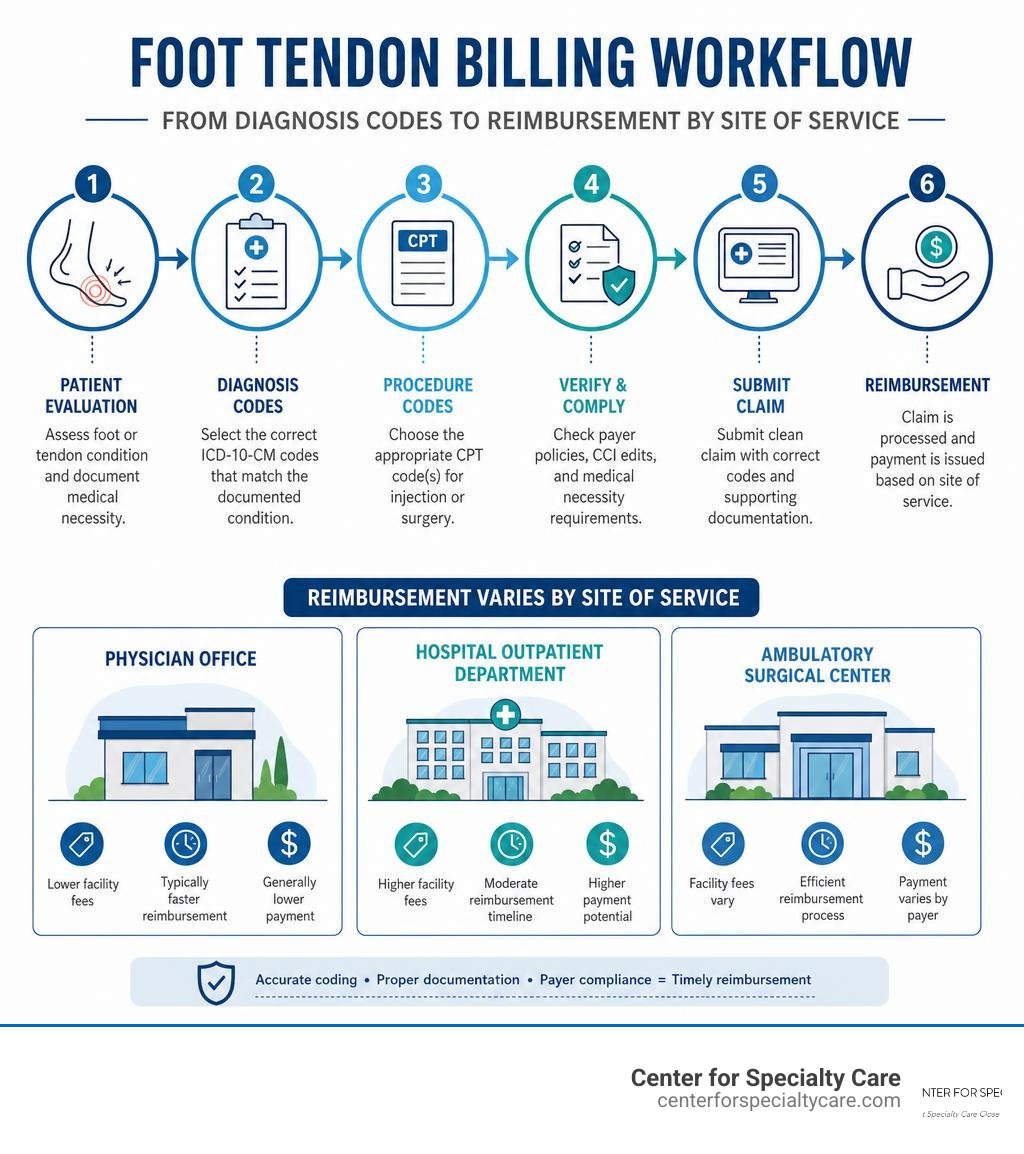
The coding landscape is genuinely complex. Different injection types require different CPT codes. ICD-10-CM diagnosis codes must match the documented condition precisely. Medicare’s Correct Coding Initiative (CCI) edits restrict which codes can be billed together. And reimbursement rates vary significantly depending on whether care is delivered in a physician office, hospital outpatient department, or ambulatory surgical center.
I’m Dr. Corey Welchlin, a board-certified orthopedic surgeon with over 30 years of experience treating foot and tendon conditions at Center for Specialty Care in Fairmont, Minnesota — and foot tendon billing questions are among the most common concerns I hear from both patients and referring providers. The step-by-step breakdown below covers everything you need to bill accurately and get reimbursed correctly.
Coding for Foot Tendon and Nerve Injections
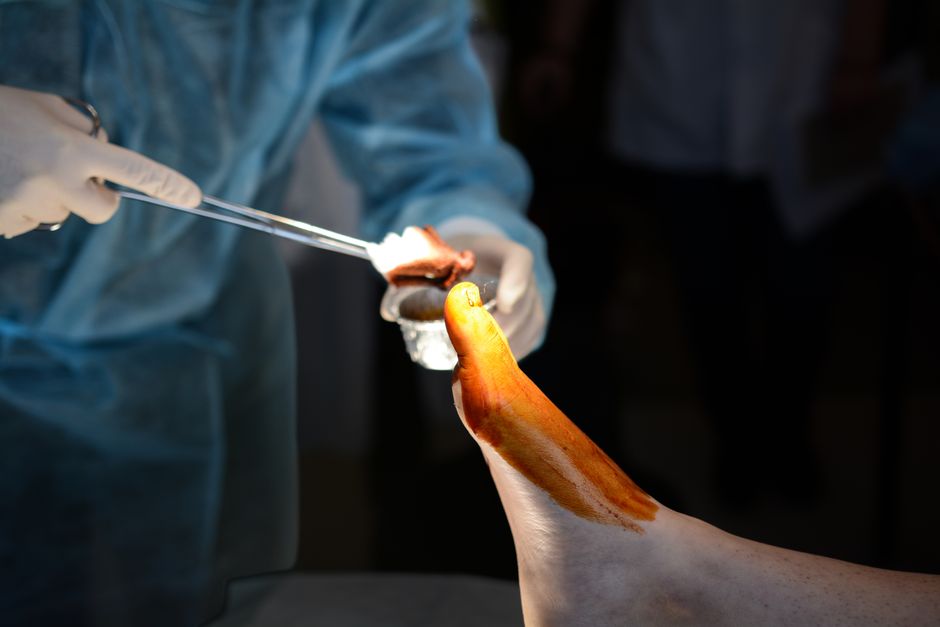
Injections are a cornerstone of conservative management for chronic inflammatory foot conditions. However, selecting the correct Current Procedural Terminology (CPT) code is one of the most frequent areas where billing errors occur. To prevent denials, providers must carefully distinguish whether they are treating a tendon sheath, a tendon origin/insertion, or a localized nerve.
Understanding the underlying anatomy is critical for both clinical success and accurate coding. For a detailed review of how these structures function, you can Learn more about foot tendon anatomy.
Distinguishing Injection Codes for Foot Tendon Billing Questions
When billing for injections, medical coders must choose between four primary codes based on the exact anatomical structure targeted:
- CPT 20550 (Injection(s); single tendon sheath, or ligament, aponeurosis): This code is used when the clinician injects an anesthetic agent and/or steroid directly into a tendon sheath (such as the peroneal or posterior tibial tendon sheaths).
- CPT 20551 (Injection(s); single tendon origin/insertion): This is the correct code when the injection is delivered at the point where the tendon or ligament attaches to the bone, rather than within a sheath.
- CPT 64455 (Injection(s), anesthetic agent and/or steroid, plantar common digital nerve(s)): This code is specifically reserved for treating Morton’s neuroma (or other plantar common digital nerve lesions) using a local anesthetic and/or corticosteroid.
- CPT 64632 (Destruction by neurolytic agent; plantar common digital nerve(s)): If the provider is performing a chemical destruction of the nerve rather than a temporary block, this destruction code must be used instead of 64455.
Using the wrong code—such as billing CPT 20550 for a Morton’s neuroma injection—is a major audit trigger. For a comprehensive look at standard podiatric coding rules, consult the Podiatry Medical Billing & Coding Guide (2026).
Plantar Fascia and Calcaneal Spur Injection Rules
Plantar fasciitis is incredibly common, and billing for its treatment often raises specific foot tendon billing questions. A frequent point of confusion is how to code when a patient receives an injection that addresses both plantar fasciitis and an adjacent heel (calcaneal) spur.
Under National Correct Coding Initiative (NCCI) guidelines, providers cannot bill separately for injecting the plantar fascia and the calcaneal spur during the same encounter. Because these structures are anatomically adjacent, Medicare and commercial payers require a single code to cover the entire procedure.
Specifically, an injection covering both the plantar fascia and the calcaneal spur area must be reported using CPT code 20551 (tendon origin/insertion). Attempting to split this into multiple codes violates bundling edits and will result in immediate claim denials.
Medical Necessity and ICD-10-CM Diagnosis Coding

Accurate CPT coding is only half the battle. To secure reimbursement, the procedure must be paired with an ICD-10-CM diagnosis code that supports medical necessity. Payers look for a clear, logical link between the patient’s documented symptoms, the clinical exam, and the billed procedure.
Documenting Multiple Injections in a Six-Month Period
A common issue in pain management is the “three-injection limit.” Most local coverage determinations (LCDs) state that more than three injections to the same anatomical site within a six-month period are generally not considered medically necessary.
If a patient requires a fourth injection, the clinical record must provide robust justification. The documentation should answer:
- Why did the previous three injections fail to provide long-term relief?
- What is the long-term treatment plan (e.g., is the patient being prepared for surgery)?
- Have alternative conservative treatments been exhausted?
Before moving to repeated injections, we always evaluate whether conservative home therapies are being utilized correctly. For instance, patients often ask whether they should apply ice or heat to their inflamed tendons. To guide your patients, you can Discover if heat or cold is best for tendonitis.
ICD-10-CM Codes for Foot Tendonitis and Injuries
To support claims for tendonitis and soft tissue injuries, providers must use highly specific ICD-10-CM codes. The table below outlines the primary diagnosis codes used in foot and ankle billing:
| Condition | ICD-10-CM Code | Clinical Indications & Billing Notes |
|---|---|---|
| Achilles Tendonitis (Right) | M76.61 | Pain and inflammation of the right Achilles tendon. |
| Achilles Tendonitis (Left) | M76.62 | Pain and inflammation of the left Achilles tendon. |
| Peroneal Tendonitis (Right) | M76.71 | Inflammation of the peroneal tendons on the outer ankle. |
| Plantar Fasciitis | M72.2 | Plantar fascial fibromatosis/heel pain. |
| Achilles Rupture (Initial) | S86.011A / S86.012A | Traumatic rupture of the Achilles tendon (Right/Left), initial encounter. |
When coding traumatic injuries (such as an acute tendon rupture), pay close attention to the 7th character of the ICD-10-CM code:
- A (Initial encounter): Used while the patient is receiving active treatment for the injury (e.g., surgical evaluation or the surgical procedure itself).
- D (Subsequent encounter): Used for encounters after the patient has completed active treatment (e.g., routine post-operative follow-up visits, cast removals).
- S (Sequela): Used for complications or conditions that arise as a direct result of the injury (e.g., scar tissue or chronic pain years later).
Medicare Billing Rules, CCI Edits, and Reimbursement Rates
Medicare billing is governed by strict rules designed to prevent overpayment and unbundling. Navigating these rules requires an understanding of NCCI edits, modifier usage, and how reimbursement rates are structured across different clinical settings.
To review how Medicare handles specific surgical devices and hardware used during these procedures, see the Foot/Ankle Soft-Tissue Anchors 2026 Guidelines.
Understanding CCI Edits and Modifiers for Foot Tendon Billing Questions
Correct Coding Initiative (CCI) edits prevent providers from billing for two procedures that are normally bundled together. However, when procedures are performed on separate anatomical sites or during separate sessions, modifiers can be used to bypass these edits.
- Modifier 50 (Bilateral Procedure): Used when the same procedure is performed on both the left and right feet during the same operative session. Some payers prefer bilateral services to be billed on a single line with modifier 50, while others require two separate line items (one with RT and one with LT).
- Modifier 59 (Distinct Procedural Service): Used to identify procedures that are not normally billed together but were performed independently of each other.
- Modifier XS (Separate Structure): Under Medicare guidelines, modifier XS is often preferred over modifier 59 because it explicitly states that the bundled procedure was performed on a completely separate anatomical structure or organ.
Never append these modifiers automatically. The medical record must clearly document two distinct incisions or separate anatomical locations to justify bypassing an NCCI edit.
Facility vs. Physician Reimbursement for Tendon Repair and Neuroplasty
Reimbursement for foot surgery depends heavily on the place of service (POS). The Medicare fee schedule establishes different rates for the physician’s work (measured in Relative Value Units, or RVUs) and the facility’s overhead (Ambulatory Payment Classifications, or APCs).
Under the 2025 and 2026 Medicare national averages, we see substantial differences in site-of-service payments:
- CPT 28035 (Tarsal Tunnel Release / Neuroplasty):
- Physician Fee: Approximately $358 (based on 11.08 RVUs).
- Hospital Outpatient Department (HOPD): Reimbursed under APC 5431 at approximately $1,953.
- Ambulatory Surgical Center (ASC): Reimbursed at a lower facility rate (typically around $826).
- CPT 28222 (Tenolysis, flexor, foot; multiple tendons):
- Physician Fee: Approximately $365 (based on 11.28 RVUs).
- HOPD: Absorbed under MS-DRG or APC musculoskeletal groupings.
For procedures involving tendon lengthening or shortening, such as equinus contracture releases, specific guidelines dictate how to prevent downcoding to simple tenolysis. To ensure accurate coding for these complex cases, refer to the CPT 27685 Surgical Lengthening Guidelines.
Non-Surgical vs. Surgical Management Billing
When a patient presents with a foot tendon injury, the clinical pathway typically begins with non-surgical conservative care. Achilles tendonitis affects anywhere from 1% to 9% of elite and recreational athletes, and the vast majority recover fully without permanent damage using conservative treatments. Most non-surgical cases heal completely within a few months.
However, if conservative treatments fail after at least six months, or if there is an acute, complete rupture, surgical intervention becomes necessary. If surgery is required, the recovery period is much longer, often taking from six to 12 months to return to full activity.
From a billing perspective, the transition from conservative care to surgical management changes the coding rules entirely:
- Conservative Phase: Billed using Evaluation and Management (E/M) codes, physical therapy codes, orthotic fitting codes, and localized injection codes (CPT 20550/20551).
- Surgical Phase: Billed using major surgical CPT codes (e.g., CPT 27650 for primary Achilles repair). Major surgeries carry a 90-day global period. This means all routine post-operative care—including follow-up exams, cast changes, and boot adjustments within 90 days of the surgery—is bundled into the initial surgical payment and cannot be billed separately.
For patients dealing with specific lateral ankle pain, understanding conservative treatment options is essential. To read more about non-surgical management, you can Read about peroneal tendonitis care.
Frequently Asked Questions About Foot Tendon Billing Questions
Can CPT 27685 be billed for multiple tendons in the same session?
Yes, CPT 27685 (Surgical lengthening or shortening of a single tendon) is a per-tendon code. If you perform length-altering procedures (such as a Z-plasty or step-cut lengthening) on multiple tendons during the same session, you can bill CPT 27685 multiple times.
To do this successfully:
- Append modifier 51 (Multiple Procedures) to the secondary units.
- Ensure the operative notes describe distinct incisions and document the specific lengthening or shortening technique used on each individual tendon. Simple tendon releases (tenolysis) do not qualify for CPT 27685.
Are soft-tissue anchors separately reimbursable under Medicare?
No. For Medicare patients, surgical implants such as soft-tissue anchors, screws, and joint devices (often reported under HCPCS code C1713) are not separately reimbursed in any setting.
Instead, the cost of these devices is bundled into the facility’s APC (for outpatient hospital settings) or MS-DRG (for inpatient settings) payment. Commercial insurance contracts vary, so providers should verify with individual payers whether implant carve-outs are permitted.
What is the global period for major foot tendon repairs?
Major surgical repairs of foot and ankle tendons (such as an Achilles repair) have a 90-day global period.
This global package bundles:
- Pre-operative visits on the day before or day of surgery.
- The surgery itself.
- All routine post-operative care, including suture removal, wound checks, cast changes, and boot adjustments.
If a patient requires treatment for an unrelated condition during this 90-day window, you must append modifier 24 to the E/M code. If they must return to the operating room for an unrelated complication, modifier 79 should be used.
Conclusion
Navigating foot tendon billing questions requires meticulous attention to clinical documentation, precise CPT and ICD-10-CM code selection, and a clear understanding of payer-specific bundling edits. By aligning your clinical records with standard coding guidelines, you can minimize claim denials and ensure your practice is fairly reimbursed for the complex care you provide.
At Center for Specialty Care, we are committed to providing personalized orthopedic care with a focus on 100% patient satisfaction and quick appointment availability. Whether you need conservative pain management or advanced surgical tendon reconstruction, our team in Fairmont, MN, Estherville, IA, Buffalo Center, IA, and St. James, MN, is here to support you every step of the way.
To learn more about keeping your feet healthy and addressing common structural issues, read our comprehensive guide: A Walk Towards Healthy Feet: Common Foot Problems and Solutions.