
Sweet Dreams, Pain-Free Shoulders: A Guide to Relieving Nighttime Rotator Cuff Pain
December 2, 2025
Achilles Tendinitis: What It Is and How to Find Relief
December 5, 2025
Heat therapy for pain: #1 Ultimate Relief 2025
Why Heat Therapy for Pain Matters to Your Body
Heat therapy for pain is one of the oldest, safest, and most accessible ways to ease muscle aches, joint stiffness, and chronic discomfort. Here’s what you need to know:
What Heat Therapy Does:
- Increases blood flow to the painful area, delivering oxygen and nutrients
- Relaxes tight muscles and reduces spasms
- Decreases joint stiffness by making connective tissue more flexible
- Relieves pain by activating thermoreceptors that block pain signals
When to Use It:
- Chronic muscle pain or stiffness
- Arthritis and joint aches
- Muscle soreness after exercise
- Back, neck, or shoulder tension
- Before stretching or physical activity
When NOT to Use It:
- First 48 hours after an acute injury
- On bruised, swollen, or inflamed areas
- Over open wounds or burns
- If you have diabetes with nerve damage or poor circulation
Whether you’re dealing with morning stiffness from arthritis, persistent back pain, or sore muscles after yard work, heat therapy offers real relief without medication. Research shows that more than 30% of people worldwide experience musculoskeletal pain, and heat therapy is recommended by 86.5% of medical experts as a safe, effective treatment option.
The best part? You can apply heat therapy at home using simple tools like heating pads, warm towels, or even a DIY rice sock. But knowing when and how to use heat—and when to choose cold instead—makes all the difference.
I’m Dr. Corey Welchlin, a board-certified orthopedic surgeon with over 30 years of experience treating musculoskeletal pain in southern Minnesota and northern Iowa. Throughout my career, I’ve seen how heat therapy for pain helps patients manage chronic conditions like arthritis and back pain, often reducing their need for medication and improving their daily quality of life.
Key Heat therapy for pain vocabulary:
- heating pad for achilles tendonitis
- is heat or cold best for tendonitis
- ice pack
Understanding Thermotherapy: The Science Behind the Soothe
When you place a warm compress on an aching shoulder or sink into a hot bath after a long day, you’re tapping into something powerful: thermotherapy. This fancy word simply means using heat to treat pain and help your body heal. It’s been around for centuries because it works—and now we understand exactly why.
Heat therapy for pain does something remarkable the moment it touches your skin. It tells your blood vessels to relax and open wider, a process called vasodilation. Think of it like opening the floodgates on a dam. Suddenly, more blood can flow through, carrying fresh oxygen and nutrients to the sore, stiff areas that need them most.
This increased blood flow is the secret sauce behind why heat feels so good. When circulation improves, your body can finally deliver what those tight muscles and creaky joints have been crying out for. The warmth helps relax muscles that have been clenched tight, decreases joint stiffness by making tissues more flexible, and even helps flush out waste products like lactic acid that build up and cause that achy feeling after you’ve overdone it.
The science backs this up beautifully. Research on the physiologic basis of thermotherapy shows these effects aren’t just in your head—they’re real, measurable changes happening in your body.
How Heat Works on a Cellular Level
Here’s where heat therapy for pain gets really interesting. Your skin is packed with tiny nerve endings called cutaneous thermoreceptors—basically, heat sensors. When you apply warmth, these sensors light up and send messages to your brain that can actually block pain signals from getting through. It’s called the pain gate theory, and it’s why a heating pad can make discomfort melt away so quickly.
But that’s not all. Heat also triggers the release of bradykinin, a chemical that causes smooth muscle relaxation in your blood vessel walls. This doubles down on that vasodilation effect we talked about, keeping those pathways open and blood flowing freely.
The temperature change itself matters too. When you warm tissue by even one degree Celsius, you boost increased tissue metabolism by 10-15%. Your cells essentially shift into a higher gear, working faster to repair damage, bring in fresh supplies, and cart away inflammatory chemicals that contribute to pain. It’s like giving your body’s natural healing system a turbo boost.
The Key Benefits of Heat for Muscles and Joints
After three decades of treating patients throughout Fairmont, Estherville, Buffalo Center, and St. James, I’ve seen how heat therapy for pain transforms people’s daily lives. The benefits show up quickly and make a real difference.
The most immediate effect is pain signal interruption. Those warm sensations traveling from your skin to your brain essentially crowd out the pain messages trying to get through. It’s a natural way to find relief without reaching for a pill bottle.
Heat also creates increased flexibility of soft tissues. When muscles and connective tissues warm up, they become more elastic and pliable—like taffy that’s been sitting in the sun. This is why athletes warm up before competing and why heat feels so good on stiff morning joints. You’re literally making your body easier to move.
If you’ve ever had a muscle spasm—that sudden, involuntary clenching that just won’t let go—you know how miserable it can be. Heat is remarkably effective at reducing muscle spasms. The warmth helps overactive muscles calm down and release their grip, whether it’s a knot between your shoulder blades or a cramp in your lower back.
And let’s not overlook the simple comfort factor. There’s something deeply soothing about warmth on sore spots. Beyond all the biological mechanisms, that gentle heat reduces stress, helps you relax, and reminds your body that it’s okay to let go of tension. Sometimes the psychological relief is just as important as the physical.
Choosing Your Warmth: Types of Heat Therapy
When it comes to heat therapy for pain, you’re not limited to just one approach. The warmth you choose can make a real difference in how effectively you manage your discomfort. Some people swear by their electric heating pad, while others find nothing beats a long soak in a warm bath. The best option really depends on where you’re hurting, what feels most comfortable to you, and what fits into your daily routine.
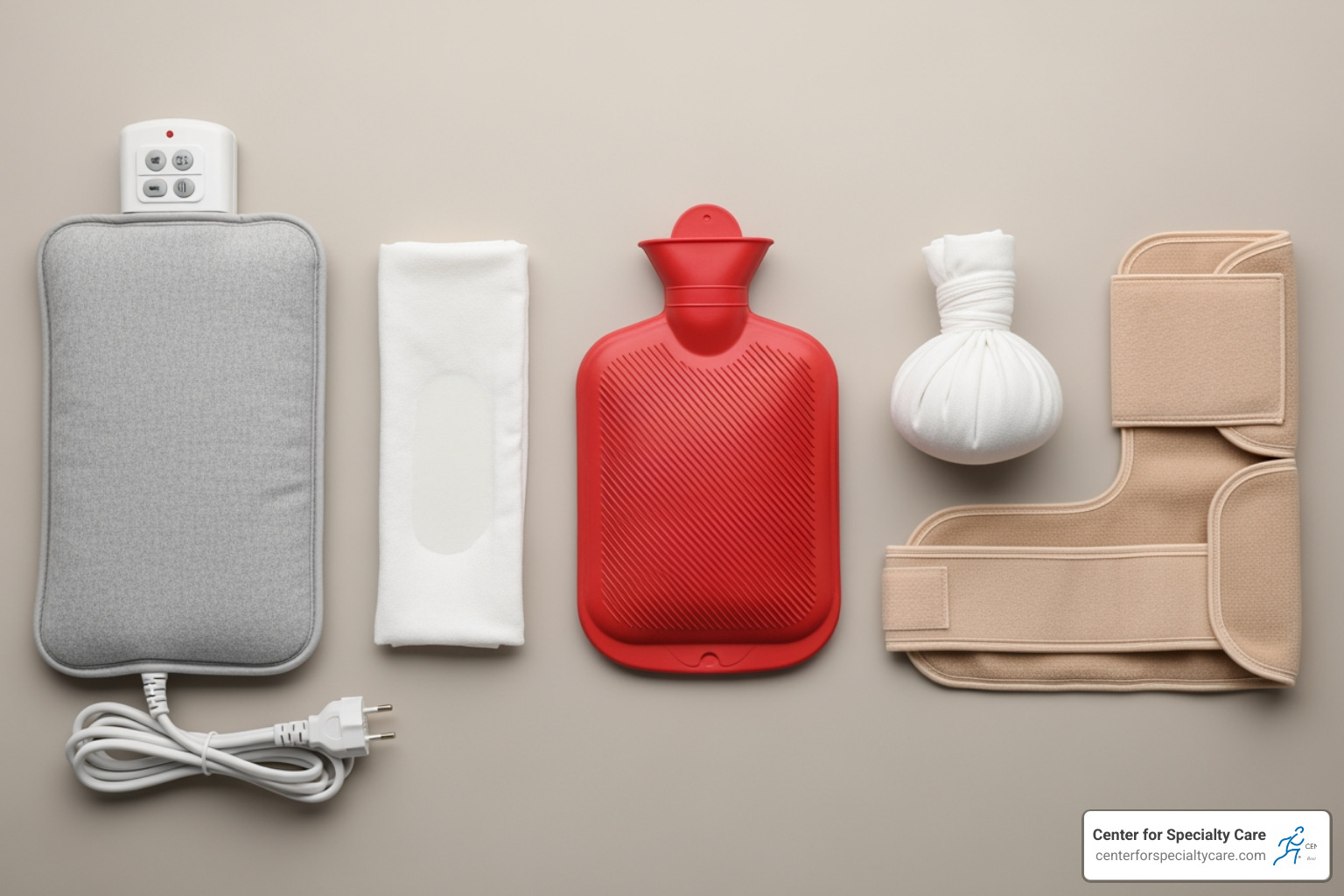
Let’s look at the two main categories of heat therapy, so you can find what works best for your body.
Dry Heat
Dry heat is exactly what it sounds like—warmth without moisture. It’s the go-to choice for many people because it’s straightforward and convenient.
Electric heating pads are probably sitting in half the homes across Fairmont and Estherville right now. They plug into the wall, heat up quickly, and let you control the temperature with the push of a button. Whether you’re dealing with a stiff neck from sleeping wrong or chronic lower back pain, these reliable devices deliver consistent warmth exactly where you need it.
Disposable heat wraps are perfect for busy days when you can’t sit still with a heating pad. These thin, adhesive wraps stick right to your skin or clothing and provide continuous low-level heat for hours. I’ve had patients wear them to work, to the grocery store, even while doing yard work. They’re discreet enough that no one knows you’re treating your pain while you go about your day.
Saunas take a different approach by warming your entire body at once. While not practical for targeting one specific sore spot, a sauna session can work wonders for overall muscle relaxation and circulation. It’s more of a full-body experience that leaves you feeling loose and refreshed.
The main thing to know about dry heat is that it can be a bit dehydrating to your skin. Nothing serious—just keep some lotion handy and moisturize after your heat session.
Moist Heat
Here’s where things get interesting. Moist heat combines warmth with moisture, and many people find it penetrates deeper and feels more soothing than dry heat alone.
Steamed towels are beautifully simple. Wet a towel with warm water, wring it out so it’s damp but not dripping, and drape it over your aching shoulder or knee. You can also dampen a towel, place it in a microwave-safe bag, heat it for a minute or two, then wrap it in another towel to create your own moist heat pack. It’s an old-fashioned remedy that still works remarkably well.
Moist heating packs bring more convenience to the table. These can be electric or microwavable, and they’re designed to hold both heat and moisture. They often contain special beads or gel that stay warm longer and deliver that deep, penetrating warmth that reaches down into your muscles and joints.
Warm baths might be the most relaxing option of all. Sliding into a tub of warm water allows your whole body to benefit from moist heat therapy. Your muscles can fully relax, your joints can move more freely, and the buoyancy of the water takes pressure off painful areas. Many people add Epsom salts to their bath, which certainly makes it feel more luxurious, though the real therapeutic benefit comes from the warmth and moisture itself.
There’s actually research showing that moist heat may be more effective than dry heat for muscle pain. The moisture helps conduct heat more efficiently into your tissues, which means you might get better relief in less time. That’s why so many of our patients in St. James and Buffalo Center tell us they prefer moist heat when their arthritis is acting up or their back is particularly stiff.
The choice between dry and moist heat often comes down to personal preference and convenience. Both can provide excellent relief for heat therapy for pain—it’s just a matter of finding what feels best for your body.
Heat vs. Cold: Which Therapy Is Right for Your Pain?
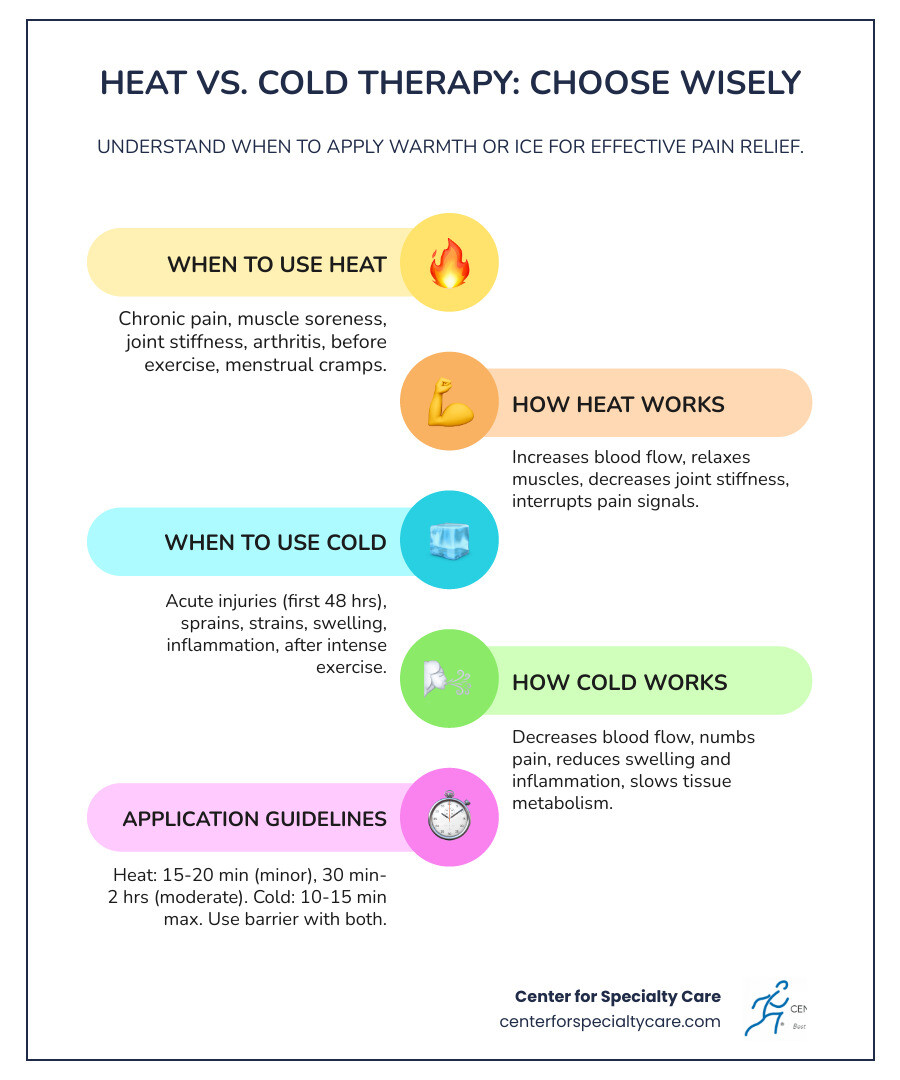
One of the most frequent questions we hear at Center for Specialty Care is, “Should I use heat or cold?” It depends on the problem. Both therapies are effective, but they work differently and are best for different situations.
Think of it this way: heat is for relaxation and chronic issues; cold is for acute injuries and inflammation.
| Feature | Heat Therapy (Thermotherapy) | Cold Therapy (Cryotherapy) |
|---|---|---|
| Primary effect | Increases blood flow and promotes relaxation | Decreases blood flow and reduces inflammation |
| Best for | Chronic pain, stiffness, muscle tension | Acute injuries, swelling, inflammation |
| When to use | For ongoing issues and before activity | First 48 to 72 hours after injury |
| How it helps | Relaxes muscles and improves flexibility | Numbs pain and controls swelling |
| Example conditions | Arthritis, chronic back pain, delayed-onset muscle soreness (DOMS) | Sprains, strains, bruises, fresh injuries |
When to Choose Heat
Heat therapy for pain is your go-to for chronic, persistent aches and stiffness. It is ideal for:
- Chronic pain: For ongoing issues like old injuries or arthritis, heat increases blood flow and promotes relaxation, helping manage long-term discomfort.
- Muscle soreness (DOMS): Heat helps relieve soreness after a workout by increasing circulation and flushing out metabolic byproducts.
- Joint stiffness: Warming up joints improves flexibility, especially for morning stiffness from osteoarthritis.
- Pre-activity warm-up: Applying warmth before stretching or exercise can help reduce injury risk.
- Menstrual cramps: Heat can relax uterine muscles and ease pain.
When to Choose Cold
Cold therapy is best for new injuries where inflammation and swelling are the main concerns. Use it for:
- Acute injuries: Apply an ice pack to a new sprain or strain within the first 48 to 72 hours to control swelling and pain.
- Inflammation: If an area is red, swollen, or warm to the touch, cold helps reduce the inflammatory response.
- Bruises: Cold therapy can help minimize bleeding under the skin.
The bottom line: cold for new injuries and inflammation, heat for chronic pain and stiffness. If your pain persists despite home treatment, reach out to Center for Specialty Care for personalized guidance.
Understanding Thermotherapy: The Science Behind the Soothe
When you apply warmth to a sore area, you’re using thermotherapy. This simple technique works by increasing blood flow to the affected tissue, a process known as vasodilation. This boost in circulation delivers more oxygen and nutrients, which helps to:
- Relax tight muscles and reduce spasms.
- Decrease joint stiffness by making connective tissues more flexible.
- Promote healing by flushing out metabolic waste products.
On a deeper level, heat stimulates sensory receptors in your skin. These receptors send signals to your brain that can override and block pain signals, a concept known as the pain gate theory. This is why a heating pad can provide such immediate relief. The warmth also increases the elasticity of soft tissues, making it a great tool to use before stretching or physical activity. For those interested in the details, research on the physiologic basis of thermotherapy confirms these benefits.
In my three decades of treating patients throughout Fairmont, Estherville, Buffalo Center, and St. James, I’ve seen how heat therapy for pain can significantly improve daily life by providing natural, effective relief from chronic aches and stiffness.
Choosing Your Warmth: Types of Heat Therapy
When it comes to heat therapy for pain, you have several options. The best choice depends on your specific needs, the location of your pain, and your personal preference.
Dry Heat
Dry heat is convenient and easy to use. Common forms include:
- Electric Heating Pads: Offer adjustable, consistent warmth.
- Disposable Heat Wraps: Provide low-level heat for hours, ideal for being active.
- Saunas: Offer full-body heat for overall muscle relaxation.
While effective, dry heat can sometimes dehydrate the skin, so be sure to moisturize.
Moist Heat
Moist heat combines warmth with moisture, and many people find it penetrates deeper and feels more soothing than dry heat alone.
- Steamed Towels: A simple DIY option. Wet a towel with warm water, wring it out, and apply it to the affected area.
- Moist Heating Packs: Microwavable or electric packs that hold both heat and moisture.
- Warm Baths: An excellent way to apply gentle, full-body heat. Adding Epsom salts can improve the relaxing experience.
Research suggests that moist heat may be more effective and work faster than dry heat for muscle pain, as the moisture helps conduct heat more efficiently into your tissues. The choice between dry and moist heat often comes down to personal preference and convenience. Both can provide excellent relief for heat therapy for pain.
Heat vs. Cold: Which Therapy Is Right for Your Pain?
One of the most frequent questions we hear at Center for Specialty Care is, “Should I use heat or cold?” Both are effective, but they work in different ways and are best for different types of pain.
Think of it this way: heat is for relaxation and chronic issues, while cold is for acute injuries and inflammation.
| Feature | Heat Therapy (Thermotherapy) | Cold Therapy (Cryotherapy) |
|---|---|---|
| Primary effect | Increases blood flow and promotes relaxation | Decreases blood flow and reduces inflammation |
| Best for | Chronic pain, stiffness, muscle tension | Acute injuries, swelling, inflammation |
| When to use | For ongoing issues and before activity | First 48 to 72 hours after injury |
| How it helps | Relaxes muscles and improves flexibility | Numbs pain and controls swelling |
| Example conditions | Arthritis, chronic back pain, DOMS | Sprains, strains, bruises, fresh injuries |
When to Choose Heat
Heat therapy for pain is your go-to for chronic, persistent aches and stiffness. It is ideal for:
- Chronic pain: For ongoing issues like old injuries or arthritis, heat increases blood flow and promotes relaxation, helping manage long-term discomfort.
- Muscle soreness (DOMS): Heat helps relieve soreness after a workout by increasing circulation.
- Joint stiffness: Warming up joints improves flexibility, especially for morning stiffness from osteoarthritis.
- Pre-activity warm-up: Applying warmth before stretching or exercise can help prevent injury.
- Menstrual cramps: Heat can relax uterine muscles and ease pain.
When to Choose Cold
Cold therapy is best for new injuries where inflammation and swelling are the main concerns. Use it for:
- Acute injuries: Apply an ice pack to a new sprain or strain within the first 48 to 72 hours to control swelling and pain.
- Inflammation: If an area is red, swollen, or warm to the touch, cold is the right choice to reduce the inflammatory response.
- Bruises: Cold therapy can help minimize bleeding under the skin.
The bottom line: cold for new injuries and inflammation, heat for chronic pain and stiffness. When in doubt, or if your pain persists despite home treatment, contact Center for Specialty Care for guidance custom to your situation.
Applying Heat Therapy for Pain Safely and Effectively
While heat therapy for pain is generally safe, applying it correctly is key to maximizing benefits and preventing injury. Here’s how to do it right.
How to Apply Heat Safely
- Use a Barrier: Always place a towel or cloth between the heat source and your skin to prevent burns.
- Mind the Time: For most aches, 15-20 minutes is sufficient. For chronic pain, longer sessions like a warm bath can be beneficial. Continuous low-level heat wraps can be worn for up to 8 hours, but always follow package directions.
- Stay Awake: Never fall asleep with an electric heating pad on.
- Check Your Skin: Periodically check for excessive redness or blistering, especially if you have sensitive skin.
At-Home Methods for Heat Therapy
- Electric Heating Pads: Offer consistent, adjustable heat.
- Microwavable Gel Packs: Versatile and can also be used for cold therapy.
- DIY Rice Socks: Fill a sock with uncooked rice, tie it off, and microwave for 1-2 minutes for a simple, moldable heat pack.
- Warm Baths: A full-body soak can relax muscles and ease joint stiffness. Adding Epsom salts can improve the experience.
- Paraffin Wax Baths: Excellent for soothing arthritic hands and feet.
When to Avoid Heat Therapy
Heat is not always the right choice. Do not use heat therapy if you have:
- An acute injury (within the first 48-72 hours), especially with swelling or bruising.
- Open wounds, infections, or dermatitis.
- A history of deep vein thrombosis (DVT).
- Diabetes with nerve damage (neuropathy) or peripheral vascular disease, as reduced sensation increases the risk of burns.
- Recently applied menthol or other medicated ointments to the area.
If you have any of these conditions or are pregnant, consult your doctor before using heat therapy. If pain worsens or you have any concerns, contact us at Center for Specialty Care for guidance.
Managing Chronic Conditions with Heat Therapy
For many of our patients in Fairmont, Estherville, Buffalo Center, and St. James, heat therapy for pain is an essential part of managing daily discomfort and improving quality of life. It’s a non-pharmacological approach that empowers you to take an active role in your own care. In fact, 86.5% of healthcare experts recommend heat therapy for its proven effects on relaxation and tissue perfusion.
Arthritis Pain Relief
If you suffer from arthritis, especially osteoarthritis, you know how debilitating morning stiffness can be. Applying heat to affected joints can:
- Increase flexibility: The warmth makes connective tissues more pliable, making movement easier and less painful.
- Soothe aching joints: Increased blood flow and muscle relaxation bring comfort to sore areas.
- Improve range of motion: Regular use helps maintain flexibility and prevent stiffness from worsening.
Important Note: During an acute arthritis flare-up (when a joint is hot, red, and swollen), use cold therapy instead. Once the inflammation subsides, you can return to using heat for chronic aches.
Chronic Back and Neck Pain
Chronic back and neck pain are among the most common complaints we see. Heat therapy for pain is a highly recommended and effective treatment for these issues.
- Relaxes Muscles: Heat helps release tight, spasming muscles that contribute to back and neck pain.
- Improves Circulation: Better blood flow delivers oxygen and nutrients to the spine’s supporting structures, aiding in healing and reducing discomfort.
Studies on superficial heat for low back pain have shown its effectiveness, with some research indicating it can be more beneficial than over-the-counter pain relievers for short-term relief. For persistent or severe pain, however, professional evaluation is crucial. At Center for Specialty Care, we offer personalized pain management options to provide lasting relief.
Conclusion: Your Next Step Towards Pain Relief
Heat therapy is an effective, accessible, and non-invasive tool for managing many types of pain. By increasing blood flow, relaxing muscles, and reducing stiffness, it can provide significant relief for chronic aches and soreness.
Remember the key principles:
- Heat is for chronic pain and stiffness.
- Cold is for new injuries and swelling.
- Always use it safely: Use a barrier, don’t apply to broken skin, and never fall asleep with a heating pad.
While home remedies are helpful, they aren’t a substitute for professional medical advice. If your pain is severe, persistent, or worsening, it’s time to consult a specialist.
At Center for Specialty Care, we’re dedicated to providing personalized orthopedic and pain management solutions. We serve patients in Fairmont, Estherville, Buffalo Center, and St. James with a commitment to 100% patient satisfaction and quick appointment availability.
Don’t let pain control your life. Find out more about our advanced pain management options and let us help you get back to doing what you love, pain-free.