

A Deep Dive into Rotator Cuff Muscles and Tendons
April 1, 2026Tendon Trouble: When to Chill Out and When to Warm Up
April 3, 2026
Navigating your Intracept procedure recovery journey
What You Should Know About Intracept Procedure Side Effects Before Your Recovery
Intracept procedure side effects are generally mild and short-lived — but knowing what to expect makes recovery far less stressful.
Here is a quick overview of what most patients experience:
| Side Effect | How Common | Typical Duration |
|---|---|---|
| Soreness around the incision | Very common | A few days |
| Bruising at the treatment site | Common | 1-2 weeks |
| Minor swelling | Common | 1-2 weeks |
| Temporary pain flare | Common | Days to a few weeks |
| Muscle spasms | Less common | Days to weeks |
| Infection, nerve damage, or bleeding | Rare (<0.3%) | Varies |
The Intracept procedure — also called basivertebral nerve ablation — uses radiofrequency energy to disrupt pain signals from damaged vertebral endplates. It is minimally invasive and done as an outpatient procedure. Clinical trials show a serious complication rate of less than 0.3%, making it one of the safest options for chronic vertebrogenic low back pain.
Most patients recover fully within one to two weeks. Pain relief itself may take anywhere from two weeks to three months as the body adjusts after ablation.
I’m Dr. Corey Welchlin, a board-certified orthopedic surgeon with over 30 years of experience in minimally invasive spine and joint care — including helping patients understand and navigate intracept procedure side effects as part of their recovery. In the sections below, I’ll walk you through everything you need to know about what’s normal, what’s not, and how to recover well.
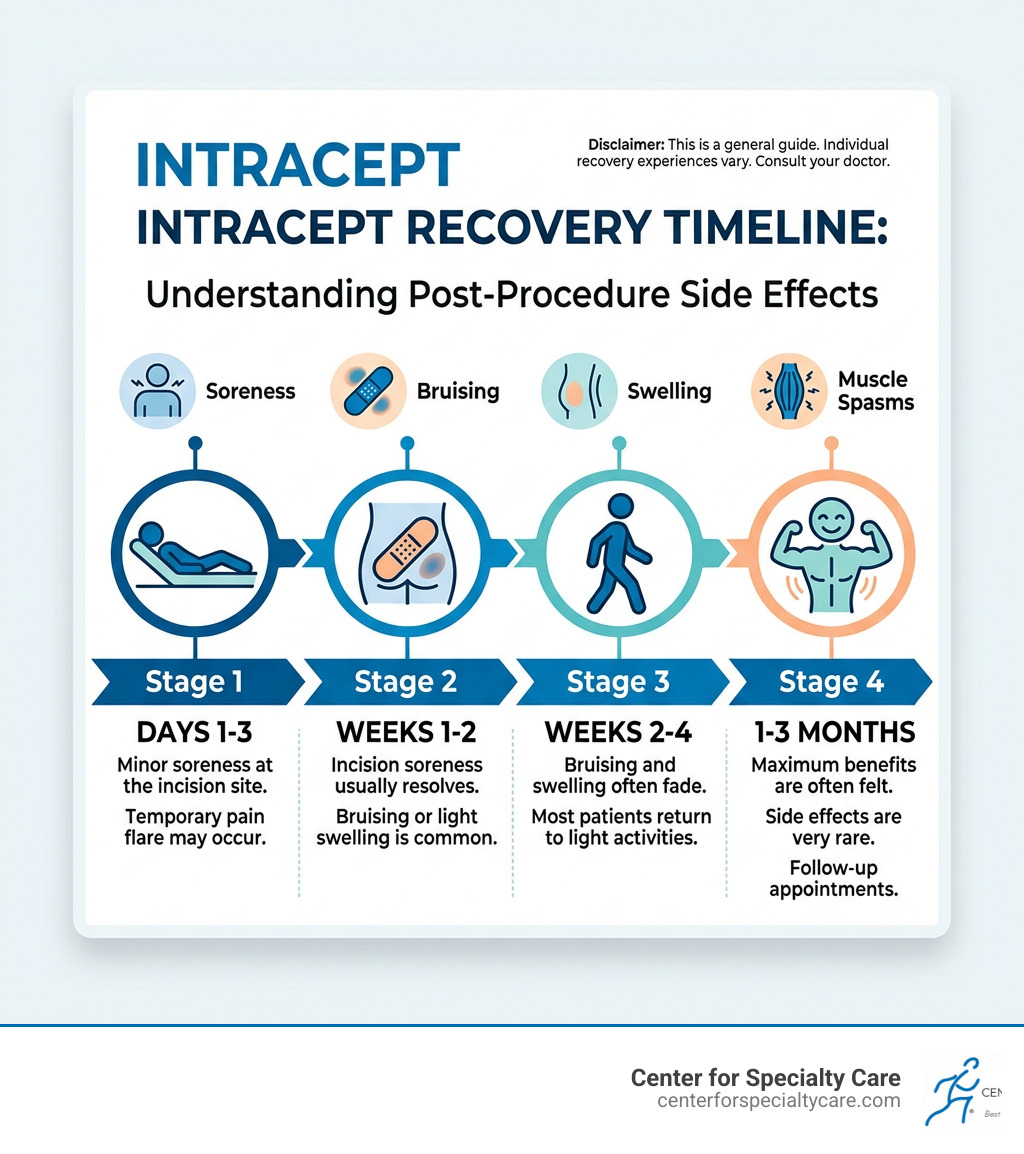
Simple intracept procedure side effects glossary:
Understanding common Intracept procedure side effects
When we perform the Intracept procedure at our Fairmont or St. James clinics, we are targeting a very specific source of pain: the basivertebral nerve (BVN). This nerve sits inside your vertebrae and carries pain signals from damaged endplates—the “shock absorbers” between your discs and the bone. Because we have to access the interior of the bone to deactivate this nerve, your body will naturally have a healing response.
Post-operative soreness and bruising
The most frequent intracept procedure side effects are localized soreness and bruising at the injection site. Think of this like a deep “bone bruise.” Because the procedure involves a small incision and the insertion of a cannula (a thin tube) into the pedicle of the vertebra, the surrounding muscles and skin will feel tender. This typically peaks within the first 48 hours and fades significantly by the end of the first week.
Minor swelling and muscle spasms
It is not uncommon to see slight swelling around the lower back where the instruments were placed. Some patients also report mild muscle spasms. These occur because the deep muscles of the back may “guard” the area following the radiofrequency ablation. Understanding the secrets of spinal anatomy helps explain why these muscles react; they are intricately connected to the structural integrity of your lumbar spine.
The temporary pain flare
One of the more surprising intracept procedure side effects is a temporary increase in your typical back pain. We call this a “post-ablation flare.” According to scientific research on post-ablation recovery, this discomfort is part of the inflammatory process as the nerve is deactivated. Most patients find that this “normal” procedural pain fades within 1 to 2 weeks, eventually giving way to the long-term relief you are looking for.
Serious risks and rare complications of basivertebral nerve ablation
While we focus on the common, mild side effects, it is our responsibility to discuss the more serious, albeit rare, risks. The Intracept procedure has an incredibly strong safety profile. In clinical trials like the SMART trial, there were no device-related serious adverse events reported through 12 months.
Complication statistics
The data is very reassuring for our patients in Minnesota and Iowa. Serious complications—such as significant bleeding, infection, or permanent nerve damage—occur in less than 0.3% of cases. To put that in perspective, traditional spine surgeries like fusions often have complication rates ranging from 5% to 15% or higher.
Rare risks to monitor
- Infection: Even with minimally invasive techniques, any break in the skin carries a small risk. We use strict sterile protocols to keep this risk below 1%.
- Nerve Irritation: Because we are working near the spinal canal, there is a theoretical risk of transient leg pain or numbness. If you experience radiating pain, we have protocols to manage it immediately.
- Radiation Exposure: The procedure uses fluoroscopy (real-time X-ray) to ensure the probe is placed perfectly. While the dose is low, it is a factor we track for patient safety.
- Hemostasis: Ensuring bleeding stops at the bone entry point is a standard part of our surgical “timeout” and closing process.
Clinical evidence on long-term outcomes confirms that even when these rare events occur, they are typically manageable and do not detract from the five-year success rate of the procedure.
What to expect during your recovery timeline
Recovery from the Intracept procedure is a marathon, not a sprint—though it’s a very short marathon! Most of our patients are pleasantly surprised by how quickly they can return to their daily routines in Fairmont or Estherville.
The first 48 hours: Rest and reset
During the first two days, your primary job is to rest. You will likely feel the “sunburn” sensation or deep ache mentioned earlier. We recommend staying home, avoiding any lifting over 10-15 pounds, and strictly following our rest protocols. This is the period where intracept procedure side effects are most noticeable.
The 2-week milestone: Turning the corner
By the 14-day mark, the initial soreness and bruising should be gone. Most patients return to light work within 2 to 3 days, but by two weeks, you can usually resume most non-strenuous daily activities. If you are a candidate for pain management therapies, we may integrate gentle stretching at this stage.
3 to 6 months: Full improvement
It is important to remember that Intracept is not “instant” relief like a local anesthetic block. The nerve signals need time to shut down completely, and the vertebral endplate needs time to settle. While many feel better in weeks, the peak benefits are often realized between 3 and 6 months post-procedure.
Managing temporary Intracept procedure side effects at home
You don’t have to just “tough it out” during your recovery. There are several simple steps you can take to minimize discomfort:
- Ice Packs: Apply ice to the incision area for 15-20 minutes every few hours during the first 48 hours. This is your best defense against swelling.
- OTC Relievers: Standard over-the-counter medications like acetaminophen or ibuprofen are usually all that’s needed to manage the soreness.
- Hydration: Staying well-hydrated helps your body process the minor inflammation more efficiently.
- Gentle Walking: Once the first 48 hours have passed, short, frequent walks on flat ground are encouraged. This prevents stiffness and promotes circulation.
- Posture Support: Avoid slouching or sitting in soft, deep couches that put extra strain on your lower back.
In some cases, we may discuss the role of physical therapy to help strengthen the muscles around the treated vertebrae, ensuring your long-term results are as robust as possible.
When to contact your doctor about Intracept procedure side effects
While we expect a certain level of “normal” discomfort, there are “red flag” symptoms that require an immediate call to our office. If you are looking for a bone specialist doctor near me in the Fairmont area, our team is always available to triage these concerns.
Contact us immediately if you experience:
- A fever higher than 101°F or chills (signs of a possible infection).
- New or worsening weakness in your legs.
- Persistent numbness or “pins and needles” that wasn’t there before.
- Excessive drainage, redness, or heat at the incision site.
- Severe pain that is not controlled by your prescribed or OTC medications.
Frequently Asked Questions about Intracept safety
We hear many of the same questions from our patients in Buffalo Center and St. James. Here are the facts to help put your mind at ease.
Is post-procedure pain normal?
Yes! As we discussed, a temporary increase in pain is a standard healing response. It is often a sign that the radiofrequency energy successfully reached the target. This basivertebral nerve ablation study explains that the deactivation of the nerve involves a thermal process that the body must recover from. It does not mean the procedure failed.
How does the safety profile compare to surgery?
Intracept is significantly safer than traditional back surgery. Because it is implant-free, there is no risk of hardware failure or “adjacent segment disease” (where the levels above or below a fusion wear out). There are no large incisions, meaning less blood loss and a much lower risk of deep tissue infection. Being an outpatient procedure also means you avoid the risks associated with a multi-day hospital stay.
Who is at a higher risk for complications?
While the procedure is safe for most, we take extra precautions with certain groups:
- Older Adults: We evaluate bone density (often via DEXA scan) to ensure the vertebrae are structurally sound enough for the cannula.
- Pacemakers/ICDs: Because we use radiofrequency energy, we must coordinate with your cardiologist if you have an active implanted electronic device.
- Pregnancy: The use of fluoroscopy (X-rays) makes this procedure unsuitable for pregnant patients.
- Cardiac/Pulmonary Compromise: Since general anesthesia or deep sedation is typically used, your heart and lung health must be cleared for the procedure.
Conclusion
At Center for Specialty Care, we believe that no one should have to live with the grinding, daily burden of vertebrogenic pain. The Intracept procedure represents a breakthrough in how we treat chronic low back pain—offering a one-time, minimally invasive solution with a safety profile that is hard to beat.
Our commitment to 100% patient satisfaction means we don’t just perform the procedure and send you on your way. We walk with you through the entire journey, from the initial MRI review of your Modic changes to the final check-up of your recovery. With locations across Southern Minnesota and Northern Iowa, including Fairmont, St. James, and Estherville, specialized care is never far from home.
If you have tried conservative treatments like physical therapy or injections for more than six months without relief, it’s time to explore a more permanent solution. Don’t let back pain dictate your life any longer.
Schedule your Intracept procedure consultation with our team today and take the first step toward a more mobile, pain-free future.