
When Acid Reflux Backs Up Into Your Back
July 11, 2026
Don’t Get Tied Down by a Knot in Your Lumbar Region
July 15, 2026
Rhomboid Knot Foam Rolling: The Ultimate Guide to Shoulder Blade Relief
That Ache Between Your Shoulder Blades Is Telling You Something
Rhomboid knot foam rolling is one of the most effective ways to relieve the nagging tension that builds up between your shoulder blades — and you can do it at home in just a few minutes a day.
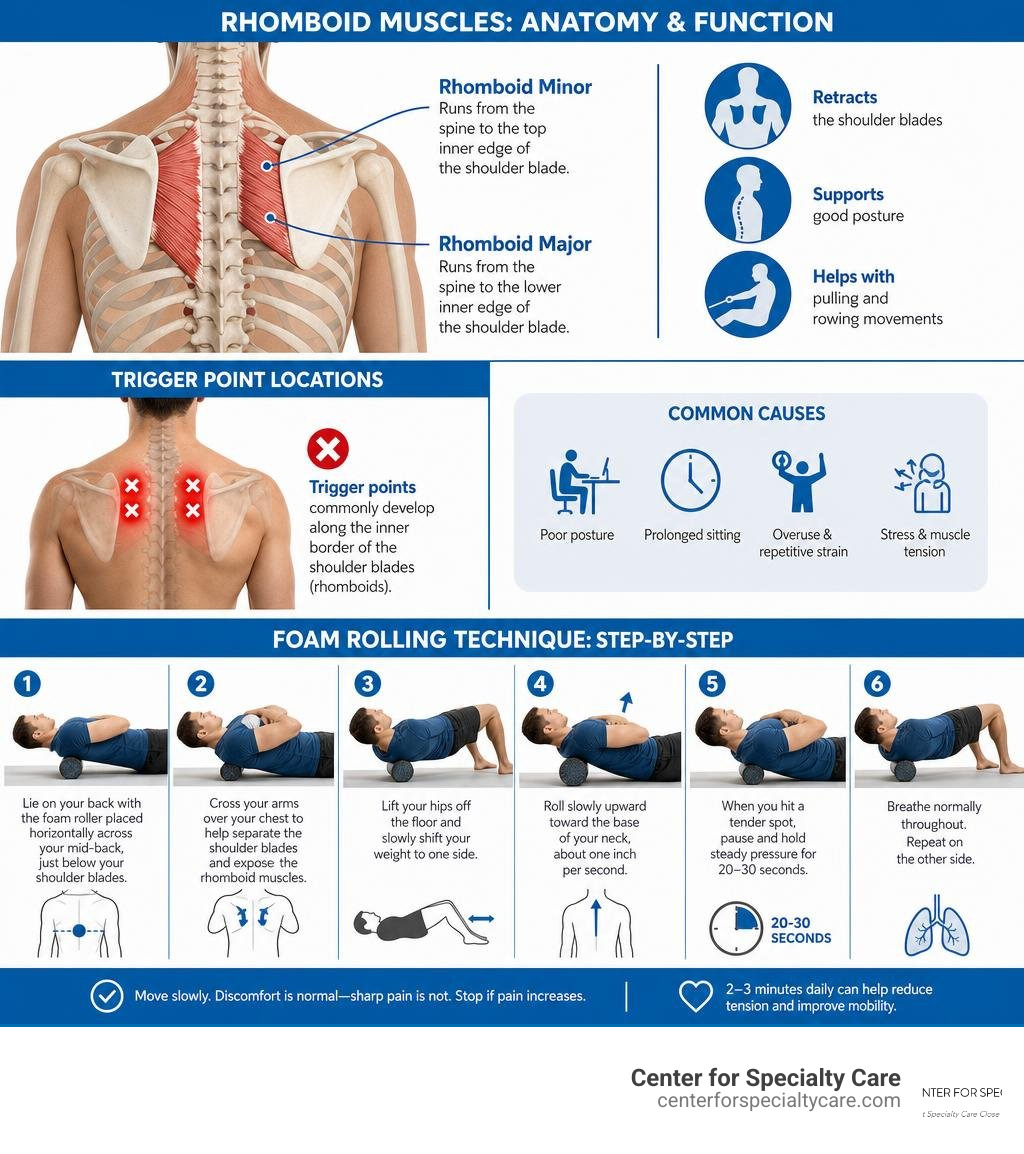
Quick answer — here’s how to foam roll a rhomboid knot:
- Lie on your back with a foam roller placed horizontally across your mid-back, just below your shoulder blades.
- Cross your arms over your chest to help separate the shoulder blades and expose the rhomboid muscles.
- Lift your hips off the floor and slowly shift your weight to one side.
- Roll slowly upward toward the base of your neck, about one inch per second.
- When you hit a tender spot, pause and hold steady pressure for 20–30 seconds.
- Breathe normally throughout. Repeat on the other side.
That dull, burning ache between your shoulder blades is one of the most common complaints physical therapists and orthopedic specialists hear. It often comes from tight rhomboid muscles — a small but important muscle group that sits between your spine and the inner edges of your shoulder blades. Poor posture, long hours at a desk, and repetitive movements all put these muscles under constant stress, making them prone to developing trigger points, or knots.
The good news? Consistent, targeted foam rolling can make a real difference. Research shows that just 2–3 minutes of daily rolling can reduce pain sensitivity and help restore normal movement in the upper back.
I’m Dr. Corey Welchlin, a board-certified orthopedic surgeon and sports medicine physician with over 30 years of experience treating musculoskeletal pain — including the kind of chronic upper back tension that rhomboid knot foam rolling can help address before it becomes a bigger problem. In this guide, I’ll walk you through everything you need to know to do it safely and effectively.
Terms related to rhomboid knot foam rolling:
Understanding Rhomboid Knots and Upper Back Pain
If you have ever felt a nagging, deep ache right next to your shoulder blade, you are not alone. Many of our patients describe this sensation as a “muscle kink” that makes their upper back feel incredibly stiff and restricted. When a muscle is constantly overworked or placed under uneven strain, it can go into a state of micro-spasm. This localized tension is what we commonly refer to as a “knot” or a myofascial trigger point.
To understand why this area is so prone to discomfort, it helps to look at how the shoulder blades (scapula) and the thoracic spine interact. Your upper back is a complex network of muscles, tendons, and joints designed to support your neck, head, and arms. When one part of this system is out of alignment, the surrounding muscles have to work twice as hard to stabilize the area. For a deeper look at why this happens, you can read our article on shoulder blade knots why your back is acting like a pre-tangled slinky.
What Are the Rhomboid Muscles?
The rhomboid muscles consist of two primary parts: the rhomboid major and the rhomboid minor. These thin, flat muscles sit directly underneath the middle portion of the trapezius.
- Rhomboid Minor: The smaller of the two, starting at the base of the neck (C7 and T1 vertebrae) and attaching to the upper portion of the inner edge of the shoulder blade.
- Rhomboid Major: The larger muscle, starting from the upper thoracic spine (T2 to T5 vertebrae) and attaching to the remaining inner border of the shoulder blade.
Together, these muscles are a crucial part of the shoulder girdle. Their primary job is scapular retraction—which is the clinical term for pulling your shoulder blades back and squeezing them toward your spine. They also help stabilize the shoulder blades during arm movements, ensuring that your shoulder joint moves smoothly without rubbing or pinching.
Why Do We Get Knots in the Upper Back?
The modern lifestyle is practically designed to irritate the rhomboids. When we sit at a computer, look down at our phones, or drive for long periods, we often fall into a slouch. This forward-head posture and rounded-shoulder position (known as thoracic kyphosis) places the rhomboids in a chronically lengthened, overstretched state.
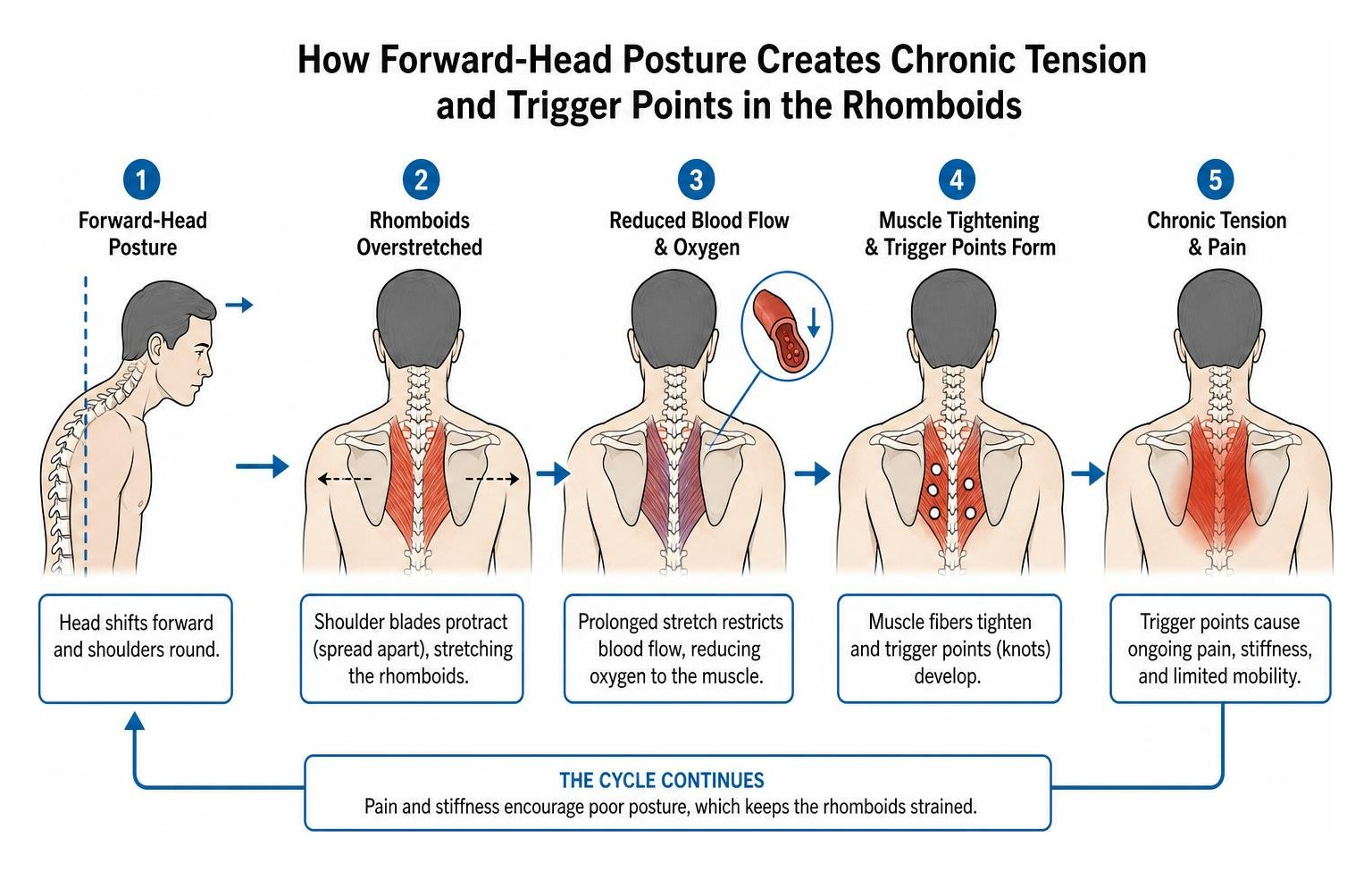
When muscles are stretched out for hours at a time, their blood supply is restricted, leading to oxygen deprivation in the tissue. In response, the muscle fibers tighten up and form painful trigger points to prevent further stretching. Other common culprits include:
- Desk Work: Sitting at poorly designed workstations without proper arm support forces the upper back to carry the weight of your arms.
- Repetitive Movements: Activities like throwing a ball, swinging a golf club, or carrying a heavy, single-strap bag can strain the muscle.
- Weakness in the Shoulder Girdle: If the surrounding muscles are weak, the rhomboids must overcompensate to keep the shoulder blades steady.
To explore more about the underlying causes of this discomfort and find additional treatment options, check out our guide on muscle kink in shoulder blade causes effective relief.
The Benefits of Rhomboid Knot Foam Rolling
When your upper back feels like a tight sheet of plywood, stretching alone often isn’t enough. This is where self-myofascial release (SMR) comes in. Using a foam roller for Rhomboids SMR acts like a deep-tissue massage, helping to break up adhesions, restore tissue elasticity, and bring immediate relief to tired muscles.
For those managing persistent discomfort, incorporating SMR can be a game-changer. You can learn more about comprehensive pain strategies in our pain management dr complete guide.
How Foam Rolling Releases Myofascial Trigger Points
Myofascial trigger points are hyper-irritable spots in skeletal muscle associated with palpable nodules in taut bands of muscle fibers. When you perform rhomboid knot foam rolling, you apply direct, mechanical pressure to these tight areas.
According to a 2024 study published in the Journal of Bodywork and Movement Therapies, foam rolling significantly reduces pain sensitivity and improves pressure pain thresholds in soft tissue. The sustained pressure from the roller helps:
- Improve Tissue Hydration: Rolling acts like squeezing a sponge. It pushes stagnant fluid out of the compressed tissue, allowing fresh, nutrient-rich blood and oxygen to rush back in once the pressure is released.
- Reduce Muscle Stiffness: The mechanical pressure helps realign disorganized muscle fibers and smooth out the fascia (the connective tissue wrapping around your muscles).
- Calm the Nervous System: SMR stimulates sensory receptors in the muscles, sending signals to the brain to relax the overactive muscle fibers.
Improving Thoracic Mobility and Posture
Your thoracic spine (mid-back) is designed to bend, twist, and extend. However, hours of slouching can lock this section of your spine into a rounded position.
Foam rolling your upper back helps promote spinal extension. By gently arching over the roller, you stretch the tight muscles on the front of your body (like the chest) while mobilizing the joints of your mid-back. Improved thoracic mobility directly translates to better shoulder movement, reduced strain on your neck, and a more natural, upright posture. In fact, statistics show that 80% of patients with upper back pain reported significant improvement within just one month of starting a targeted training program that combined foam rolling and mobility work.
Step-by-Step Guide: How to Roll Out Your Rhomboids
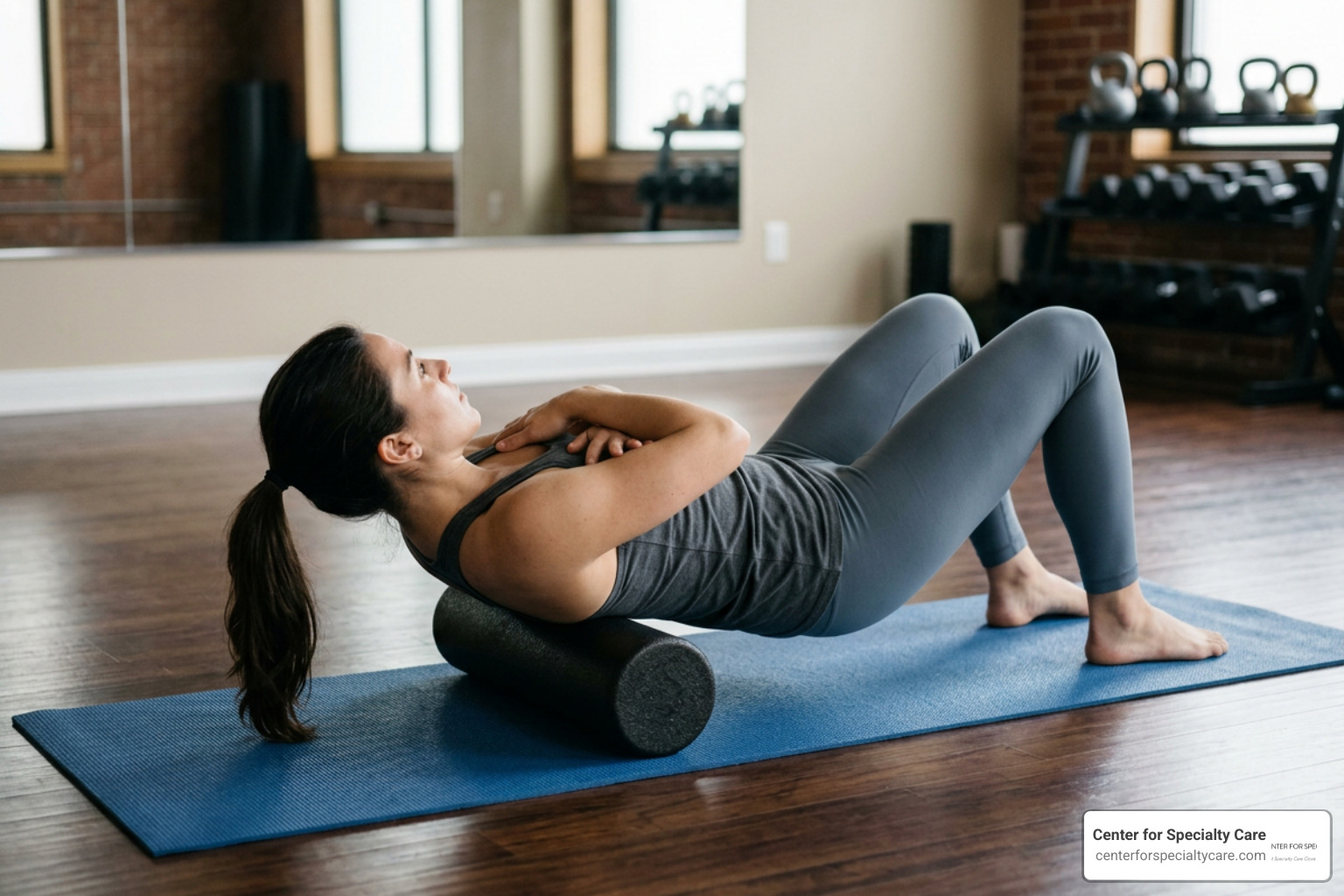
To get the most out of your foam rolling session—and to avoid irritating your joints—it is essential to use the correct technique. Follow this step-by-step guide to safely release your rhomboid knots.
Preparing for Rhomboid Knot Foam Rolling
- Equipment Selection: If you are new to foam rolling or currently in pain, start with a soft or medium-density, smooth foam roller. Avoid ultra-firm or heavily textured rollers initially, as they can apply too much pressure and cause your muscles to tense up defensively.
- Find a Flat Surface: Place your yoga mat on a firm, flat floor. Avoid rolling on a bed or a soft rug, as you need a stable surface to control your body weight.
- Body Alignment: Sit on the floor with your knees bent and feet flat on the ground. Place the foam roller horizontally behind you.
- Muscle Relaxation: Take a few deep, slow breaths. Your goal is to keep your muscles as relaxed as possible during the exercise. If you tense your back, the roller will only press against rigid muscle, reducing the effectiveness of the release.
Execution Technique for Rhomboid Knot Foam Rolling
- Position the Roller: Lie back so that the foam roller sits horizontally across your mid-back, right at the lower level of your shoulder blades. Keep your knees bent and feet flat on the floor to support your weight.
- Cross Your Arms: Hug yourself tightly by crossing your arms over your chest, or interlock your fingers and push your shoulders forward. This movement (scapular protraction) pulls your shoulder blades apart, exposing the rhomboid muscles underneath so the roller can reach them directly.
- Lift Your Hips: Gently press through your heels to lift your hips slightly off the floor. Keep your core engaged and your neck in a neutral, comfortable position.
- Shift and Roll: Lean slightly to one side to focus the pressure on one shoulder blade at a time. Slowly roll your body downward so the roller moves upward toward the base of your neck. Move at a slow, controlled speed of about one inch per second.
- Target the Knots: If you find a particularly tender spot, stop rolling. Hold steady, tolerable pressure on that spot for 20–30 seconds while breathing deeply.
- Add Side-to-Side Movement: For a deeper release, keep your hips lifted and gently rock your torso from side to side across the roller. This creates a cross-friction massage on the muscle fibers.
For a visual demonstration and additional variations of this movement, you can refer to the guide on Rhomboid Massage With Foam Roller | +1000 Exercises – Pelank Gym © .
Foam Roller vs. Massage Ball: Which is Best?
While a foam roller is an excellent tool for general upper back release and improving thoracic mobility, it has its limitations. Because a foam roller has a wide surface area, it distributes your body weight broadly. This makes it great for larger muscle groups, but sometimes it cannot sink deeply enough to release a specific, stubborn trigger point.
A massage ball (such as a lacrosse ball, tennis ball, or specialized spikey ball) offers a much smaller surface area. This allows you to apply highly targeted, pinpoint pressure to a single knot.
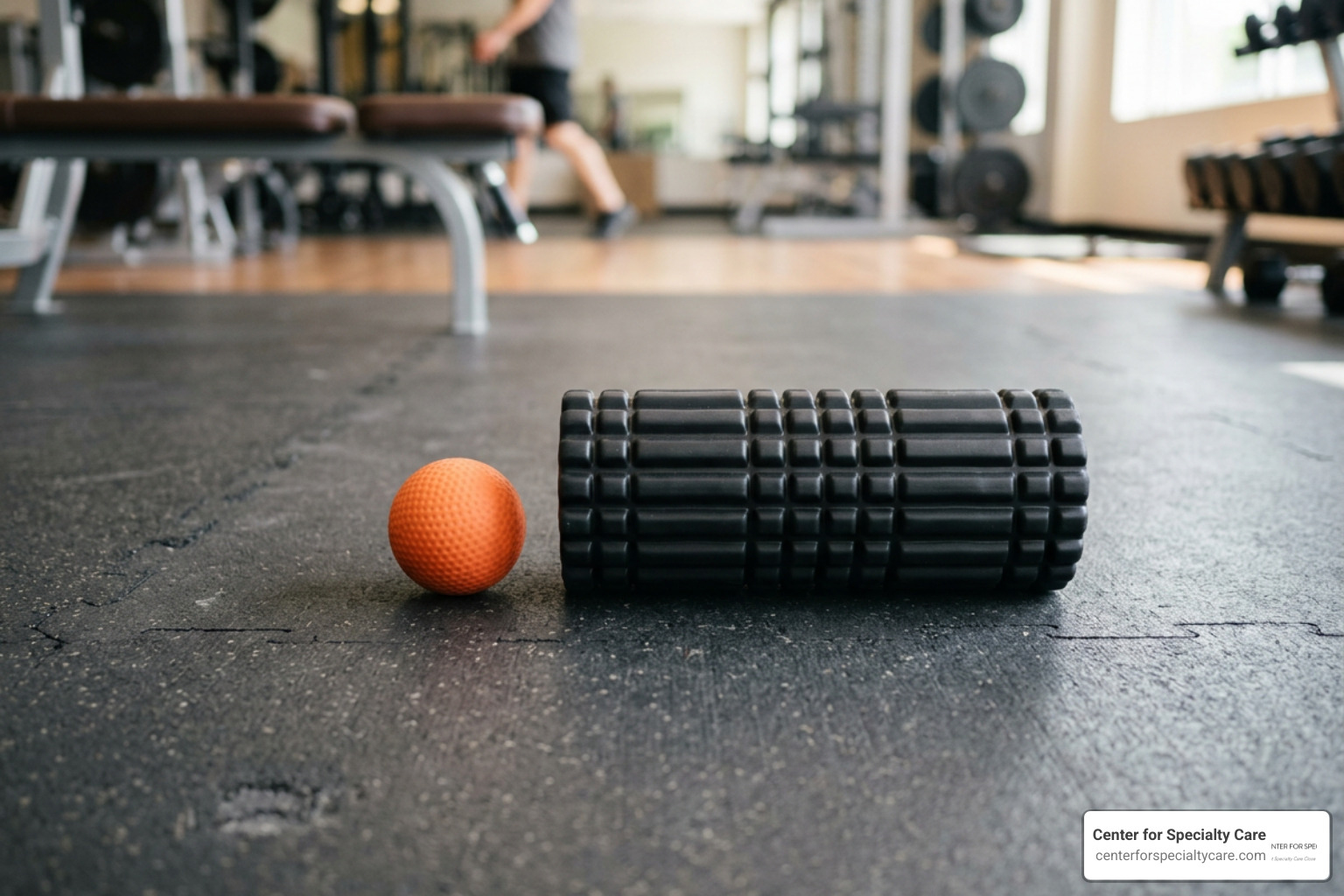
Many people find that using a ball against a wall is much easier to control than lying on a ball on the floor. To learn more about this approach, you can read about Rolling the Rhomboids – Optimum Condition .
Here is a quick comparison to help you decide which tool to use:
| Feature | Foam Roller | Massage Ball (Lacrosse / Spikey) |
|---|---|---|
| Primary Use | Broad muscle release, thoracic extension, general stiffness | Pinpoint trigger point release, deep knots |
| Pressure Intensity | Mild to Moderate (highly adjustable) | Moderate to Intense (concentrated) |
| Ease of Use | Very easy for beginners | Requires more precision and control |
| Best Position | Lying on the floor | Standing against a wall or lying on the floor |
| Mobility Benefits | Excellent for mobilizing the thoracic spine | Focused on releasing localized muscle tension |
Frequently Asked Questions About Rhomboid Pain
We receive many questions from patients looking for the best ways to manage upper back discomfort. Below are some of the most common questions regarding rhomboid pain and self-treatment.
How long should I hold pressure on a rhomboid knot?
When you find a tender spot during rhomboid knot foam rolling, you should hold sustained, steady pressure on it for 20 to 30 seconds. If the knot is particularly stubborn, you can extend this up to 45 to 60 seconds.
During this time, focus on deep, controlled breathing. As you exhale, imagine the muscle melting over the roller. If you find yourself holding your breath or tensing up, the pressure is too intense. Reduce the pressure by lowering your hips or shifting some of your weight off the roller.
Is it safe to foam roll my upper back every day?
Yes, daily foam rolling is safe and highly recommended for managing chronic upper back tension. Because our daily habits (like working at a computer) constantly pull us into poor postural positions, a daily “reset” is incredibly beneficial.
Aim for short, consistent sessions of 2 to 3 minutes per day rather than one long session once a week. This regular, gentle input keeps the tissue hydrated and prevents new knots from forming. To learn more about managing persistent shoulder and back discomfort, explore our article on how to shoulder the burden no more a guide to constant pain relief.
When should I see a doctor for shoulder blade pain?
While muscle tightness is the most common cause of upper back pain, some symptoms require professional medical evaluation. You should schedule an appointment with a specialist if you experience:
- Sharp, shooting, or stabbing pain rather than a dull, muscular ache.
- Pain that radiates down your arm, into your chest, or up into your neck.
- Numbness, tingling, or weakness in your shoulder, arm, or hand (which could indicate a pinched nerve in the neck).
- Pain that does not improve or gets worse after two weeks of consistent rest, stretching, and foam rolling.
- Difficulty breathing or a feeling of pressure in your chest.
Sometimes, what feels like a simple muscle knot can actually be referred pain from a cervical spine issue, shoulder joint dysfunction, or even tendon inflammation. If you are dealing with persistent joint or tendon issues, you can read our guide on tendinitis the lowdown on those pesky tendon inflammations.
Conclusion
Rhomboid knot foam rolling is a simple, highly effective self-care tool that can help you break the cycle of chronic upper back pain, improve your posture, and keep your shoulders moving freely. By spending just a few minutes a day using a foam roller or a massage ball, you can directly address the trigger points caused by modern desk work and repetitive daily movements.
However, if your upper back pain persists, is accompanied by radiating symptoms, or keeps you from enjoying your daily life, it is time to seek professional care. At the Center for Specialty Care, we are dedicated to helping our patients find lasting relief. Our orthopedic and pain management clinic in Fairmont, MN—along with our convenient locations in Estherville, IA, Buffalo Center, IA, and St. James, MN—offers comprehensive, personalized care tailored to your unique needs.
We pride ourselves on our quick appointment availability, customized treatment plans, and a warm, patient-first approach. Whether you need advanced physical therapy, non-surgical pain management, or a comprehensive diagnostic evaluation, our team is here to support you every step of the way.
Don’t let chronic upper back tension hold you back. Contact us today to schedule your consultation and take the first step toward living pain-free!