

Navigating your Intracept procedure recovery journey
April 2, 2026
Finding Relief Fast: A Guide to Podiatry Offices Near Me
April 4, 2026Tendon Trouble: When to Chill Out and When to Warm Up
The Fastest Way to Know: Heat or Cold for Tendon Injury?

Heat or cold for tendon injury is one of the most common questions people ask when tendon pain strikes — and the answer depends on one key factor: how long you’ve had the injury.
Here’s the quick answer:
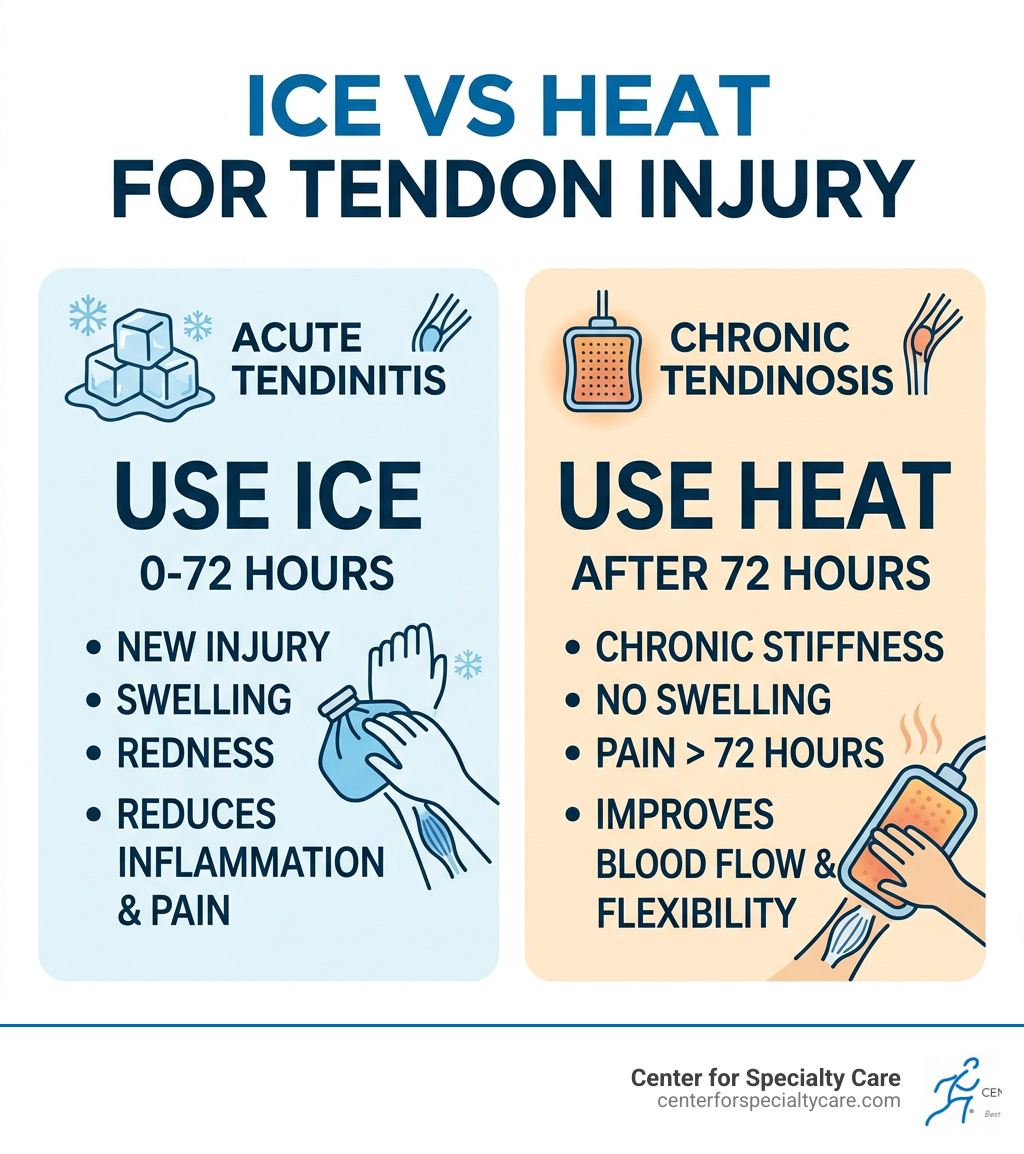
| Situation | Use |
|---|---|
| New injury (0-72 hours), swelling, redness | Ice (cold therapy) |
| Chronic stiffness, no swelling, pain >72 hours | Heat therapy |
| After activity causes flare-up | Ice |
| Before activity to loosen stiff tendon | Heat |
Tendons are tough, rope-like tissues that connect your muscles to bones. They take a beating from repetitive movements — whether you’re a runner, a construction worker, or someone who reaches overhead all day. When they become irritated or damaged, the pain can range from a sharp, sudden twinge to a slow, nagging ache that just won’t quit.
The type of pain you feel — and when it started — tells you exactly which therapy your body needs. Using the wrong one at the wrong time can actually make things worse.
I’m Dr. Corey Welchlin, a board-certified orthopedic surgeon and sports medicine physician with over 30 years of experience treating tendon injuries ranging from Achilles tendinopathy to rotator cuff damage. Knowing whether to reach for ice or heat is one of the first decisions I guide patients through when managing a heat or cold for tendon injury question, and getting it right can meaningfully speed up recovery.
Relevant articles related to heat or cold for tendon injury:
Understanding Your Injury: Tendinitis vs. Tendinosis
To make the right choice between heat or cold for tendon injury, we first need to look under the hood. While many people use the term “tendinitis” for any tendon pain, medical professionals actually distinguish between two very different conditions.

Identifying Acute Tendinitis
Tendinitis is the “fire” in your joint. The suffix “-itis” literally means inflammation. This is an acute condition, meaning it happens suddenly. Maybe you spent the weekend overdoing it on the tennis court or lifted a heavy box the wrong way.
In these cases, the body sends a rush of blood and inflammatory cells to the site to begin repairs. This results in:
- Sudden onset of sharp pain.
- Redness and warmth over the joint.
- Visible swelling (the area might look puffy).
- Pain that worsens significantly with any movement.
Recognizing Chronic Tendinosis
Scientific research on tendinopathy shows that many long-term injuries aren’t actually inflamed at all. Instead, they are “tendinosis”—a chronic state of degeneration. Think of a rope that isn’t on fire, but is slowly fraying and thinning out from years of use.
Common signs of tendinosis include:
- Persistent aching that has lasted for weeks or months.
- Morning stiffness that feels like a “rusty hinge” but improves once you move around.
- Crepitus, which is a crunchy or grating sensation when you move the joint.
- Tender lumps or nodules along the tendon (common in the Achilles).
| Feature | Acute Tendinitis | Chronic Tendinosis |
|---|---|---|
| Primary Issue | Inflammation/Swelling | Collagen Degeneration |
| Pain Type | Sharp, Stabbing | Dull, Aching, Stiff |
| Duration | 0-72 Hours | Weeks to Months |
| Best Therapy | Ice (Cold) | Heat |
The Cold Truth: When to Use Ice for Tendon Injury
When you have a fresh injury, ice is your best friend. Cold therapy works through a process called vasoconstriction, which is a fancy way of saying it narrows your blood vessels. This restricts blood flow to the area, which is exactly what you want when a joint is puffing up like a balloon.
When to Choose Ice for Tendon Injury
According to Mayo Clinic’s guidance on tendinitis pain, ice is the gold standard for sudden injuries. We recommend reaching for the ice pack during the first 48 to 72 hours after an injury occurs.
Ice is also excellent for:
- Post-activity flare-ups: If you have a chronic injury that suddenly feels “angry” and swollen after a workout.
- Pain relief: Cold numbs the nerve endings, providing a natural anesthetic effect.
- Controlling internal bleeding: If the injury involved a significant strain or tear.
For those recovering from shoulder issues, following shoulder treatment physical therapy tips often involves strategic icing to keep inflammation down so you can progress with your exercises.
Best Practices for Icing Safely
Icing seems simple, but doing it wrong can lead to skin damage or even frostbite. Follow these safety rules:
- 15-20 Minute Sessions: Never ice for more than 20 minutes at a time. After this point, your body may actually trigger “reflex vasodilation,” sending more blood to the area to prevent freezing.
- Use a Barrier: Always wrap your ice pack or bag of frozen peas in a thin towel. Direct contact with the skin is a recipe for an ice burn.
- Elevation: Whenever possible, keep the injured tendon above the level of your heart while icing. This uses gravity to help drain the swelling.
- The 2-Hour Rule: Wait at least two hours between icing sessions to allow the skin and tissue to return to normal temperature.
Turning Up the Heat for Tendon Injury Recovery
Once the initial “fire” of inflammation has died down (usually after 3 days), or if you are dealing with a nagging, stiff injury that has been bothering you for months, it is time to switch gears. Heat therapy works through vasodilation, opening up the blood vessels to “feed” the tendon with oxygen and nutrients.
When to Choose Heat for Tendon Injury
Research on tendon extensibility indicates that heat is far superior for improving the flexibility of collagen tissues. If your tendon feels like a piece of dry leather, heat will help it become more like a rubber band.
We recommend heat for:
- Chronic stiffness: Especially that “first thing in the morning” pain.
- Pre-exercise warm-up: Applying heat for 15 minutes before you stretch or start your workout can prevent re-injury.
- Muscle relaxation: Tendon pain often causes the surrounding muscles to “guard” and spasm; heat breaks that cycle.
If you’re struggling with persistent joint pain that doesn’t respond to these home remedies, knowing how to find the best elbow doctors can help you get a more advanced diagnostic look at the tissue.
Safe Application of Heat Therapy
To get the most out of your heating pad, keep these tips in mind:
- Moist Heat is King: Moist heat (like a damp warm towel or a specialized moist heat pack) penetrates deeper into the tissue than dry electric heating pads.
- 15-20 Minutes: Just like ice, 20 minutes is the “sweet spot.”
- Check the Temperature: It should feel comfortably warm, not scalding. If your skin looks mottled or bright red, it’s too hot.
- Avoid on Swelling: Never apply heat if you can see visible swelling or if the area feels hot to the touch. This will only add fuel to the inflammatory fire.
Advanced Recovery: Contrast Therapy and Prevention
Sometimes, a tendon injury is in a “gray area”—it’s not brand new, but it still gets a little puffy. This is where contrast therapy comes in. By alternating between hot and cold, you create a “pumping action” in the blood vessels. The heat opens them up, and the cold squeezes them shut. This helps flush out metabolic waste and brings in fresh, healing blood.
How to Perform Contrast Baths
This is particularly effective for injuries in the hands or feet (like Achilles or wrist issues).
- The 3:1 Ratio: Submerge the area in warm water for 3 minutes.
- The Cold Dip: Switch to cold water for 1 minute.
- Repeat: Cycle through this 4 to 5 times.
- The Finish: Always end on cold if there is any lingering swelling; end on heat if stiffness is the main problem.
Long-Term Tendon Health
Temperature therapy is a great tool, but it’s only one piece of the puzzle. Research on injury prevention warm-ups highlights that neuromuscular training is essential for keeping tendons healthy.
- Activity Modification: If running hurts, try swimming for a few weeks. Give the tendon “relative rest.”
- Eccentric Exercise: This is the “gold standard” for tendinosis. It involves lengthening the muscle under tension (like slowly lowering your heel off a step for Achilles pain).
- Ergonomics: If you have wrist pain, check your keyboard height. If you have shoulder pain, look at how you reach for things at work.
- Smoking Cessation: Smoking significantly reduces blood flow to tendons, which already have a poor blood supply to begin with. Quitting is one of the best things you can do for your joints.
For those dealing with more systemic issues, understanding the role of physical therapy can provide a roadmap for managing inflammation across the whole body.
Frequently Asked Questions about Heat or Cold for Tendon Injury
Can using heat make a new tendon injury worse?
Yes, absolutely. If you apply heat to a brand-new injury, you are essentially “adding heat to a fire.” Heat increases blood flow and vasodilation, which can cause more internal bleeding and significantly increase swelling. This can lead to more pressure on the nerves and a much longer recovery time. Stick to ice for the first 72 hours!
How long should I continue using ice or heat?
The general rule is to use ice as long as there is active swelling or sharp pain (the acute phase). Once the swelling is gone and the pain becomes more of a dull, stiff ache (the chronic phase), you can transition to heat. Many patients find success using heat before their physical therapy exercises and ice afterward to calm any irritation caused by the movement.
Is ice or heat better for Achilles tendonitis?
It depends on the time of day! Many Achilles patients experience severe stiffness in the morning; a warm soak or heat pack can help loosen the tendon so you can walk comfortably. However, if you’ve been on your feet all day and the heel is throbbing and puffy, ice is the better choice.
Conclusion
Deciding between heat or cold for tendon injury doesn’t have to be a guessing game. By listening to your body and noting the timing of your pain, you can use these simple household tools to take control of your recovery. Remember: Ice for the fire, heat for the rust.
At the Center for Specialty Care, we know that every patient’s “Tendon Trouble” is unique. Whether you’re in Fairmont, MN, or our Iowa locations in Estherville and Buffalo Center, our goal is 100% patient satisfaction through personalized, expert care. We offer quick appointment availability so you don’t have to wait in pain.
If your tendon pain persists for more than two weeks despite home care, or if you experience a sudden loss of strength, it’s time to see a professional. Finding an orthopedic surgeon near me is the first step toward a definitive diagnosis and a path back to the activities you love.
Ready to get back in the game? Schedule an orthopedic consultation with us today. We’re here to help you move freely again!