
Say Goodbye to Aches with Buffalo Center Pain Solutions
July 2, 2026
The Ultimate Guide to Relieving Rhomboid Trigger Points
July 4, 2026
Are Your Tendons Happy? What Wearable Tech Can Tell Us About Foot Health
Why Foot Tendon Wearable Technology Is Changing How We Understand Foot Health
Foot tendon wearable technology is giving patients and clinicians something that was nearly impossible just a few years ago: a real-time window into how your tendons are actually loading, moving, and recovering — during everyday life, not just in a lab.
Here’s a quick answer to what foot tendon wearables do:
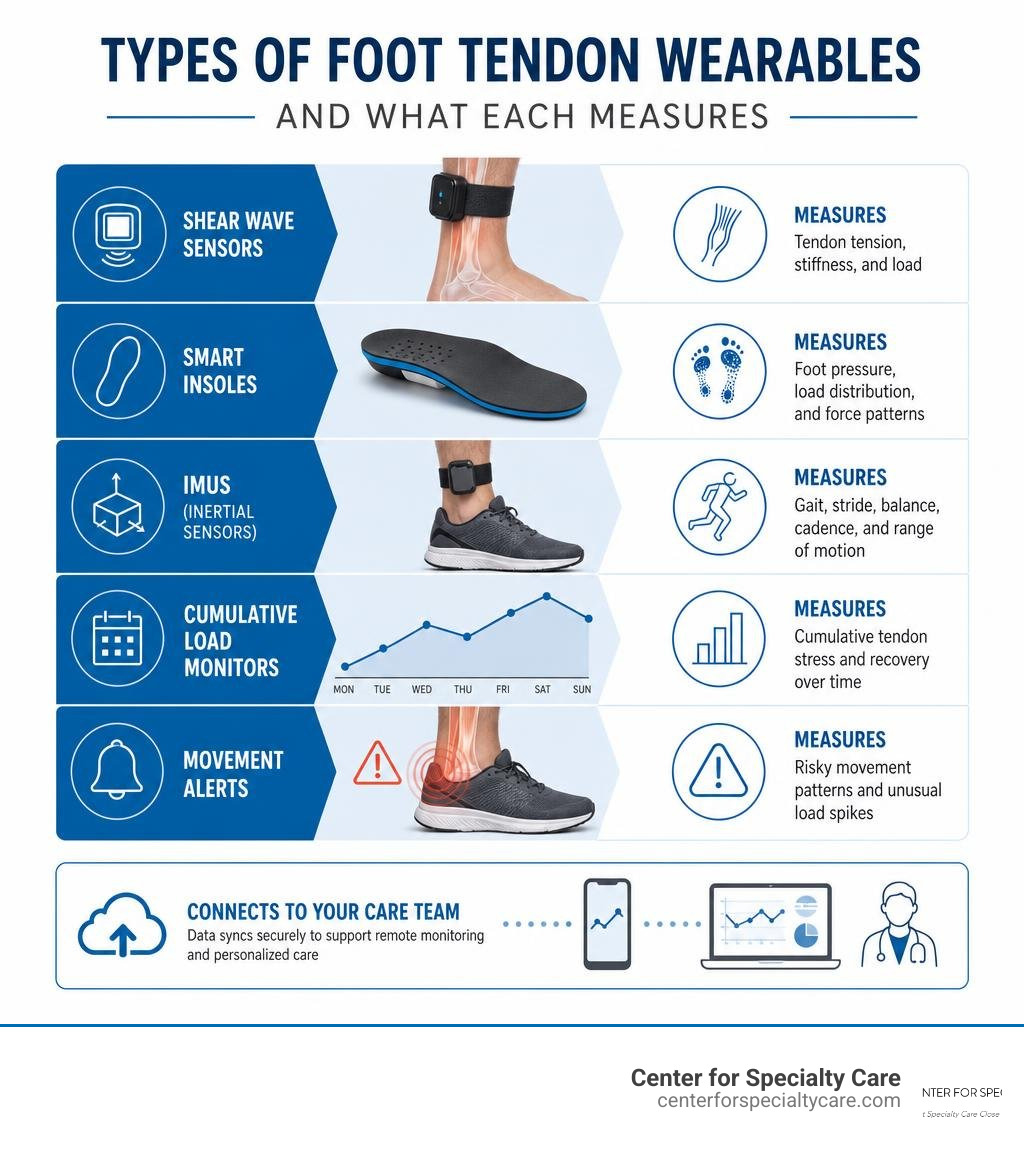
- Measure tendon tension and load using shear wave sensors, smart insoles, and IMUs
- Track gait, balance, and range of motion during walking, running, and rehab exercises
- Monitor cumulative stress on tendons like the Achilles over days or weeks
- Alert clinicians to risky movements before they become injuries
- Enable remote rehabilitation by sending data directly to your care team
Foot and ankle problems are among the most common reasons people seek orthopedic care. Conditions like Achilles tendinopathy, plantar fasciitis, and post-surgical tendon repair can seriously affect your ability to walk, work, and stay active. The challenge has always been this: what’s actually happening inside your tendon when you’re not in the clinic?
Traditional physical exams rarely exceed 10 minutes and happen on flat, controlled surfaces. They can’t capture what your tendons experience during a full day of real-world activity. Wearable sensors are closing that gap — and fast.
A recent scoping review covering 58 studies found a growing range of devices now capable of tracking tendon biomechanics outside the lab, from inertial measurement units (IMUs) to shear wave tensiometers to pressure-sensitive smart insoles. The field is moving quickly, and the clinical implications are significant.
I’m Dr. Corey Welchlin, a board-certified orthopedic and sports medicine surgeon with over 30 years of experience treating tendon injuries and guiding patients through recovery — and foot tendon wearable technology is one of the most exciting developments I’ve seen for improving how we manage these conditions. In the sections below, we’ll break down exactly how these devices work, what they can measure, and how they’re beginning to shape real-world clinical care.
Foot tendon wearable technology terms to learn:
The Evolution of Foot Tendon Wearable Technology

Historically, evaluating tendon health meant relying on static imaging like MRIs and ultrasounds or having a patient perform basic movements in a laboratory setting. While these methods are invaluable, they do not tell us how a tendon behaves when you are running up a hill in Fairmont, walking across a farm in Estherville, or simply going about your daily routine.
To bridge this gap, engineers and clinicians have collaborated to develop a diverse suite of sensor modalities. According to a landmark scoping review on wearable approaches for non-invasive monitoring of tendons, 58 studies have collectively mapped out how we can track these internal structures. The technologies broadly fall into five main categories, each operating on distinct physical principles:
- Inertial Measurement Units (IMUs) and Kinematic Sensors: These are the most common wearable tools, with 34 out of the 58 studies relying on them. Comprising accelerometers and gyroscopes, IMUs track the spatial movement, velocity, and joint angles of your foot and ankle. They are fantastic for analyzing overall movement patterns but do not directly measure the internal forces experienced by the tendons in the foot.
- Shear Wave Tensiometers: A highly advanced approach used in 11 studies. These devices tap the tendon to send mechanical vibrations (shear waves) through the tissue. By measuring how fast these waves travel, we can determine the exact mechanical tension of the tendon.
- Pressure-Sensitive Insoles: Utilized in 9 studies, these smart insoles measure ground reaction forces (GRF) and plantar pressure. They help us understand how weight is distributed across your foot and how those forces translate up into the Achilles tendon during the gait cycle.
- Ultrasound Compression Wave Trackers: Featured in 5 studies, these sensors track the propagation of high-frequency acoustic waves to evaluate the structural density and thickness of the tendon tissue.
- Flexible Sensors and Triboelectric Nanogenerators (TENGs): Representing the cutting edge of material science, these flexible, self-powered sensors stretch and bend with your skin, converting mechanical motion directly into electrical signals without needing bulky batteries.
| Sensor Type | Primary Measurement Principle | What It Tells Us About Your Foot | Major Advantage |
|---|---|---|---|
| IMUs / Accelerometers | Kinematics, angular velocity, and acceleration | Joint range of motion, stride length, and gait speed | Lightweight, highly accessible, long battery life |
| Shear Wave Tensiometers | Vibrational wave propagation speed | Direct internal tendon tension and force loading | Calibration-free, measures actual muscle-tendon forces |
| Smart Insoles | Plantar pressure and ground reaction forces | Weight distribution, cumulative daily loading cycles | Easily fits inside standard footwear, great for daily tracking |
| Flexible / TENG Sensors | Triboelectric charge generation via skin deformation | Joint angles, posture classification, and movement anomalies | Self-powered, ultra-thin, highly customizable |
How Foot Tendon Wearable Technology Tracks Real-Time Loading
To truly appreciate this technology, let’s look at how we measure the actual force pulling on your tendon. For decades, directly measuring tendon tension in a living person required invasive surgical procedures, such as inserting a force transducer directly into the tissue. Obviously, this is not something we want to do to a patient trying to recover from tendonitis!
Now, a breakthrough noninvasive wearable device developed by engineers at the University of Wisconsin-Madison has completely changed the game. This device works on a simple but ingenious acoustic principle: just like tightening a guitar string increases the pitch (frequency) of its vibration, increasing the tension on a tendon increases the speed of the vibrational waves traveling through it.
According to a report on how this future wearable device could tell how we power human movement, the device utilizes a tiny electromagnetic actuator to gently tap the tendon 50 times per second. This action initiates micron-scale shear waves that propagate along the tissue. Two miniature accelerometers mounted on the skin measure exactly how quickly those waves travel between them.
Because shear wave speed varies predictably with tendon tension, this portable, inexpensive system can accurately calculate the real-time forces acting on your Achilles, patellar, or hamstring tendons while you walk, run, or perform rehabilitation exercises.
Advanced Materials in Smart Insoles
While shear wave tensiometers are perfect for tracking active exercises, smart insoles are the champions of passive, long-term daily monitoring. The latest iterations of this technology have moved far beyond simple pressure pads.
Recent breakthroughs published in material science journals highlight the design of a therapeutic smart insole technology featuring an Archimedean algorithmic spiral triboelectric nanogenerator-based power system and sensors. By utilizing advanced biopolymers like bacterial cellulose and PDMS/PEDOT:PSS blends, researchers have created fully flexible, lightweight insoles that generate their own power from the simple act of walking.
These self-powered insoles achieve a power density of 500–600 μW/cm² and a current density of 40–50 μA/cm². This means they can continuously run advanced pedobarometry—analyzing your gait, posture, and localized foot pressure—without requiring bulky, heavy batteries that need to be plugged in every night. The data can then be transmitted via Bluetooth to a smartphone, giving us a continuous picture of your foot health.
Assessing Tendon Biomechanics and Loading in Real-Time

When you take a step, your foot undergoes a complex sequence of movements known as the gait cycle. During this cycle, your foot tendons act like mechanical springs, storing and releasing energy to propel you forward. If a tendon is injured, inflamed, or recovering from surgery, its ability to handle these dynamic loads is severely compromised.
With foot tendon wearable technology, we can measure these dynamic loads during real-world activities. For example, a recent clinical study evaluated how two weeks of cumulative tendon load monitored by insole sensors is associated with plantar flexor function in Achilles tendinopathy. The researchers tracked 15 patients over a 14-day period as they went about their normal lives.
The study revealed a fascinating clinical insight: overall cumulative loading (which includes low-level activities) did not correlate strongly with patient recovery. However, high-level tendon load (forces equal to or greater than three times the patient’s body weight, which typically occur during push-off or running) showed a very strong correlation ($r = 0.687$) with the patient’s actual plantar flexor functional capacity, such as their double-leg heel raise height.
This tells us that tracking how often a patient loads their tendon under high stress is a critical biomarker for tracking recovery and designing effective rehabilitation protocols.
Real-World Locomotion and Variable Terrain
One of the biggest limitations of traditional clinical gait analysis is that it takes place on flat, level flooring. But life doesn’t happen on a flat treadmill. We walk on grass, gravel, concrete, and variable slopes.
Using wearable shear wave tensiometry, researchers have successfully mapped how variable outdoor terrain alters tendon kinetics. A study published in MDPI’s Sensors journal, titled Wearable Technology Applications and Methods to Assess Clinical Outcomes in Foot and Ankle Disorders: Achievements and Perspectives, analyzed over 5,100 walking strides across variable outdoor terrain.
The researchers found that:
- Uphill slopes significantly increase Achilles tendon wave speed (tension) during the push-off phase of walking. Each 1° increment in grade was associated with a 3.8% increase in estimated peak tendon load.
- Downhill slopes shift the peak tendon load to the early stance braking phase, as the Achilles tendon works to control the foot’s descent.
- Walking speed heavily modulates peak tendon forces on uphill climbs but has a much smaller impact during downhill walking.
This level of detail allows us to give patients highly specific instructions. If you are recovering from an Achilles injury, we might advise you to avoid steep inclines during your early walks, or suggest specific walking speeds to keep your tendon forces within a safe healing zone.
Clinical Outcomes, Validity, and Adoption Barriers
For any new medical technology to be useful, it must be valid, reliable, and practical. In podiatry and orthopedics, we look at several key clinical outcomes:
- Range of Motion (ROM): The angular movement of the ankle joint (dorsiflexion, plantar flexion, inversion, and eversion).
- Gait Spatiotemporal Metrics: Stride length, step frequency, swing-to-stance ratio, and walking speed.
- Balance and Posture: How well a patient maintains stability during standing and movement.
We know that traditional, brief physical exams cannot capture how these metrics change when a patient is fatigued at the end of a long day. Wearable sensors, particularly IMUs, provide excellent reliability when tracking these outcomes. For instance, smartwatches and fitness trackers equipped with basic accelerometers and gyroscopes have demonstrated an impressive 88.9% accuracy, 90.6% sensitivity, and 86.2% specificity in identifying gait abnormalities.
However, the transition from lab-grade equipment to daily wearables does introduce some challenges. If a sensor shifts on the skin, if the battery dies, or if the calibration is slightly off, the data can become noisy. This is why researchers are working hard to validate these tools against the “gold standards” of biomechanical analysis, such as force plates and optical motion capture systems.
Clinical Validation of Foot Tendon Wearable Technology
To prove that wearables can be trusted for clinical decision-making, researchers have put them to the test in challenging clinical scenarios, such as walking in an immobilizing orthopedic boot.
A study published in the Journal of Biomechanics explored how a wearable sensor and machine learning can estimate tendon load and walking speed during immobilizing boot ambulation. When patients are recovering from severe injuries like an Achilles tendon rupture, they are placed in a rigid boot, often with heel wedges to prevent the tendon from stretching too far.
The researchers placed a single IMU on the lateral aspect of the boot and used machine learning (specifically, LASSO regression models) to predict the forces acting on the Achilles tendon. They discovered that:
- Personalized models (trained on just 82 steps of subject-specific walking data) were highly accurate, achieving a Mean Absolute Percent Error (MAPE) as low as 8.35% for predicting tendon load.
- Generalized models (which do not require subject-specific calibration) were excellent for predicting walking speed, with a MAPE of 6.38%, but were less accurate for predicting exact tendon loads due to individual variations in gait.
- Battery optimization was highly achievable: removing the power-hungry gyroscope data and lowering the sampling frequency to 50 Hz had virtually no impact on the model’s accuracy, while quadrupling the sensor’s battery life.
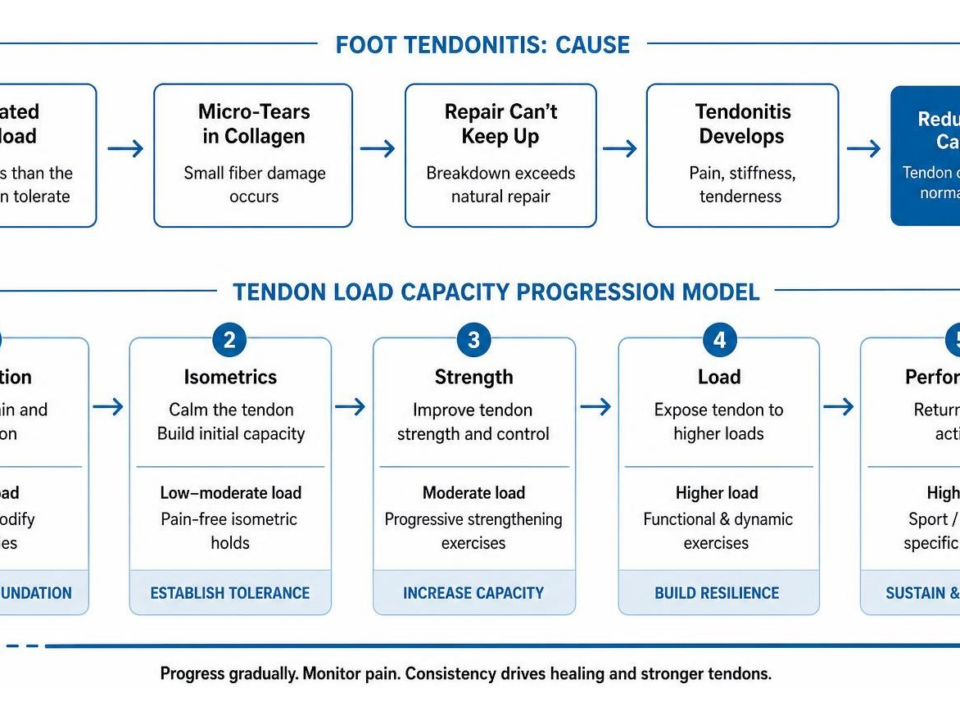
This research proves that with a single, inexpensive sensor and a few minutes of calibration, we can safely and accurately monitor a patient’s real-world tendon loading during their recovery in a walking boot. If you want to dive deeper into the clinical symptoms of these conditions, you can read our comprehensive guide on stepping up to foot tendonitis everything you need to know.
Integrating Wearables into Rehabilitation and Clinical Workflows
At the Center for Specialty Care, we believe the true value of foot tendon wearable technology lies in how it can be integrated into your actual recovery plan. Imagine this workflow:
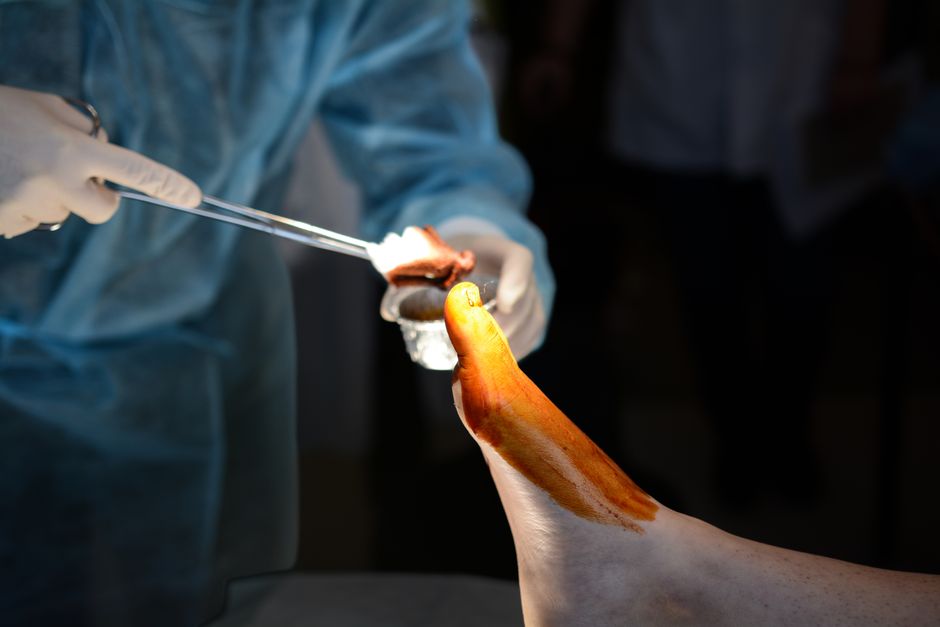
- Post-Surgical Evaluation: After undergoing a tendon repair, you are fitted with a lightweight, boot-mounted sensor. As you begin partial weight-bearing exercises at home, the sensor tracks your movement. If you accidentally exceed the safe loading limit prescribed by your surgeon, your phone gently vibrates to alert you.
- Tele-Rehabilitation: Instead of driving to our Fairmont or Estherville clinics multiple times a week, you perform your physical therapy exercises at home. A smart ankle brace tracks your joint angles and muscle engagement, sending the data directly to our clinical team. We can review your progress, verify that you are achieving the correct range of motion, and adjust your exercises remotely.
- Orthotic Interventions: If you suffer from flat feet (pes planus) or chronic heel pain, a smart insole can analyze your daily walking habits. This data allows us to design highly customized orthotic inserts that specifically redirect forces away from your irritated tendons.
A great example of this integrated approach is the design of a smart foot-ankle brace for tele-rehabilitation and foot drop monitoring. This device combines accelerometers, gyroscopes, and Fiber Bragg Grating (FBG) optical sensors embedded in a 3D-printed insole.
Because FBG sensors use light instead of electricity, they are completely immune to electromagnetic interference and can measure multi-point structural strain across the entire sole of your foot using a single optical fiber. In patients with foot drop (a form of paralysis where the front of the foot drags), this smart brace successfully detected abnormal toe accelerations (which were twice as high as normal walking) and tracked joint rotation in real-time, proving to be an invaluable tool for remote home monitoring.
To understand what to expect during surgical recoveries, you can read the patients guide to podiatric surgery expectations and outcomes.
Self-Powered Sensors and Machine Learning for Injury Prevention
Wearable technology isn’t just for rehabilitation; it is also a powerful tool for preventing injuries before they occur. This is especially true for athletes and individuals with physically demanding jobs.
In a study published in Materials Horizons, researchers engineered self-powered triboelectric nanofiber sensors for the classification of risky ankle postures. By using a dual-filler strategy in electrospun PVDF-HFP nanofibers, they created a highly sensitive, self-powered sensor that can be worn around the ankle.
When integrated with machine learning algorithms trained on 700 movement datasets, this system achieved an astonishing 99% accuracy in identifying risky ankle postures—such as sudden, excessive inversion that leads to lateral ankle sprains. If a dangerous movement is detected, the system can trigger an ultra-fast electrical stimulation response in just 7 milliseconds to help the muscles contract and stabilize the joint, potentially preventing a severe sprain or tendon tear before it even happens.
Frequently Asked Questions about Foot Tendon Wearables
Can wearable sensors directly measure tendon tension?
Yes, through an advanced technique called shear wave tensiometry. By sending gentle mechanical vibrations (shear waves) through the skin and tracking how quickly they travel along the tendon, these devices can calculate actual mechanical tension. This is highly accurate because wave speed in a tendon is directly proportional to its tightness, much like a guitar string.
How do smart insoles help with Achilles tendinopathy?
Smart insoles measure plantar pressure and ground reaction forces to calculate your cumulative daily tendon load. They help us monitor how much high-level stress (forces greater than 3 times your body weight) your Achilles tendon is experiencing. Research shows that tracking this high-level load over at least 6 days provides a highly reliable biomarker of your actual muscle strength and healing progress. For more tips on managing localized tendon pain, check out our guide on peroneal tendonitis heat or ice.
What are the main limitations of current wearable tendon monitors?
While the technology is advancing rapidly, there are still a few hurdles to widespread clinical adoption:
- Battery Life: High-frequency sampling can drain small wearable batteries quickly, though self-powered TENG materials are beginning to solve this.
- Sensor Placement: Accurately positioning sensors on the skin is crucial; minor shifting can introduce data errors.
- Clinical Standardization: We are still working to establish universal, validated protocols and “cut-off” values across diverse patient populations.
Conclusion
The intersection of medicine and material science is completely rewriting the playbook for foot and ankle care. Foot tendon wearable technology is transitioning from a futuristic concept into a practical, clinical reality that empowers patients and gives orthopedic specialists the objective, real-world data they need to deliver truly personalized care.
At the Center for Specialty Care, we are committed to staying at the absolute forefront of these technological advancements. Serving patients across southern Minnesota and northern Iowa—including our clinics in Fairmont, MN, Estherville, IA, Buffalo Center, IA, and St. James, MN—our team focuses on delivering comprehensive, personalized orthopedic and pain management care.
Whether you are looking for advanced non-surgical rehabilitation, state-of-the-art surgical interventions, or simply want to ensure your feet stay healthy and pain-free, we are here to help. We pride ourselves on our quick appointment availability, personalized treatment plans, and our unwavering commitment to 100% patient satisfaction.
If you are experiencing foot or ankle pain, or if you want to learn more about how we can help you get back on your feet, we invite you to take the next step toward happy, healthy tendons. Read our guide on a walk towards healthy feet common foot problems and solutions or schedule a personalized consultation with our team today!